

In the world of sales and marketing, leads are the lifeblood of the business. But not all leads are created equal. For every perfectly-fit prospect who has their credit card out and is ready to buy, there are a hundred more who are just browsing, students doing research, or competitors checking out your pricing. The challenge isn’t a lack of leads; it’s the overwhelming volume and the monumental task of sifting through them to find the gold. This is where most sales funnels spring a leak. Sales reps, eager to hit their quota, waste countless hours chasing dead-end leads, while genuinely hot prospects go cold waiting for a response. The result? Frustration, inefficiency, and lost revenue.
The traditional solution has been manual qualification, a process heavily reliant on a salesperson’s intuition and time. But in today’s high-velocity environment, this manual approach is a critical bottleneck. It’s inconsistent, slow, and simply doesn’t scale. What if you could build an automated, intelligent gatekeeper that stands guard at the top of your funnel? A system that could instantly analyze every incoming lead, assess its potential, and route it to the perfect destination—all without a single human click. This is the power of a Lead Qualification Automation Decision Tree, a strategic framework that transforms your lead management from a chaotic free-for-all into a streamlined, revenue-generating machine.
The High Cost of Flying Blind: Why Manual Qualification Fails at Scale
Before diving into the solution, it’s crucial to understand the deep-seated problems of relying solely on manual lead qualification. When every lead is treated as a potential priority, no lead is a priority. This creates a series of cascading failures that ripple through the entire sales organization.
- Inconsistency is the Norm: Ask five different sales reps what makes a “good lead,” and you might get five different answers. One might prioritize company size, another might focus on job titles, and a third might chase anyone who requests a demo. This lack of a standardized, universally accepted definition leads to cherry-picking, dropped leads, and a fundamental misalignment between marketing efforts and sales outcomes.
- The Black Hole of Time: A salesperson’s most valuable asset is their time, and the best use of that time is talking to qualified buyers. Manual qualification forces them into the role of a detective and an administrator. They spend hours on LinkedIn trying to verify a lead’s role, researching company revenue, and making initial calls just to ask basic discovery questions. Every minute spent on a tire-kicker is a minute not spent closing a deal with a future champion.
- Speed to Lead Suffers: Studies have consistently shown that the odds of connecting with a lead decrease dramatically within the first hour. When a sales team is bogged down with a long list of unsorted leads, response times inevitably drag. A prospect who fills out a “Contact Us” form at 10:00 AM might not get a call until the next afternoon, by which time their initial buying intent has faded, or worse, they’ve already been contacted by a more agile competitor.
- Lack of Data-Driven Insight: Manual processes are notoriously difficult to measure and optimize. It’s a system based on gut feelings and anecdotal evidence. You can’t easily analyze which lead sources produce the most qualified opportunities or identify bottlenecks in the handoff process because the qualification criteria are not codified. You’re flying blind, unable to make informed decisions to improve your funnel’s performance.
Enter the Decision Tree: Your Automated Qualification Gatekeeper
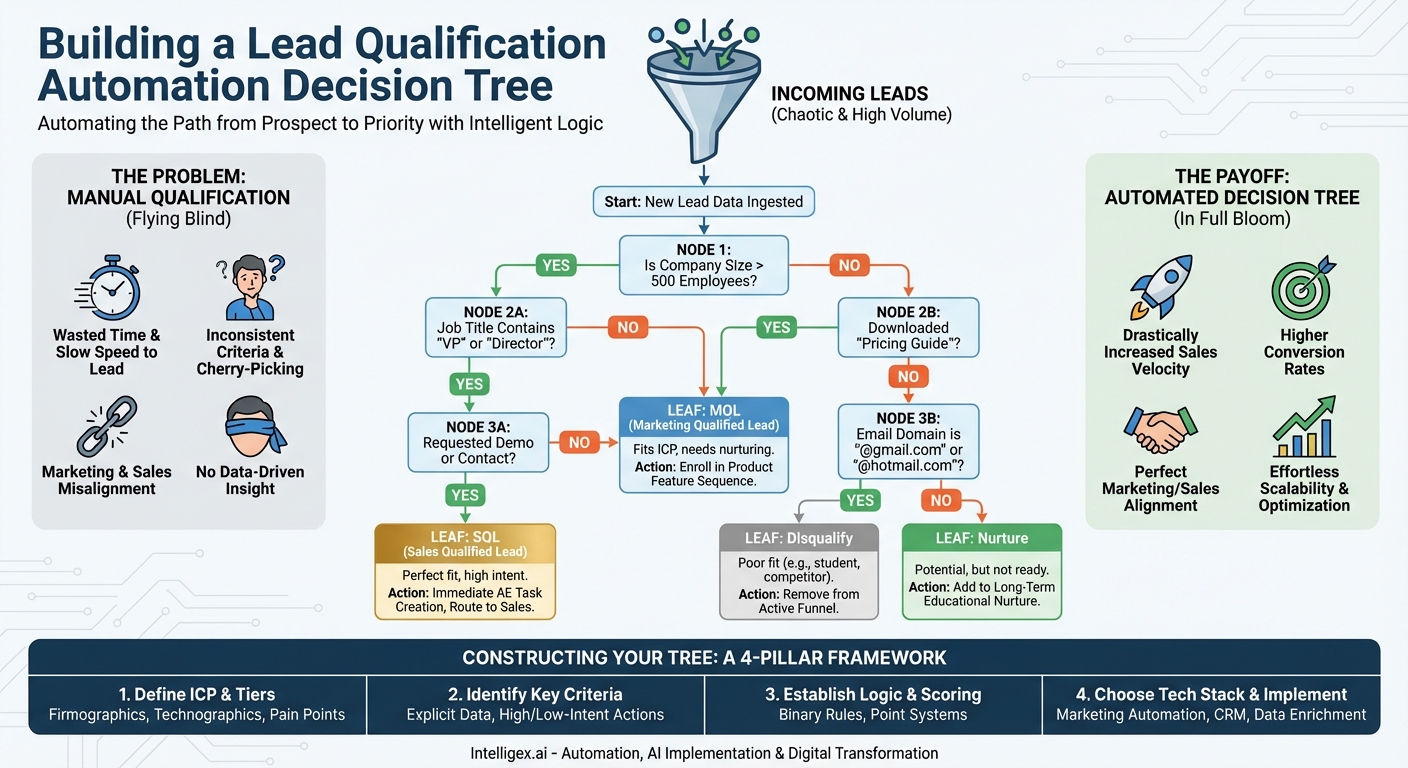
A Lead Qualification Automation Decision Tree is a model that uses a series of rules and conditional logic to automatically segment, score, and route incoming leads. Think of it as a digital flowchart or a “choose your own adventure” for your leads. At each step (or “node”), the system asks a question about the lead’s data. Based on the answer (the “branch”), the lead is moved to the next node, until it reaches a final destination (a “leaf”).
This isn’t about replacing salespeople; it’s about empowering them. By automating the top-of-funnel sorting process, you ensure that your sales team only ever engages with leads that have been pre-vetted and confirmed to be a strong potential fit. The system acts as a perfect, tireless Sales Development Representative (SDR) that works 24/7, operates with flawless consistency, and never takes a coffee break.
The core components are simple:
- Nodes: These are the questions or criteria you evaluate. For example, “Is the company’s annual revenue over $50 million?” or “Did the lead download the pricing guide?”
- Branches: These are the possible answers to the questions, typically “Yes” or “No,” but they can also be ranges or specific values (e.g., Industry = “SaaS”).
- Leaves: These are the final outcomes or actions. A lead might be classified as a Sales Qualified Lead (SQL) and routed to a senior account executive, a Marketing Qualified Lead (MQL) sent to a nurturing sequence, or disqualified entirely.
Visualizing this process as a flowchart makes the logic incredibly clear and intuitive. It’s a structured, repeatable system that replaces guesswork with data-driven precision.
Constructing Your Decision Tree: A Step-by-Step Blueprint
Building an effective decision tree isn’t a one-size-fits-all process. It requires a deep understanding of your business, your customers, and your sales cycle. Here is a four-pillar framework to guide you through the construction.
Pillar 1: Define Your Ideal Customer Profile (ICP) and Tiers
You can’t qualify leads if you don’t know what you’re qualifying them for. The first step is to get marketing and sales in a room and agree on a crystal-clear definition of your Ideal Customer Profile. This goes beyond basic demographics and should include:
- Firmographics: Industry, company size (both employee count and annual revenue), geographic location.
- Technographics: What technologies do they currently use? Are they using a competitor’s product?
- Pain Points: What specific problems does your product or service solve for them?
- Budgetary and Authority Signals: The job titles of typical decision-makers, influencers, and economic buyers.
Once you have your ICP, define your lead tiers. These will be the “leaves” of your decision tree.
- Sales Qualified Lead (SQL): This is the gold standard. A lead that perfectly matches your ICP and has demonstrated strong buying intent (e.g., requested a demo, viewed the pricing page). They are ready for an immediate sales conversation.
- Marketing Qualified Lead (MQL): A lead that fits your ICP but hasn’t yet shown strong buying intent. They might have downloaded a whitepaper or attended a webinar. They are a good fit, but need further nurturing from the marketing team.
- Nurture: A lead that has some positive attributes but doesn’t quite meet the ICP criteria yet (e.g., a manager at an ideal company, or a director at a company that is slightly too small). They have potential but aren’t ready for sales. They should be placed in a long-term email nurture campaign.
- Disqualify: A lead that is a poor fit and should be removed from the active funnel (e.g., students, competitors, companies from non-target industries).
Pillar 2: Identify Your Key Qualification Criteria (The Questions)
With your ICP and tiers defined, you can now brainstorm the specific data points that will serve as the nodes of your tree. These criteria fall into two main categories: explicit data (what they tell you) and implicit data (what they do).
Explicit Data Points (from forms and enrichment):
- Job Title / Seniority Level (e.g., C-Suite, VP, Director, Manager)
- Company Size (e.g., 1-50, 51-200, 201-1000, 1000+)
- Industry (e.g., SaaS, Manufacturing, Healthcare)
- Country/Region
- Specific answers to form fields like “What is your biggest challenge?”
Implicit/Behavioral Data Points (from tracking):
- High-Intent Actions: Requested a demo, filled out a contact form, viewed the pricing page.
- Medium-Intent Actions: Attended a webinar, downloaded a case study.
- Low-Intent Actions: Subscribed to the blog, downloaded a top-of-funnel ebook.
- Website Engagement: Number of pages visited, time on site.
- Email Engagement: Click-through rates on specific campaigns.
Pillar 3: Establish the Logic and Scoring (The Rules)
This is where you connect your criteria to your tiers by building the branches of your tree. You can start with simple, binary logic and evolve to a more sophisticated lead scoring model.
Example of Simple Logic:
IF a lead requests a demo AND their company size is > 200 employees AND their job title contains “VP” or “Director”, THEN set lifecycle stage to SQL and create a task for the appropriate Account Executive.
ELSE IF a lead downloads a whitepaper AND their company size is > 200 employees, THEN set lifecycle stage to MQL and enroll them in the “Product Features” nurture sequence.
As you grow, you can implement a point-based lead scoring system. Each attribute is assigned a positive or negative point value. For example:
- Job Title “VP” = +20 points
- Company Size > 500 employees = +15 points
- Visited Pricing Page = +25 points
- Email Domain is “@gmail.com” = -10 points
You can then set thresholds for your tiers: a score over 80 becomes an SQL, 40-79 becomes an MQL, and so on. This provides a more nuanced and flexible way to qualify leads.
Pillar 4: Choose Your Tech Stack and Implement
The beauty of this model is that it can be built using readily available marketing and sales technology. You don’t need a team of developers. The core components are:
- A Marketing Automation Platform: Tools like HubSpot, Marketo, or Pardot are the engines of your decision tree. Their workflow or automation builders allow you to create complex if/then branching logic visually.
- A CRM: Your Customer Relationship Management system (like Salesforce) is the destination. The automation platform will update lead statuses, assign owners, and create tasks directly in the CRM, ensuring a seamless handoff to the sales team.
- Data Enrichment Tools (Optional but Recommended): Services like Clearbit or ZoomInfo can automatically populate firmographic data based on a lead’s email address, saving you from having to ask for too much information on your forms.
The Payoff: What to Expect When Your Tree is in Full Bloom
Implementing a lead qualification decision tree is a strategic investment that pays dividends across the entire organization. The benefits are profound and immediate:
- Drastically Increased Sales Velocity: Hot leads are identified and routed to a sales rep in minutes, not days. This immediate engagement dramatically increases the chances of a connection and conversion.
- Higher Conversion Rates: Sales reps are no longer wasting their breath on unqualified prospects. Their time is spent exclusively with leads who have been algorithmically determined to be a great fit, leading to more productive conversations and more closed deals.
- Perfect Marketing and Sales Alignment: The decision tree is the ultimate Service Level Agreement (SLA). The rules are codified, transparent, and agreed upon by both teams. Marketing knows exactly what to deliver, and sales knows exactly what to expect.
- Effortless Scalability: Your automated system can process ten leads or ten thousand leads with the same efficiency and consistency. As your company grows, your qualification process scales seamlessly with it.
- A Feedback Loop for Optimization: The system generates a wealth of data. You can analyze which paths on your decision tree produce the most revenue and use those insights to refine your ICP, adjust your scoring, and optimize your marketing campaigns.
From Chaos to Clarity: Your Next Steps
A Lead Qualification Automation Decision Tree is more than just a workflow; it’s a fundamental shift in how you approach your go-to-market strategy. It replaces chaos with clarity, guesswork with data, and inefficiency with velocity. Getting started doesn’t require overhauling your entire system overnight. Begin by mapping out your current process. Talk to your top-performing sales reps and ask them how they *really* qualify their leads. Identify two or three key criteria that separate the winners from the duds. Build a simple, V1 decision tree in your marketing automation platform. Measure the results, gather feedback, and iterate. By taking these first steps, you begin the journey of transforming your lead funnel from a leaky bucket into a high-pressure pipeline for predictable, scalable revenue growth. It’s time to stop sorting and start selling.
Your Next Read:
Get a FREE
Proof of Concept
& Consultation
No Cost, No Commitment!
