

It’s a scenario that plays out far too often. Your team has spent months identifying, negotiating with, and preparing to implement a critical new software vendor. The project is on the line, the launch date is set, and expectations are high. Then, at the eleventh hour, the email arrives from the security team: “This vendor does not meet our data handling requirements. We cannot approve this integration.” The project grinds to a halt. The blame game begins. Deadlines are missed, and thousands of dollars in staff time and resources are wasted.
This isn’t a failure of the security team or the procurement department. It’s a failure of the process. A traditional, sequential approach to vendor onboarding, where security is the final gatekeeper, is fundamentally broken in today’s fast-paced digital environment. To build a resilient and agile organization, you must integrate security and procurement from the very beginning. This isn’t about adding more bureaucracy. It’s about creating a smarter, faster, and more secure pathway for innovation.
The Hidden Costs of a Disconnected Review Process
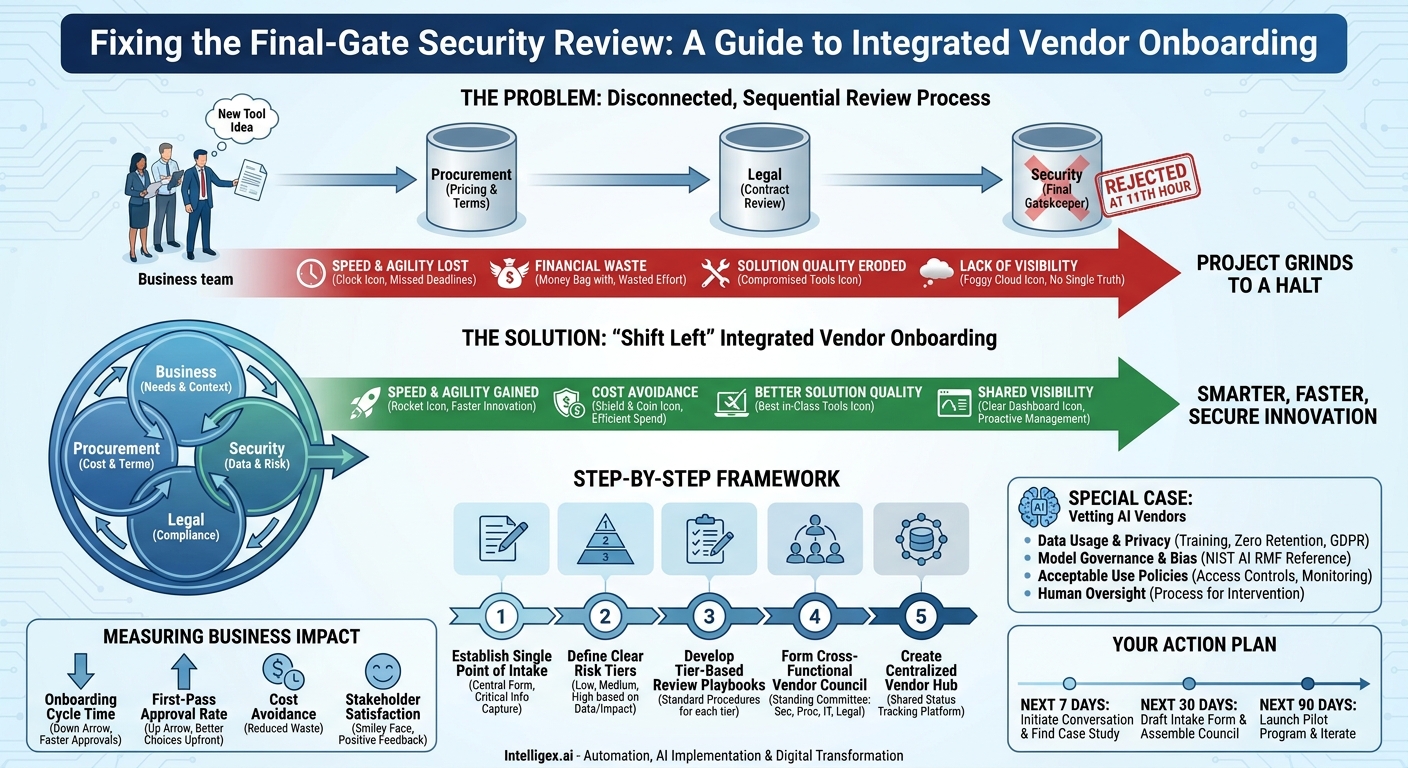
When procurement, legal, and security teams operate in separate silos, they create a chain of handoffs that introduces massive friction and risk. The process typically looks like this: a business unit finds a solution, hands it to procurement for pricing, who then passes it to legal for contract review, with security getting the final, and often rushed, look. This sequential model directly harms business value in four key areas.
Speed and Agility
The most obvious cost is time. A sequential review can add weeks, or even months, to a vendor onboarding timeline. While one team waits for another to complete its review, the project stagnates. A marketing team might miss a key campaign window because their new automation tool is stuck in legal. An operations team might delay a critical efficiency improvement because their chosen logistics platform is waiting for a security audit. In a competitive market, this lost time translates directly to lost opportunity.
Financial Waste
Consider the sunk costs. Your team invests significant time and resources in vendor demos, proof-of-concept trials, and contract negotiations. If the vendor is rejected by security at the final stage, all of that effort is wasted. Legal has spent hours redlining a contract that will never be signed. Procurement has negotiated terms for a tool that will never be used. These costs are real, measurable, and entirely avoidable. Furthermore, rushing to find a replacement often means accepting less favorable pricing and terms just to meet a deadline.
Solution Quality
When the vendor approval process is slow and painful, teams may start to compromise. Instead of fighting for the best-in-class tool that perfectly meets their needs, they might settle for a less effective, but previously approved, vendor to avoid the gauntlet. This “path of least resistance” approach leads to a suboptimal technology stack, where tools are chosen based on ease of approval rather than strategic value. Over time, this erodes the quality of your operations, marketing, and customer service.
Lack of Visibility
In a siloed model, there is no single source of truth. The business team thinks the deal is done, procurement is tracking negotiation milestones, and security is just starting to review the vendor’s data processing addendum. This lack of shared visibility makes it impossible to accurately forecast project timelines and manage risk proactively. Questions like “What’s the status of the new HR analytics platform?” get different answers depending on who you ask.
Shift Left: Integrating Security at the Source
The solution is to “shift left,” a concept borrowed from software development where testing and quality assurance are moved to the earliest stages of the development lifecycle. In vendor management, shifting left means embedding security and compliance checks at the very beginning of the procurement process, not at the end. It transforms security from a gatekeeper into a strategic partner.
Instead of a linear relay race, the process becomes a parallel collaboration. When a business team identifies a need for a new tool, they engage a cross-functional group that includes procurement and security from day one. Security can provide initial guidance on data requirements and flag potential red flags before the team even conducts its first demo. Procurement can leverage this information to focus negotiations on vendors that are not only cost-effective but also compliant.
This integrated approach delivers immediate business value. Finding a security issue in the first week saves months of wasted effort compared to finding it in the final week. Teams can pursue the best possible solutions with confidence, knowing that security considerations are being addressed concurrently. This creates a virtuous cycle: faster approvals lead to faster innovation, which drives better business outcomes.
A Step-by-Step Framework for Integrated Vendor Onboarding
Transitioning to an integrated model requires a structured framework. It’s not about having more meetings. It’s about having the right conversations with the right people at the right time. Here is a five-step process to build your own unified review workflow.
- Establish a Single Point of Intake: Create one simple, centralized form for all new vendor or software requests across the company. This form should be the starting point for every business team, from sales to supply chain. The goal is to capture critical information upfront that helps triage the request. Key fields should include the business case, the type of data the tool will handle (e.g., PII, financial data, intellectual property), and whether it needs to integrate with core systems like your ERP or CRM.
- Define Clear Risk Tiers: Not every vendor requires the same level of scrutiny. A graphic design tool that never touches customer data is fundamentally different from a new cloud-based payroll system. Develop a simple risk-tiering model (e.g., Low, Medium, High) based on factors like data sensitivity, system access, and business impact. This allows you to apply the right amount of diligence to each request, fast-tracking low-risk tools while giving high-risk vendors the attention they deserve.
- Develop Tier-Based Review Playbooks: For each risk tier, document a standard operating procedure. A low-risk vendor might only require a quick review of their terms of service and security posture by the IT team. A medium-risk vendor might need a standardized security questionnaire and a review by both IT and procurement. A high-risk vendor should trigger a full review from a dedicated cross-functional team including security, legal, procurement, and the sponsoring business unit.
- Form a Cross-Functional Vendor Council: Create a standing committee responsible for reviewing all medium and high-risk vendor requests. This “vendor council” should include permanent members from security, procurement, IT, and legal. It should also include a representative from the business unit making the request to provide context. This group should meet regularly (e.g., weekly or bi-weekly) to make informed, collective decisions, eliminating endless email chains and conflicting feedback.
- Create a Centralized Vendor Hub: Transparency is key. Use a shared platform to track the status of all vendor requests. This doesn’t need to be a complex, expensive system. A dedicated board in a project management tool like Asana or Jira, or even a well-organized SharePoint site, can serve as a single source of truth. Anyone in the organization should be able to see where a vendor is in the review process, who is responsible for the next step, and what the final decision was.
Practical Tools and a Pre-Submission Checklist
Empowering your business teams is crucial for making an integrated process work. They are the first line of defense. Provide them with simple tools and checklists to help them think about security and compliance before they even fall in love with a potential solution. This pre-work makes the official review process much smoother.
The Five-Minute Pre-Submission Checklist
Before submitting a formal request, the business stakeholder should be able to answer these basic questions. If the answer to several of these is “yes” or “I don’t know,” it’s a strong signal to engage with security early.
- Will this tool process, store, or access personally identifiable information (PII) for customers or employees?
- Will this tool require integration with our core business systems (e.g., Salesforce, NetSuite, Workday)?
- Does the vendor handle regulated data, such as financial (PCI DSS) or health (HIPAA) information?
- Does the vendor publicly share information about their security program, such as having certifications like SOC 2 or ISO 27001? (You can often find this on a “Trust” or “Security” page on their website.)
- Will this tool be used by a large number of employees or external partners?
For tracking the process itself, you can leverage the tools you already have. Use a dedicated Slack or Microsoft Teams channel for your vendor council to facilitate quick communication. Standardized document templates in Google Workspace or Microsoft 365 can be used for security questionnaires and risk assessments. The goal is to build a process with existing resources first, proving its value before investing in specialized GRC (Governance, Risk, and Compliance) software.
The Special Case: Vetting AI and Generative AI Vendors
The explosion of AI tools presents a unique and urgent challenge for vendor management. An AI vendor isn’t just processing your data; it may be using it to train its models, and its outputs can have a direct impact on business decisions. This requires a deeper level of scrutiny during the review process.
When evaluating an AI vendor, your review should expand to cover several critical areas:
- Data Usage and Privacy: This is the most important question. Does the vendor use your company’s data to train their global models? If so, your confidential information could be exposed to other customers. Insist on vendors that offer a “zero data retention” policy or a private, single-tenant instance. Clarify exactly where your data will be stored and processed to ensure compliance with data residency laws like GDPR.
- Model Governance and Bias: Ask where the model comes from and what steps the vendor has taken to mitigate bias. An AI tool used for resume screening, for example, could introduce significant legal and ethical risks if its training data contains historical biases. For guidance on structuring these questions, frameworks like the NIST AI Risk Management Framework provide a solid, vendor-neutral foundation.
- Acceptable Use Policies: Your internal policy for using AI must be clear. For instance, employees should be explicitly prohibited from inputting sensitive intellectual property or customer PII into a public generative AI tool. The vendor review process must confirm that any tool you onboard has the necessary access controls and monitoring to enforce these internal policies.
- Human Oversight: For any AI tool that automates or influences critical business decisions (like credit scoring, medical diagnoses, or employee performance reviews), there must be a clear process for human review and intervention. The system should never be a complete “black box.”
Measuring the Business Impact of Integration
To get sustained executive buy-in for this process change, you need to demonstrate its value with clear metrics. A well-run integrated vendor management program produces measurable improvements that resonate with business leaders.
Focus on tracking a few key performance indicators (KPIs) that tell a compelling story:
- Vendor Onboarding Cycle Time: Measure the average time from the initial request to final approval and contract signature. Your goal is to see a steady reduction in this cycle time, especially for low and medium-risk vendors.
- First-Pass Approval Rate: Track the percentage of vendors that proceed through the entire review process without being rejected for a security or compliance reason. A rising rate indicates that your business teams are making better choices upfront and that the collaboration is working.
- Cost Avoidance: While harder to quantify, you can create a simple model. For every high-risk vendor rejected early in the new process, estimate the number of hours (from legal, procurement, and business teams) that would have been wasted in the old, sequential process. This represents direct cost avoidance.
- Business Stakeholder Satisfaction: Periodically survey the business units that request new vendors. Ask them to rate the process on transparency, speed, and clarity. Positive feedback is a powerful testament to the program’s success.
When you can report that “our new process has reduced vendor onboarding time by 40% while increasing our first-pass approval rate to 95%,” you are speaking the language of business value. This data justifies the investment in collaboration and transforms the perception of security from a cost center to a business enabler. Many cloud providers, like AWS, provide public documentation on their compliance programs, which can serve as a good benchmark for what to expect from mature vendors. You can see an example on the AWS Compliance Programs page.
Next Steps: Your Action Plan for Integration
Moving from a siloed to an integrated vendor management model is a journey, not an overnight switch. The key is to start small, build momentum, and demonstrate value quickly. Here is a simple action plan to get started.
In the Next 7 Days:
- Initiate the Conversation: Schedule a 30-minute meeting between the leaders of your Procurement and Information Security teams. The only goal is to map out the current, separate processes and identify the most obvious points of friction.
- Find Your Case Study: Identify one recent, painful example of a last-minute vendor block. Document the timeline, the wasted effort, and the business impact. This story will be your most powerful tool for earning buy-in from other leaders.
In the Next 30 Days:
- Draft Version 1.0: Create a first draft of your single intake form and the “Five-Minute Pre-Submission Checklist.” Use a simple tool like Google Forms or Microsoft Forms. Don’t aim for perfection. Aim for “good enough” to start.
- Assemble the Council: Identify the specific individuals from Security, IT, Legal, and Procurement who will form your initial vendor council. Invite them to a kickoff meeting to review the case study and the draft process.
In the Next 90 Days:
- Launch a Pilot Program: Select one business unit, perhaps a tech-savvy one like Marketing or Sales, to pilot the new integrated process on their next vendor request. Treat it as a learning experience.
- Iterate and Communicate: Gather feedback from the pilot team. What worked? What was confusing? Refine your forms, checklists, and playbooks based on this real-world input. Share the early wins and lessons learned with the wider organization to build confidence and momentum.
By taking these deliberate steps, you can begin to dismantle the silos that create risk and delay. An integrated vendor review process doesn’t just prevent last-minute problems. It builds a foundation for the entire organization to move faster, make smarter technology decisions, and innovate with confidence and security.
Your Next Read:
Get a FREE
Proof of Concept
& Consultation
No Cost, No Commitment!
