

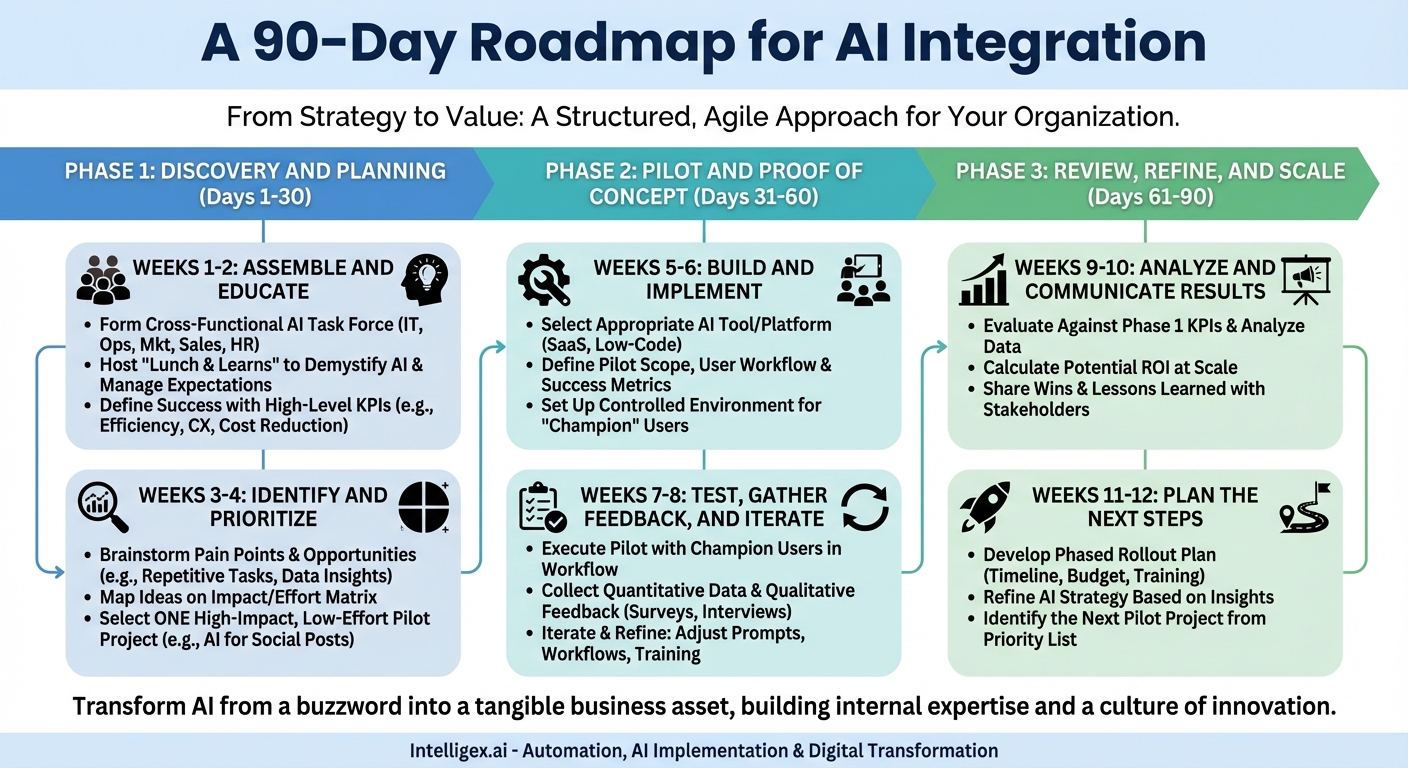
The buzz around Artificial Intelligence is impossible to ignore. From automating routine tasks to uncovering deep business insights, the potential of AI is transformative. Yet, for many organizations, the path from potential to reality is foggy. Where do you even begin? The fear of a costly, complex, and time-consuming implementation can lead to paralysis. The good news is that integrating AI doesn’t have to be a multi-year odyssey. By adopting a structured, agile approach, you can achieve meaningful results and build a foundation for future innovation in just 90 days.
This roadmap isn’t about solving every problem with AI overnight. It’s a strategic framework designed to demystify the process, secure early wins, and build momentum. It’s about moving from “we should do something with AI” to “here is the value AI is delivering to our business today.” Let’s break down the journey into three manageable 30-day phases.
Phase 1: Discovery and Planning (Days 1-30)
The first month is all about laying a solid foundation. Rushing into technology without a clear strategy is a recipe for wasted resources. This phase is dedicated to understanding your organization’s unique needs, educating your team, and identifying the most promising opportunities for AI integration.
Weeks 1-2: Assemble and Educate
Your first step is to build the right team and ensure everyone is speaking the same language. AI is not just an IT project; it’s a business transformation initiative.
- Form a Cross-Functional AI Task Force: Assemble a small, dedicated group with representatives from key departments like IT, Operations, Marketing, Sales, and HR. This diversity ensures you’re looking at problems and opportunities from every angle. This team will champion the initiative, drive the process, and facilitate communication.
- Demystify AI for Stakeholders: Host workshops or “lunch and learns” to establish a baseline understanding of what AI is and, just as importantly, what it isn’t. Focus on practical applications relevant to your industry, not just abstract technical concepts. Dispel myths and manage expectations early on.
- Define What Success Looks Like: As a group, define your primary objectives. Are you trying to increase operational efficiency, enhance the customer experience, reduce costs, or accelerate product innovation? Establish high-level Key Performance Indicators (KPIs) that will help you measure the success of your AI initiatives later on.
Weeks 3-4: Identify and Prioritize
With a team and a common understanding in place, it’s time to find the best starting point. The goal here is to identify the low-hanging fruit—use cases that offer a high potential for impact with a relatively low level of effort and complexity.
- Brainstorm Use Cases: Get your task force and other department heads in a room to brainstorm pain points and opportunities. Ask questions like, “What are the most repetitive, time-consuming tasks in your day?” or “Where do we have a lot of data but struggle to find insights?” Think about customer service chatbots, internal knowledge base search, sales lead scoring, or content summarization.
- Create an Impact/Effort Matrix: Map the brainstormed ideas on a simple four-quadrant matrix with “Business Impact” on the Y-axis and “Implementation Effort” on the X-axis. Your prime candidates for the first pilot project will be in the high-impact, low-effort quadrant.
- Select Your Pilot Project: From your prioritized list, choose one specific use case for your 90-day pilot. It should be well-defined, measurable, and visible enough to demonstrate value if successful. For example, instead of “improve marketing,” a better goal is “use an AI tool to draft initial social media posts, reducing content creation time by 20%.”
Phase 2: Pilot and Proof of Concept (Days 31-60)
This is where theory meets practice. The second month is dedicated to executing your chosen pilot project. The goal is not perfection but progress. You want to build a functional Proof of Concept (PoC) that demonstrates the viability and value of AI in your specific business context.
Weeks 5-6: Build and Implement
Now you’ll focus on the technical and logistical setup of your pilot. Keep the scope small and tightly controlled to ensure you can deliver within the timeframe.
- Select Your Tool: Based on your pilot project, research and choose an appropriate AI tool or platform. This could be an off-the-shelf SaaS product, an open-source model, or a platform API. For a 90-day plan, starting with a user-friendly, low-code solution is often the most practical choice.
- Define the Pilot Scope and Metrics: Clearly document what the PoC will and will not do. What is the specific workflow it will impact? Who are the users? Crucially, define the specific metrics you will use to evaluate its success. For the social media example, this would be time-tracking before and after implementation and qualitative feedback on draft quality.
- Set Up a Controlled Environment: Implement the tool for a small, selected group of “champion” users—employees who are enthusiastic and willing to provide constructive feedback. Don’t roll it out to an entire department yet. This limits disruption and makes feedback collection more manageable.
Weeks 7-8: Test, Gather Feedback, and Iterate
Your PoC is live in its controlled environment. Now it’s time to observe, learn, and refine.
- Execute the Pilot: Let your champion users work with the new AI tool as part of their regular workflow. Encourage them to document their experience, including both wins and frustrations.
- Collect Quantitative and Qualitative Data: Track the hard metrics you defined earlier (e.g., time saved, tasks completed, error rates). Simultaneously, conduct short interviews or surveys with your users to gather qualitative feedback on usability, accuracy, and overall helpfulness.
- Iterate and Refine: No pilot is perfect on the first try. Use the feedback to make quick adjustments. This might involve refining prompts for a generative AI tool, tweaking the workflow, or providing additional user training. This agile approach is key to finding what truly works.
Phase 3: Review, Refine, and Scale (Days 61-90)
In the final month, you’ll take the results and learnings from your pilot and translate them into a strategic plan for the future. The goal is to prove the value of your initial effort and build a compelling case for broader AI adoption.
Weeks 9-10: Analyze and Communicate the Results
Data-driven storytelling is your most powerful tool for building momentum. It’s time to analyze your pilot results and share the story of its impact.
- Evaluate Against KPIs: Go back to the success metrics you established in Phase 1. Did the PoC meet, exceed, or fall short of its goals? Analyze both the quantitative data and the qualitative user feedback to form a complete picture.
- Calculate the Potential ROI: Build a simple business case. If you saved one user 4 hours per week, what would be the impact if you rolled this out to the entire 50-person department? Extrapolate the pilot results to show the potential return on investment at scale.
- Share the Wins: Prepare a concise presentation or report for key stakeholders. Highlight the successes, be honest about the challenges, and showcase the lessons learned. Celebrate the work of the AI Task Force and the champion users to foster a culture of innovation.
Weeks 11-12: Plan the Next Steps
A successful pilot is not the finish line; it’s the starting gate. Use the momentum you’ve built to plan for a wider rollout and identify your next AI initiative.
- Develop a Rollout Plan: Based on the PoC’s success, create a phased plan to scale the solution. This should include a timeline, budget considerations, comprehensive training materials for new users, and a support plan.
- Refine Your AI Strategy: What did you learn from this 90-day cycle? Use these insights to refine your process for identifying, prioritizing, and implementing future AI projects. Your Impact/Effort matrix might look different now that you have real-world experience.
- Identify the Next Pilot: The cycle begins anew. With a proven process and a success story under your belt, it’s time to go back to your prioritized list of use cases and select the next project.
By following this 90-day roadmap, you can transform AI from an intimidating buzzword into a tangible business asset. You’ll not only implement a technology but also build the internal expertise, confidence, and culture needed to thrive in an increasingly AI-driven world. The journey starts not with a giant leap, but with a single, well-planned step.
Your Next Read:
Category:
Get a FREE
Proof of Concept
& Consultation
No Cost, No Commitment!
