

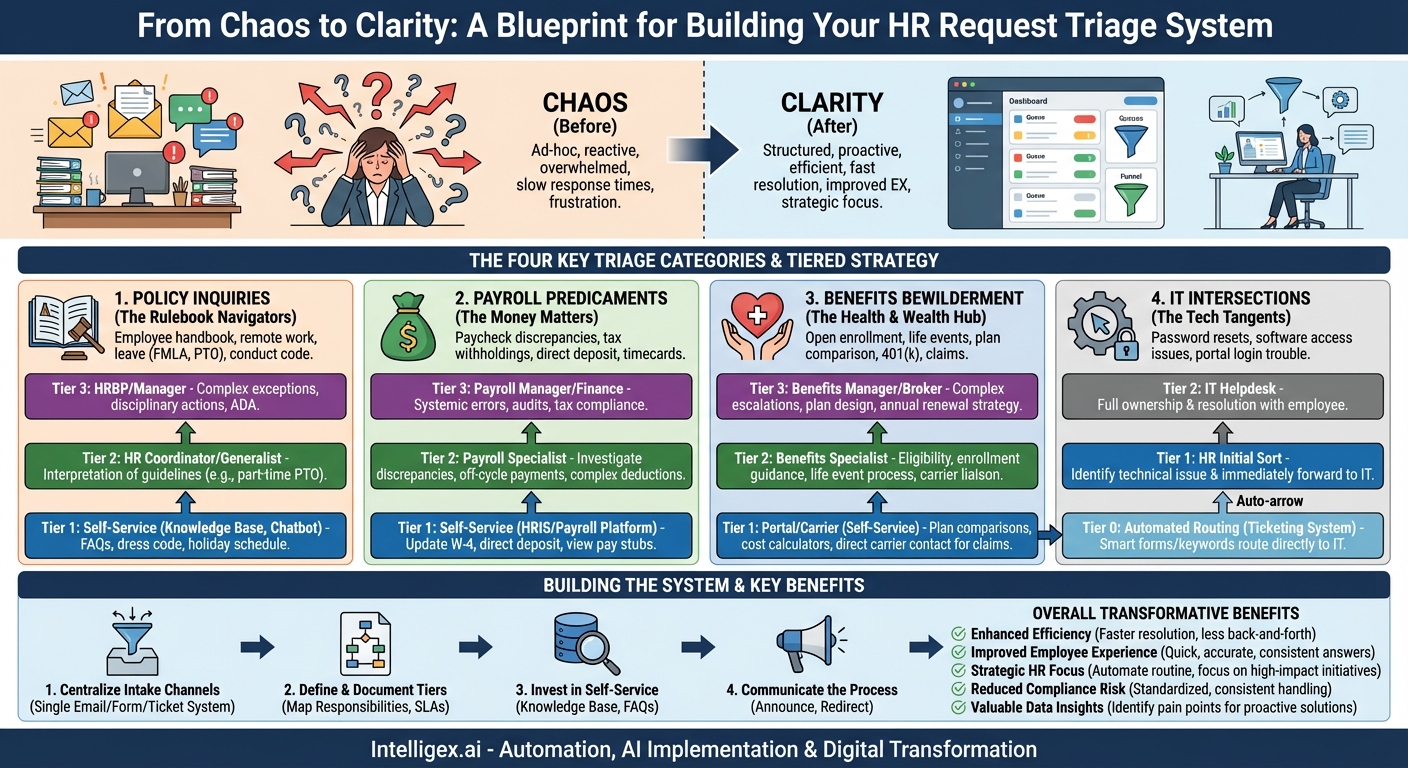
The modern Human Resources department is the nerve center of an organization, a bustling hub of constant communication. Emails flood inboxes, chat notifications ping incessantly, and phone calls interrupt strategic work. Employees have urgent questions about their paychecks, complex queries about benefits, and need clarification on a new company policy—all at the same time. Without a system to manage this influx, HR teams can quickly become overwhelmed, leading to slow response times, frustrated employees, and a perpetually reactive, rather than proactive, operational state. This is where the power of a structured HR request triage system comes into play. Triage, a term borrowed from the medical field, is the process of sorting, categorizing, and prioritizing incoming requests to ensure they are routed to the correct person or resource for the most efficient resolution. By establishing a clear framework for handling inquiries across key areas—Policy, Payroll, Benefits, and IT—organizations can transform HR chaos into a streamlined, effective, and highly responsive function.
Why a Triage System is No Longer a “Nice-to-Have”
Failing to implement a formal triage process is a recipe for inefficiency and a poor employee experience. When requests are handled in an ad-hoc manner, several problems inevitably arise. An employee’s simple question about PTO might get bounced between three different HR team members before finding the right person, turning a five-minute query into a two-day ordeal. A critical payroll discrepancy might get buried under a pile of less urgent emails. This “hot potato effect” not only frustrates employees who feel their needs aren’t being met but also burns out HR professionals who spend their days redirecting traffic instead of engaging in meaningful, strategic work.
Furthermore, a lack of standardization opens the door to inconsistency and compliance risks. If two employees ask the same question about a leave policy and receive slightly different answers from two different HR generalists, it can create confusion and even perceptions of unfairness. A well-designed triage system mitigates these issues by creating clear pathways for resolution. The benefits are transformative:
- Enhanced Efficiency: By immediately routing requests to the right specialist or self-service tool, resolution times plummet. The back-and-forth is eliminated, and the entire process becomes faster and smoother.
- Improved Employee Experience (EX): When employees know exactly where to go for help and receive quick, accurate, and consistent answers, their trust and satisfaction with the company soar. A positive EX is a cornerstone of engagement and retention.
- Strategic HR Focus: A triage system automates and delegates the routine, freeing up senior HR professionals to concentrate on high-impact initiatives like talent development, succession planning, organizational culture, and employee relations.
- Reduced Compliance Risk: Standardized processes ensure that sensitive requests related to policies, pay, and benefits are handled consistently and in accordance with all legal and regulatory requirements.
- Valuable Data Insights: Tracking and categorizing requests provides a goldmine of data. If 30% of all inquiries are about navigating the benefits portal, it’s a clear sign that better training or a more user-friendly system is needed. This data allows HR to proactively address common pain points.
Breaking It Down: The Four Key Triage Categories
While employee requests can span a wide range of topics, most can be effectively sorted into four primary pillars. Building your triage system around these categories creates a logical and scalable framework for managing virtually any inquiry that comes your way.
1. Policy Inquiries: The Rulebook Navigators
These are questions related to the “how” and “why” of working at your company. They cover everything from the employee handbook and remote work guidelines to leave policies (FMLA, parental, PTO), performance management processes, and the code of conduct. These inquiries are frequent and often repetitive, making them prime candidates for a tiered triage approach.
Triage Strategy:
- Tier 1 (Self-Service): The first line of defense should be a comprehensive, well-organized, and easily searchable knowledge base, often housed on the company intranet. For common questions like, “What is the dress code?” or “Where can I find the holiday schedule?”, employees should be able to find the answer themselves in seconds. A simple chatbot can also be programmed to answer these frequently asked questions instantly.
- Tier 2 (HR Coordinator/Generalist): When a question requires a degree of interpretation that a knowledge base can’t provide—for example, “How does our PTO policy apply to my specific part-time schedule?”—it should be routed to a junior HR team member. They can provide clarification based on established guidelines.
- Tier 3 (HR Business Partner/Manager): The most complex and sensitive policy issues belong here. This includes requests for policy exceptions, guidance on complex disciplinary actions, or accommodation requests under the ADA. These situations require senior expertise and careful consideration.
2. Payroll Predicaments: The Money Matters
Nothing is more personal or time-sensitive to an employee than their compensation. Inquiries in this category include everything from “My paycheck seems incorrect” to questions about tax withholdings, direct deposit issues, understanding a pay stub, timecard corrections, and bonus calculations. Speed and accuracy are paramount.
Triage Strategy:
- Tier 1 (Self-Service via HRIS): Modern Human Resources Information Systems (HRIS) and payroll platforms are powerful tools. Employees should be empowered to perform many tasks themselves, such as updating their W-4 form, changing direct deposit information, or accessing and downloading their past pay stubs. Clear instructions on how to use these features can deflect a huge volume of tickets.
- Tier 2 (Payroll Specialist/Administrator): This is the dedicated expert for most payroll queries. They have the system access and specialized knowledge to investigate pay discrepancies, process off-cycle payments for corrections, and explain complex pre-tax deductions. Due to their urgency, these tickets should be flagged with high priority.
- Tier 3 (Payroll Manager/Finance Department): Systemic problems, such as an error affecting an entire department’s pay, requests for detailed historical payroll audits, or complex questions about payroll tax compliance, should be escalated to the highest level of expertise for resolution and strategic oversight.
3. Benefits Bewilderment: The Health and Wealth Hub
Navigating the world of health insurance, retirement plans, and wellness programs can be confusing for employees. Common questions revolve around open enrollment, adding a dependent after a qualifying life event (like marriage or birth), comparing medical plans, understanding 401(k) matching, and troubleshooting claim issues.
Triage Strategy:
- Tier 1 (Benefits Portal/Insurance Carrier): Your first goal should be to direct employees to the source of truth. Most benefits administration platforms offer detailed plan comparisons and cost calculators. For specific claim questions, the most efficient route is often for the employee to contact the insurance provider’s member services line directly. Providing easy access to these resources is a key part of triage.
- Tier 2 (Benefits Specialist): This individual is the internal expert and liaison. They handle questions about eligibility, explain the nuances of different plans during open enrollment, and guide employees through the process of a qualifying life event. They can also assist when an employee has difficulty resolving an issue directly with a carrier.
- Tier 3 (Benefits Manager/External Broker): Complex claim escalations that require company intervention, questions about the strategic design of the benefits package itself, and planning for the annual renewal and open enrollment cycle are handled at this level.
4. IT Intersections: The Tech Tangents
Many employee requests that land in HR’s lap are actually technical issues in disguise. These include password resets for the HRIS, access problems with the performance review software, or trouble logging into the benefits portal. While the context is HR, the solution is IT. A poor triage process turns HR into a manual pass-through, wasting time for everyone involved.
Triage Strategy:
- Tier 0 (Automated Routing): The ideal solution is a centralized ticketing system used by multiple departments. With smart forms, an employee selecting “Password Reset” from a dropdown menu can have their ticket automatically routed to the IT queue without an HR team member ever touching it. Keywords in emails can also trigger automatic forwarding rules.
- Tier 1 (HR Initial Sort): In the absence of an automated system, the first HR person who sees the request must be trained to quickly identify it as a technical issue. Their only job is to immediately forward the request to the IT helpdesk and reply to the employee to let them know it has been rerouted to the correct team. They should not attempt to troubleshoot the problem themselves.
- Tier 2 (IT Helpdesk): Once properly routed, the IT team takes full ownership of the ticket and works directly with the employee to resolve the technical problem, keeping HR out of the middle.
Building Your Triage System: A Practical Blueprint
Knowing the categories is the first step; building the system is the next. You can implement a robust triage process by following a few key principles.
- Centralize Your Intake Channels: Stop trying to monitor individual inboxes, chat messages, and phone calls. Establish a single, official point of entry for all HR requests. This could be a dedicated email alias (e.g., [email protected]), a simple form on the company intranet, or, ideally, a formal ticketing system (like Zendesk, Jira, or a specialized HR case management tool). This creates one unified queue to manage.
- Define and Document Your Tiers: Use the four pillars as a starting point and map out who is responsible for what. Create a simple chart or process flow that clearly defines Tier 1, 2, and 3 responsibilities for each category. This document becomes the rulebook for your internal HR team. Consider establishing Service Level Agreements (SLAs) for response times for different priority levels.
- Invest in Self-Service: Your most powerful tool is a well-maintained knowledge base. Proactively answer the top 80% of questions before they are asked. Regularly review your ticket data to identify common themes, and then create articles, guides, and FAQs to address them. The goal is to make self-service the easiest and fastest option for employees.
- Communicate the Process: A new system is only effective if people use it. Announce the new, centralized intake channel to all employees. Explain how it benefits them by ensuring a faster, more organized response. Gently redirect employees who continue to email individuals directly, guiding them back to the official channel to reinforce the new habit.
Implementing an HR request triage system is not about creating rigid bureaucracy; it’s about bringing clarity, speed, and sanity to a critical business function. It’s a strategic shift from a reactive, firefighting mode to a proactive, service-oriented model. By systematically sorting and directing employee needs, HR departments can dramatically improve their efficiency, elevate the employee experience, and finally carve out the time and mental space needed to focus on the strategic initiatives that truly drive the organization forward. It is the foundational framework upon which a modern, high-impact HR function is built.
Your Next Read:
Category:
Get a FREE
Proof of Concept
& Consultation
No Cost, No Commitment!