

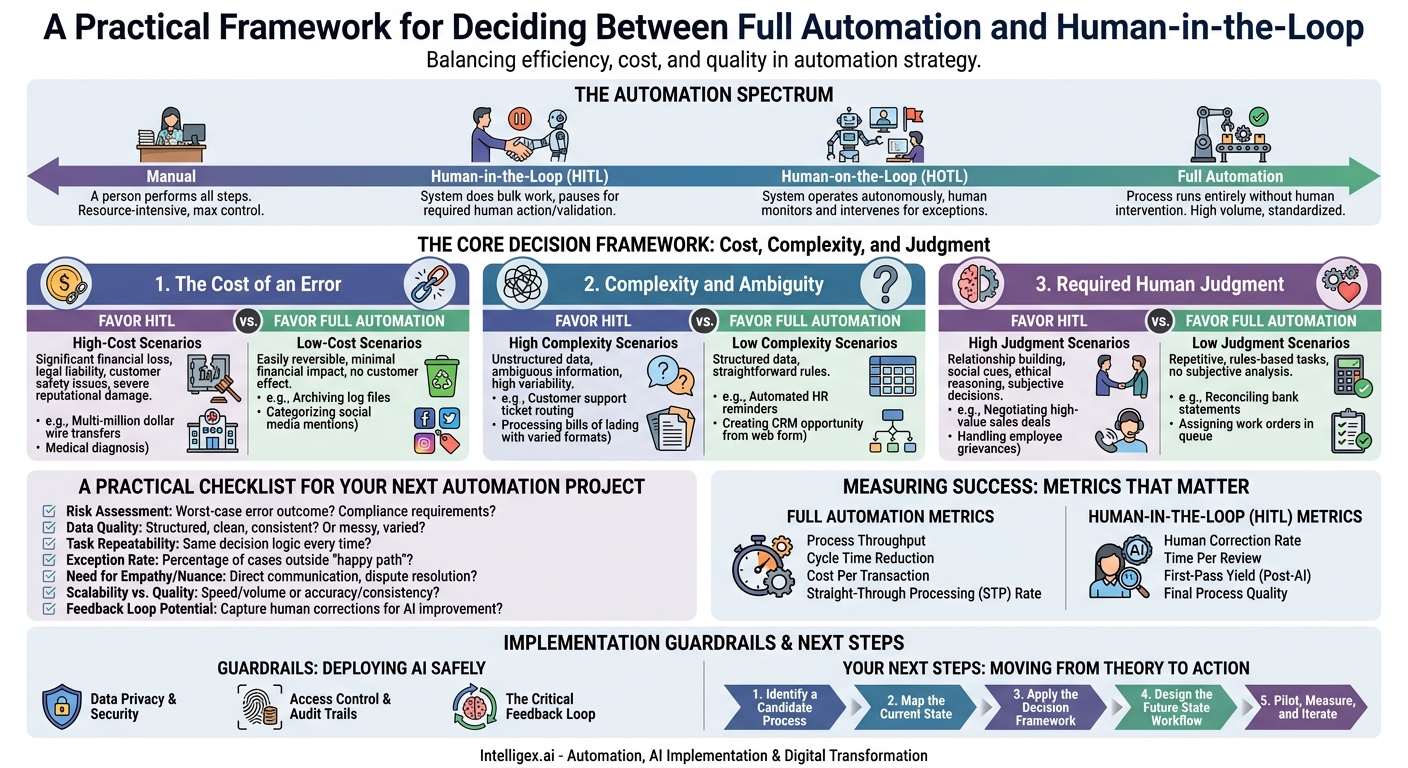
The allure of full, hands-off automation is powerful. It promises a world of streamlined operations, reduced costs, and hyper-scalability. But in the rush to eliminate every manual step, businesses often discover a critical truth: removing the human isn’t always the smartest move. Sometimes, the most valuable, robust, and effective automated systems are the ones that strategically keep a person in the loop.
This isn’t a compromise. It’s a design choice known as Human-in-the-Loop (HITL) automation. It combines the raw processing power and speed of machines with the nuance, judgment, and contextual understanding of a human expert. The real challenge isn’t choosing between humans or machines; it’s knowing precisely where to draw the line between them. This guide provides a practical framework to help you decide when to push for full automation and when a well-placed human step creates more business value.
Understanding the Automation Spectrum
Automation is not a simple on-or-off switch. It’s a spectrum of human involvement, and choosing the right point on that spectrum is key to a successful implementation. Understanding these levels helps frame the decision beyond a binary choice of “manual vs. automated.”
- Manual: A person performs all steps of a task. This is resource-intensive and doesn’t scale well, but it provides maximum control and flexibility.
- Human-in-the-Loop (HITL): This is the classic partnership model. The system performs the bulk of the work but pauses for a required human action before proceeding. The human acts as a validator, a corrector, or a decision-maker at a critical juncture. Think of an AI that extracts data from an invoice, then presents it to an accounts payable clerk to confirm the GL code before posting it to the ERP. The process cannot continue without human approval.
- Human-on-the-Loop (HOTL): In this model, the system operates autonomously but is monitored by a human who can intervene if necessary. The system doesn’t stop and wait for approval for every transaction. Instead, it flags exceptions or anomalies for human review. A cybersecurity system that automatically blocks known threats but alerts an analyst to investigate novel, suspicious activity is a perfect example.
- Full Automation: The process runs entirely without human intervention, from start to finish. This is ideal for high-volume, low-risk, and highly standardized tasks, such as sending automated order confirmation emails or de-provisioning a user’s access upon termination.
The goal is not to achieve full automation everywhere. The goal is to apply the appropriate level of automation to each process to maximize its specific business objectives, whether that’s speed, cost reduction, quality improvement, or risk mitigation.
The Core Decision Framework: Cost, Complexity, and Judgment
How do you decide where a process should fall on the automation spectrum? Your decision should balance three fundamental factors: the cost of an error, the complexity of the task, and the need for human judgment. By evaluating a process against these three pillars, you can build a strong business case for either HITL or full automation.
1. The Cost of an Error
This is the most important question to ask. What are the real-world consequences if the automation fails? The higher the potential cost, the stronger the argument for keeping a human in the loop.
- High-Cost Scenarios (Favor HITL): When an error could lead to significant financial loss, legal liability, customer safety issues, or severe reputational damage.
- Example (Finance): An automated system for processing multi-million dollar wire transfers. An error could be catastrophic. An HITL approach, where AI prepares the transfer but a finance manager provides final authorization, is a necessary safeguard.
- Example (Healthcare): An AI model that suggests patient diagnoses based on medical imaging. Full automation is out of the question due to the high risk. A radiologist must always make the final determination, using the AI as a powerful support tool.
- Low-Cost Scenarios (Favor Full Automation): When an error is easily reversible, has minimal financial impact, and does not affect customers or compliance.
- Example (IT Ops): An automated script that archives old log files. If it fails, the worst outcome is a temporary increase in disk space usage, which can be easily corrected.
- Example (Marketing): An automation that categorizes incoming social media mentions by keyword. If a post is miscategorized, it can be manually re-tagged with little to no negative impact.
2. Complexity and Ambiguity
This pillar relates to the nature of the data and the rules governing the process. Automation thrives on structured, predictable inputs and clear, binary logic.
- High Complexity Scenarios (Favor HITL): When the process deals with unstructured data, ambiguous information, or a high degree of variability.
- Example (Customer Support): An AI can perform an initial routing of support tickets based on keywords, but it may struggle with sarcasm, subtle intent, or complex, multi-part questions. A human agent is needed to review ambiguously worded tickets to ensure they reach the correct specialist.
- Example (Supply Chain): Processing bills of lading that arrive in hundreds of different formats from various logistics partners. An AI using Optical Character Recognition (OCR) can extract most data, but a logistics coordinator is needed to validate exceptions and handle documents with unusual layouts or handwritten notes.
- Low Complexity Scenarios (Favor Full Automation): When the data is structured and the rules are straightforward.
- Example (HR): Sending an automated reminder to employees to complete their mandatory compliance training. The input (a list of employees) and the logic (if training status is “incomplete,” send email) are perfectly clear.
- Example (Sales): Creating a new opportunity record in a CRM like Salesforce when a prospect fills out a “Contact Us” form on your website. The data fields map directly from the web form to the CRM.
3. Required Human Judgment
Some tasks require uniquely human skills like empathy, negotiation, strategic thinking, or ethical reasoning. These are the last frontiers of automation and are prime candidates for a HITL approach.
- High Judgment Scenarios (Favor HITL): When the task requires building relationships, understanding subtle social cues, or making a decision that isn’t based on data alone.
- Example (Sales): While an AI can generate a draft proposal, a human salesperson is needed to negotiate the terms, understand the customer’s underlying concerns, and build the rapport needed to close a high-value deal.
- Example (HR): Handling a sensitive employee grievance. This process requires empathy, active listening, and nuanced judgment that cannot be automated. An AI might help schedule meetings, but the core function is fundamentally human.
- Low Judgment Scenarios (Favor Full Automation): Repetitive, rules-based tasks that require no subjective analysis.
- Example (Finance): Reconciling bank statements against internal accounting records for matching transactions. It’s a pure data-matching exercise.
- Example (Operations): Assigning a new work order to the next available technician in a queue. The logic is simple and requires no subjective input.
A Practical Checklist for Your Next Automation Project
Before you commit to a specific automation strategy for any process, walk through this checklist with your team. Answering these questions honestly will guide you to the right point on the automation spectrum and help you avoid costly implementation mistakes.
- Risk Assessment: What is the absolute worst-case outcome of an automated error? Does this process touch on any sensitive areas with compliance or regulatory requirements (e.g., GDPR, SOX, HIPAA)?
- Data Quality: Is our input data structured, clean, and consistent? Or is it messy, varied, and full of free-text fields, scans, or images?
- Task Repeatability: Is the decision-making logic the same every single time? Or does it require frequent adaptation and creative problem-solving based on unique circumstances?
- Exception Rate: What percentage of cases do we expect will fall outside the “happy path”? Can we clearly define the rules for what constitutes an exception that needs human review?
- Need for Empathy or Nuance: Does the task involve direct communication with customers, resolving disputes, or making subjective judgments about quality or intent?
- Scalability vs. Quality: Is the primary business driver to increase volume and speed, or is it to improve accuracy and consistency? HITL is often a powerful tool for boosting quality, as it catches errors before they impact downstream systems.
- Feedback Loop Potential: Do we need to capture human corrections to improve the system over time? A well-designed HITL process is one of the best ways to generate high-quality training data for future AI models.
Measuring Success: Metrics That Matter
The key performance indicators (KPIs) you track depend on your chosen automation strategy. Measuring the right things will not only demonstrate ROI but also highlight opportunities for continuous improvement.
Metrics for Full Automation
For fully automated processes, the focus is on efficiency and reliability.
- Process Throughput: The number of tasks completed per hour or day. This directly measures the system’s capacity and scalability.
- Cycle Time Reduction: The percentage decrease in the end-to-end time it takes to complete a process compared to the manual baseline.
- Cost Per Transaction: The total operational cost to complete one unit of work. This should steadily decrease as you eliminate manual labor costs.
- Straight-Through Processing (STP) Rate: The percentage of transactions that are completed successfully without any errors or need for manual rework. A high STP rate is the hallmark of a healthy automated process.
Metrics for Human-in-the-Loop (HITL)
For HITL systems, you are measuring the effectiveness of the human-machine collaboration.
- Human Correction Rate: The percentage of AI-processed items that a human needs to modify. A high rate might indicate problems with the AI model or input data quality. The goal is to drive this down over time.
- First-Pass Yield (Post-AI): The percentage of items the AI processes correctly on the first try. This is a direct measure of the AI model’s quality and its contribution to the process.
- Final Process Quality: The final error rate after the human review step. This should be exceptionally low, demonstrating the value of HITL in improving overall quality and reducing risk.
– Time Per Review: The average time a human spends validating or correcting an AI-generated result. This measures the efficiency of the human portion of the workflow. A well-designed user interface can significantly reduce this metric.
Implementation Guardrails: Deploying AI Safely and Responsibly
Whether you choose HITL or full automation, integrating AI into business processes requires careful planning to ensure security, compliance, and trustworthiness. These guardrails are not optional; they are essential for responsible implementation.
Data Privacy and Security
AI models are only as good as the data they are trained on, and they often need access to business-critical information. Ensure that any data pipeline feeding an AI system, especially one using a third-party API, adheres to your company’s strictest data governance policies. Anonymize or pseudonymize personally identifiable information (PII) and other sensitive data wherever possible before it is processed.
Access Control and Audit Trails
For any automated system that takes action (e.g., makes a payment, sends a communication, changes a record), you must have clear controls and visibility. Implement role-based access control (RBAC) to define who can manage, override, or approve automated decisions. Furthermore, maintain an immutable audit trail that logs every automated action and every human intervention. This is non-negotiable for debugging, security investigations, and demonstrating compliance.
The Critical Feedback Loop
An HITL system should be designed as more than just a safety net. It is a powerful engine for continuous improvement. Every time a human corrects an AI’s output, they are creating a valuable piece of training data. Your system should be architected to capture these corrections in a structured way. This feedback can be used to periodically retrain and fine-tune the AI model, creating a virtuous cycle where the AI gets smarter, the human correction rate drops, and the process becomes more efficient over time.
Your Next Steps: Moving from Theory to Action
Understanding the theory is the first step. The next is to apply it to a real business process in your organization. Follow this simple plan to get started on your first targeted automation project.
- Identify a Candidate Process. Don’t try to boil the ocean. Start with a process that is high-volume, repetitive, and currently a known pain point for a specific team. Look for “stare and compare” tasks, data entry bottlenecks, or manual approvals that slow everything down.
- Map the Current State. Before you change anything, you must understand it. Document the existing process from end to end. Note every step, every system involved, and every human touchpoint. Quantify what you can: How long does it take? How many people are involved? What is the current error rate?
- Apply the Decision Framework. Using the criteria of cost, complexity, and judgment, evaluate the process with the relevant stakeholders. This will lead you to a natural conclusion about whether full automation or an HITL approach makes the most sense. Use the checklist provided earlier to guide the conversation.
- Design the Future State Workflow. If you’ve chosen an HITL path, be very specific about the human interaction point. What exact information will the AI provide to the human? What will the user interface look like to allow for a fast and easy review? What actions can the human take (e.g., approve, reject, edit)?
- Pilot, Measure, and Iterate. Start with a small pilot program. Run a subset of transactions through the new system and carefully track the key metrics. This allows you to prove the business value on a small scale, gather feedback from users, and make adjustments before a full-scale rollout.
By taking this deliberate, value-driven approach, you can move beyond the hype and implement automation that delivers real, measurable results, whether it’s a fully autonomous workflow or a powerful partnership between your best people and your smartest technology.
Your Next Read:
Category:
Get a FREE
Proof of Concept
& Consultation
No Cost, No Commitment!
