

Automation promises efficiency, but reality is often more complex. Many critical business processes are not simple, binary tasks. They involve nuance, context, and judgment, qualities that have traditionally kept them firmly in the realm of manual work. The result is a bottleneck. Teams are stuck between fully manual workflows that do not scale and fully automated systems that are too rigid to handle real-world exceptions. This is where a Human-in-the-Loop (HITL) approach provides a practical, powerful solution.
HITL is not about replacing people with algorithms. It is about creating a partnership where artificial intelligence handles the high-volume, repetitive work, and human experts handle the complex, high-stakes exceptions. By intelligently blending machine speed with human oversight, businesses can achieve new levels of speed, accuracy, and scalability without sacrificing quality control.
What is Human-in-the-Loop (and What It Isn’t)
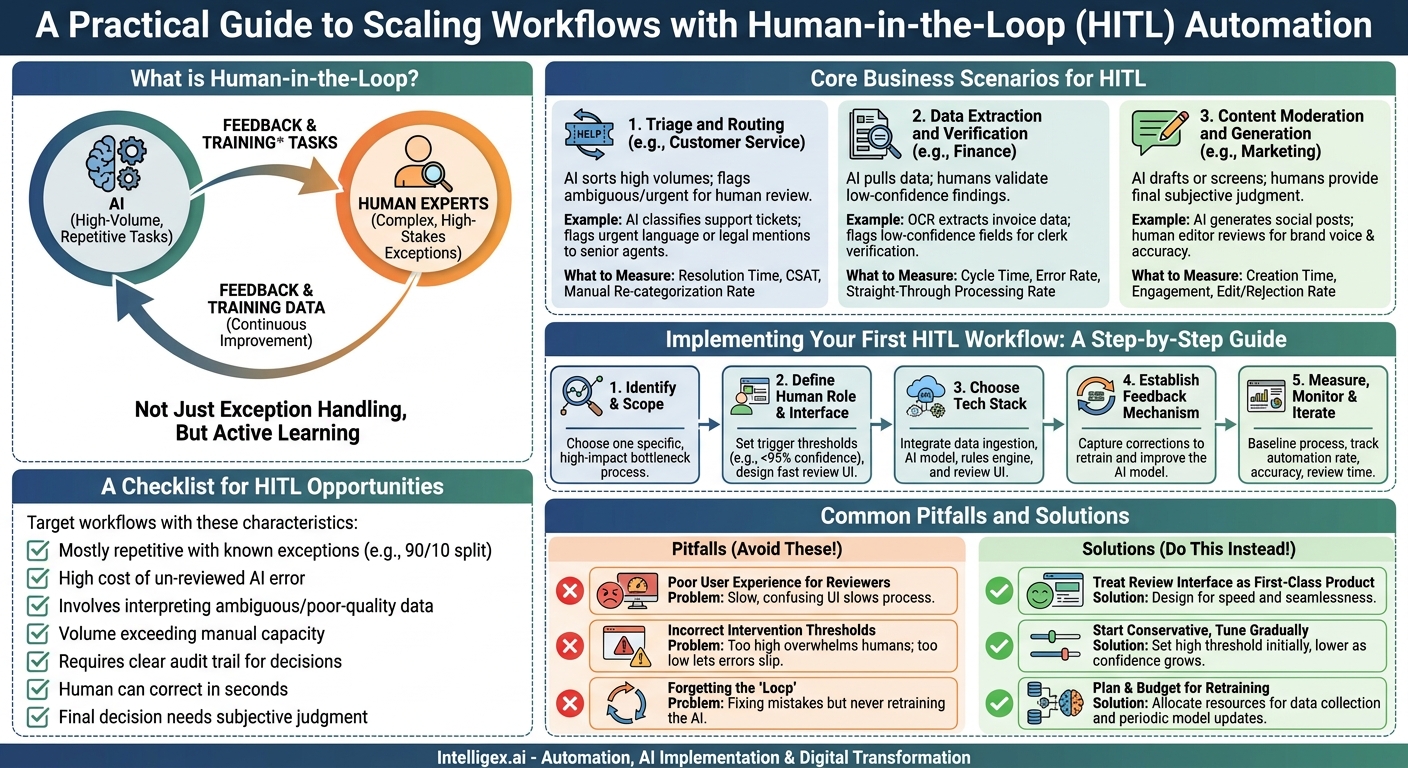
At its core, a Human-in-the-Loop system is a workflow where an AI model performs a task but is designed to recognize when it has low confidence in its own result. Instead of making a potential error, the system flags the specific task and routes it to a human for review and a final decision. The most important part of this process is the “loop.” The human’s correction or validation is fed back as training data, systematically making the AI model smarter and more accurate over time.
This is fundamentally different from simple exception handling. An HITL system is designed for continuous improvement. It is not just a safety net; it is an active learning mechanism.
It is important to clarify what HITL is not:
- It is not just manual data entry with a new name. The goal is to minimize human touches, not just manage them.
- It is not a temporary bridge to full automation. For many complex tasks, the need for human judgment will always exist. HITL makes that judgment scalable.
- It is not about AI “failing.” It is about AI succeeding at its primary job, which is to identify what it can and cannot handle reliably.
The business value is direct and measurable. By automating the 80% to 95% of tasks that are straightforward, you free up your skilled employees to focus on the 5% to 20% that truly require their expertise. This leads to faster processing times, higher quality outcomes because every edge case gets expert review, and the ability to scale operations without a proportional increase in headcount.
The Three Core HITL Scenarios in Business
While the applications are vast, most successful HITL implementations fall into one of three primary categories. Understanding these patterns helps in identifying opportunities within your own organization.
1. Triage and Routing
This scenario involves sorting and directing large volumes of incoming items. An AI model performs the initial categorization, but flags anything ambiguous or high-priority for immediate human attention.
- Department Example (Customer Service): A support helpdesk receives thousands of emails and tickets daily. An AI model reads each ticket, classifies it (e.g., “Billing Question,” “Technical Issue,” “Product Feedback”), and assigns it a priority level. If the model detects urgent language, mentions of legal action, or expresses extreme customer frustration, the ticket is immediately routed to a senior support agent or a manager. The rest are sent to the appropriate queues.
- What to Measure: Average ticket resolution time, first-contact resolution rate, customer satisfaction scores (CSAT), and the rate of manual re-categorization.
2. Data Extraction and Verification
Here, the goal is to pull structured information from unstructured or semi-structured documents. The AI does the heavy lifting of finding and extracting the data, while humans validate the results, particularly when the AI’s confidence is low.
- Department Example (Finance): An Accounts Payable team processes thousands of vendor invoices. An AI-powered Optical Character Recognition (OCR) system reads each PDF, extracting key fields like vendor name, invoice number, date, and total amount. If the AI model has less than a 98% confidence score on the “total amount” field (perhaps due to a blurry scan or unusual format), the invoice is flagged in a dashboard for an AP clerk to quickly verify against the original document.
- What to Measure: Invoice processing cycle time, data entry error rate, cost per invoice processed, and the straight-through processing rate (percentage of invoices handled with no human touch).
3. Content Moderation and Generation
This involves either reviewing content for compliance or creating new content with AI assistance. Humans provide the final judgment call on subjective matters like brand voice, safety, and appropriateness.
- Department Example (Marketing): A marketing team needs to generate dozens of social media posts for an upcoming product launch. They use a generative AI tool to create initial drafts based on a creative brief. A human content strategist then reviews, edits, and refines these drafts to ensure they perfectly match the brand’s tone, are factually accurate, and are strategically sound. This is far faster than writing every post from scratch.
- What to Measure: Time to create content, content engagement metrics (likes, shares, clicks), and the number of rejected or heavily edited AI drafts.
A Checklist for Identifying HITL Opportunities
Not every workflow is a good candidate for a Human-in-the-Loop system. The ideal process is one where automation can handle the majority of cases, but human intelligence is indispensable for the exceptions. Use this checklist to evaluate potential workflows in your business.
Ask yourself if the target workflow has these characteristics:
- Is the task mostly repetitive but has known, tricky exceptions? Think of processes that are 90% “standard” and 10% “it depends.”
- Is the cost of an un-reviewed AI error high? If a mistake could result in financial loss, regulatory fines, customer churn, or brand damage, HITL is a critical safeguard.
- Does the task involve interpreting ambiguous or poor-quality data? This includes things like reading handwriting on forms, understanding industry-specific jargon in contracts, or analyzing low-resolution images.
- Is the volume of work growing beyond your team’s manual capacity? HITL allows you to handle surges in volume without being forced into a risky, all-or-nothing automation decision.
- Do you need a clear, defensible audit trail for decisions? An HITL system inherently logs whether a decision was made by the AI or a specific human, which is vital for compliance and governance.
- Can a human correct a potential AI mistake in seconds? The review process must be fast. If a human needs to spend 10 minutes investigating each exception, the efficiency gains are lost.
- Does the final decision require subjective judgment or nuanced context? Tasks involving brand voice, customer sentiment analysis, or complex policy interpretation are perfect candidates.
Implementing Your First HITL Workflow: A Step-by-Step Guide
Moving from concept to a working system requires a structured approach. Starting with a well-defined pilot project is the best way to demonstrate value and build momentum.
- Identify and Scope the Workflow. Using the checklist above, choose one specific, high-impact process. Do not try to automate an entire department at once. A great starting point is often a workflow that is already a known bottleneck, like client onboarding document verification or sales order processing. Clearly define the start and end points of the process you are targeting.
- Define the “Human” Part of the Loop. Be precise about what triggers a human review. Is it a confidence score from the AI falling below a certain threshold (e.g., 95%)? Is it the presence of specific keywords or anomalies? Also, define who the reviewers are. Will it be a dedicated team or will tasks be routed to existing subject matter experts? Finally, think about their interface. A well-designed review screen that shows the source document, the AI’s extracted data, and clear buttons to approve or correct is essential.
- Choose the Right Technology Stack. You do not need to build everything from scratch. A typical HITL stack includes a few key components: a way to ingest the data (e.g., an email inbox or API), an AI model to perform the core task (this could be a cloud service like AWS Textract for document analysis or a natural language processing model), a business rules engine to handle the routing logic, and the review user interface for your team.
- Establish the Feedback Mechanism. This is the most critical step for long-term success. Plan how human corrections will be captured and used to retrain the AI model. This might involve creating a “golden dataset” of validated corrections that is used to fine-tune the model on a quarterly basis. Without this feedback loop, your AI will never get smarter.
- Measure, Monitor, and Iterate. Before you begin, baseline your current process. How long does it take? What is the error rate? Once the HITL system is live, continuously track your key metrics: the automation rate (what percentage of items are processed without any human touch?), the average time a human spends per review, and the overall accuracy of the process. Use this data to adjust your confidence thresholds and identify areas for further improvement.
Common Pitfalls and How to Avoid Them
While powerful, HITL projects can stumble if not managed carefully. Awareness of these common challenges can help you navigate them successfully.
Pitfall: A Poor User Experience for Reviewers.
The problem: If the review tool is slow, confusing, or requires too many clicks, the efficiency gains from the AI are lost. Reviewers become frustrated, and the entire process slows to a crawl.
The solution: Treat the review interface as a first-class product. Involve your human experts in the design process from day one. The goal should be to make their decision-making process as fast and seamless as possible.
Pitfall: Incorrect Intervention Thresholds.
The problem: If your confidence score threshold for triggering a review is too high (e.g., 99%), almost everything will be sent to humans, overwhelming them. If it is too low (e.g., 70%), critical errors might slip through the system.
The solution: Start conservatively. Set a higher threshold initially to ensure quality, and then gradually lower it as you monitor the accuracy and gain confidence in the model. This is an ongoing tuning process, not a one-time setting.
Pitfall: Forgetting the “Loop.”
The problem: Many organizations build the “human-in-the” part but forget the “loop.” They use humans to fix AI mistakes but never use those corrections to make the AI better. The automation rate never improves.
The solution: From the very beginning of the project, plan and budget for the model retraining process. This includes the technical infrastructure for collecting and labeling feedback data and the data science resources needed to periodically update the model.
Governance and Safe Implementation
Integrating AI into critical workflows requires a strong governance framework, especially when dealing with sensitive information. HITL systems, with their inherent human oversight, provide a robust model for responsible AI, but you must be intentional about it.
Data Privacy and Access Control: Ensure your review interface is designed with security in mind. Human reviewers should only have access to the information strictly necessary to make their decision. For workflows involving Personally Identifiable Information (PII) or other sensitive data, use techniques like data masking to redact information that is not relevant to the task at hand.
Auditability and Transparency: Every action in the system must be logged. It should be easy to trace any given transaction and see whether the final decision was made by the AI or a specific human user, and when that decision was made. This complete audit trail is non-negotiable for financial, legal, and other regulated processes.
Training and Consistency: The quality of your AI model is directly dependent on the quality of the human feedback it receives. Provide clear guidelines, documentation, and training to your human reviewers. This ensures their decisions are consistent and aligned with company policies, which prevents the introduction of human bias or error back into the AI model.
Your Next Steps
Adopting a Human-in-the-Loop strategy does not require a massive, company-wide overhaul. The path to value starts with a single, well-chosen project. Begin by having a conversation with your team leaders in operations, finance, or customer support. Ask them where their biggest manual bottlenecks are.
Map out one of those processes from start to finish. Use the checklist in this guide to confirm it is a strong candidate for HITL. Focus on a workflow where the potential gains in speed and accuracy are high, and the risk is manageable.
Your goal should be to build a small pilot to prove the concept. Measure your current performance, implement a simple HITL workflow for a subset of the work, and compare the results. By blending AI-driven automation with the irreplaceable expertise of your team, you can build more resilient, efficient, and scalable operations for the future.
Related Posts
Category:
Get a FREE
Proof of Concept
& Consultation
No Cost, No Commitment!