

The drive for hyper-efficiency has placed full, “lights-out” automation at the top of many digital transformation agendas. The vision is compelling: processes that run end-to-end, 24/7, without any human touch. While this is the right goal for certain tasks, pursuing it universally can lead to costly errors, broken processes, and missed opportunities. The most effective automation strategies are not about replacing humans, but about augmenting them.
The critical question isn’t if you should automate, but how. The choice between full automation and a Human-in-the-Loop (HITL) approach is a strategic one that directly impacts cost, quality, and your ability to scale. A HITL system intentionally keeps a person involved at a key decision point, using AI to handle the repetitive work while relying on human expertise for validation, exception handling, or complex judgment. Understanding when and where to apply each approach is the difference between a brittle, high-maintenance system and a resilient, intelligent workflow.
Understanding the Automation Spectrum: HITL vs. Full Automation
Before you can choose the right path, it’s essential to understand the fundamental difference between these two models. They are not competitors, but two ends of a spectrum, each suited for different business challenges.
Full Automation
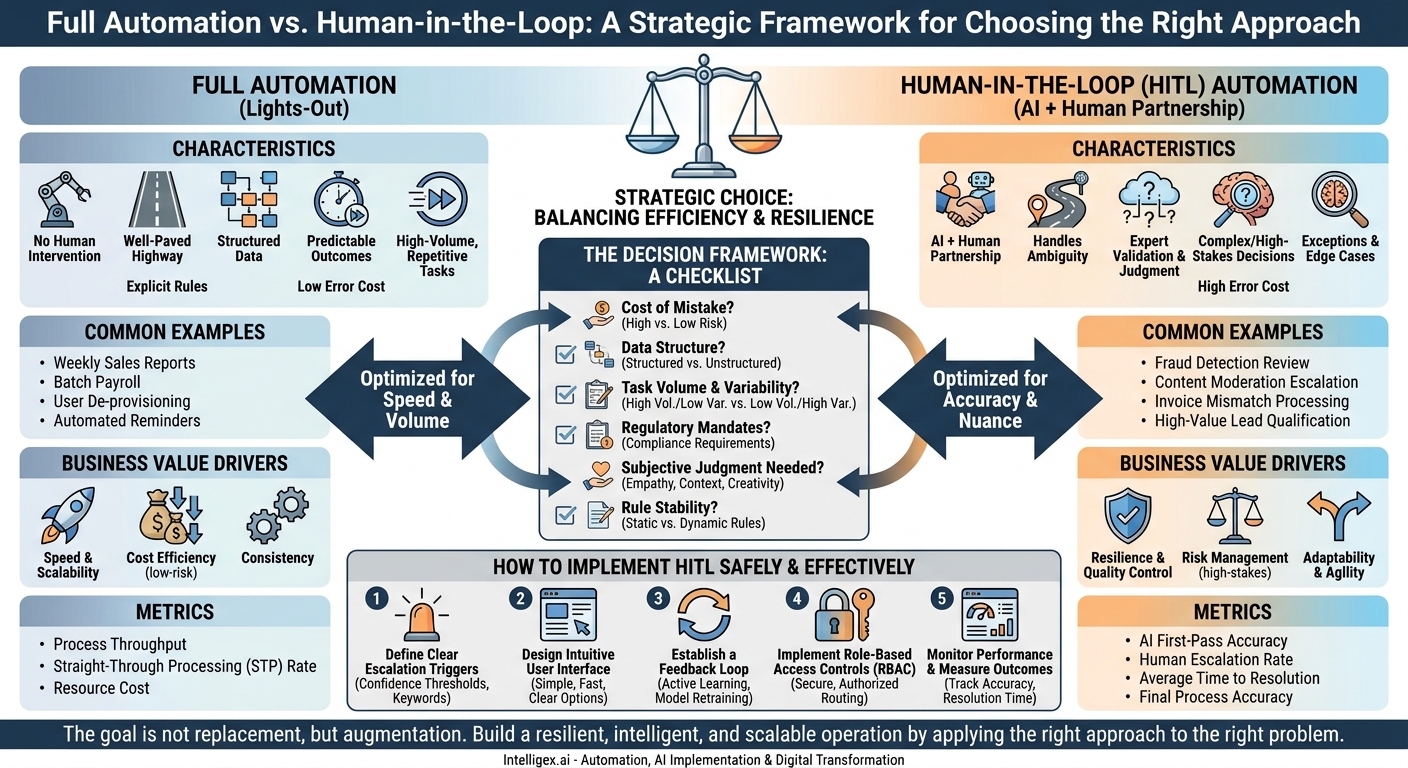
Full automation describes a process that, once initiated, runs to completion without any human intervention. The rules are explicit, the data is structured, and the outcomes are predictable. Think of it as a well-paved highway with no exits. It is incredibly efficient for high-volume, repetitive tasks where the cost of an error is low and the rules rarely change.
Common examples include:
- Generating a standard weekly sales report from CRM data.
- Batch processing payroll calculations for salaried employees.
- De-provisioning a user’s access to standard systems upon their departure.
- Sending automated appointment reminder emails.
The primary value of full automation is its speed and scalability. It can perform thousands or millions of transactions with perfect consistency, freeing up your team to focus on higher-value work.
Human-in-the-Loop (HITL) Automation
A HITL system, by contrast, is designed to be a partnership between a human and an AI. The system automates the vast majority of the work, but it is programmed to pause and ask for human input when it encounters ambiguity, a low-confidence prediction, or a high-stakes decision. This approach combines the speed of machine processing with the nuance, context, and judgment of a human expert.
Common examples include:
- An AI flags a potentially fraudulent insurance claim, which is then routed to a human investigator for final review.
- A content moderation tool automatically removes clear policy violations but escalates borderline cases to a human moderator.
- A marketing automation platform scores leads, but an SDR reviews the top-scoring leads to personalize outreach.
-An AI system processes invoices, but forwards any that have a mismatch with a purchase order to an accounts payable specialist.
HITL is not a sign that your automation has failed. It is a deliberate design choice that builds resilience, quality control, and accountability directly into your workflow.
The Business Case: Mapping Automation to Core Value Drivers
The decision to use full automation or HITL should be grounded in the business value you want to create. Each approach serves different goals related to speed, cost, quality, and risk management.
Cost and Efficiency
Full automation is the undisputed leader for reducing the cost of high-volume, standardized tasks. When a process is performed millions of times, shaving off a few seconds and eliminating human labor for each transaction results in significant savings. However, the calculation changes when the cost of an error is high. A fully automated system that incorrectly approves a multi-million dollar wire transfer creates a problem far more expensive than the cost of a human review. In these cases, a HITL model provides a cost-effective form of insurance, optimizing for total business cost, not just per-transaction cost.
Speed and Scalability
At first glance, full automation seems faster. For a single, predictable task, it is. But business processes are rarely that simple. A fully automated system can grind to a halt when it encounters an unexpected edge case, creating a backlog that requires manual intervention to fix. A HITL system is designed for these exceptions. It maintains momentum by handling the 95% of standard cases instantly while seamlessly routing the 5% of complex cases to the right person. This allows the overall process to scale smoothly, even as complexity and volume grow.
Quality and Accuracy
For tasks requiring consistency and adherence to simple rules, full automation delivers superior quality by eliminating human error. But for anything requiring subjective judgment, contextual understanding, or ethical consideration, human oversight is irreplaceable. An AI can screen resumes for keywords, but it cannot gauge a candidate’s potential or cultural fit. An AI can analyze sentiment, but it might miss sarcasm or industry-specific jargon. HITL systems create a powerful combination: the AI provides an accurate, data-driven first pass, and the human provides the final layer of nuanced quality control.
Visibility and Control
In regulated industries like finance, healthcare, and law, auditability is non-negotiable. Full automation can sometimes feel like a “black box,” making it difficult to demonstrate compliance or trace why a specific decision was made. HITL provides natural audit points. Every time a human reviews, approves, or rejects an AI’s suggestion, that action is logged. This creates a clear, auditable trail that satisfies compliance requirements and gives leadership better visibility into how critical processes are operating.
The Decision Framework: A Checklist for Choosing Your Approach
To move from theory to action, your team needs a structured way to evaluate each process. Before you start building a new automation, walk through these key questions. The answers will guide you toward the right point on the automation spectrum.
Key Questions to Ask Before Automating
- What is the true cost of a mistake? If an error would result in minor internal inconvenience (e.g., miscategorizing a document), full automation is likely safe. If it could lead to financial loss, customer churn, legal liability, or reputational damage (e.g., approving a faulty loan application), a HITL approach is essential.
- How structured and predictable is the input data? If the data arrives in a consistent format with clear fields (e.g., an online order form), full automation is a strong fit. If the data is unstructured or highly variable (e.g., customer emails, legal contracts, scanned images), a HITL system is needed to handle the inevitable exceptions and ambiguities.
- What is the task volume and variability? A task that is performed thousands of times a day with very little variation (e.g., password resets) is a prime candidate for full automation. A process with lower volume but high variability (e.g., negotiating enterprise sales contracts) benefits more from tools that augment, rather than replace, human experts.
- Are there regulatory or compliance mandates? Many industries require a human to be accountable for certain decisions, such as SOX controls in finance or clinical trial approvals in pharmaceuticals. In these scenarios, HITL isn’t just a good idea, it’s a requirement.
- Does the task require subjective judgment or real-world context? Tasks that involve empathy (customer service), creativity (marketing copy), or strategic planning (supply chain disruption response) are poor fits for full automation. These rely on human skills that AI can support but not replace.
- How quickly do the underlying rules or conditions change? If business rules are in constant flux, a fully automated system will require constant re-engineering. A HITL system is more agile, as the human experts can adapt to new rules immediately while the AI model is being updated.
Putting it into Practice: Scenarios Across Business Functions
Let’s examine how this decision framework applies to common processes in different departments.
Finance: Accounts Payable Invoice Processing
A classic business process ripe for automation. An AI model can read invoices, extract key information like vendor, date, and amount, and match it against a purchase order (PO).
- Full Automation: When an invoice has a perfect three-way match (invoice, PO, and goods receipt note), the system can approve it for payment without human review. The rules are clear and the risk is low.
- HITL: If the invoice amount doesn’t match the PO, the vendor is not in the system, or a line item is missing, the AI flags the invoice and routes it to an AP clerk. The clerk’s dashboard shows the invoice image, the extracted data, and the specific discrepancy, allowing them to resolve the issue in seconds.
Sales and Marketing: Lead Qualification
Your team wants to respond to promising leads quickly without wasting time on unqualified prospects.
- Full Automation: An AI can score leads based on firmographic data (company size, industry) and behavioral data (website pages visited, content downloaded). Leads below a certain score are placed into a nurturing campaign, while high-scoring leads are automatically assigned to a sales rep in a CRM like Salesforce.
- HITL: A lead from a Fortune 500 company might only get a medium score because they used a generic email address. Instead of ignoring it, the system flags it for a Sales Development Representative (SDR). The SDR can do a quick manual search on LinkedIn, confirm the person’s role, and enroll them in a personalized outreach sequence.
Human Resources: Resume Screening
A job posting can attract hundreds of applications. Sifting through them is time-consuming.
- Full Automation: The system can perform an initial pass to filter out any applicants who lack non-negotiable requirements, such as a specific certification, security clearance, or the legal right to work in the country.
- HITL: The AI creates a shortlist of the top 20 candidates based on skills and experience alignment. A human recruiter then reviews this much smaller pool to assess for nuanced qualities like career progression, project details, and potential cultural fit, which are difficult for an algorithm to weigh accurately.
How to Implement a HITL System Safely and Effectively
A successful HITL implementation requires more than just good technology. It requires a thoughtful approach to workflow design, user experience, and governance.
- Define Clear Escalation Triggers. Don’t leave the decision to escalate up to the AI’s “best guess.” You must explicitly define the rules for when a human is required. This could be based on a model’s confidence score falling below a certain threshold (e.g., below 95% confident), the presence of specific keywords, or a mismatch between two data fields.
- Design an Intuitive User Interface (UI). The human in the loop is not a data scientist. The interface for reviewing tasks must be simple, fast, and provide all necessary context at a glance. It should highlight the potential issue and provide clear options for action (e.g., Approve, Reject, Re-route). A confusing UI will erase all the efficiency gains from the automation.
- Establish a Feedback Loop. This is the most important step for long-term success. When a human corrects the AI’s output, that correction is valuable data. Your system should be designed to capture this feedback and use it to retrain and improve the AI model over time. This process, known as active learning, makes your entire system smarter with every human interaction.
- Implement Role-Based Access Controls (RBAC). When escalating tasks, especially those involving sensitive information (financial, PII, health data), you must ensure they are routed to the right person. RBAC ensures that only authorized users can view and act on specific queues, protecting data privacy and maintaining a secure chain of custody.
- Monitor Performance and Measure Outcomes. Track everything. How many tasks are processed automatically versus escalated? What is the average time a task waits for human review? What is the final accuracy rate of the process? This data will prove the ROI of your system and highlight opportunities for further tuning and improvement.
Measuring Success: Metrics for Your Automation Strategy
Whether you choose full automation or a HITL approach, you need to measure its impact. However, the key performance indicators (KPIs) you track will differ slightly.
Metrics for Full Automation
- Process Throughput: The number of tasks completed per hour or day. This is a measure of pure speed.
- Straight-Through Processing (STP) Rate: The percentage of tasks that are completed without any errors or exceptions.
- Resource Cost: The infrastructure or API costs associated with running the automation.
Metrics for HITL Systems
- AI First-Pass Accuracy: The percentage of tasks the AI handles correctly without needing human correction. Your goal is to increase this over time.
- Human Escalation Rate: The percentage of tasks flagged for human review. This helps you understand process complexity and model performance.
- Average Time to Resolution: The time it takes for a human to resolve an escalated task. This measures the efficiency of your human workforce.
- Final Process Accuracy: The post-review accuracy of the entire workflow. For critical processes, this should approach 100%.
Your Next Steps: Building a Smarter Automation Roadmap
The debate over full automation versus human-in-the-loop is not an academic one. It’s a practical decision with real-world consequences for your budget, your team’s morale, and your customers’ experience. The most successful organizations don’t choose one over the other. They build a balanced portfolio of solutions, applying the right level of automation to the right problem.
Start by identifying one or two processes within your department that are manual, repetitive, and impactful. Use the checklist in this article to analyze the task’s complexity, risk, and data structure. Don’t aim for a “big bang” lights-out solution from day one. Instead, consider starting with a HITL approach. It allows you to gain the benefits of automation quickly while building a safety net that protects your business and gathers the data needed to make your AI models smarter over time.
The ultimate goal is not automation for its own sake. The goal is to build more resilient, intelligent, and scalable operations. The key is recognizing that in many cases, your team’s expertise is not a bug to be eliminated, but a feature to be leveraged.
Related Posts
Category:
Get a FREE
Proof of Concept
& Consultation
No Cost, No Commitment!
