

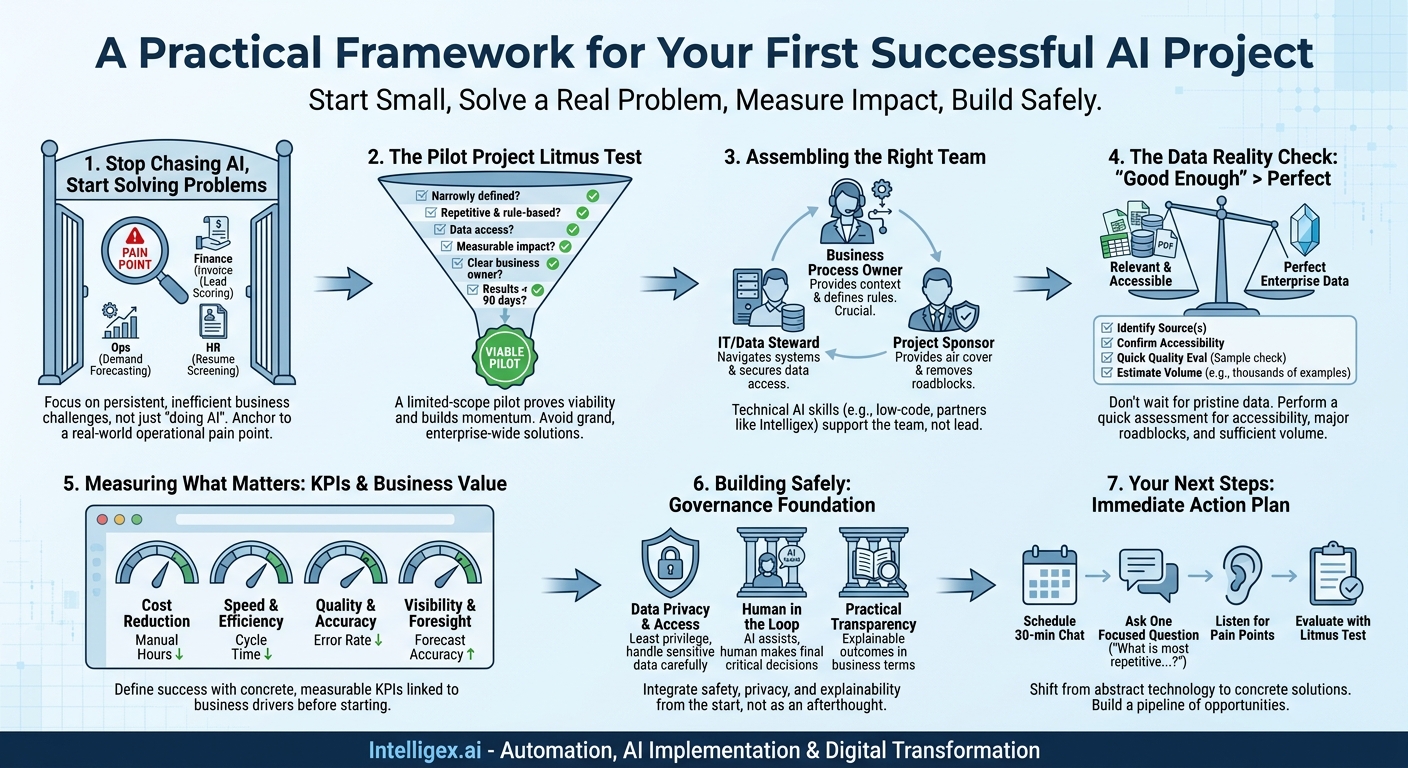
Starting your first Artificial Intelligence project can feel like standing at the base of a mountain. You hear about its transformative power, but the path to the summit is shrouded in technical jargon, budget anxieties, and the fear of a chaotic, never-ending implementation. The good news is that successful AI adoption doesn’t start with a massive, complex moonshot. It starts with solving a single, tangible business problem.
Forget the hype about sentient robots and revolutionary disruption for a moment. Think of AI as a powerful category of tools designed to automate repetitive tasks, uncover patterns in data, and make predictions to help your team make better, faster decisions. This guide provides a simple, repeatable framework to get your first AI project off the ground, delivering real value without the chaos.
Stop Chasing AI, Start Solving Problems
The most common mistake we see is the “AI-first” approach, where the mandate is simply to “do AI.” This strategy is a recipe for expensive science projects with no clear business outcome. A successful initiative always begins with the opposite approach: problem-first.
Instead of asking, “What can we do with AI?” ask, “What is our most persistent, resource-draining, or inefficient business problem?” Frame the challenge in clear, operational terms. When you anchor your project to a real-world pain point, you build an undeniable business case and create a clear finish line.
Virtually every department has processes ripe for AI-powered improvement. Consider these common scenarios:
- Finance: Manually matching thousands of invoices to purchase orders is slow and prone to error. An AI model can automate this matching process, flagging only the exceptions for human review. The business value is reduced labor cost and faster payment cycles.
- Sales & Marketing: Your team struggles to identify which leads are most likely to convert. AI can analyze historical data from your CRM, like the one from Salesforce, to score new leads, allowing your sales team to focus their energy on the highest-potential opportunities. The value is increased sales velocity and higher conversion rates.
- Operations & Supply Chain: Inaccurate demand forecasting leads to costly overstocking or frustrating stockouts. Predictive AI models can analyze sales history, seasonality, and even external factors to create more accurate forecasts. This improves capital efficiency and customer satisfaction.
- Human Resources: Sifting through hundreds of resumes for a single position is a huge time sink. Natural Language Processing (NLP) tools can scan and shortlist candidates based on key qualifications, freeing up recruiters to focus on interviews and engagement. This accelerates the hiring process.
The key is to connect the problem directly to a core business driver: improving speed, reducing costs, increasing quality, or providing better visibility into your operations. When you do that, AI stops being a vague technological concept and becomes a practical solution.
Your First Step: The Pilot Project Litmus Test
Once you have a problem in mind, resist the urge to design a grand, enterprise-wide solution. The path to AI maturity is paved with small, successful pilot projects. A pilot is a limited-scope initiative designed to prove viability, generate learnings, and build organizational momentum. Its primary goal is not a massive immediate ROI; it is to demonstrate that the approach works in your specific environment.
But not all problems make for good pilots. A poorly chosen first project can stall and drain enthusiasm for future initiatives. Before committing resources, run your idea through a simple litmus test. A strong candidate for a pilot project checks most, if not all, of these boxes.
Pilot Project Selection Checklist:
- Is the problem narrowly defined? “Improve customer service” is too broad. “Reduce the time it takes to categorize and route new support tickets” is a perfect, narrow scope.
- Is the process repetitive and rule-based? Tasks that humans perform by following a consistent (even if complex) set of rules are often ideal for automation and AI.
- Do we have access to the necessary data? You don’t need perfect data, but you need some data. Can you access the historical records related to the problem? For example, to automate ticket routing, you need a history of past tickets and how they were categorized.
- Is the potential impact measurable? You must be able to quantify success. Can you measure the “before” state? Examples include hours spent, error rates, or lead conversion percentages.
- Is there a clear business owner? A successful project needs a champion, someone who deeply understands the problem and will benefit directly from its solution. This person will be your most valuable partner.
- Can we realistically see results in under 90 days? A pilot should be quick. This maintains focus and prevents the project from becoming a multi-quarter drag on resources.
A project that involves predicting equipment failure in a single factory is a great pilot. A project that aims to overhaul the entire global supply chain with a new AI system is not. Start small, prove value, and then earn the right to expand.
Assembling the Right Team (It’s Not Just Data Scientists)
Another myth that paralyzes organizations is the belief that you need to hire a full team of PhD-level data scientists before you can even begin. While deep technical expertise is valuable for complex, bespoke models, your first project requires a much more practical and cross-functional team. For a pilot, focus on roles, not just titles.
Your lean AI pilot team should include three key perspectives:
- The Business Process Owner: This is the most critical role. It is the person who lives with the problem you are trying to solve every day. It might be the Head of Accounts Payable, the Marketing Operations Manager, or the Customer Support Team Lead. They provide the context, define the rules of the process, and are the ultimate judge of whether the solution is successful. Without their active participation, the project is likely to miss the mark.
- The IT or Data Steward: This individual knows where the data lives and how to get it. They understand the company’s systems, databases (like your ERP or CRM), and data security protocols. They are your guide to navigating the technical landscape to access the raw materials the AI model needs. This might be a business analyst, a database administrator, or someone from your IT infrastructure team.
- The Project Sponsor or Champion: This person, often a director or VP, provides air cover. They have the authority to remove roadblocks, secure modest resources (like access to a software tool), and communicate the project’s purpose and progress to other stakeholders. Their belief in the project’s potential is crucial for maintaining momentum.
Notice that “AI Developer” isn’t necessarily on this core list. For many well-defined business problems, you can leverage existing cloud platforms, such as those offered by AWS, Google Cloud, or Microsoft Azure, which have pre-built AI services. Low-code and no-code AI tools are also becoming increasingly powerful, allowing business-savvy users to build effective models with minimal programming. You can also engage a specialist partner like Intelligex to provide the technical horsepower, working alongside your internal team. The key is to bring the technical capability to the business problem, not the other way around.
The Data Reality Check: Good Enough is Better Than Perfect
Perhaps the single biggest reason AI projects fail to launch is the belief that “our data isn’t ready.” Many companies imagine they need a pristine, perfectly organized, enterprise-wide data warehouse before they can begin. This leads to multi-year data cleansing initiatives that delay any actual value creation. The truth is, for a focused pilot project, you need good enough data, not perfect data.
Your goal is to find a dataset that is relevant to your specific problem and reasonably accessible. Don’t let a quest for perfection become a blocker. Follow this straightforward process for a quick data assessment.
A 4-Step Process for Assessing Your Data for a Pilot
- Identify the Source(s): First, pinpoint where the data you need actually resides. Is it in your ERP system? Your sales CRM? A collection of spreadsheets on a shared drive? For an invoice processing project, this would be the system holding purchase orders and the folder where PDF invoices are saved. Be specific.
- Confirm Accessibility: Once you know where the data is, can your project team get access to it? This is a practical question of security permissions and IT policy. Work with your IT/Data Steward to secure read-only access for the pilot team in a safe, controlled manner.
- Perform a Quick Quality Evaluation: You are not boiling the ocean here. Take a sample of the data (e.g., 100 records) and look for obvious, show-stopping issues. Are key fields consistently blank? Is the data in a completely unusable format? For example, if you are analyzing customer feedback, but 90% of the feedback entries are empty, you have a problem. You are looking for major roadblocks, not minor inconsistencies.
- Estimate the Volume: Does enough data exist to train a model? The answer depends on the problem, but a good rule of thumb for many classification or prediction tasks is having at least a few thousand historical examples. If you want to predict customer churn, you need a history of thousands of customers, both those who stayed and those who left.
The pilot project itself will be a great diagnostic tool for your data. You will quickly discover what is missing or messy. This targeted learning is far more valuable than a generic, company-wide data cleanup effort.
Measuring What Matters: From Project Metrics to Business Value
To prove the value of your AI pilot, you must define what success looks like before you write a single line of code or configure any software. Vague goals like “improved efficiency” are not enough. You need specific, measurable Key Performance Indicators (KPIs) that connect directly to the business value you set out to achieve.
Work with your Business Process Owner to establish a baseline. How does the process perform today? Once you have that “before” picture, you can set a realistic “after” target for the pilot.
Here’s how to translate business goals into concrete metrics:
- If your goal is Cost Reduction:
- Metric: Manual hours per week spent on the task (e.g., data entry, report generation).
- Example Goal: Reduce the 40 weekly hours spent on manual invoice reconciliation to less than 10 hours.
- If your goal is to Increase Speed and Efficiency:
- Metric: Average cycle time to complete a process (e.g., time from new lead to first contact, time to resolve a support ticket).
- Example Goal: Decrease the average lead response time from 24 hours to under 1 hour.
- If your goal is to Improve Quality and Accuracy:
- Metric: Error rate per transaction or record (e.g., percentage of shipping orders with incorrect addresses).
- Example Goal: Reduce the order entry error rate from 5% to less than 0.5%.
- If your goal is to Gain Better Visibility and Foresight:
- Metric: Forecast accuracy percentage (e.g., how closely inventory demand forecasts matched actual sales).
- Example Goal: Improve the accuracy of quarterly sales forecasts by 15 percentage points.
Tracking these metrics provides an objective way to evaluate the pilot’s success. When you can go back to your sponsor and say, “This pilot reduced our team’s manual workload by 75%,” you have a powerful case for further investment.
Building Safely: Governance Isn’t an Afterthought
Even for a small pilot project, building with safety and governance in mind is not bureaucratic red tape. It is the foundation for scaling AI responsibly. Ignoring these principles early on can create technical debt and erode trust, making future projects much harder. You don’t need a complex legal framework for a pilot, but you should address three core concepts.
1. Data Privacy and Access Control
Start with the principle of least privilege. The project team should only have access to the specific data they need to solve the problem, and nothing more. If the data includes Personally Identifiable Information (PII) or other sensitive commercial data, ensure you are following your company’s existing data handling policies. When possible, use anonymized or de-identified data, especially during the exploration phase.
2. The “Human in the Loop”
For your first projects, AI should be viewed as a tool to assist, not replace, human judgment, especially for critical decisions. The AI can analyze, filter, and recommend, but a person should make the final call. For example:
- An AI can flag a financial transaction as potentially fraudulent, but a human analyst must investigate and make the final determination.
- An AI can shortlist the top 10 resumes for a job, but a human recruiter must conduct interviews and make the hiring decision.
This approach, known as “human in the loop,” builds trust, reduces risk, and provides a crucial feedback mechanism for improving the AI model over time.
3. Practical Transparency
You don’t need the AI model to write a scientific paper explaining its every move. But your team should be able to answer, in simple business terms, why a certain outcome occurred. For instance, if an AI model flags a lead as “high priority,” the sales team should be able to see the factors that contributed to that score, such as “visited pricing page 3 times” and “works at a company in our target industry.” This explainability is key to user adoption and makes it much easier to troubleshoot when the model gets something wrong.
Your Next Steps: From Pilot to Pipeline
Starting an AI project without chaos boils down to a simple, repeatable formula: start small, focus on a real business problem, measure your impact, and build safely. The goal of your first pilot is to create a small, undeniable success story that you can build upon.
So, what can you do today to get started? Don’t start by researching complex algorithms. Start by talking to people.
Here is your immediate action plan:
- Schedule one 30-minute conversation. Reach out to a manager or director in a department like Finance, Operations, or Marketing. Choose someone you have a good relationship with.
- Ask them one focused question: “What is the most repetitive, time-consuming, data-driven task that your team absolutely hates doing?”
- Listen for the pain points. You will likely hear about manual data entry, endless report generation, or tedious reconciliation tasks.
- Evaluate their answer using the “Pilot Project Litmus Test” checklist from earlier. Does it seem narrow, measurable, and achievable in a short timeframe?
By following this process, you shift the conversation from abstract technology to concrete solutions. You build a pipeline of high-value opportunities, and you begin the journey of embedding AI into your organization as a practical tool for growth and efficiency, one successful project at a time.
Your Next Read:
Category:
Get a FREE
Proof of Concept
& Consultation
No Cost, No Commitment!
