

Every customer support interaction is a moment of truth for your brand. A single conversation can turn a frustrated user into a loyal advocate or send them running to a competitor. But with dozens, hundreds, or even thousands of tickets flowing in each day, how can you be sure your team is consistently delivering an exceptional experience? The answer isn’t guesswork or hope; it’s a structured Quality Assurance (QA) review process.
The term “QA” might conjure images of complex software, spreadsheets with endless columns, and a feeling of being micromanaged. But it doesn’t have to be that way. A simple, well-designed support QA process isn’t about catching people making mistakes. It’s about creating a culture of continuous improvement, providing agents with the coaching they need to grow, and ensuring every customer receives the high-quality support they deserve. This guide will walk you through a straightforward framework for building a QA process that empowers your team and delights your customers.
Why a QA Process is Non-Negotiable for Modern Support Teams
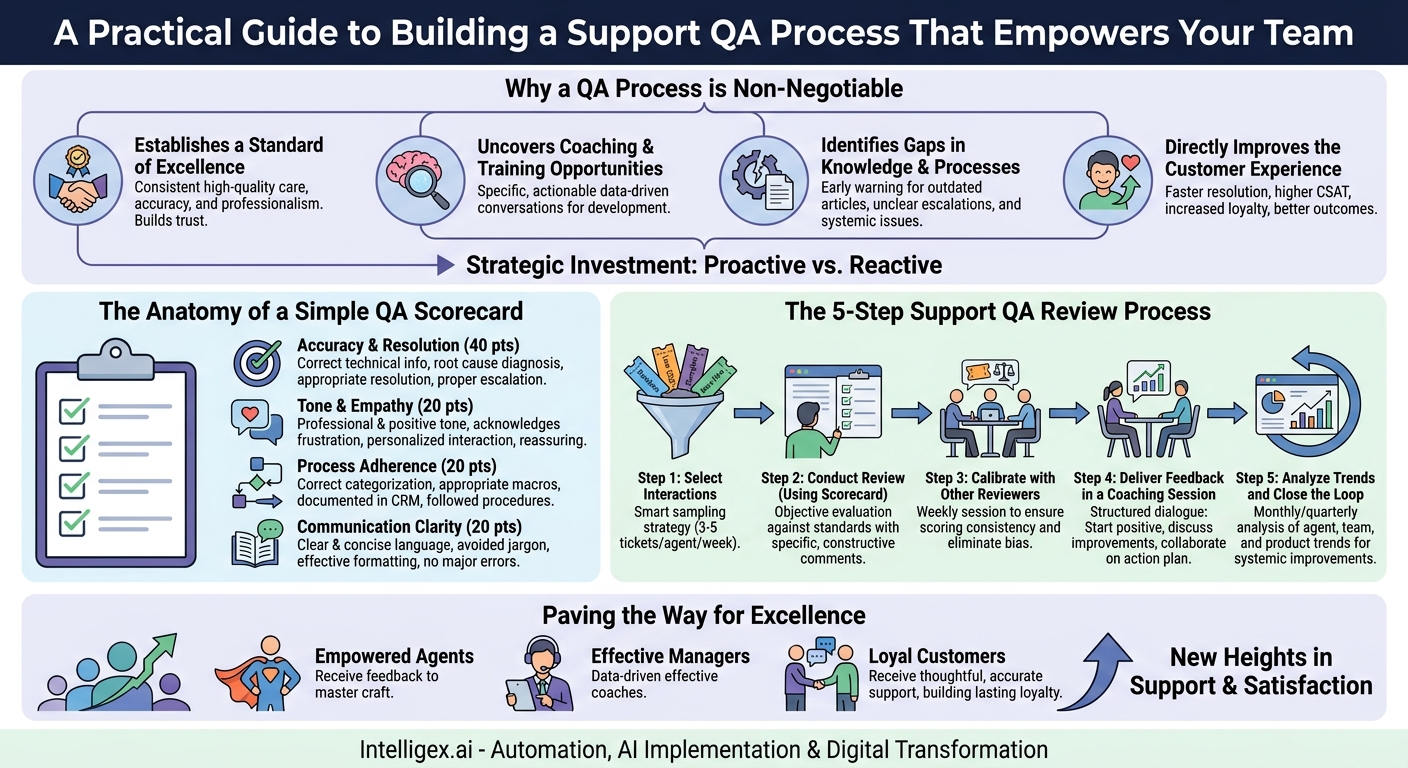
Before diving into the “how,” let’s solidify the “why.” Implementing a QA review process is a strategic investment in your team and your customers. It moves you from a reactive support model (putting out fires) to a proactive one (preventing them in the first place).
It Establishes a Standard of Excellence
What does “good support” actually mean at your company? Without a QA process, the answer can vary wildly from one agent to another. One might be incredibly empathetic but slow to resolve, while another is fast but terse. A QA scorecard defines your brand’s voice and service standards in concrete terms. It ensures that whether a customer interacts with Sarah on Monday or David on Friday, they receive a consistently high level of care, accuracy, and professionalism. This consistency builds trust and reinforces your brand identity.
It Uncovers Coaching and Training Opportunities
A QA review is one of the most powerful coaching tools at a manager’s disposal. Instead of generic feedback like “be more empathetic,” you can provide specific, actionable examples from a real ticket. You might uncover that multiple agents are struggling with a new feature, indicating a need for a team-wide training session. Or perhaps one agent needs help with their writing clarity. QA transforms feedback from a subjective opinion into a data-driven conversation focused on professional development and growth.
It Identifies Gaps in Your Knowledge Base and Processes
Often, when an agent gives incorrect information, the problem isn’t the agent—it’s the resources they’re using. QA reviews can act as an early warning system for internal issues. Are agents consistently giving the wrong answer about your refund policy? The problem might be an outdated article in your internal knowledge base. Are they failing to escalate tickets correctly? Your escalation process might be unclear or overly complicated. By analyzing trends from QA scores, you can identify and fix systemic problems that impact the entire team’s performance.
It Directly Improves the Customer Experience
This is the ultimate goal. Every improvement in agent performance, every clarified process, and every updated knowledge base article directly contributes to a better customer experience. When agents are more confident, knowledgeable, and aligned with company standards, customers get their issues resolved faster and more effectively. This leads to higher customer satisfaction (CSAT), improved loyalty, and better business outcomes.
The Anatomy of a Simple QA Scorecard
The heart of any QA process is the scorecard or rubric. This is the tool you’ll use to evaluate each interaction objectively. The key to a *simple* process is to start with a focused scorecard that covers the most critical aspects of an interaction. You can always add more complexity later. A great starting point is to focus on four core categories.
1. Accuracy & Resolution
This is the foundation. Did the agent solve the customer’s problem correctly? This category is typically binary (yes/no) and carries the most weight.
- Was the technical information provided accurate?
- Did the agent correctly diagnose the root cause of the issue?
- Was the final resolution appropriate and complete?
- If the issue couldn’t be solved, was it escalated correctly?
2. Tone & Empathy
This category measures how the interaction *felt* to the customer. It’s about the human connection.
- Did the agent use a professional, positive, and brand-aligned tone?
- Did they acknowledge the customer’s frustration or issue (show empathy)?
- Did they personalize the interaction (e.g., using the customer’s name)?
- Was the overall tone helpful and reassuring?
3. Process Adherence
This covers the internal mechanics of handling a ticket. Following these processes is crucial for efficiency, data integrity, and a seamless customer journey.
- Was the ticket categorized and tagged correctly?
- Did the agent use the appropriate macros or canned responses (if applicable)?
- Was the interaction documented properly in the CRM or helpdesk?
- Did the agent follow specific security or verification procedures?
4. Communication Clarity
A correct answer is useless if the customer can’t understand it. This category focuses on the quality of the writing or speech.
- Was the language clear, concise, and easy to follow?
- Did the agent avoid unnecessary jargon or overly technical terms?
- Was the formatting (e.g., paragraphs, bullet points, bolding) used effectively to improve readability?
- Were there significant spelling or grammar errors that undermined professionalism?
Pro-Tip: Assign a point value to each category. For example, Accuracy might be worth 40 points, while the other three are worth 20 points each, for a total of 100. This helps you weigh what’s most important to your organization.
The 5-Step Support QA Review Process
With your “why” established and your scorecard built, it’s time to put the process into action. Here is a simple, five-step workflow you can implement immediately.
Step 1: Select Interactions for Review
You can’t review every single ticket, so you need a smart selection strategy. The goal is to get a representative sample of an agent’s work. A good starting point is to review 3-5 tickets per agent, per week.
Don’t just pick the easy ones. A healthy mix is best:
- Random Selection: This provides an unbiased look at an agent’s typical performance.
- Tickets with Low CSAT: Reviewing interactions that received a negative customer rating is crucial for learning and service recovery.
–Complex Cases: Choose multi-touch, technically challenging tickets to see how an agent handles difficult situations.
–Tickets from New Hires: More frequent reviews for new team members can help accelerate their onboarding and identify knowledge gaps early.
Step 2: Conduct the Review Using the Scorecard
The reviewer—whether a manager, a peer, or a dedicated QA specialist—now sits down with the selected ticket and the scorecard. They read through the entire interaction from start to finish, evaluating it against each category in the rubric.
The key here is objectivity. The goal isn’t to ask, “Would I have written it this way?” but rather, “Did the agent meet the defined standard?” Beyond just scoring, the reviewer should leave specific, constructive comments. Instead of “Poor tone,” write “The opening felt a bit abrupt. Try starting with a more empathetic phrase like, ‘I’m sorry to hear you’re running into this issue.'” Similarly, celebrate wins: “Excellent job explaining that complex feature in simple terms!”
Step 3: Calibrate with Other Reviewers
This step is the secret sauce to a fair and effective QA program. If you have more than one person conducting reviews, you need to ensure they are all scoring consistently. Calibration is the process of getting everyone on the same page.
Once a week, have all reviewers score the *exact same ticket* independently. Then, bring everyone together to discuss their scores. Why did one person give a 95 while another gave an 85? They should talk through their reasoning for each category. This discussion helps refine everyone’s understanding of the scorecard and eliminates the bias that can make a QA process feel unfair to agents. Consistency builds trust in the system.
Step 4: Deliver Feedback in a Coaching Session
A QA score is just a number. Its true value is realized in the coaching conversation. Don’t just email an agent their score; schedule a brief 1-on-1 to discuss the reviews. This transforms QA from a judgment into a development tool.
Structure the conversation for success:
- Start with the Positive: Begin by highlighting what the agent did well. This reinforces good habits and makes them more receptive to constructive feedback.
- Discuss Areas for Improvement: Focus on one or two key opportunities for growth. Use specific examples from the reviewed tickets.
- Make it a Dialogue: Ask open-ended questions. “What was your thought process on this ticket?” or “What challenges are you facing with this type of issue?” This gives the agent a voice and provides valuable context.
- Collaborate on an Action Plan: End the conversation by agreeing on a small, concrete goal for the upcoming week. For example, “This week, let’s focus on double-checking the ticket tags before you hit ‘submit’.”
Step 5: Analyze Trends and Close the Loop
The final step is to zoom out. Don’t let your QA data gather dust. On a monthly or quarterly basis, analyze the aggregate data. What trends are you seeing?
- Agent Trends: Is one agent a superstar at de-escalation? Have them lead a lunch-and-learn session. Is another agent consistently struggling with a specific product area? Assign them targeted training.
- Team-Wide Trends: If 70% of your team is getting low scores on “Process Adherence” for a certain ticket type, the problem likely isn’t the team—it’s the process. Use this data to justify simplifying the workflow.
- Product/Policy Trends: Are you seeing a spike in tickets about a confusing new feature? Pass that feedback directly to the product team. This makes the support team a valuable source of business intelligence.
Paving the Way for Excellence
Implementing a support QA review process doesn’t require expensive software or a dedicated team of analysts from day one. It starts with a commitment to excellence and a simple, consistent framework. By defining what “good” looks like with a clear scorecard, reviewing work regularly, and using the findings to fuel constructive coaching conversations, you create a powerful engine for improvement.
This process empowers your agents with the feedback they need to master their craft. It gives managers the data they need to be effective coaches. And most importantly, it ensures your customers receive the thoughtful, accurate, and empathetic support that builds lasting loyalty. Start simple, stay consistent, and watch your entire support organization—and your customers’ satisfaction—reach new heights.
Your Next Read:
Category:
Get a FREE
Proof of Concept
& Consultation
No Cost, No Commitment!
