

In the world of customer support, consistency is the bedrock of trust. A customer might have a fantastic, five-star interaction with one of your agents on Monday, but if they call back on Wednesday and have a confusing, frustrating experience with another, that initial goodwill evaporates. The brand experience becomes a lottery, and nobody likes to gamble when they need help. So, how do you move from a support system of individual heroics and occasional fumbles to a cohesive team that delivers reliable, high-quality service every single time? The answer lies in a structured Quality Assurance (QA) review process.
For many, the term “QA” conjures images of micromanagement, nit-picking, and anxiety-inducing report cards. But when implemented correctly, a support QA process is the single most powerful tool you have for coaching, development, and team improvement. It’s not about catching people doing something wrong; it’s about creating a framework for doing things right, consistently. This guide will walk you through a simple, actionable version of a support QA review process that you can implement without needing complex software or a dedicated department. It’s about starting small, being consistent, and focusing on growth.
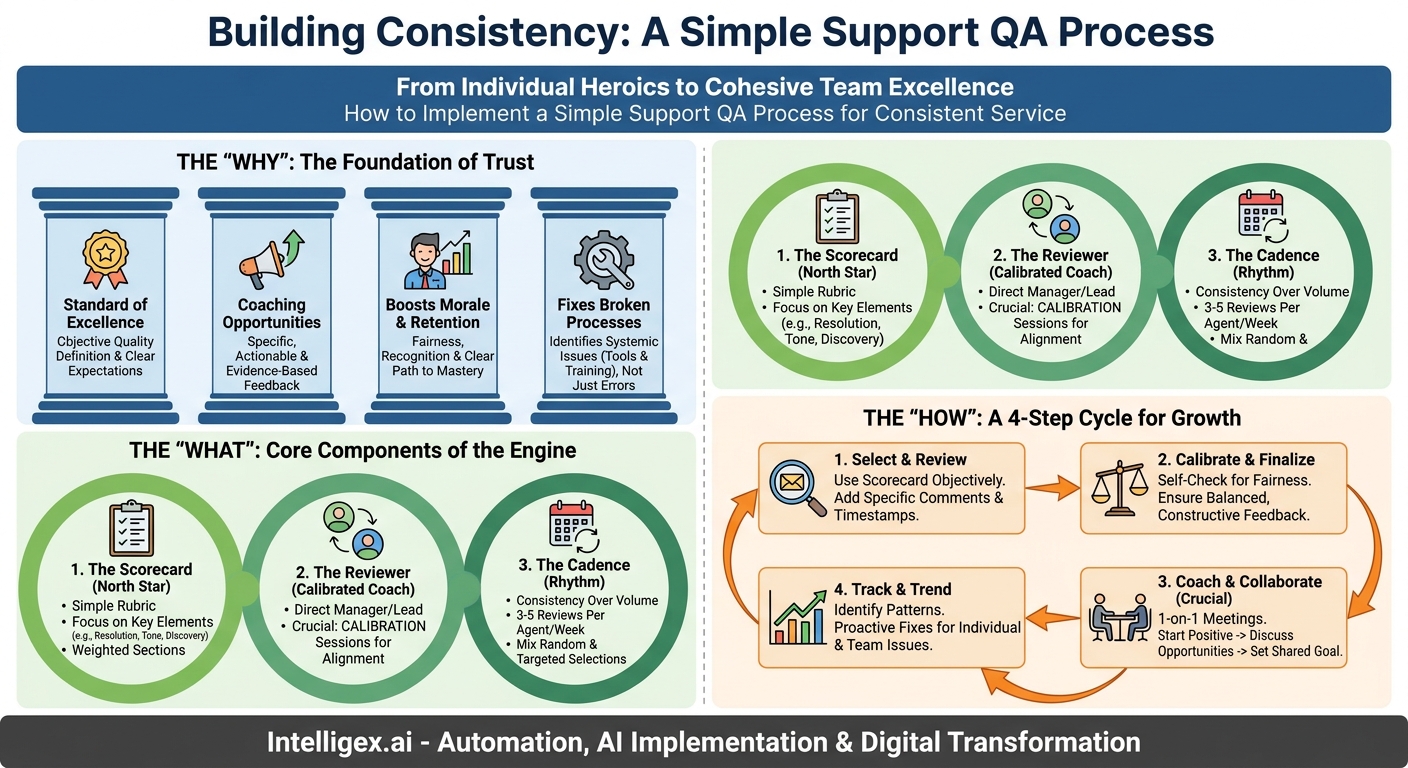
The ‘Why’: The Unbeatable Case for a QA Process
Before diving into the “how,” it’s crucial to understand and champion the “why.” If your team sees QA as just another administrative task, it will fail. If they see it as a genuine investment in their skills and a tool for making their jobs easier, it will become an integral part of your culture.
It Creates a Standard of Excellence
Without a defined quality standard, “good service” is subjective. One agent might think a quick, blunt answer is efficient, while another believes in taking the time to build rapport. A QA scorecard and process codifies what your organization defines as a great interaction. It sets clear, objective expectations for everyone on the team, removing guesswork and ensuring every customer receives a consistent level of care, empathy, and accuracy, regardless of who they speak to.
It Uncovers Powerful Coaching Opportunities
A manager telling an agent to “be more empathetic” is vague and unhelpful. A QA review that highlights a specific ticket and says, “Here, when the customer said they were frustrated, we jumped straight to the solution instead of acknowledging their feeling with a phrase like, ‘I can certainly understand why that’s frustrating,'”—that’s a concrete, actionable coaching moment. QA transforms generic feedback into targeted, evidence-based guidance that helps agents actually improve their skills.
It Boosts Agent Morale and Retention
This might seem counterintuitive, but a fair and transparent QA process is a powerful morale booster. Top performers appreciate being recognized for their excellent work. Agents who are struggling receive the specific support they need to succeed instead of feeling lost or unsupported. A great QA program signals to your team that you are invested in their professional development. It provides a clear path for advancement and mastery, which is a key driver of job satisfaction and retention in any role.
It Identifies Broken Processes, Not Just People
Sometimes, an agent provides an incorrect answer not because they are careless, but because the internal knowledge base is outdated. An agent might fail to follow a procedure because the tool they’re required to use is buggy and slow. A strong QA process acts as an early warning system for systemic issues. When you see multiple agents making the same mistake, the problem often isn’t the agents—it’s the process, the training, or the tools. QA gives you the data to fix the root cause, making everyone’s job easier and improving the customer experience at a foundational level.
The ‘What’: Core Components of a Simple QA Program
A simple QA program doesn’t need a dozen moving parts. It just needs three core, well-defined components to function effectively. Simplicity at this stage is key; you can always add complexity later as your program matures.
1. The Scorecard: Your North Star
The scorecard is the rubric you’ll use to evaluate each interaction. The goal is not to create an exhaustive, 50-point checklist that scrutinizes every keystroke. A simple, effective scorecard focuses on the handful of elements that truly define a quality interaction for your business.
Consider building your scorecard around a few key sections:
- Opening & Closing: Did the agent use the proper greeting? Did they set the tone for a positive interaction? At the end, did they confirm the issue was resolved and wrap up the conversation professionally?
- Discovery & Understanding: Did the agent ask clarifying questions to fully understand the customer’s problem? Did they actively listen and demonstrate they grasped the core issue before jumping to a solution?
- Solution & Resolution: Was the information provided accurate, relevant, and complete? Was the solution effective? If a resolution wasn’t possible on the first contact, were clear next steps and expectations set? This should be the most heavily weighted section.
- Tone & Empathy: Did the agent demonstrate empathy for the customer’s situation? Was their tone appropriate and professional? Did they build rapport and make the customer feel heard and valued?
- Process Adherence: Did the agent correctly categorize the ticket? Did they follow required security or verification procedures? Did they use internal tools as expected? This section ensures operational consistency.
Assign points to each section based on its importance. For example, Solution & Resolution might be worth 40 points, while Opening & Closing is only worth 10. This ensures that a minor slip-up on the greeting doesn’t tank the score of an otherwise perfect resolution.
2. The Reviewer: The Calibrated Coach
In a simple setup, the reviewer is typically the agent’s direct manager or team lead. This is ideal because they already have a coaching relationship with the agent. The most important quality of a reviewer is not a critical eye, but a calibrated one. Calibration is the process of ensuring all reviewers score interactions in the same way. An “excellent” rating from one manager should mean the same thing as an “excellent” rating from another.
To achieve this, hold regular calibration sessions. Have two or more reviewers score the same ticket independently, and then come together to discuss their scores. Where did they differ? Why? This conversation is vital for aligning on what “good” looks like and guarantees fairness and consistency across the team.
3. The Cadence: The Rhythm of Review
How many tickets should you review, and how often? Consistency is more important than volume. A good starting point for a simple program is to review 3 to 5 interactions per agent, per week. This provides enough data to identify trends without becoming an overwhelming administrative burden.
Your selection of tickets should be a mix. Include some randomly selected interactions to get a baseline, but also be strategic. You might want to review interactions that received a low Customer Satisfaction (CSAT) score, involved a particularly complex issue, or were handled by a new hire. This targeted approach helps you focus your coaching efforts where they’re needed most.
The ‘How’: A 4-Step Process for Review and Coaching
With the components in place, here is a simple, repeatable 4-step process for putting your QA program into action.
Step 1: Select & Review
Following your established cadence, select the tickets for each agent. As you review an interaction (whether it’s reading an email thread, a chat transcript, or listening to a call recording), use your scorecard as your guide. Be objective. The key is to move beyond gut feelings and score based on the defined criteria.
Crucially, add specific, constructive comments. “Poor tone” is not helpful feedback. “The agent used blunt, one-word answers, which could be perceived as dismissive. A better approach would be to use full sentences and a more reassuring tone, like ‘I can definitely help you with that,'” is excellent feedback. Always include timestamps or direct quotes to provide clear, undeniable examples.
Step 2: Calibrate & Finalize
Before you ever share a review with an agent, take a moment to self-calibrate. Read through your scoring and comments. Is it fair? Is it constructive? If you have another lead or manager available, ask them for a quick second opinion on one of your reviews. This brief gut-check ensures you’re delivering feedback that is balanced and helps build trust in the process.
Step 3: Coach & Collaborate (The Most Important Step)
A scorecard with a number on it is data. A coaching conversation turns that data into growth. Schedule a regular, dedicated time to go over QA reviews with your agents, typically during your one-on-one meetings. Do not just email them the score.
Frame these sessions as collaborative coaching, not a performance review. Follow this simple structure:
- Start with a positive. Begin by highlighting something the agent did exceptionally well in one of their reviews. This sets a constructive tone and reinforces good behavior.
- Discuss opportunities. Focus on one or two key areas for improvement. Don’t overwhelm them with a laundry list of every minor error. Use your specific examples. Ask open-ended questions like, “Walk me through your thought process here,” or “What do you think we could have done differently in this situation?” This encourages self-correction and critical thinking.
- Collaborate on a goal. Work together to set a small, achievable goal for the coming week. For example, “For this week, let’s focus on confirming the customer’s issue is fully resolved before ending every chat.” This creates a clear action item and a focus for their development.
Step 4: Track & Trend
Finally, don’t let your QA data sit in individual silos. Zoom out and look for trends over time. Is a specific agent consistently struggling with a particular part of the scorecard? That’s a sign they need more targeted training in that area. Is the *entire team* scoring poorly on a new product? That’s a sign your initial training or documentation was insufficient.
These trends are gold. They allow you to be proactive, updating your knowledge base, scheduling group training sessions, and fixing those systemic issues we talked about earlier. When you use QA data to make everyone’s job easier, the team’s buy-in to the process will skyrocket.
Implementing a support QA review process doesn’t have to be a monumental undertaking. By starting with a simple scorecard, a consistent cadence, and a deep focus on collaborative coaching, you can build a powerful engine for continuous improvement. The result isn’t just better metrics; it’s a more skilled, confident, and engaged team. And that team is what will turn your customer support from a functional department into a true competitive advantage, delivering the kind of consistently excellent service that builds lasting customer loyalty.
Your Next Read:
Category:
Get a FREE
Proof of Concept
& Consultation
No Cost, No Commitment!
