

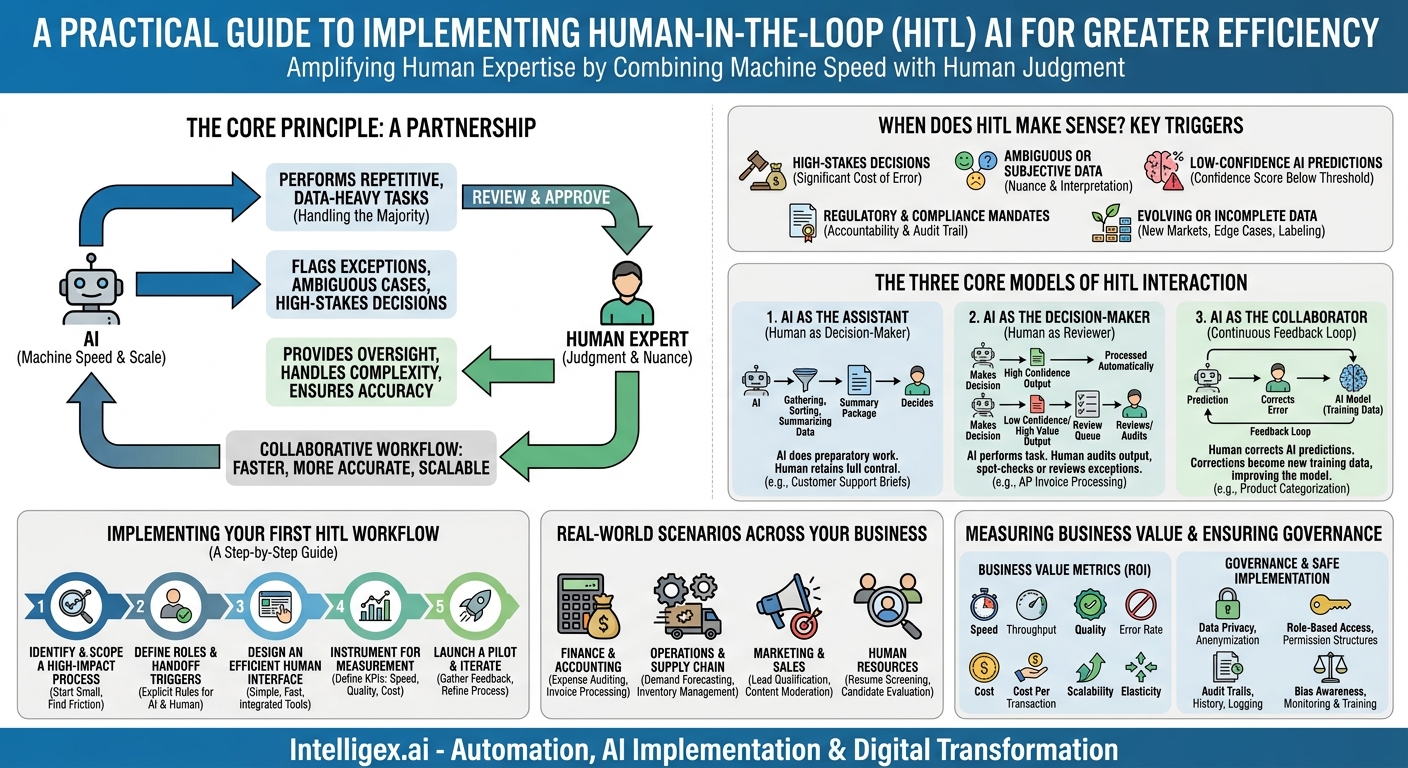
In the push to automate, it’s easy to imagine a future where artificial intelligence runs everything, a kind of “lights out” operation for business processes. But the reality is far more practical and powerful. The most effective AI integrations aren’t about replacing human expertise, they’re about amplifying it. This is the core principle behind Human-in-the-Loop (HITL), a strategy that combines machine speed and scale with human judgment and nuance.
An HITL system is a partnership. The AI performs the repetitive, data-heavy lifting, handling the vast majority of tasks with incredible speed. It then flags exceptions, ambiguous cases, or high-stakes decisions for a human expert to review. This collaborative approach creates a workflow that is faster, more accurate, and more scalable than either a human or an AI could achieve alone. It’s not about taking people out of the process, it’s about putting them in the right place to add the most value.
When Does HITL Make Sense? Key Triggers for Your Business
Not every workflow is a good candidate for HITL automation. Pushing for full automation where human oversight is critical can lead to costly errors, compliance issues, and poor customer experiences. Conversely, leaving humans to handle tasks that a machine could do in seconds is a waste of talent and resources. The key is to identify processes with the right characteristics.
An HITL approach is likely a strong fit if your workflow involves:
- High-Stakes Decisions: When the cost of an error is significant, you need human oversight. Think about approving a multi-million dollar loan, diagnosing a critical equipment failure from sensor data, or deactivating a major customer’s account. AI can provide a recommendation, but a human should make the final call.
- Ambiguous or Subjective Data: Machines excel at processing structured data, but they can struggle with nuance. Examples include interpreting sarcastic customer feedback, assessing the brand safety of user-generated content, or judging the creative quality of a marketing asset.
- Regulatory and Compliance Mandates: In many industries, like finance and healthcare, regulations require a human to be accountable for certain decisions. An HITL workflow builds this accountability directly into the process, creating an auditable trail of who reviewed and approved a decision.
- Low-Confidence AI Predictions: No AI model is 100% perfect. A well-designed system uses a confidence score to measure how certain the AI is about its output. When the score dips below a set threshold (for example, 95%), the task is automatically routed to a human for verification.
- Evolving or Incomplete Data: If you are entering a new market or launching a new product, you may not have enough historical data to train a fully autonomous AI. HITL allows you to get started immediately, using human experts to handle the edge cases while simultaneously generating the labeled data needed to improve the model over time.
For example, consider an insurance claims processing workflow. An AI can instantly process 90% of standard, low-value claims by extracting data from forms and photos. But it automatically flags a complex, high-value claim involving unusual circumstances for a senior claims adjuster. The adjuster’s time is freed up to focus on the cases that truly require their expertise, leading to faster payouts for most customers and more careful scrutiny where it matters most.
The Three Core Models of HITL Interaction
Human-in-the-Loop isn’t a single, one-size-fits-all concept. It can be implemented in several ways depending on the specific needs of your workflow. Understanding these models helps you design a system that fits your operational goals, risk tolerance, and team structure.
1. AI as the Assistant (Human as the Decision-Maker)
In this model, the AI does all the preparatory work. It gathers information, sorts data, extracts key details, and presents a summarized, easy-to-digest package to a human. The human retains full control over the final decision. This is often called a “human-gated” process.
Business Scenario: A customer support agent receives a complex technical ticket. Before the agent even opens it, an AI has already scanned the customer’s entire support history, pulled up relevant technical documentation, and summarized the current issue. The agent gets a complete brief, allowing them to resolve the problem in minutes instead of spending that time on research.
2. AI as the Decision-Maker (Human as the Reviewer)
Here, the roles are reversed. The AI performs the task and makes a decision autonomously. A human then reviews or audits the AI’s output, either for every transaction or on a spot-check basis. This model is ideal for high-volume processes where the AI is generally accurate, but you need a layer of quality control.
Business Scenario: An accounts payable department uses AI to process thousands of invoices. The AI uses Optical Character Recognition (OCR) to extract the vendor, date, amount, and line items, and then matches them to a purchase order. The system automatically processes payments for invoices under $1,000 with a confidence score above 98%. All invoices over that amount, or any with a lower confidence score, are placed in a queue for an AP clerk to quickly verify before payment is released.
3. AI as the Collaborator (A Continuous Feedback Loop)
This is the most dynamic model and the foundation of active learning. The AI makes a prediction, and the human expert corrects it when it’s wrong. Crucially, every correction is fed back into the system as new training data. The AI learns from the human expert, becoming more accurate and autonomous over time.
Business Scenario: An e-commerce company uses an AI to categorize millions of products from third-party sellers. When the AI incorrectly assigns a new type of wireless earbud to the “Computer Accessories” category, a human merchandiser corrects it to “Audio Equipment > Headphones.” This correction not only fixes the immediate error but also teaches the model to better classify similar products in the future, reducing the need for manual intervention down the line.
A Step-by-Step Guide to Implementing Your First HITL Workflow
Moving from theory to practice requires a structured approach. Launching a successful HITL project isn’t just a technical challenge, it’s a process change. Following a clear plan ensures you solve the right problem and deliver measurable business value.
- Identify and Scope a High-Impact Process. Don’t try to overhaul your entire department at once. Start with a single, well-defined workflow that is repetitive, high-volume, and a known bottleneck. Good candidates often live in areas like data entry, document classification, or initial lead screening. Map the current process and pinpoint exactly where the friction occurs.
- Define the Roles and Handoff Triggers. Be explicit about what the machine does and what the human does. What is the specific task for the AI? (e.g., “Extract the PO number from an invoice.”) What is the specific task for the human? (e.g., “Verify the extracted PO number if the AI’s confidence is below 95%.”) These triggers are the rules of the road that govern the collaboration.
- Design an Efficient Human Interface. This is the most critical and often overlooked step. The tool your team uses to review the AI’s work must be simple, fast, and intuitive. A clunky interface will negate any efficiency gains from the AI. The goal is to make the human review a quick “confirm” or “correct” action, not a complex investigation. Ideally, this interface should be integrated directly into the systems your team already uses, like your CRM or ERP. For example, a task queue with “Approve” and “Reject” buttons inside Salesforce is far more effective than asking a sales rep to log into a separate AI platform.
- Instrument for Measurement. Before you launch, define your key performance indicators (KPIs). You cannot improve what you do not measure. This allows you to build a business case and demonstrate ROI. I’ll cover specific metrics in more detail below, but you should track things like processing time per item, error rates, and overall throughput.
- Launch a Pilot and Iterate. Roll out the new HITL workflow to a small group of power users first. They can provide invaluable feedback on the interface, the AI’s accuracy, and the handoff triggers. Use their experience to refine the process before a full-scale deployment. Treat it as a product, continuously gathering feedback and making improvements.
Real-World HITL Scenarios Across Your Business
The power of Human-in-the-Loop is that it can be applied to almost any department. By handling the bulk of repetitive work, HITL systems free up your teams to focus on strategy, customer relationships, and complex problem-solving.
Finance and Accounting
Finance teams are often buried in manual document processing. An HITL workflow for expense report auditing can use AI to automatically check receipts against company policy, flagging only out-of-policy or high-value reports for a human auditor to review. This dramatically speeds up reimbursement times and ensures compliance without requiring an auditor to look at every single coffee receipt.
Operations and Supply Chain
Predicting demand and managing inventory is a constant challenge. An AI can analyze sales data, weather patterns, and economic indicators to generate a demand forecast. A human planner then reviews this forecast, using their industry knowledge and awareness of upcoming promotions or market shifts to adjust the final numbers before placing orders. This combines data-driven precision with real-world expertise.
Marketing and Sales
Your sales team’s time is valuable. Instead of having them manually sift through hundreds of inbound leads, an AI can score and qualify them based on firmographics, website behavior, and engagement. The top 10% of “hot” leads are routed directly to sales development reps for immediate, personalized follow-up, while the rest are placed in an automated nurturing campaign. The human touch is reserved for the most promising opportunities.
Human Resources
Screening hundreds of resumes for a single position is time-consuming. An AI can perform the initial screen, checking for mandatory qualifications, skills, and experience. This produces a qualified shortlist, which is then passed to a human recruiter. The recruiter can then focus their time on what truly matters: evaluating soft skills, cultural fit, and candidate potential through interviews and conversations.
Measuring the Business Value of Your HITL System
To justify and expand your HITL initiatives, you must be able to demonstrate a clear return on investment. The benefits typically fall into four key categories, and each can be measured with specific metrics.
- Speed and Efficiency: This is often the most immediate benefit. Measure the average handling time for a single work item (e.g., one invoice, one support ticket) before and after implementation. You should also track overall throughput, or the total number of items your team can process in a day or week.
- Quality and Accuracy: Automation without accuracy is useless. Track the error rate of the process. For example, what percentage of leads were incorrectly qualified? What was the rate of inaccurate data entry in your financial system? HITL should significantly reduce these errors by catching them before they cause downstream problems.
- Cost Reduction: This is a direct result of improved speed and quality. Calculate the cost per transaction. By reducing the human hours required for each item and eliminating the costs associated with rework and fixing errors, you can achieve substantial operational savings.
- Scalability: An HITL workflow allows your team to handle significant fluctuations in volume without needing to hire temporary staff. You can process 10,000 items with nearly the same team and quality as 1,000. This operational elasticity is a major competitive advantage, especially in seasonal or high-growth businesses.
Governance and Safe Implementation: A Critical Foundation
Integrating AI into your workflows introduces new considerations for security and governance. An HITL system is not just about technology, it’s about creating a trusted, reliable, and secure business process. Ignoring this foundation can expose your company to significant risk.
Data Privacy and Security: When working with customer data or other sensitive information, ensure your process is secure from end to end. If you are using third-party AI models, you must understand their data handling policies. A best practice is to anonymize or mask all Personally Identifiable Information (PII) before it is sent to the model for processing.
Role-Based Access Control: The human reviewers in your loop should only have access to the information they absolutely need to do their job. Your HITL interface must respect the existing access controls and permission structures within your organization. A junior analyst, for example, should not be able to review or approve the same transactions as a department head.
Comprehensive Audit Trails: Every action taken within the HITL system must be logged. The system should record what decision the AI made, who reviewed it, what action the human took (e.g., approved, corrected, rejected), and a timestamp for every step. This audit trail is essential for regulatory compliance, accountability, and troubleshooting any issues that arise.
Bias Awareness and Mitigation: Both AI models and human reviewers can be sources of bias. It is crucial to monitor the outcomes of your HITL system to ensure it is not producing unfair or inequitable results. This requires ongoing analysis and regular training for the humans in the loop to be aware of potential unconscious biases. For more on this, major technology leaders provide frameworks and guidance, such as Microsoft’s Responsible AI principles.
Your Next Steps: Putting Human-in-the-Loop into Action
Human-in-the-Loop is more than just a technology, it’s a strategic approach to automation. It recognizes that the goal is not to eliminate humans, but to elevate their work by pairing them with powerful AI tools. By automating the mundane, you free up your team’s cognitive resources for critical thinking, creativity, and strategic decision-making.
Getting started doesn’t require a massive, company-wide transformation. The most successful implementations begin with a focused effort to solve a specific, tangible problem. Here is a simple action plan:
- Find the Friction: Sit down with one of your teams and identify a single process that is slow, error-prone, or just plain tedious. Where is the bottleneck?
- Ask the 80/20 Question: For that process, could a machine reliably handle 80% of the cases, leaving only the most complex or ambiguous 20% for a person?
- Start the Conversation: Begin a discussion with your team and a knowledgeable integration partner about what a small-scale pilot project would look like. Focus on delivering measurable value quickly.
By taking a practical, step-by-step approach, you can build a system that makes your processes faster, your outcomes more accurate, and your employees more effective. You can build a workflow where humans and machines truly work together, each playing to their own strengths.
Your Next Read:
Category:
Get a FREE
Proof of Concept
& Consultation
No Cost, No Commitment!