

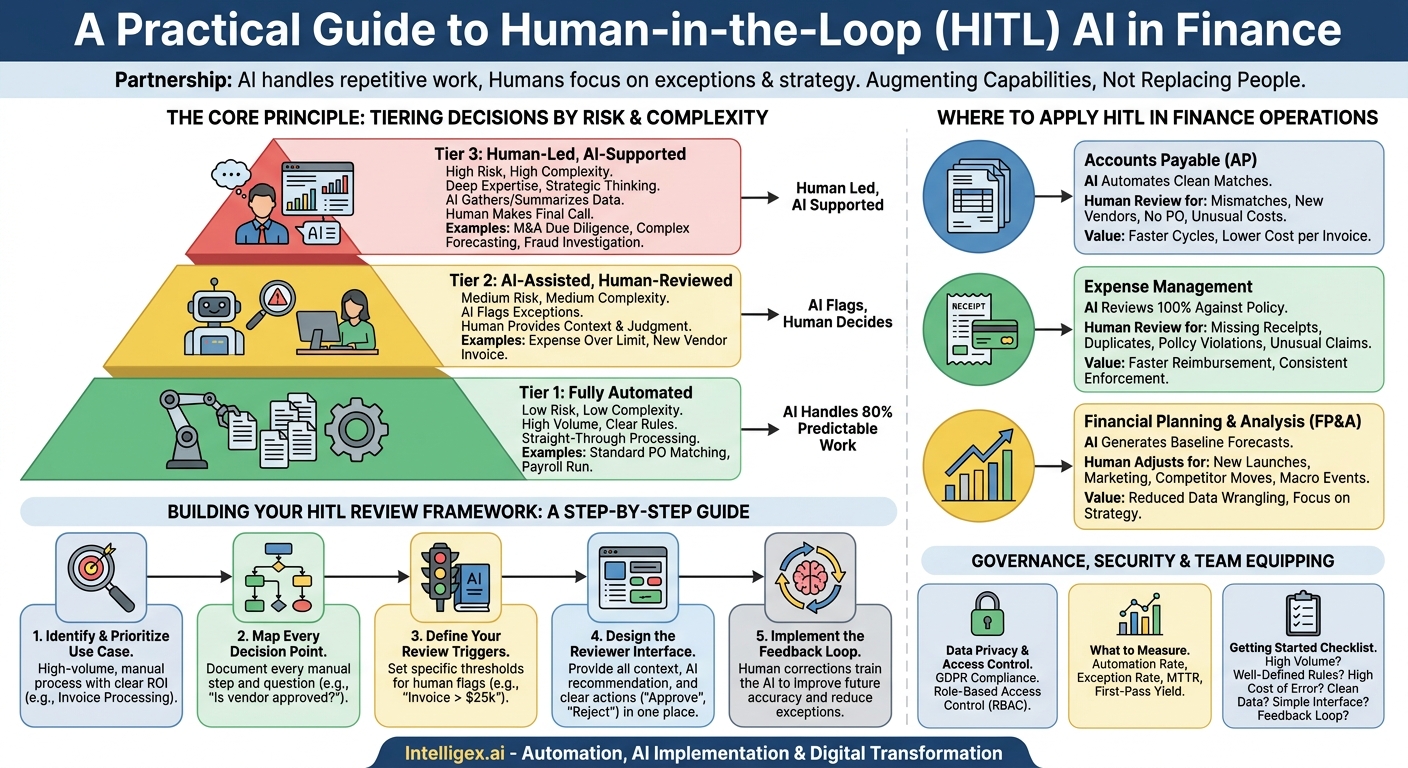
Artificial intelligence in finance is no longer about futuristic algorithms making every decision. The most practical and valuable applications today combine the speed of machines with the judgment of human experts. This approach, known as Human-in-the-Loop (HITL), creates a powerful partnership where AI handles the repetitive, high-volume work, and your team focuses on the exceptions, complex cases, and strategic decisions that truly matter. It’s not about replacing people; it’s about augmenting their capabilities.
An HITL system is essentially a business process designed to flag specific transactions or data points for human review based on a set of predefined rules. The goal is to automate the predictable 80% of the work so your finance professionals can dedicate their expertise to the challenging 20%. This improves speed, reduces costs by optimizing labor, and enhances quality by catching errors that pure automation might miss. The key is knowing exactly what to review, when to review it, and why.
The Core Principle: Tiering Decisions by Risk and Complexity
Not all financial transactions are created equal. The foundation of a successful HITL strategy is to stop treating them as if they are. Instead of a one-size-fits-all review process, you should segment workflows based on their inherent risk and complexity. This ensures that your most valuable resource, your team’s time, is allocated to the areas where it has the greatest impact.
Think of your financial processes in three distinct tiers:
- Tier 1: Fully Automated (Low Risk, Low Complexity). These are the straightforward, high-volume tasks that follow clear rules. Examples include matching a purchase order to an invoice with no discrepancies, processing a standard payroll run, or reconciling a low-value bank account. The cost of an error is low, and the rules for success are unambiguous. These tasks are prime candidates for straight-through processing with no human touch required.
- Tier 2: AI-Assisted, Human-Reviewed (Medium Risk, Medium Complexity). This is the heartland of HITL. Here, the AI does the initial heavy lifting but flags exceptions for human verification. An example is an expense report where an employee has claimed a meal slightly over the policy limit. The AI can flag it, present the policy details, and allow a manager to approve or deny with a single click. The machine provides context; the human makes the judgment call.
- Tier 3: Human-Led, AI-Supported (High Risk, High Complexity). These are tasks that require deep domain expertise, strategic thinking, and qualitative judgment. Examples include M&A due diligence, building a complex five-year financial forecast, or investigating a sophisticated fraud alert. Here, AI acts as a powerful assistant, gathering and summarizing vast amounts of data, identifying patterns, and running simulations. But the final analysis, narrative, and strategic recommendation come from your human experts.
By categorizing work this way, you create a system that is both efficient and robust. You gain the scalability of automation for the bulk of your transactions while retaining precise human oversight for the decisions that can make or break your business.
Where to Apply HITL in Your Finance Operations
The principles of HITL can be applied across virtually every function within the finance department. The key is to identify processes burdened by manual checks and repetitive, rules-based decisions. Here are some concrete examples of where HITL delivers immediate business value.
Accounts Payable (AP)
AP is often the first and best place to start. A typical AP team spends an enormous amount of time manually matching invoices to purchase orders and receipts. An HITL workflow automates this entirely for clean matches. Human review is only triggered when specific conditions are met, such as:
- An invoice amount that doesn’t match the purchase order by more than a set percentage.
- An invoice from a new vendor not yet in the master file.
- An invoice that lacks a valid PO number.
- Unusually high line-item costs compared to historical averages.
Business Value: This dramatically accelerates payment cycles, reduces the cost per invoice processed, and allows AP specialists to focus on valuable activities like vendor relationship management and early payment discount capture.
Expense Management
Reviewing every employee expense report is a time-consuming task for managers. AI can review 100% of expense reports against company policy in seconds. It flags only the exceptions for review, presenting the manager with a clear summary of the issue. Triggers could include:
- Expenses submitted without a receipt above a certain threshold.
- Duplicate submissions for the same expense.
- Flights or hotels booked outside the approved corporate travel tool.
- Claims in categories that are unusual for that employee’s role (e.g., a software developer expensing industrial equipment).
Business Value: This speeds up reimbursement for employees, ensures consistent policy enforcement, and frees up managers’ time while providing the business with better visibility into T&E spending.
Financial Planning & Analysis (FP&A)
Forecasting often involves manually pulling data from multiple systems and running repetitive calculations in spreadsheets. AI can automate the generation of a baseline forecast using historical data and recognized seasonality. The FP&A analyst is then presented with this baseline, and their job shifts to a more strategic role. They use their business knowledge to adjust the forecast based on factors the AI doesn’t know, such as:
- A planned new product launch.
- An upcoming marketing campaign.
- Intelligence about a competitor’s moves.
- Changes in the macroeconomic environment.
Business Value: This reduces the time spent on data wrangling by over 70-80% in many cases, allowing analysts to focus on scenario planning, strategic analysis, and providing better guidance to business leaders.
Building Your HITL Review Framework: A Step-by-Step Guide
Implementing an HITL system isn’t just about plugging in a new piece of software. It requires a thoughtful approach to process design. By following a structured framework, you can ensure your system is effective, scalable, and embraced by your team.
- Identify and Prioritize a Use Case. Don’t try to automate everything at once. Start with a single process that is high-volume, highly manual, and has well-understood rules. Invoice processing in AP is a classic starting point because the ROI is often clear and quick to measure.
- Map Every Decision Point. Take your chosen process and document every single step and decision that a person makes today. For an invoice, this includes questions like: “Is there a PO?”, “Does the line-item match?”, “Is the vendor approved?”, “Is the total amount reasonable?”. This map becomes the blueprint for your automation rules.
- Define Your Review Triggers. For each decision point, define the exact conditions that will route an item for human review. Be specific. Instead of “flag large invoices,” define it as “flag all invoices over $25,000” or “flag invoices that are 10% greater than their associated PO.” These thresholds are your control levers for balancing automation with oversight.
- Design the Reviewer’s Interface. This is a critical step. The person reviewing exceptions needs all relevant information in one place to make a fast, accurate decision. The interface should clearly show what the AI flagged, its recommended action (if any), and snippets of the source documents. The goal is to eliminate the need for the reviewer to switch between multiple systems to find information. Provide simple, clear action buttons like “Approve,” “Reject,” or “Send to Senior Accountant.”
- Implement the Feedback Loop. This is what makes an HITL system truly intelligent. When a human corrects the AI’s initial assessment, that correction must be fed back into the system. For example, if the AI incorrectly categorized an invoice and a human fixes it, that data point helps train the AI model to be more accurate in the future. This continuous improvement cycle reduces the exception rate over time, leading to even greater efficiency.
This systematic approach turns a complex project into a series of manageable steps, ensuring you build a system that solves a real business problem and delivers measurable value.
The Human Side of the Loop: Equipping Your Team for Success
Technology is only half of the equation. A successful HITL implementation requires a shift in how your team works and the skills they use. Ignoring the human element is the most common reason these projects fail to deliver on their promise.
The role of a finance professional in an HITL environment evolves from a data processor to a data validator and problem solver. They are no longer performing manual data entry; they are managing the exceptions and teaching the AI. This requires a greater degree of analytical thinking and domain expertise. To support this transition, you must focus on training and clear performance metrics.
What to Measure
To understand the impact of your HITL system and guide your team, you need to track the right metrics. Move beyond simple volume counts and focus on a balanced scorecard that reflects efficiency, quality, and continuous improvement.
- Automation Rate: The percentage of total transactions processed without any human intervention. This is your primary measure of efficiency.
- Exception Rate: The percentage of transactions flagged for human review. Your goal is for this to decrease over time as the feedback loop improves the AI’s accuracy.
- Mean Time to Resolution (MTTR): The average time it takes for a human reviewer to resolve a flagged exception. This measures the efficiency of your review process and the usability of your review interface.
- First-Pass Yield: The percentage of reviewed items that are resolved correctly without needing to be re-routed or escalated. This is a key measure of quality and reviewer proficiency.
By focusing on these metrics, you can clearly demonstrate the business value of your HITL system in terms of cost savings, speed, and quality, while also identifying areas where your team may need additional training or support.
A Practical Checklist for Getting Started
Before diving into a full-scale implementation, run your potential use case through this quick checklist. If you can answer “yes” to most of these questions, you have a strong candidate for an HITL project.
- Is the task high-volume and largely repetitive? HITL delivers the best return on investment where automation can handle significant scale.
- Are the rules for a “correct” outcome well-defined? The AI needs clear, objective criteria to separate good transactions from potential exceptions.
- Is the business cost of an error high enough to justify human oversight? If an error has a negligible impact, full automation might be better. HITL shines where accuracy is critical.
- Do we have access to clean, structured historical data? The AI model needs good data to learn the patterns of your business.
- Can we design a simple, intuitive interface for human reviewers? If the review process is clunky and slow, you will lose many of the efficiency gains.
- Is there a commitment to using human feedback to improve the model over time? A system that doesn’t learn is just a rigid rules engine. The feedback loop is essential for long-term value.
Governance and Security in HITL Systems
When implementing any system that touches sensitive financial data, governance and security must be a primary concern, not an afterthought. An HITL system, by its nature, creates a new set of data flows and access points that need to be managed carefully to maintain compliance and protect against risk.
Data Privacy: Financial data often contains personally identifiable information (PII). Your system must be designed to comply with regulations like the EU’s General Data Protection Regulation (GDPR). This means ensuring data is handled securely, used only for its intended purpose, and that access is strictly controlled.
Access Control: Not everyone on the finance team should be able to review all types of transactions. Implement strict Role-Based Access Control (RBAC) to ensure that employees can only view and act upon the data necessary for their specific job function. For example, a junior AP clerk might only be able to review invoices up to $5,000, while a manager is required for larger amounts. Major cloud platforms like Amazon Web Services provide extensive documentation on how to properly implement these controls.
Audit Trails: Every action within the HITL system must be logged immutably. The audit trail should capture what the AI did, which transaction it flagged, what data was presented to the human reviewer, who the reviewer was, what decision they made, and the exact timestamp. This detailed logging is non-negotiable for internal audits, regulatory compliance, and troubleshooting any issues that may arise.
Building these controls into the system from day one protects your organization, builds trust with your team, and ensures the long-term viability of your automation efforts.
Your Next Steps to an Intelligent Finance Function
Implementing a Human-in-the-Loop system is a journey toward a more efficient, accurate, and strategic finance organization. It’s not about a single “big bang” project, but rather an incremental process of continuous improvement.
To get started, focus on taking small, deliberate steps:
- Start with One Problem. Resist the temptation to automate the entire finance department. Pick one process, like invoice approvals or expense report auditing, where the pain points are well-understood and the potential gains are clear.
- Build a Cross-Functional Team. Bring together stakeholders from Finance, IT, and the relevant business operations. This collaboration is essential to ensure the solution meets the real-world needs of the users and is technically sound.
- Focus on the Business Process First. Before you evaluate any technology, make sure you have thoroughly mapped and understood your existing process. The goal is to improve the process, and technology is simply the enabler.
- Define Success Before You Begin. Establish the key metrics you want to improve, such as “reduce invoice processing time by 40%” or “increase the policy compliance rate on expense reports to 99%.” Having clear goals will keep the project focused and make it easy to demonstrate its value to the rest of the organization.
By starting small, measuring your results, and building momentum, you can systematically transform your finance operations. You can move your team away from repetitive, low-value work and empower them to become the strategic business partners your organization needs them to be.
Your Next Read:
Category:
Get a FREE
Proof of Concept
& Consultation
No Cost, No Commitment!