

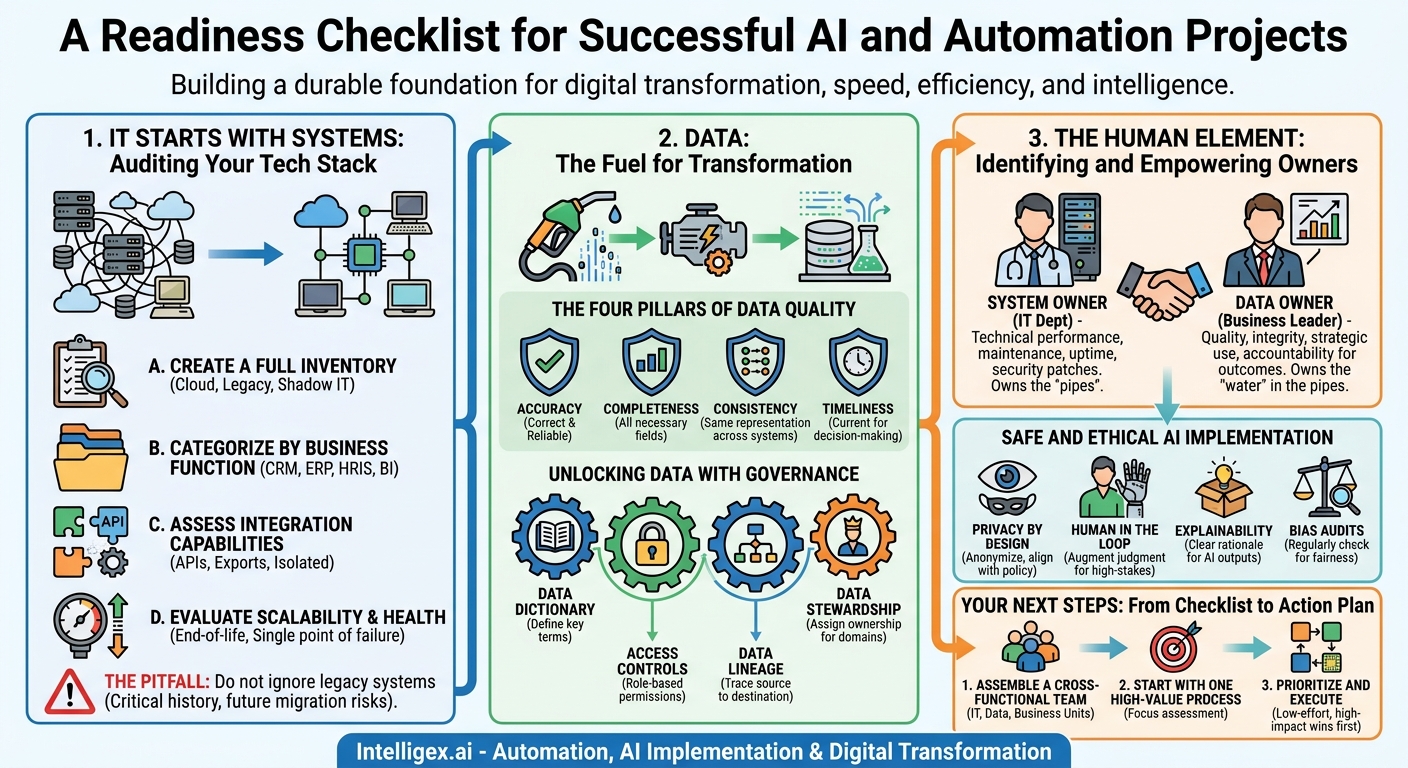
Digital transformation is no longer a distant goal. It is a present-day imperative for survival and growth. Yet, many initiatives stall or fail, not because of a flawed vision, but because of a flawed foundation. Before you can harness the power of AI, automate workflows, or unlock predictive insights, you must first ensure your organization is truly ready. Jumping into a major technology project without this groundwork is like building a skyscraper on sand. It is expensive, slow, and destined to collapse.
This is not about chasing trends. It is about building a durable capability to adapt and win. True readiness is found in the deliberate assessment and alignment of three core pillars: your systems, your data, and the people who own them. By methodically addressing each area, you can move from ambition to execution, transforming your operations with confidence and unlocking tangible business value in speed, efficiency, and intelligence.
It Starts with Systems: Auditing Your Technology Stack
You cannot integrate what you cannot see. The first step toward transformation is achieving a clear, honest, and comprehensive view of your current technology landscape. Many organizations operate with a tangled web of modern cloud applications, legacy on-premise software, and undocumented “shadow IT” tools adopted by individual teams. An exhaustive audit is non-negotiable. It provides the map you need to navigate any future integration project.
This audit is not just a technical exercise for the IT department. It is a strategic business activity. Understanding your systems reveals bottlenecks slowing down your finance team, data silos preventing your marketing team from personalizing campaigns, and redundant software subscriptions inflating your operational costs. The goal is to create a single source of truth for your technology stack, which is the bedrock for any successful automation or AI initiative.
A Practical Process for a System Audit
Follow these steps to build a comprehensive inventory and assessment of your systems:
- Create a Full Inventory: List every piece of software and every platform your business uses. This includes the obvious, like your CRM and ERP, and the less obvious, like departmental project management tools or data visualization software. Engage with department heads to uncover tools that IT may not formally manage.
- Categorize by Business Function: Group each system by the job it performs. For example: Customer Relationship Management (CRM), Enterprise Resource Planning (ERP), Human Resources Information System (HRIS), Supply Chain Management (SCM), Marketing Automation, and Business Intelligence (BI).
- Assess Integration Capabilities: For each system, document how it currently connects to others. Does it have a modern, well-documented API? Does it rely on manual CSV file exports and imports? Or is it a completely isolated island? This analysis highlights your biggest integration challenges and opportunities for improved speed and data visibility.
- Evaluate Scalability and Health: Identify any systems that are nearing end-of-life, are poorly supported, or represent a single point of failure. Ask the tough questions. If your order volume doubled tomorrow, could your inventory management system handle it? A system that cannot scale will cap your business growth.
The Pitfall to Avoid: Do not ignore your legacy systems. That 20-year-old database might seem like a relic, but it often contains decades of critical customer or financial history. Understanding its limitations is essential for planning a successful migration or integration strategy, preventing costly project delays and data loss.
Data: The Fuel for Transformation
If your systems are the engine, your data is the fuel. And just like an engine, feeding it low-quality fuel leads to poor performance, breakdowns, and expensive repairs. The promise of AI and advanced analytics hinges entirely on the quality of the data you provide. A predictive model trained on inaccurate or incomplete sales data will produce flawed forecasts, leading to poor inventory decisions and lost revenue. Before you can leverage data, you must first trust it.
Achieving trustworthy data requires a focus on four fundamental pillars of quality. Improving these directly translates to better business outcomes: higher quality insights, more reliable reporting, and increased operational speed because teams are not constantly second-guessing the numbers.
The Four Pillars of Data Quality
- Accuracy: Is the information correct and reliable? For an operations team, this means shipping addresses in your order system must match real-world locations to avoid costly delivery failures.
- Completeness: Are all the necessary data fields filled in? A sales team cannot effectively segment customers if the “industry” or “company size” fields in their CRM are mostly blank.
- Consistency: Is data represented in the same way across different systems? If your sales CRM lists a client as “Intelligex, Inc.” while your finance system lists them as “Intelligex,” you cannot create a single, unified view of that customer’s history and value. This lack of visibility complicates everything from billing to support.
- Timeliness: Is the data current enough to be useful for decision-making? A supply chain manager needs real-time inventory data to make effective purchasing decisions, not a report from last week.
What to Measure: Start tracking simple metrics to baseline your data quality. Measure the percentage of complete records in critical tables (e.g., customer contacts with valid phone numbers). Track the error rate discovered during manual data validation processes. Monitor the latency between an event happening and the data being available in your analytics platform. These metrics make an abstract concept like “data quality” tangible and measurable.
Unlocking Data with a Clear Governance Framework
Having high-quality data is one thing; managing it effectively at scale is another. This is where data governance comes in. It is not about creating bureaucracy. It is about creating clarity, trust, and security. A solid governance framework ensures everyone in the organization understands what the data means, who is allowed to use it, and who is responsible for keeping it healthy. This structure is essential for scaling operations and for complying with regulations like GDPR.
Without governance, you get data chaos. Multiple departments produce reports with conflicting numbers, nobody can trace a metric back to its source, and sensitive information is exposed to unnecessary risk. Good governance accelerates your transformation by providing a trusted, secure foundation for all data-driven activities, from simple dashboards to complex AI models.
Key Components of a Governance Framework
Your framework does not need to be overly complex, but it should include these core elements:
- Data Dictionary: This is a central, living document that defines your key business terms. What, precisely, constitutes an “Active Customer” or “Gross Margin”? Defining these terms eliminates ambiguity and ensures that when a sales leader and a finance leader discuss revenue, they are talking about the same thing.
- Access Controls: Implement clear, role-based permissions for who can view, create, edit, and delete data. An HR analyst needs access to employee salary data, but a marketing coordinator does not. Proper access controls are fundamental to data security and privacy.
- Data Lineage: You must be able to trace data from its source to its final destination in a report or application. When a number in a financial report looks wrong, data lineage allows you to quickly debug the issue by following its path through various transformations and systems. This builds immense trust in your analytics.
- Data Stewardship: Assign clear ownership for different data domains. The Head of Sales, for example, is the natural steward for “customer” and “opportunity” data. This person is accountable for its quality and proper use, not the IT department.
The Human Element: Identifying and Empowering Owners
Technology and data are only tools. Their value is unlocked by people. For any transformation to succeed, accountability must be crystal clear. Every critical system and every important data set needs a designated owner, a specific person who is responsible for its health and effective use. This simple act of assigning ownership eliminates confusion, prevents finger-pointing, and dramatically speeds up problem-solving.
System Owners vs. Data Owners
It is crucial to distinguish between these two vital roles, as they are often confused.
A System Owner is typically in the IT department. Their responsibility is the technical performance and maintenance of a specific application. For example, the System Owner for your company’s Salesforce instance is responsible for uptime, managing user licenses, applying security patches, and ensuring the platform runs smoothly. They own the “pipes.”
A Data Owner, on the other hand, is a business leader. Their responsibility is the quality, integrity, and strategic use of the data *within* a system. The VP of Sales is the Data Owner for the customer and pipeline data inside Salesforce. They define what constitutes a qualified lead, ensure sales reps are entering data correctly, and are ultimately accountable for the accuracy of the sales forecast generated from that data. They own the “water” flowing through the pipes.
When a sales report is wrong, this distinction is critical. Is it wrong because the system is down (a System Owner issue) or because the underlying data was entered incorrectly (a Data Owner issue)? Clear ownership means you know exactly who to call, leading to faster resolution and higher quality outcomes.
A Note on Safe and Ethical AI Implementation
As you prepare for transformation, it is likely that incorporating artificial intelligence is part of your roadmap. AI introduces immense opportunities, but it also brings new responsibilities. A readiness checklist must include preparing for the safe and ethical deployment of these powerful technologies. Treating this as an afterthought is a recipe for reputational damage, regulatory fines, and failed projects.
Key Considerations for Safe AI
Build these principles into your planning from day one:
- Privacy by Design: Do not wait to bolt on privacy features at the end. Anonymize or pseudonymize personally identifiable information (PII) before it is used to train a model. Ensure your data usage is aligned with your privacy policy and customer expectations.
- Human in the Loop: For high-stakes decisions, use AI to augment, not replace, human judgment. An AI model can recommend candidates for a job or flag a transaction for fraud, but the final decision should be reviewed and made by a person. This maintains accountability and reduces the risk of automated errors causing serious harm.
- Explainability: If your AI model denies a customer’s credit application, can you explain why? Using “black box” models for critical decisions is risky. Strive to use models that can provide a clear rationale for their outputs. This is essential for building trust with both internal users and external customers.
- Bias Audits: AI models learn from the data they are trained on. If your historical data contains human biases, the model will learn and potentially amplify them. Regularly audit your models to check for biased outcomes related to sensitive attributes to ensure fairness and prevent discriminatory results.
Your Next Steps: From Checklist to Action Plan
Moving from theory to practice is the final, most important step. This readiness assessment is not a one-time project but the beginning of a continuous process of improvement. Use your findings to build a concrete action plan that methodically strengthens your foundation for transformation. By taking deliberate, focused steps now, you pave the way for more ambitious, successful, and valuable initiatives in the future.
Here is how to get started:
- Assemble a Cross-Functional Team: Transformation is a team sport. Create a small working group with representatives from IT, data analytics, and key business units like finance, operations, and marketing. This group will own the readiness assessment process.
- Start with One High-Value Process: Do not try to audit everything at once. Choose a single, critical business process that is a candidate for transformation, such as customer onboarding or financial month-end closing. Apply this readiness checklist to only the systems, data, and owners involved in that specific process.
- Prioritize and Execute: Your initial assessment will uncover numerous issues. Create a simple 2×2 matrix to prioritize them based on business impact and implementation effort. Start with the “low-effort, high-impact” fixes to score some quick wins and build momentum for the larger journey ahead.
Your Next Read:
Category:
Get a FREE
Proof of Concept
& Consultation
No Cost, No Commitment!
