

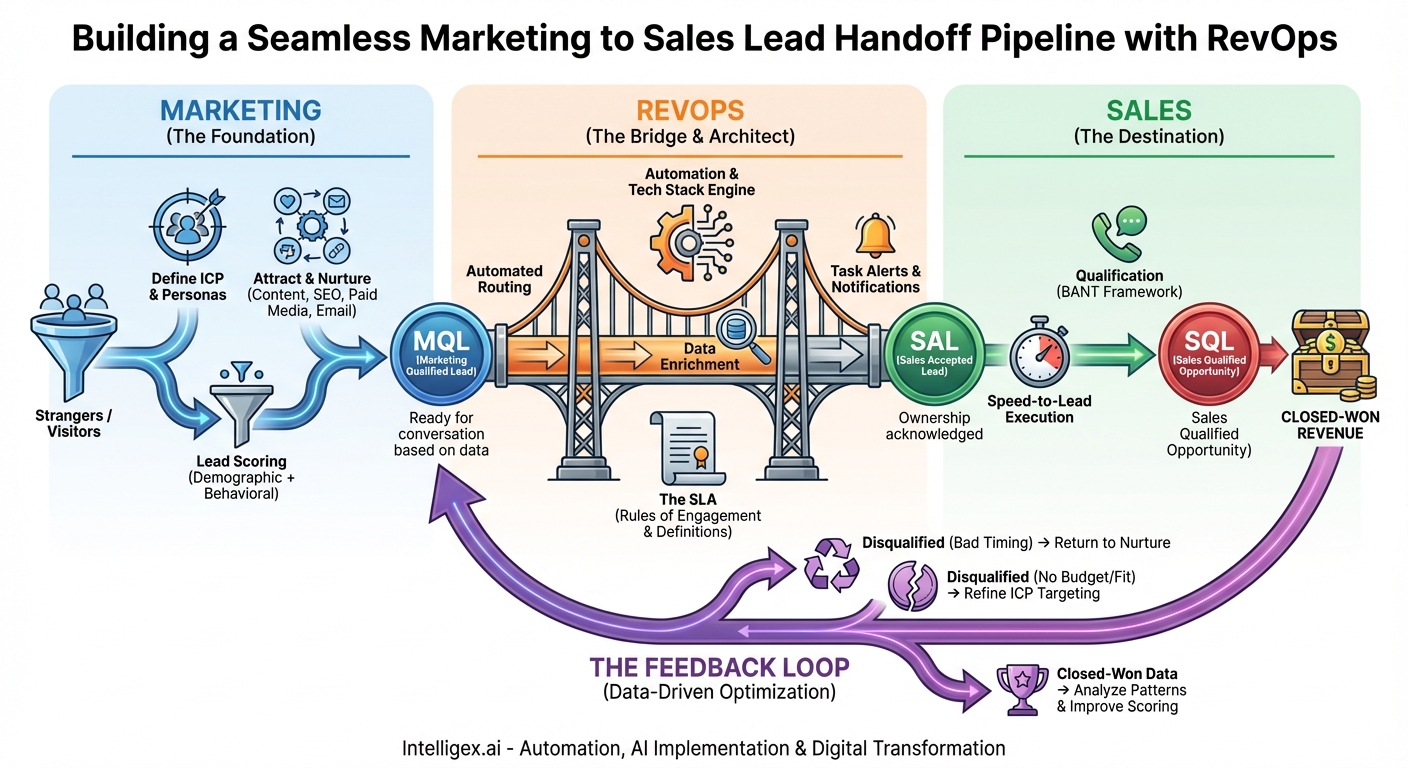
The journey from a curious website visitor to a loyal, paying customer is not a straight line. It’s a complex, multi-stage pipeline fraught with potential pitfalls. One of the most common and costly points of failure is the handoff—that critical moment when a lead, lovingly nurtured by marketing, is passed to the sales team. Too often, this exchange resembles a hurried toss over a high wall, with leads getting dropped, lost, or ignored in the process. This “leaky bucket” syndrome is where potential revenue vanishes into a void of miscommunication and process gaps. The solution? A meticulously designed handoff pipeline, orchestrated not by two, but by three key players: Marketing, Revenue Operations (RevOps), and Sales.
For decades, the relationship between Marketing and Sales has been famously adversarial. Marketing generates leads and complains that Sales doesn’t follow up effectively. Sales receives leads and complains they are unqualified and a waste of time. This finger-pointing stems from a fundamental misalignment of goals, definitions, and processes. The introduction of RevOps as a strategic intermediary and architect transforms this dysfunctional dynamic into a high-performance revenue engine. RevOps doesn’t just patch the holes; it rebuilds the entire plumbing system, ensuring a smooth, data-driven, and accountable flow from first touch to final sale.
The Foundation: Marketing’s Role in Generating and Qualifying the Spark
The handoff pipeline begins long before a lead ever speaks to a salesperson. It starts with Marketing’s strategic efforts to attract, engage, and qualify potential customers. Their primary responsibility is not just to generate a high volume of names, but to cultivate genuine interest and identify individuals who fit the company’s Ideal Customer Profile (ICP).
Defining the “Who”: ICP and Personas
Everything starts here. Before a single ad is run or blog post is written, Marketing must work collaboratively with Sales and company leadership to define the Ideal Customer Profile. The ICP is a detailed description of the perfect-fit company you are trying to sell to, considering factors like industry, company size, revenue, and geographical location. Layered on top of the ICP are buyer personas—semi-fictional representations of the actual people within those companies who will be involved in the buying decision. The tech-savvy CTO has different pain points and motivations than the budget-conscious CFO. Marketing’s content and campaigns must speak directly to these specific personas.
Attraction and Nurturing
With a clear understanding of who they’re targeting, Marketing executes a multi-channel strategy to draw them in. This includes:
- Content Marketing: Creating valuable, educational content (blogs, whitepapers, webinars) that addresses the pain points of their target personas.
- Search Engine Optimization (SEO): Ensuring that when a potential customer searches for a solution, your company appears as a credible answer.
- Paid Media: Using targeted ads on platforms like LinkedIn or Google to reach specific demographics and job titles within your ICP.
- Email Marketing: Building a subscriber list and nurturing leads over time with relevant information, moving them from initial awareness to deeper consideration.
The Gatekeeper: Lead Scoring and the MQL
Not every person who downloads a whitepaper is ready to buy. This is where lead scoring becomes mission-critical. Lead scoring is the process of assigning points to leads based on their attributes and behaviors. It’s typically broken into two categories:
- Demographic/Firmographic Scoring: Points awarded for how well a lead matches the ICP. A VP of Engineering at a 500-person tech company gets more points than an intern at a non-profit.
- Behavioral Scoring: Points awarded for actions that signal intent. Visiting the pricing page is a high-intent signal and gets more points than just reading a blog post. Attending a product demo webinar gets the most points of all.
When a lead’s score reaches a pre-determined threshold, they are officially designated a Marketing Qualified Lead (MQL). This is Marketing’s signal to the rest of the organization: “Based on our data and criteria, we believe this person is a strong potential customer who is ready for a sales conversation.” This is the moment the handoff begins.
The RevOps Bridge: Architecting a Bulletproof Handoff
The MQL is a fragile entity. Without a robust process, it can languish in a CRM queue, be routed to the wrong person, or arrive without the necessary context for Sales to act upon. This is where Revenue Operations steps in, not as a passive administrator, but as the active architect and engineer of the handoff process. RevOps ensures the transition is seamless, automated, and rich with data.
Defining the Rules of Engagement: The SLA
The most important document in this entire pipeline is the Service Level Agreement (SLA) between Marketing, RevOps, and Sales. RevOps facilitates the creation of this agreement, which codifies the entire process. The SLA answers critical questions:
- What is the precise, universally agreed-upon definition of an MQL? (e.g., “A lead with a score of 100 or more, from a company with 50+ employees, who has requested a demo.”)
- What is the definition of a Sales Accepted Lead (SAL)? This is the formal acknowledgment from Sales that the lead meets the MQL criteria and they are taking ownership.
- What is the expected timeframe for Sales to follow up on an MQL? (e.g., “All MQLs must be actioned within 2 hours.”)
- What are the specific steps for disqualifying a lead, and what feedback is required?
This SLA eliminates ambiguity and creates a system of mutual accountability. It’s the constitution that governs the revenue pipeline.
Technology and Automation: The Engine Room
RevOps owns the tech stack that powers the handoff. Their job is to configure the CRM (like HubSpot or Salesforce) and integrated tools to execute the SLA flawlessly. This involves:
- Automated Lead Routing: When a lead becomes an MQL, RevOps builds rules that instantly route it to the correct sales development representative (SDR) based on territory, industry, company size, or even a round-robin system to ensure fair distribution.
- Data Enrichment: An MQL might only come in with a name and an email. RevOps implements tools (like ZoomInfo, Clearbit, or Cognism) that automatically enrich this record with crucial data: company size, revenue, phone number, LinkedIn profile, and tech stack. The lead that arrives in the SDR’s queue is a complete, actionable profile, not a digital ghost.
- Task Creation and Notifications: The moment a lead is routed, the system automatically creates a task in the SDR’s name and sends a notification (via email or Slack) to ensure immediate visibility. This is key to enforcing the speed-to-lead SLA.
Data Hygiene and Governance
A pipeline built on bad data will inevitably fail. RevOps acts as the guardian of data quality. They implement processes for de-duplication, standardization (e.g., ensuring “United States,” “USA,” and “U.S.” are all treated the same), and regular data cleansing. This ensures that routing rules work correctly, personalization is accurate, and reporting is trustworthy.
The Destination: Sales’ Role in Converting Opportunity to Revenue
Once a clean, enriched, and properly-routed lead lands in the sales queue, the final stage of the handoff begins. The Sales team’s responsibility is to act with speed, intelligence, and a focus on providing value.
Acceptance and Speed-to-Lead
The first step for an SDR is to review the lead and formally accept it, transitioning it from an MQL to a Sales Accepted Lead (SAL). This simple click of a button is a powerful act of accountability. Following this, speed is everything. Studies have shown that the odds of connecting with a lead decrease dramatically after the first five minutes. The systems RevOps built enable this speed, but it’s up to the Sales team to execute.
Qualification and the SQL
The SDR’s job is not to sell the product, but to sell the next meeting. They conduct initial outreach to qualify the lead further, often using a framework like BANT (Budget, Authority, Need, Timeline). Their goal is to have a meaningful conversation to confirm the pain point, understand the buying process, and determine if there’s a genuine opportunity. If the lead is a good fit and agrees to a formal discovery call or demo with an Account Executive (AE), it is now promoted to a Sales Qualified Lead (SQL) or Sales Qualified Opportunity (SQO).
Closing the Loop: The Feedback Mechanism
This is arguably the most critical and often-missed step for the Sales team. The health of the entire pipeline depends on feedback. When a lead is dispositioned in the CRM, the reason matters immensely.
- Disqualified – Bad Timing: This lead isn’t a lost cause. The CRM should automatically place them back into a long-term nurturing campaign run by Marketing.
- Disqualified – No Budget: This is valuable intel for Marketing. Perhaps they are attracting companies that are too small and need to adjust their targeting.
- Disqualified – Not the Decision-Maker: The SDR should capture who the correct contact is, and that information should be used to update the account record.
- Closed-Won: Hooray! This data is gold. What marketing campaign brought in this customer? What was their lead score? RevOps analyzes this “win” data to find patterns and double down on what works.
This feedback loop, managed and analyzed by RevOps, allows Marketing to continuously refine their campaigns, targeting, and scoring models, ensuring that the quality of MQLs improves over time. The entire system learns and self-optimizes.
By moving away from the old, siloed “over-the-wall” toss and embracing a structured, RevOps-led pipeline, organizations transform their go-to-market motion. Marketing is no longer just a lead factory; they are producers of qualified opportunities. Sales is no longer a team of prospectors sifting through sand; they are closers acting on high-probability leads. And RevOps is the central nervous system connecting it all, ensuring the process is efficient, the data is reliable, and the entire revenue engine is humming in perfect harmony. This alignment isn’t just a “nice to have”—it’s the foundational blueprint for scalable, predictable growth.
Your Next Read:
Get a FREE
Proof of Concept
& Consultation
No Cost, No Commitment!
