

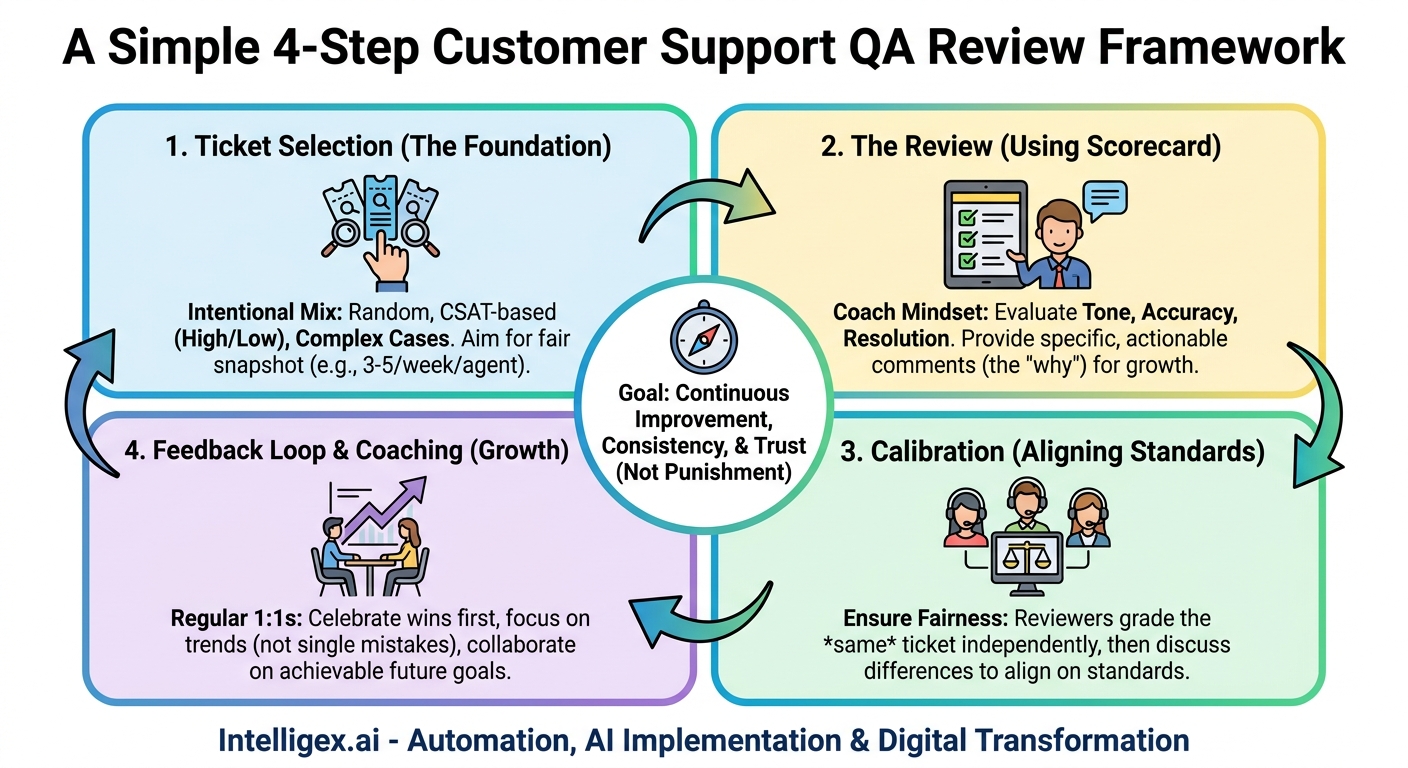
In the world of customer support, consistency is the bedrock of trust. A customer’s experience with your brand shouldn’t be a roll of the dice, dependent on which agent happens to pick up their ticket. They deserve the same high level of care, accuracy, and empathy every single time. But how do you ensure that level of quality across a team of individuals with different styles, strengths, and experience levels? The answer lies in a structured, yet simple, Quality Assurance (QA) review process. Many teams are intimidated by the idea of QA, picturing complex spreadsheets and confrontational meetings. It doesn’t have to be that way. A streamlined QA process is less about catching people making mistakes and more about creating a culture of continuous improvement, providing a compass for coaching, and ultimately, elevating your entire customer experience.
This guide will walk you through a straightforward, four-step framework for implementing a support QA review process. It’s designed to be actionable, scalable, and focused on what truly matters: helping your agents grow and making your customers happier.
Why a Formal QA Process is Non-Negotiable
Before diving into the “how,” it’s crucial to understand the “why.” Investing time in QA isn’t just another administrative task; it’s a strategic investment in your team, your customers, and your brand. A well-executed QA program delivers powerful, compounding benefits that ripple through the entire organization.
Consistency is King
Your brand has a voice, a tone, and a promise. A QA process ensures that promise is kept in every interaction. It codifies what a “great” conversation looks like, moving it from a subjective feeling to a defined standard. This means a customer receives the same accurate information, the same empathetic tone, and the same procedural diligence whether they contact you on a Monday morning or a Friday afternoon. This reliability builds immense customer trust and loyalty.
A Compass for Coaching
Vague feedback like “be more empathetic” or “be more thorough” is frustrating and unhelpful for agents. A QA process transforms coaching. Instead of guessing where an agent needs help, you have concrete data. You can pinpoint specific trends and use real ticket examples to guide your 1:1s. The conversation shifts from “I feel like you’re struggling with X” to “I noticed in these three tickets, we missed the opportunity to do Y. Let’s brainstorm some phrasing we can use next time.” This makes coaching targeted, effective, and far more empowering for the agent.
Data-Driven Decisions
QA data is a goldmine of insights that extends far beyond individual performance. Are a large number of agents struggling to answer questions about a new feature? That’s not an agent problem; it’s a training or documentation problem. Are you seeing a spike in tickets where agents are providing an incorrect policy detail? Your internal knowledge base needs an update. QA helps you spot these systemic issues, allowing you to fix the root cause rather than just addressing the symptoms. This data can inform product development, marketing messaging, and operational strategy.
Crafting Your Simple QA Scorecard: The Heart of the Process
The foundation of any good QA process is the scorecard. This is the rubric you’ll use to evaluate each interaction. The key to a simple process is a simple scorecard. Avoid the temptation to create a 100-point checklist covering every conceivable micro-interaction. Instead, focus on the core pillars of a quality support conversation. A great starting point is to group your criteria into three or four key categories.
Here’s a sample structure you can adapt:
-
Communication & Tone (The ‘How’)
- Empathy and Tone: Did the agent acknowledge the customer’s frustration? Was their tone professional, friendly, and aligned with our brand voice?
- Clarity and Grammar: Was the communication easy to understand, free of jargon, and grammatically correct?
- Formatting (for text): For email or chat, was the response well-formatted with paragraphs and spacing for easy reading?
-
Process & Accuracy (The ‘What’)
- Correct Information: Was the solution or information provided to the customer 100% accurate?
- Internal Process: Did the agent follow the correct internal procedures (e.g., tagging the ticket correctly, using the right macros, logging details in the CRM)?
- Policy Adherence: Did the agent adhere to all company policies, such as refund or return policies?
-
Problem Resolution (The ‘Result’)
- Full Resolution: Did the agent fully resolve the customer’s issue? Did they address all parts of the customer’s query?
- Efficiency: Was the issue resolved in a timely manner without unnecessary back-and-forth?
- Next Steps: If the issue couldn’t be solved immediately, were clear next steps communicated to the customer (e.g., “I’ve escalated this to our technical team, and you can expect a response within 24 hours.”)?
For scoring, keep it simple. A basic Yes/No for each criterion works well to start. You can also use a 3-point scale like Meets Expectations, Needs Improvement, or Exceeds Expectations. The goal is clarity, not complexity. Most importantly, get your team involved in creating the scorecard. When agents have a say in defining what “quality” looks like, they have immediate buy-in and a deeper understanding of the standards they’re being held to.
The Simple 4-Step Support QA Review Cycle
With your scorecard ready, you can now implement the review cycle. This is the recurring process of selecting, reviewing, and learning from customer interactions. Consistency here is key; QA is a marathon, not a sprint.
Step 1: Ticket Selection
The first step is deciding which tickets to review. To get a fair and accurate picture of performance, your selection process should be intentional. Aim to review 3-5 tickets per agent, per week. This is enough to spot trends without being an overwhelming administrative burden.
Your selection method should be a mix:
- Random Selection: This is your bread and butter. Pulling tickets randomly provides the most unbiased view of an agent’s typical day-to-day performance.
- CSAT-Based Selection: Intentionally review tickets that received very low (or very high) customer satisfaction scores. The low-scoring ones are obvious coaching opportunities, but the high-scoring ones are just as valuable. They showcase what an agent is doing exceptionally well and can be used as training examples for the whole team.
- Complex Tickets: Pull tickets that you know were technically or emotionally challenging. Reviewing how agents handle difficult situations is a great way to assess their advanced problem-solving and de-escalation skills.
Step 2: The Review
This is where you put your scorecard to work. As the reviewer, your mindset is critical. You are a coach, not a critic. Your goal is to find opportunities for growth.
During the review, read or listen to the entire interaction from start to finish to understand the full context. Go through your scorecard, marking each criterion objectively. The most important part of this step is the comments. A score is just a number; the comments provide the “why.” Be specific and actionable.
- Poor Comment: “Tone was bad.”
- Actionable Comment: “The opening ‘What’s the problem?’ came across as a bit abrupt. Let’s try starting with something more empathetic like, ‘I’m sorry to hear you’re running into trouble. I’m here to help.'”
Step 3: Calibration
This step is the secret sauce to a fair and trusted QA program, especially if you have more than one person performing reviews (e.g., multiple managers or team leads). Calibration is the process of ensuring all reviewers are applying the scorecard standards in the same way.
Once a week or bi-weekly, have all reviewers grade the exact same ticket independently. Then, come together as a group to discuss your scores. Did one manager score an agent’s tone as “Meets Expectations” while another scored it as “Needs Improvement”? Talk about why. This discussion is invaluable for aligning on what each standard truly means in practice. It eliminates the “hard grader” vs. “easy grader” problem and builds team-wide trust that the process is objective and fair.
Step 4: The Feedback Loop
A QA score with no follow-up is useless. The entire purpose of this process is to fuel productive coaching conversations. This feedback should be delivered in a regular, dedicated 1:1 meeting, not just by emailing a report.
Structure the conversation for success. Start by celebrating a win—point out something the agent did exceptionally well in one of their reviewed tickets. Then, move to the area for improvement. Focus on a trend, not a single mistake. Say, “I noticed a pattern across a couple of tickets where we could be more proactive in setting expectations.” Discuss the specific examples and collaborate with the agent on a small, achievable goal for the coming week. For instance, “For this next week, let’s focus on ending every email that isn’t fully resolved with a clear ‘next step’ for the customer.” This makes the feedback feel constructive and forward-looking, turning the QA review into a genuine partnership for professional growth.
Putting It All Together: Best Practices and Pitfalls to Avoid
As you roll out your QA process, keep these principles in mind to ensure it remains a positive and productive force on your team.
- It’s Coaching, Not a ‘Gotcha’ Game: Constantly reinforce that the goal of QA is development, not punishment. The process should never be tied to disciplinary action, but rather to coaching, training, and support.
- Celebrate Wins Publicly: When you find a fantastic ticket during a review, share it! Post it in a team Slack channel (with the agent’s permission) as a shining example of excellence. This shows that QA is also about recognizing and celebrating what your team does right.
- Stay Consistent: The benefits of QA are cumulative. A flurry of reviews for one month followed by two months of nothing is ineffective. Make it a regular, predictable part of your weekly and monthly rhythm.
- Iterate and Improve: Your first scorecard won’t be perfect. Your business will change, and your quality standards will evolve. Revisit your scorecard and process every quarter to ensure they still align with your team’s goals.
Implementing a support QA review process is one of the highest-leverage activities a support leader can undertake. By starting with a simple, focused framework, you can move beyond subjective feedback and build a powerful engine for consistency, agent development, and unparalleled customer satisfaction. It transforms quality from an abstract idea into a shared, measurable standard, empowering every agent to deliver their best work and ensuring every customer receives the exceptional experience they deserve.
Your Next Read:
Category:
Get a FREE
Proof of Concept
& Consultation
No Cost, No Commitment!
