

In the world of customer support, consistency is the bedrock of trust. A customer’s experience with your brand shouldn’t be a lottery, dependent on which agent happens to answer their ticket. They deserve the same high level of care, accuracy, and empathy every single time. But how can you ensure this when you have a team of unique individuals, each with their own communication style and knowledge level? The answer lies in a structured, simple, and supportive Quality Assurance (QA) review process.
Many team leads and managers hear “QA process” and imagine complex spreadsheets, punitive scoring, and hours of administrative overhead. It doesn’t have to be that way. A simple QA process isn’t about catching people doing something wrong; it’s about creating a framework for doing things right, consistently. It’s a tool for coaching, a catalyst for growth, and a compass that ensures your entire team is pointing toward the same north star: an excellent customer experience.
This guide will walk you through the essential components of a straightforward support QA review process. We’ll break down how to build it, how to run it, and most importantly, how to frame it as a positive force for agent development and customer satisfaction.
The Foundational Pillars: Why QA is Non-Negotiable
Before diving into the “how,” it’s crucial to understand the “why.” Implementing a QA process, even a simple one, requires time and effort. Justifying that investment—to yourself, your leadership, and your team—is the first step. A well-run QA program provides a powerful, multi-faceted return on investment.
Driving Consistency and Quality
This is the most obvious benefit. A QA process establishes a clear, documented standard for what a “good” interaction looks like. It moves quality from an abstract concept to a measurable benchmark. When every agent knows the criteria for success—from the tone they use in their greeting to the accuracy of the information they provide—the overall quality and consistency of your support naturally rises. This reduces customer frustration and builds a reliable brand reputation.
Uncovering Coaching and Training Opportunities
A QA review is a goldmine of actionable insights. It’s one of the most effective ways to identify specific areas where an agent, or even the entire team, needs support. You might discover that a new agent is brilliant at empathy but struggles with a specific technical process. Or perhaps you’ll notice a team-wide trend of misunderstanding a new policy. These aren’t failures; they are opportunities. QA allows you to move from generic, one-size-fits-all training to targeted, effective coaching that addresses real-world challenges.
Empowering Agent Growth and Development
When framed correctly, QA is a powerful tool for professional development. Regular, constructive feedback shows your agents that you are invested in their success. It gives them a clear path for improvement and celebrates what they’re already doing well. Instead of feeling micromanaged, agents feel supported. They understand the expectations, see how their work is measured, and are given the tools to excel. This boosts morale, increases engagement, and can significantly improve agent retention.
Identifying Gaps in Your Knowledge Base and Processes
Sometimes, a low-scoring ticket isn’t the agent’s fault. A QA review can shine a light on internal problems. Does your knowledge base have an outdated article? Is a specific internal process confusing and inefficient? If multiple agents are making the same mistake, the root cause might be a faulty resource, not faulty performance. QA helps you diagnose and fix these systemic issues, making everyone’s job easier and improving the customer experience at its source.
Building Your Simple QA Machine: The Core Components
A sustainable QA process is built on a few simple, well-defined components. The goal here is clarity and simplicity, not exhaustive complexity. You can always add more detail later as your team matures.
1. The Scorecard: Your Rubric for Success
The scorecard (or rubric) is the heart of your QA process. It’s a simple form used to grade each interaction against your predefined standards. The key to a good starting scorecard is to keep it focused. Don’t create a 50-point checklist that paralyzes your reviewer. Start with 3-5 core categories that truly define a quality interaction for your team.
A great starting point for scorecard categories includes:
- Tone and Empathy: Did the agent build rapport? Were they professional, friendly, and empathetic to the customer’s situation? Did they make the customer feel heard and valued?
- Accuracy and Completeness: Was the solution provided correct? Did the agent answer all of the customer’s questions, both explicit and implicit? Was any crucial information missed?
- Process Adherence: Did the agent follow the necessary internal procedures? Did they categorize the ticket correctly, use the right macros, and properly document the interaction?
- Resolution Efficiency: Was the issue resolved in a timely manner? Did the agent take ownership of the problem and guide the customer to the most efficient solution without unnecessary back-and-forth?
For each category, you can use a simple scoring system. A binary Yes/No, a 3-point scale (e.g., Exceeds, Meets, Needs Improvement), or a simple point system (e.g., 25 points per category for a 100-point total) all work well. The most important part of the scorecard isn’t the number, but the space for comments. The score tells you what, but the comments tell you why.
2. The Selection Process: What to Review
You can’t review every single ticket. You need a strategy for selecting a representative sample. For a simple process, a great place to start is with a random selection.
A good starting goal: Aim to review 3-5 interactions per agent, per week. This is manageable for the reviewer and provides enough data to identify trends without being overwhelming for the agent.
As you get more comfortable, you can introduce more targeted selections. For example, you might choose to also review:
- Tickets that received a low Customer Satisfaction (CSAT) score.
- Interactions handled by new hires to support their onboarding.
- Particularly long or complex tickets to see how they were handled.
- Tickets related to a new product feature or policy to check for understanding.
The key is to have a mix. Random sampling gives you a baseline of typical performance, while targeted sampling helps you investigate specific issues.
3. The Reviewer: Who Grades the Tickets?
In most small to medium-sized teams, the reviewer is typically the agent’s direct manager or a team lead. This is often the most effective approach because they already have a coaching relationship with the agent and are responsible for their performance.
Other options include:
- Peer Reviews: Agents review each other’s tickets. This can be great for fostering collaboration and shared learning, but requires careful calibration to ensure fairness and consistency.
- Dedicated QA Specialist: On larger teams, a person may be dedicated solely to QA. This provides maximum consistency but can sometimes feel disconnected from the day-to-day team dynamics.
For a simple start, stick with manager-led reviews. The manager is best positioned to turn the review’s findings into a productive coaching conversation.
The 4-Step Review Cycle in Action
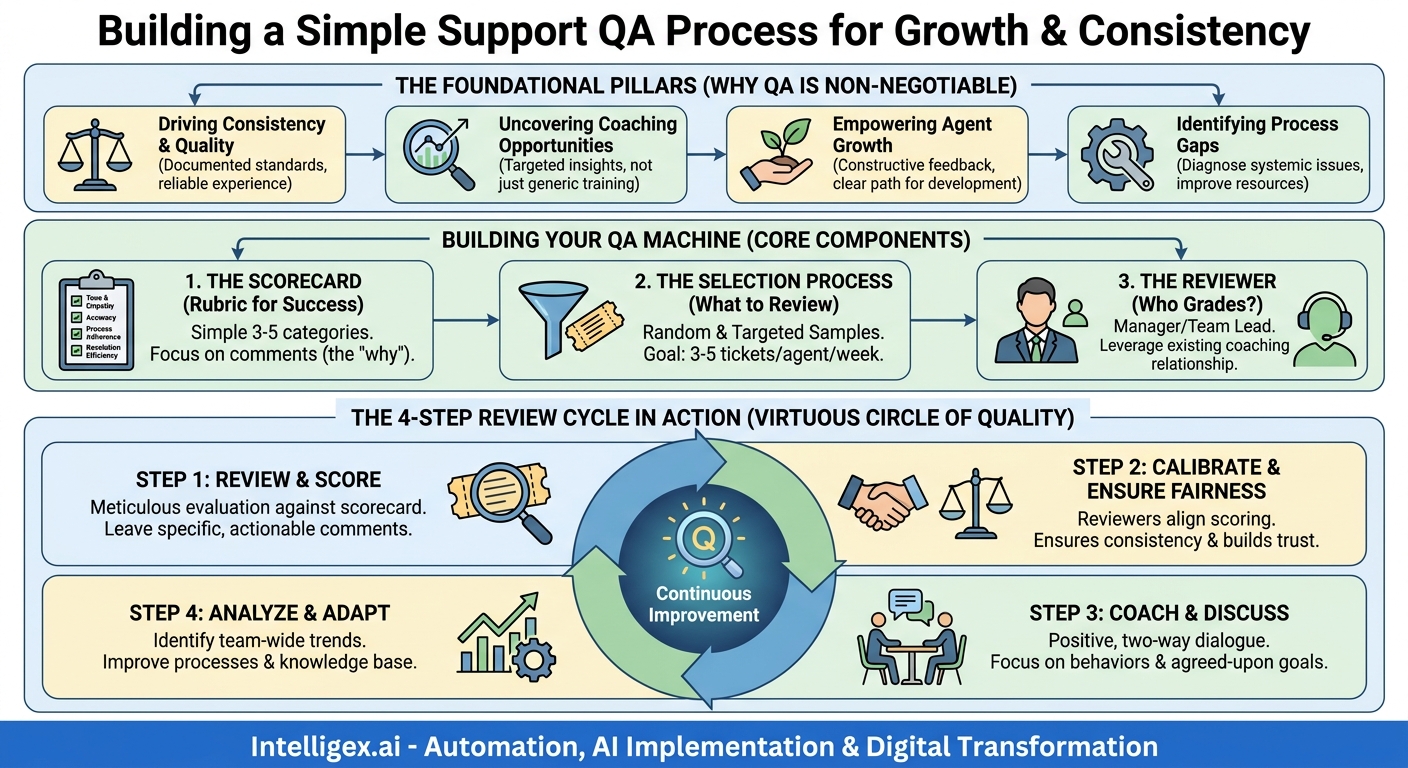
With the components in place, the process itself becomes a simple, repeatable loop. This entire cycle, from reviewing an individual ticket to adapting team-wide processes, creates a powerful feedback mechanism that drives continuous improvement. The accompanying infographic visualizes how these stages connect to form a virtuous circle of quality.
Step 1: Review and Score
The reviewer selects a ticket based on your selection criteria. They read through the entire interaction, from the customer’s initial message to the final resolution. Using the scorecard, they evaluate the interaction category by category. This step should be done with meticulous attention to detail. The reviewer’s most important job here is to leave specific, constructive, and actionable comments. Instead of just marking “Needs Improvement” on Tone, a good reviewer writes, “The solution was correct, but the opening felt a bit abrupt. Try starting with a phrase like, ‘I’m sorry to hear you’re running into this issue, let’s get it sorted out’ to build more rapport.”
Step 2: Calibrate and Ensure Fairness
This is a crucial, often overlooked step. Calibration is the process of ensuring that all reviewers are scoring in the same way. If you have multiple team leads reviewing tickets, they should periodically review the same ticket independently and then compare their scores and comments. Do they agree on what “exceeds expectations” looks like? Do they interpret the scorecard categories similarly? This process ensures that every agent is being evaluated fairly, regardless of who their reviewer is. It builds trust in the system.
Step 3: Coach and Discuss
The QA review is worthless if its insights are not shared. The review should be a conversation starter, not a final judgment. Schedule a brief, regular one-on-one session with each agent to go over their reviews. The tone of this meeting is paramount.
- Start with the positive. Begin by highlighting a ticket where the agent did an outstanding job. Celebrate their strengths.
- Focus on behaviors, not personality. Discuss the specific actions taken in the ticket. Instead of “You were unclear,” say, “In this sentence, the wording could be interpreted in two ways. How could we rephrase it to be more precise?”
- Make it a dialogue. Ask questions. “What was your thought process here?” or “What challenges did you face with this customer?” This often uncovers deeper issues and makes the agent a partner in their own development.
- End with clear, agreed-upon goals. Conclude the conversation with one or two specific things for the agent to focus on before the next review.
Step 4: Analyze and Adapt
The final step is to zoom out. Once a month or once a quarter, gather all the QA data. Don’t just look at individual agent scores; look for team-wide trends. Are scores for “Process Adherence” consistently low across the board? This probably isn’t a team of bad agents; it’s likely a bad process. Is everyone struggling to explain a certain feature? That’s a sign that you need a new knowledge base article or a team-wide training session on that topic. This high-level analysis is what transforms QA from a simple performance management tool into a strategic driver for your entire support operation.
Your Path to Continuous Improvement
Implementing a support QA review process doesn’t require a fancy software suite or a dedicated team of analysts. It starts with a commitment to consistency and a desire to help your team grow. By building a simple scorecard, establishing a clear review cycle, and focusing on coaching over criticism, you create a positive feedback loop that benefits everyone.
Your agents will gain clarity, confidence, and a clear path for development. Your customers will receive a more consistent, high-quality experience that builds loyalty and trust. And you, as a leader, will gain the invaluable insights needed to guide your team and your operations toward excellence. Start simple, stay consistent, and watch as quality becomes an integral part of your team’s culture.
Your Next Read:
Category:
Get a FREE
Proof of Concept
& Consultation
No Cost, No Commitment!