

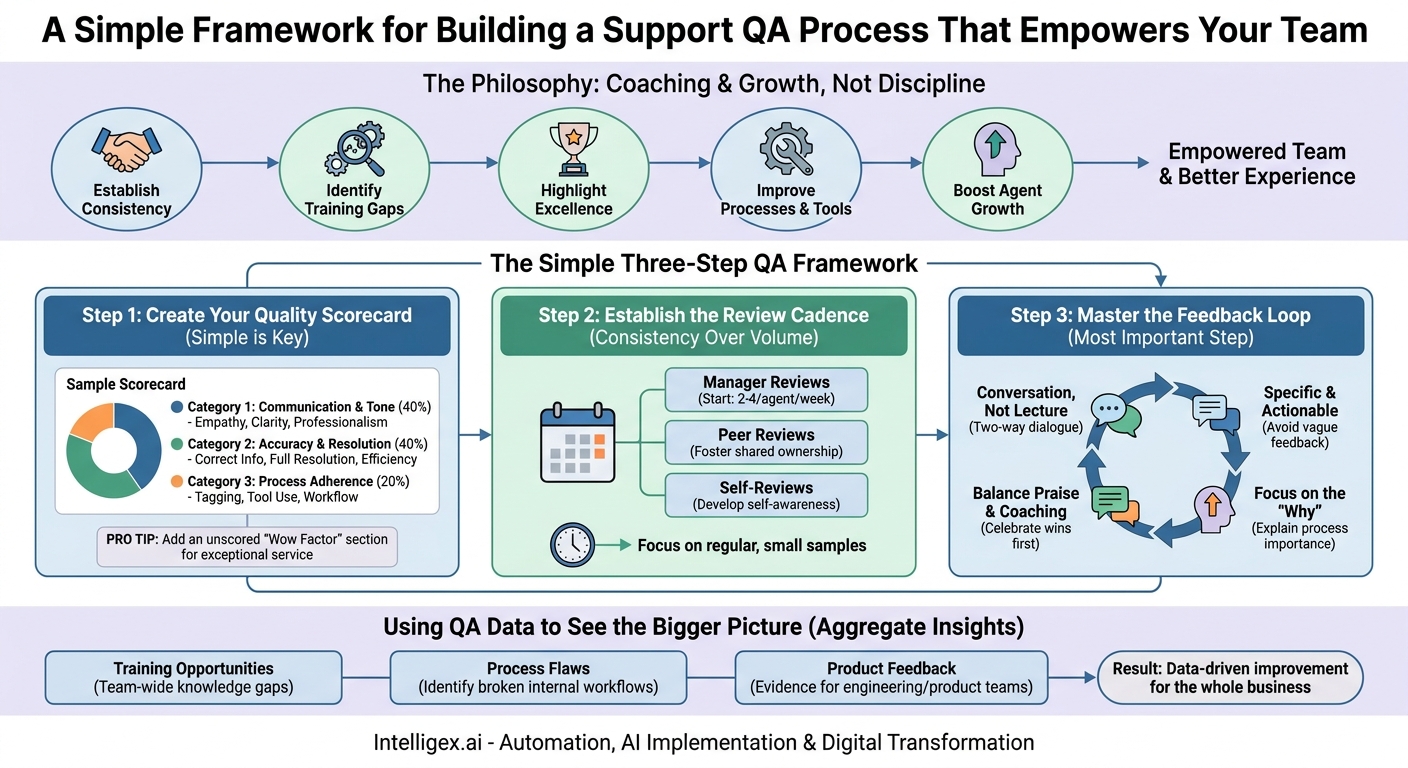
In the world of customer support, consistency is king. A customer’s experience with your brand can vary dramatically depending on which support agent they interact with. One agent might be a superstar, leaving the customer delighted. Another might provide an answer that is technically correct but lacks empathy, leaving the customer feeling like just another ticket number. This inconsistency is a silent killer of customer loyalty. The solution? A Quality Assurance (QA) review process. Now, before you imagine a world of bureaucratic checklists and micromanagement, let’s be clear: a good QA process isn’t about catching people making mistakes. It’s about creating a culture of continuous improvement, celebrating successes, and ensuring every customer receives the high-quality support they deserve. This guide will walk you through a simple, effective framework for building a support QA process that empowers your team and elevates your customer experience.
What is Support QA, Really? The Philosophy Behind the Process
At its core, a support QA review process is a system for evaluating customer interactions against a set of predefined standards. It’s a structured way to answer the question, “How are we doing?” But the philosophy behind it is what truly matters. A successful QA program should be seen as a coaching and development tool, not a disciplinary one.
Its primary goals are to:
- Establish Consistency: Ensure that every agent understands what a “great” interaction looks like and can deliver it consistently across all channels (email, chat, phone).
- Identify Training Gaps: Discover common areas where the team might be struggling. Are multiple agents confused about the new returns policy? Is there a knowledge gap about a specific product feature? QA data points directly to where your training efforts are needed most.
- Highlight Excellence: QA is just as much about finding and celebrating what’s going right. It allows you to identify top performers and use their interactions as stellar examples for the rest of the team.
- Improve Processes and Tools: Often, QA reviews uncover friction points that aren’t the agent’s fault. Perhaps a canned response is poorly worded, or a tool is clunky and inefficient. This feedback is invaluable for operational improvements.
- Boost Agent Growth: Regular, constructive feedback helps agents understand their strengths and areas for development, putting them on a clear path for professional growth within the company.
When you frame QA as a supportive mechanism for growth, you transform it from something agents fear into something they value. It becomes a collaborative effort to be better, together.
The Building Blocks: A Simple Three-Step QA Framework
You don’t need expensive software or a complex methodology to get started. A robust yet simple QA process can be built on a foundation of three core components: a clear scorecard, a consistent review schedule, and a meaningful feedback loop.
Step 1: Create Your Quality Scorecard
The scorecard is the heart of your QA process. It is the rubric you will use to grade interactions. The key here is to start simple. A 50-point checklist will lead to analysis paralysis and frustration. Instead, focus on 3-5 core categories that truly define a quality interaction for your business.
Here’s a sample structure for a simple, effective scorecard:
Category 1: Communication & Tone (40%)
This category assesses the “how” of the conversation. It’s not just what the agent said, but how they said it. Customer support is as much about feeling heard as it is about getting a solution.
- Empathy and Rapport: Did the agent acknowledge the customer’s frustration or situation? Did they build a human connection?
- Clarity and Conciseness: Was the language easy to understand, free of jargon, and to the point?
- Professionalism: Was the tone appropriate for your brand? Did it avoid being overly casual or robotic?
Category 2: Accuracy & Resolution (40%)
This is the technical side of the interaction. Did the agent solve the problem correctly and efficiently?
- Correct Information: Was the solution provided accurate and in line with company policy?
- Full Resolution: Did the agent address all parts of the customer’s query? Did they proactively anticipate any follow-up questions?
- Efficiency: Was the problem solved in a timely manner without unnecessary back-and-forth?
Category 3: Process Adherence (20%)
This covers the internal mechanics of the job. Following these processes correctly is crucial for data integrity and smooth operations.
- Proper Tagging/Categorization: Was the ticket tagged correctly to ensure accurate reporting?
- Correct Use of Tools: Did the agent use macros, internal notes, and other system features as required?
- Adherence to Workflow: If the issue required escalation or follow-up, was the correct procedure followed?
Pro Tip: Consider adding a “Wow Factor” or “Above and Beyond” section that isn’t scored but is used to highlight exceptional service. This encourages agents to do more than just check boxes and creates fantastic examples for team-wide praise.
Step 2: Establish the Review Cadence
Once you have your scorecard, you need to decide who will be doing the reviews and how often. Consistency is more important than volume. Reviewing two tickets per agent every single week is far more effective than reviewing 10 tickets for one agent one month and then none the next.
Consider a mix of review types:
- Manager Reviews: This is the most common starting point. A manager or team lead reviews a set number of tickets for each of their direct reports. This provides direct coaching opportunities.
- Peer Reviews: In this model, agents review each other’s work. This is a fantastic way to foster a shared sense of quality ownership and expose agents to different communication styles. It also lightens the load on managers.
- Self-Reviews: Asking agents to grade one of their own interactions using the scorecard is a powerful tool for developing self-awareness. They often become their own harshest critics and identify areas for improvement before you even have to mention them.
– **Starting goal:** 2-3 reviews per agent, per week.
– **Implementation:** Have each agent review 1-2 tickets from a teammate each week, focusing on providing helpful, constructive feedback.
For a simple start, begin with manager reviews. A good target is to review a random sample of 2-4 interactions per agent, per week. This provides enough data to spot trends without being an overwhelming administrative burden.
Step 3: Master the Feedback Loop
This is, without a doubt, the most important step in the entire process. A scorecard with a grade is just data. The conversation that follows is where the growth happens. Simply sending an agent a spreadsheet with their “score” is a recipe for anxiety and resentment. You must close the loop with a constructive, coaching-focused conversation.
Follow these principles for effective feedback delivery:
- Make it a Conversation, Not a Lecture: Schedule a brief, regular 1-on-1 to discuss the reviews. Start by asking the agent for their perspective on the interaction. “Walk me through your thought process on this ticket,” is a great opener.
- Be Specific and Actionable: Vague feedback is useless.
- Avoid: “You need to be more empathetic.”
- Instead, try: “In this chat, when the customer said they were frustrated, a great opportunity to show empathy would have been to say something like, ‘I can definitely understand why this has been so frustrating for you. Let’s get this sorted out.'”
- Balance Praise and Coaching: Always start by highlighting what the agent did well. People are much more receptive to constructive criticism when they feel their good work is also being recognized. Celebrate the wins, no matter how small.
- Focus on the “Why”: Explain *why* a certain process or turn of phrase is important. “When we tag tickets correctly, it helps our product team understand which features are causing the most confusion. Your work here directly impacts product improvements.”
Using QA Data to See the Bigger Picture
While QA is a fantastic tool for individual coaching, its true power is unlocked when you aggregate the data to see team-wide trends. On a weekly or monthly basis, look at your QA scores collectively. What stories do they tell?
- Training Opportunities: Is the entire team consistently scoring low on a particular part of the scorecard, like “Accuracy on Policy X”? That’s not a performance problem; it’s a training problem. You now have clear, data-driven justification for a team-wide training session on that topic.
- Process Flaws: Are agents frequently failing to follow a specific workflow? Before assuming it’s an agent issue, investigate the process itself. Is it too complicated? Is the tool failing? QA data helps you identify and fix broken internal processes.
- Product Feedback: If you see a high volume of difficult, low-scoring interactions centered around a specific product feature, you have a goldmine of feedback for your product and engineering teams. You can go to them with concrete evidence: “Our customers are consistently confused by the new dashboard, and it’s leading to a 20% increase in handle time for those tickets.”
Start Simple, Stay Consistent, and Focus on Growth
Building a support QA review process doesn’t need to be an intimidating, enterprise-level project. You can start today with a simple spreadsheet for a scorecard and a commitment to consistent, constructive conversations. The goal is not perfection on day one; it’s progress. By defining what quality means, reviewing work consistently, and turning feedback into a coaching dialogue, you create a powerful engine for improvement.
You’ll empower your agents to grow, provide your customers with a more reliable and positive experience, and transform your support team from a cost center into a valuable source of business intelligence. Start small, be consistent, and watch as your team’s quality and confidence soar.
Your Next Read:
Category:
Get a FREE
Proof of Concept
& Consultation
No Cost, No Commitment!
