

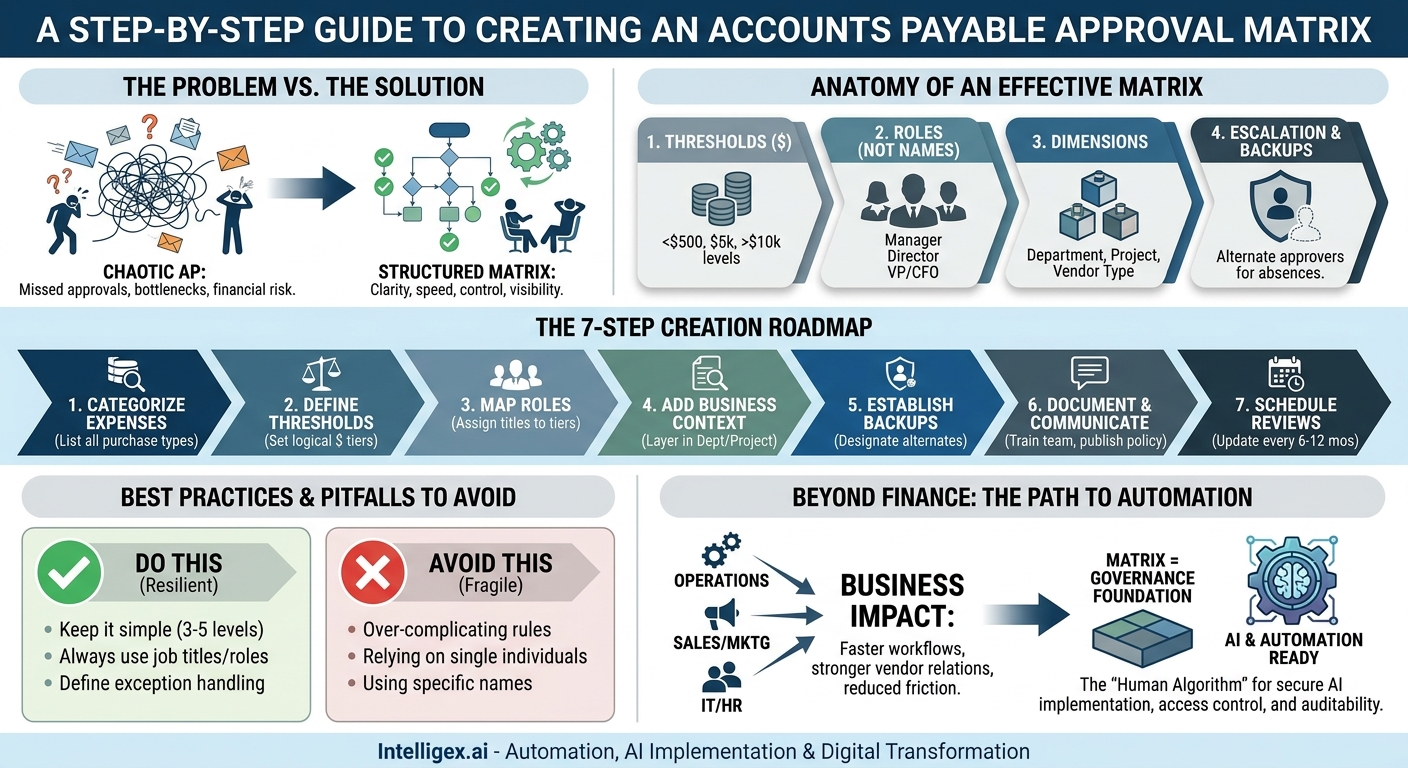
Paying bills should be the most straightforward part of running a business. Yet for many organizations, the accounts payable (AP) process is a tangled web of forwarded emails, missed approvals, and frantic questions about who signed off on what. When an urgent invoice for a critical supplier is stuck waiting for a signature from a manager who is on vacation, the entire operation can feel the impact. This isn’t just an administrative headache; it’s a source of financial risk, operational drag, and damaged vendor relationships.
The core of the problem often lies in a lack of clarity. Without a formal system, invoice approvals become a matter of habit, guesswork, or a manager’s overflowing inbox. This informal approach is slow, prone to error, and impossible to scale. A simple but powerful tool, the accounts payable approval matrix, provides the structure needed to untangle this process, bringing speed, control, and visibility to one of your most critical financial functions.
What Exactly Is an Accounts Payable Approval Matrix?
An accounts payable approval matrix is a formal chart or set of rules that defines who must approve an invoice before it can be paid. It’s a simple concept with a significant impact. Instead of relying on individuals to remember the right approval chain, the matrix provides a clear, documented guide for everyone in the company to follow.
The logic is based on specific business criteria. At its most basic, the matrix routes invoices based on their dollar amount. As your business grows, you can add more layers of complexity, such as routing by department, project code, vendor type, or expense category. The goal is to create a logical workflow that ensures the right people review the right expenditures without creating unnecessary bottlenecks.
The Key Components of an Effective Matrix
A well-designed approval matrix contains several core elements that work together to create a seamless workflow:
- Approval Thresholds: These are the dollar amounts that trigger different levels of approval. For instance, an invoice under $500 might only need a department manager’s approval, while an invoice over $10,000 might require review from a director and the CFO.
- Approvers and Roles: The matrix clearly lists the individuals or, even better, the roles (e.g., “Marketing Manager,” “IT Director”) responsible for approvals at each threshold. Using roles instead of specific names makes the matrix easier to maintain as people join, leave, or change positions.
- Dimensions: These are the business categories used to route the invoice. The most common dimension is the department or cost center (e.g., Sales, HR, Operations). Other useful dimensions can include project codes, locations, or specific expense types like software, hardware, or marketing services.
- Escalation Paths: The matrix should define what happens if a primary approver is unavailable. This usually involves naming a secondary or backup approver for each role to prevent invoices from getting stuck.
- Exception Handling: It should also outline the process for non-standard invoices, such as those without a purchase order (PO) or those that exceed the PO amount.
A Simple Example in Practice
Imagine a mid-sized company with Marketing, IT, and Operations departments. Their approval matrix might look something like this in its simplest form:
For the Marketing Department:
- Invoices under $1,000: Require approval from the Marketing Manager.
- Invoices from $1,000 to $7,500: Require approval from the Marketing Manager and the Director of Marketing.
- Invoices over $7,500: Require approval from the Director of Marketing and the VP of Finance.
For the IT Department:
- Invoices under $2,500 (for existing software renewals): Require approval from the IT Manager.
- Invoices over $2,500 or for any new hardware/software: Require approval from the IT Director and the VP of Finance.
This structure ensures that smaller, routine expenses are handled quickly by front-line managers, while larger, more strategic expenditures receive the necessary oversight from senior leadership. It removes ambiguity and empowers the AP team to process invoices confidently and efficiently.
Designing Your First Approval Matrix: A Step-by-Step Guide
Creating an approval matrix doesn’t require complex software or a massive project. It’s an exercise in documenting and formalizing the decision-making that already happens (or should be happening) within your business. By following a structured approach, you can build a practical and effective matrix that fits your organization’s needs.
Here is a step-by-step process to guide you through designing your first version.
- Identify and Categorize All Expense Types: Begin by listing all the different types of purchases your company makes. Group them logically. Common categories include software licenses, marketing services, office supplies, professional fees, raw materials, and travel expenses. This step helps you understand the flow of money and where different rules might be needed.
- Define Your Approval Thresholds: Analyze past invoices to determine logical dollar-amount tiers. You don’t need dozens of levels. Start with a few simple, clear thresholds. For example: Level 1 ($0 – $500), Level 2 ($501 – $2,500), Level 3 ($2,501 – $10,000), and Level 4 (Over $10,000). The right thresholds depend on your company’s size and spending habits. The goal is to give managers autonomy over small expenses while ensuring oversight for significant ones.
- Map Your Organizational Structure to Thresholds: For each threshold, assign an approver role. This is the most critical step. Map your company’s hierarchy to the financial tiers. For instance, Level 1 might be a Manager, Level 2 a Director, Level 3 a Vice President, and Level 4 the CFO or CEO. Remember to think in terms of roles, not individuals, to make the matrix durable.
- Incorporate Business Dimensions: Now, layer in the relevant business context. The most common dimension is the department or cost center. An IT manager should approve IT expenses, and a sales director should approve sales team expenses. You might also add project codes if your business is project-based, allowing project managers to approve expenses tied to their specific projects.
- Establish Backup Approvers and Escalation Paths: Business doesn’t stop for vacations or sick days. For every primary approver role, designate a backup. This is often the primary approver’s direct manager or a peer-level manager in the same department. Clearly document this in your matrix to ensure the AP process never stalls.
- Document and Communicate the Matrix: Consolidate all this information into a clear, easy-to-read document, such as a spreadsheet or a table in your internal knowledge base. Once finalized, communication is key. Hold a brief training session with all managers and the AP team to explain how the matrix works and where to find it. Make it clear that this is now the official company policy.
- Schedule Regular Reviews: An approval matrix is not a static document. Your company will grow, roles will change, and spending patterns will evolve. Schedule a review of the matrix every six or twelve months to ensure it still reflects your organizational structure and business needs.
Following these steps will result in a clear, logical, and maintainable approval matrix that provides a solid foundation for an efficient and controlled AP process.
Common Pitfalls and How to Avoid Them
Implementing an approval matrix can transform your AP process, but there are common traps that can undermine its effectiveness. Being aware of these pitfalls from the start can help you design a system that is robust, user-friendly, and sustainable.
Pitfall 1: Over-complicating the Matrix
The most frequent mistake is creating a matrix with too many levels, too many approvers, or too many special conditions. When the rules are too complex, people will look for workarounds or simply ignore the process. An invoice for $500 shouldn’t need four signatures.
How to avoid it: Start simple. A few clear financial thresholds and department-based routing are often enough for most businesses. You can always add more complexity later if a true business need arises. The goal is clarity and speed, not bureaucracy.
Pitfall 2: Forgetting About Backups and Delegates
An approval matrix that relies solely on primary approvers is a fragile one. As soon as a key manager goes on leave or is unavailable, the entire process for their department grinds to a halt. Invoices become overdue, and the AP team is left chasing people down.
How to avoid it: Make backup approvers a non-negotiable part of your matrix from day one. For every approval role, list a designated alternate. Modern AP automation systems often allow for setting up “out of office” delegations, but even in a manual process, having a documented backup is crucial.
Pitfall 3: Using Names Instead of Roles
Tying approvals to specific individuals (e.g., “John Smith approves IT invoices”) makes the matrix incredibly difficult to maintain. Every time there is a personnel change, the matrix is instantly outdated and must be manually updated. This creates administrative overhead and a high risk of error.
How to avoid it: Always use job titles or roles (e.g., “IT Director,” “Regional Sales Manager”). Your company’s org chart or HR system is the source of truth for who holds a role, not your AP matrix. This simple change makes the system resilient to staffing changes.
A Quick Checklist for a Resilient Matrix:
- Is the number of approval levels appropriate for our company size (ideally 3-5 levels)?
- Does every primary approver have a clearly designated backup?
- Are all approvers defined by their role, not their name?
- Is the matrix stored in a central, easily accessible location for all employees?
- Have we scheduled a recurring review (e.g., every 6 months) to update the matrix?
Beyond Finance: How a Strong AP Process Impacts Your Entire Business
While the accounts payable function lives within the finance department, the impact of a well-run AP process is felt across the entire organization. A streamlined approval matrix delivers tangible benefits to operational teams, improving their efficiency, agility, and ability to execute on their goals.
For Operations and Supply Chain
Timely payments are the bedrock of strong supplier relationships. When a critical supplier is paid on time, every time, you build trust and can often negotiate better terms or pricing. An efficient approval matrix ensures that invoices for raw materials, logistics, and other operational necessities move quickly, preventing delays in the supply chain that could impact production and customer delivery.
For Marketing and Sales
These teams often work with a wide range of external vendors, from creative agencies and digital advertising platforms to event venues. A slow, unpredictable payment process can damage these critical partnerships. With a clear approval matrix, a marketing manager can get a campaign invoice approved quickly, ensuring that vendors are paid promptly and are eager to work with them again on the next project. It allows the team to focus on their core job, not on chasing down signatures.
For IT and HR
The IT department manages crucial software licenses and infrastructure contracts where a missed payment could lead to a service disruption. Similarly, HR relies on various service providers for benefits administration, recruiting, and training. A formal approval workflow guarantees that these mission-critical invoices receive the right level of oversight from department leaders and are processed on time, ensuring business continuity.
Ultimately, a predictable and efficient AP process empowers every department to be more effective. It removes a major source of internal friction and administrative overhead, freeing up teams to focus on value-added work that drives the business forward.
Measuring Success: Key Metrics for AP Process Improvement
Implementing an approval matrix is a significant process improvement. But how do you know if it’s working? To quantify the benefits and identify areas for further optimization, you need to track the right metrics. Moving from a chaotic process to a structured one should produce measurable improvements in speed, cost, and quality.
Focus on these key performance indicators (KPIs) to measure the health of your AP workflow:
- Invoice Processing Cycle Time: This is the total time it takes from when an invoice is received to when it is fully approved and scheduled for payment. A shorter cycle time is a direct indicator of increased efficiency. A well-designed matrix should dramatically reduce this metric by eliminating ambiguity and delays.
- Cost Per Invoice: This metric calculates the total cost of processing a single invoice, including labor and system costs. By reducing manual follow-up, corrections, and manager time spent on approvals, automation and a clear matrix can significantly lower this cost.
- On-Time Payment Rate: This measures the percentage of invoices paid by their due date. A high on-time payment rate is crucial for maintaining good vendor relationships and can help you capture early payment discounts. This is often one of the first metrics to improve after implementing a clear approval workflow.
- Invoice Exception Rate: An exception is any invoice that requires manual intervention or investigation outside the standard process. This could be due to a missing PO, a price discrepancy, or an incorrect approver. A good approval matrix, especially when paired with POs, helps reduce the number of exceptions by standardizing the process upfront.
You don’t need to track dozens of metrics from day one. Start by benchmarking one or two, like cycle time and on-time payment rate. By measuring these before and after you implement your approval matrix, you can build a clear business case for the value of process discipline.
The Path to Automation: Governance and Future-Proofing
An accounts payable approval matrix is more than just a document; it’s the foundational logic for financial governance. It’s the “human algorithm” that dictates how money is spent and controlled. In the context of digital transformation, getting this human algorithm right is the essential first step before you can introduce any meaningful automation.
Attempting to automate a chaotic, undefined process only leads to faster chaos. An AI-powered invoice processing tool can extract data from an invoice in seconds, but if it doesn’t know who the correct approver is, the invoice still ends up in a digital limbo, waiting for manual intervention. Your approval matrix provides the clear, structured rules that an automation platform needs to operate effectively.
Building a Foundation for Safe AI Implementation
When you eventually move toward automating AP workflows, your matrix serves as the blueprint for configuring the system. This brings several governance benefits:
- Access Control and Security: The matrix defines who is authorized to approve payments. In an automated system, this translates directly into user permissions, ensuring that employees can only view and act on the invoices relevant to their role. This is a critical security control.
- Auditability: A digital workflow based on the matrix creates a permanent, unchangeable audit trail. Every action, from submission to final approval, is timestamped and logged. This makes internal and external audits simpler and more transparent.
- Human-in-the-Loop: No automation is perfect. The matrix helps define the exception-handling process, ensuring that any invoice that falls outside the standard rules (e.g., a potential duplicate or a major price variance flagged by an AI) is automatically routed to a specific person for human review. This combines the speed of automation with the judgment of your team.
By first establishing a clear and logical approval matrix, you are not just solving today’s AP problems. You are building the essential governance framework required to safely and effectively adopt more advanced automation and AI technologies in the future.
Your Next Steps: Putting the Matrix into Action
Understanding the value of an AP approval matrix is one thing; implementing it is another. The key is to start small and build momentum. You don’t need to solve every edge case on day one. A simple, well-communicated matrix is far more effective than a perfect but overly complex one that no one uses.
Here is a concise action plan to get you started:
- Schedule a 30-Minute Scoping Meeting: Invite key stakeholders from Finance, Operations, and one other major department. The goal is simple: agree that a problem exists and that formalizing the approval process is the right solution.
- Draft Version 1.0: Using the step-by-step guide from earlier, create a draft of your approval matrix. Focus on the 80% of common scenarios. Don’t worry about perfecting it. A spreadsheet is a great tool for this initial version.
- Identify a Pilot Department: Choose one cooperative and organized department to test the new process for a month. This allows you to gather feedback and work out any kinks in a controlled environment before a company-wide rollout.
- Communicate, Train, and Launch: Once you’ve refined the matrix based on pilot feedback, schedule a brief all-hands meeting for managers. Explain the new process, show them where the matrix is located, and set a clear go-live date.
By taking these deliberate steps, you can move from a state of ambiguity and risk to one of clarity, control, and efficiency. It’s a foundational improvement that will pay dividends in time saved, costs reduced, and stronger business relationships for years to come.
Your Next Read:
Category:
Get a FREE
Proof of Concept
& Consultation
No Cost, No Commitment!