

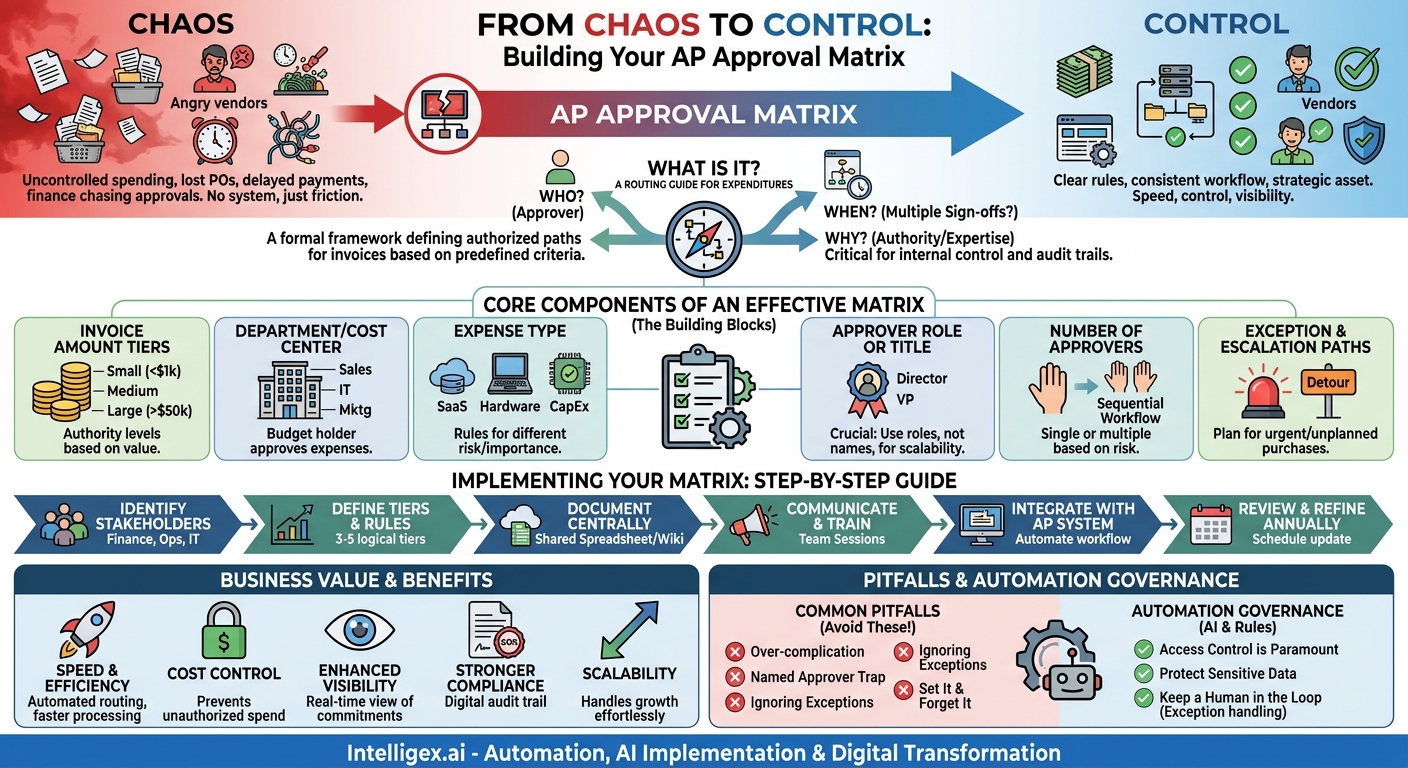
Uncontrolled spending, delayed payments, and frustrated vendors. These are the symptoms of a broken or nonexistent accounts payable process. When your team doesn’t have a clear, consistent way to approve invoices, chaos follows. Purchase orders get lost in email chains, urgent bills sit on desks waiting for a signature, and finance is left chasing down approvals just to close the books. The problem isn’t a lack of effort. It’s the lack of a system.
An Accounts Payable (AP) approval matrix is the foundational tool that brings order to this chaos. It is a simple, powerful framework that defines who is authorized to approve payments on behalf of the company. By creating clear rules, you transform your AP process from a source of friction into a strategic asset that enhances speed, control, and visibility across the entire organization.
What is an Accounts Payable Approval Matrix?
At its core, an AP approval matrix is a formal document or set of rules that dictates the path an invoice must follow before it can be paid. Think of it as a routing guide for your company’s expenditures. Instead of relying on guesswork or “whoever is available,” the matrix provides a clear, repeatable workflow based on predefined business criteria.
This framework answers critical questions for every single invoice:
- Who needs to review this expense?
- Why do they need to review it? (e.g., based on their budget authority or functional expertise)
- When does it require more than one person to sign off?
The matrix is not just a bureaucratic hurdle. It is a critical internal control that aligns spending with strategic objectives. It ensures that every dollar spent is intentional, authorized, and properly recorded. For finance teams, it provides the audit trail needed for compliance. For department heads, it provides the authority and accountability to manage their own budgets effectively. For the business as a whole, it creates a predictable and efficient process for paying vendors, strengthening those critical relationships.
The Core Components of an Effective Approval Matrix
A strong approval matrix is built on a few key data points. While the complexity can vary depending on your company’s size, the fundamental building blocks remain the same. When designing your matrix, ensure it clearly defines the rules based on a combination of the following criteria.
A Checklist for Your Matrix Design
- Invoice Amount Tiers: This is the most common element. It defines different levels of authority based on the total dollar value of the invoice. For example, a small purchase might only need a manager’s approval, while a large one requires a C-level executive’s sign-off.
- Department or Cost Center: Expenses should be approved by the head of the department that incurred them. An invoice for marketing software should be routed to the marketing team, not the IT department.
- Expense Type: Some purchases carry more risk or strategic importance than others. You might have different rules for routine office supplies versus a capital expenditure for new equipment, or for recurring software subscriptions versus one-time legal fees.
- Approver Role or Title: Crucially, the matrix should always be based on roles (e.g., “Director of IT”), not individuals (“Jane Smith”). This ensures the process doesn’t break when employees change roles or leave the company.
- Number of Approvers: For lower-value invoices, a single approver is often sufficient. For high-value or high-risk purchases, a sequential approval workflow (e.g., Manager, then Director, then VP) provides an extra layer of oversight.
- Exception and Escalation Paths: What happens if a designated approver is on vacation? What is the process for an urgent, unplanned purchase? A good matrix defines these exception paths in advance to prevent delays.
A Simple Example: Building Your First Matrix
Let’s imagine a 150-person technology company creating its first AP approval matrix. The finance team works with department heads to establish clear, logical rules. They decide to structure their matrix based on amount, department, and a few specific expense types.
Here’s what a few rows in their matrix might look like:
Scenario 1: A New Software Subscription for the Sales Team
- Invoice Amount: $450/month
- Department: Sales
- Expense Type: Software as a Service (SaaS)
- Approval Rule: Since the invoice is under their $1,000 threshold, it requires a single approval from the “Sales Manager” of the team requesting the tool. The invoice is automatically routed to that person.
Scenario 2: A Laptop Purchase for a New Engineer
- Invoice Amount: $3,500
- Department: IT
- Expense Type: Hardware
- Approval Rule: This falls into their second tier ($1,001 – $5,000). The rule requires one approver: the “Director of IT,” who is the budget holder for all company hardware.
Scenario 3: A Major Digital Advertising Campaign
- Invoice Amount: $25,000
- Department: Marketing
- Expense Type: Advertising & Promotion
- Approval Rule: This is a significant expense that falls into their third tier ($5,001 – $50,000). The process requires sequential approval. First, the “VP of Marketing” must approve it to confirm it aligns with campaign strategy and budget. Second, the “CFO” must provide a final approval as part of cash flow management.
In each case, the path is clear. There is no need for the AP clerk to email multiple people asking who should approve the bill. The system dictates the workflow, ensuring consistency and accountability.
Step-by-Step Guide to Implementing Your Approval Matrix
Putting a matrix in place doesn’t have to be a monumental project. By following a structured approach, you can roll out a practical and effective system that your teams will actually use.
- Identify Key Stakeholders: The matrix isn’t just a finance document. Involve department heads from Operations, IT, Marketing, and other key budget owners. Their input is essential for creating rules that are practical and reflect how the business actually works.
- Define Your Tiers and Rules: Start simply. Don’t create twenty different approval levels. Begin with three to five logical amount tiers. Gather existing spend data to inform these thresholds. What is a “small,” “medium,” and “large” purchase for your company today? Document the rules for each tier and department.
- Document the Matrix in a Central Location: Whether it’s a shared spreadsheet, a page in your company wiki, or built directly into your accounting software, the matrix must be a single source of truth. It needs to be easily accessible to anyone who needs to understand the process.
- Communicate and Train the Team: Don’t just send an email with the new rules attached. Hold brief training sessions to explain the purpose of the matrix. Focus on the benefits for everyone, not just finance. Explain how it empowers budget owners and speeds up payments for their critical vendors.
- Integrate with Your AP System: The true power of a matrix is realized when it’s embedded in your workflow. Manually checking a spreadsheet for every invoice is better than nothing, but it’s not efficient. Configure your accounting or procurement software (like NetSuite, Coupa, or others) to automatically enforce the rules you’ve created. This ensures the correct approver is notified the moment an invoice is processed.
- Review and Refine Annually: Your business is not static, and neither is your matrix. As the company grows, teams restructure, and budgets change, the approval thresholds and roles will need to be updated. Schedule an annual review to ensure the matrix remains relevant and effective.
The Business Value: Beyond Just Paying Bills
Implementing an AP approval matrix delivers tangible benefits that extend far beyond the finance department. It’s a strategic initiative that improves operational performance across the board.
- Speed and Efficiency: A clear, automated workflow eliminates the guesswork. Invoices are routed to the correct approver instantly, removing the manual back-and-forth that causes payment delays. What to measure: Average Invoice Processing Time, On-Time Payment Percentage.
- Cost Control and Budget Adherence: The matrix is your first line of defense against unauthorized or out-of-budget spending. It ensures every purchase is reviewed by the budget owner, preventing surprises at the end of the month. What to measure: Percentage of Spend within Budget, Number of Unapproved Purchases.
- Enhanced Visibility: With a structured approval process, leadership and finance have a real-time view of spending commitments as they happen, not weeks later when the payment is made. This proactive insight into cash flow is critical for accurate financial planning and forecasting.
- Stronger Compliance and Audit Trails: For any company subject to financial audits or regulations like the Sarbanes-Oxley Act (SOX), a documented approval matrix is non-negotiable. It provides a clear, digital audit trail demonstrating that internal controls for financial reporting are in place and being followed. What to measure: Time to Prepare for Audit, Number of Audit Findings Related to AP Controls.
- Scalability: As your company grows, the volume and complexity of invoices will increase exponentially. A manual, ad-hoc process will quickly collapse under the strain. A rules-based matrix, especially one automated in software, scales effortlessly, allowing you to handle 10,000 invoices with the same control you have for 100.
Common Pitfalls and How to Avoid Them
While the concept is simple, implementation can go wrong. Being aware of common mistakes can help you design a more resilient and user-friendly process.
- The Pitfall of Over-complication: Creating too many approval tiers or requiring multiple signatures for small purchases. This creates bottlenecks and frustrates employees, who will then look for ways to circumvent the system. How to avoid: Start with the simplest possible structure. You can always add complexity later if needed.
- The “Named Approver” Trap: Tying approvals to a specific person’s name (e.g., “Bob Smith”) instead of their role (“Operations Manager”). When Bob gets promoted or leaves, every rule assigned to him breaks. How to avoid: Always use roles or titles. This is the single most important principle for a scalable matrix.
- Ignoring the Exceptions: Failing to define a process for emergencies or non-standard purchases. When a critical server fails, the team can’t wait three days for a standard PO approval. How to avoid: Build a clear, documented “emergency” or “exception” path that still requires high-level sign-off but can be expedited.
- The “Set It and Forget It” Mindset: Creating the matrix and never updating it. Outdated roles, dollar thresholds, and department names make the system irrelevant over time. How to avoid: Schedule a formal review of the matrix at least once a year or whenever a major organizational change occurs.
Automating Your Matrix: Governance and AI Considerations
The approval matrix serves as the logical brain for any modern AP automation platform. Tools that use AI and optical character recognition (OCR) to read and process invoices are powerful, but they are only as good as the rules they are given. The matrix provides those rules.
When you connect your matrix to an automated system from a provider like Coupa or others, the process becomes incredibly efficient. The platform ingests an invoice, AI extracts key data like vendor, date, and amount, and then your matrix logic instantly routes it to the correct approver’s queue. However, this automation comes with important governance responsibilities.
- Access Control is Paramount: The system must rigorously enforce the matrix rules. An employee in marketing should not be able to see, let alone approve, a sensitive invoice from the HR department. Your platform’s security settings should mirror the divisions and authority levels defined in your matrix.
- Protecting Sensitive Data: Invoices contain confidential information, including pricing, banking details, and contact information. Ensure any automation tool you use has robust security controls to protect this data both in transit and at rest.
- Keep a Human in the Loop: Automation is about augmenting your team, not replacing it. The system should be configured to flag exceptions for human review. For example, if an invoice amount doesn’t match the purchase order, if the vendor is not in your system, or if the AI’s confidence score on a data field is low, it should be automatically routed to a human AP specialist for verification. This combines the speed of automation with the judgment of your experienced team.
Your Next Steps
Moving from an ad-hoc process to a structured approval workflow is one of the highest-impact improvements you can make to your financial operations. It reduces risk, saves time, and provides the control you need to scale your business confidently.
Here’s how to get started:
- Assess Your Current State: For one week, track the path of five different invoices. Where do they get stuck? Who do people ask for approvals? This will quickly reveal your biggest pain points.
- Start Small: Schedule a 30-minute meeting with the finance team and one other department head. Together, map out a simple two or three-tier approval matrix just for that department. Use it as a pilot.
- Leverage Your Existing Technology: Investigate your current accounting or ERP software. Most modern systems have built-in workflow capabilities. You may already have the tools you need to automate your new matrix.
By taking these first practical steps, you can begin building an accounts payable process that is not a liability, but a competitive advantage.
Your Next Read:
Category:
Get a FREE
Proof of Concept
& Consultation
No Cost, No Commitment!