

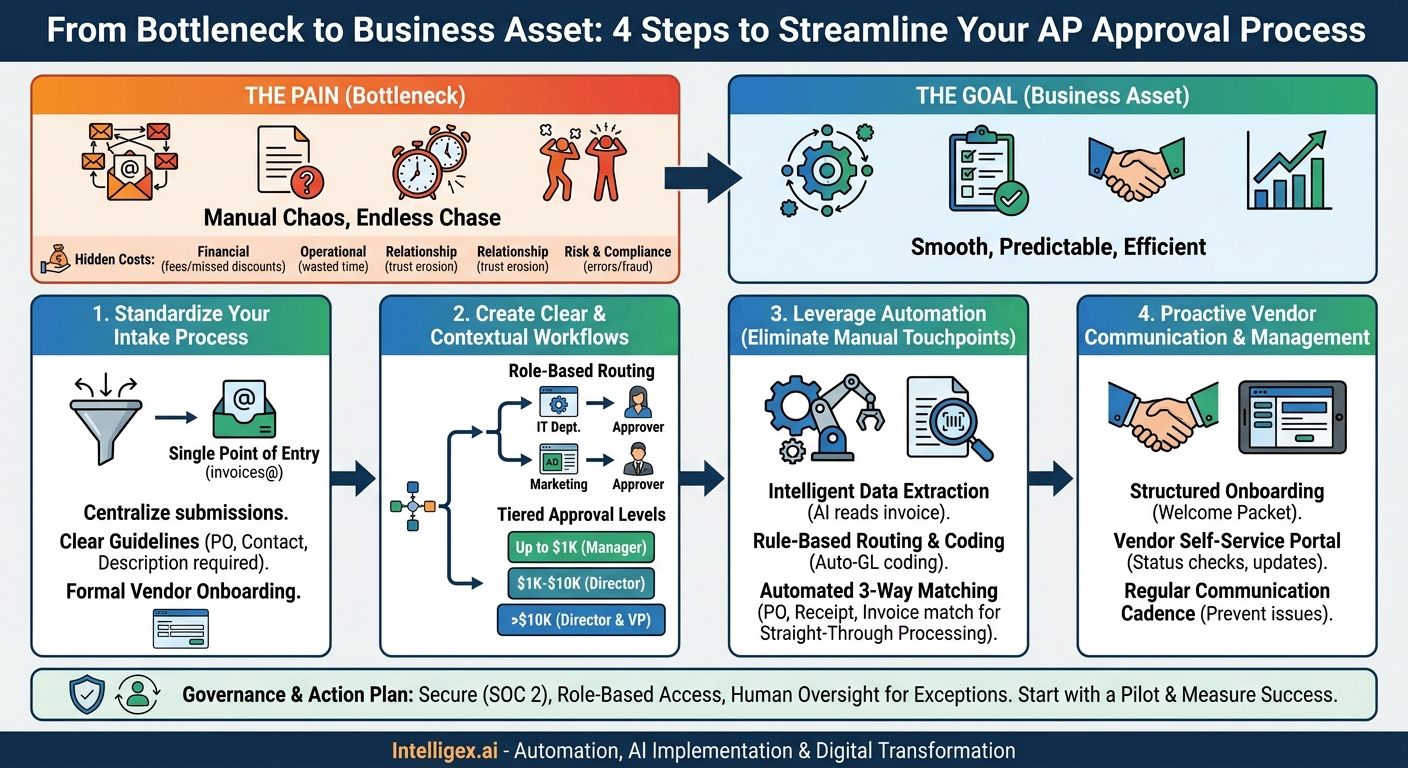
The endless email chain. The missing PO number. The frantic search for the right approver. If this sounds familiar, you understand the friction in a typical Accounts Payable (AP) approval process. It’s a constant back-and-forth that frustrates vendors, consumes valuable employee time, and creates operational bottlenecks. This isn’t just a finance problem. It’s a business-wide drag on efficiency that impacts everything from project timelines to vendor relationships.
When an invoice for a critical marketing campaign is stuck in limbo, the campaign’s momentum suffers. When a key supplier is paid late, your company’s reputation and negotiating power are damaged. The goal isn’t just to pay bills. It’s to create a smooth, predictable, and efficient process that strengthens your operations and partnerships. Moving beyond the manual chase requires a structured approach that combines clear processes, smart workflows, and targeted automation.
The Hidden Costs of Inefficient AP Approvals
The pain of a broken AP process extends far beyond the accounting department. It creates a ripple effect of tangible and intangible costs across the entire organization. Understanding these costs is the first step toward building a business case for change.
Financial Costs: The most obvious costs are financial penalties. You might face late payment fees from vendors or, just as costly, miss out on valuable early payment discounts. A 2% discount for paying in 10 days instead of 30 is an excellent return, but it’s impossible to capture when an invoice takes 25 days just to be approved. Furthermore, the cost-per-invoice processed skyrockets when employees from multiple departments spend hours tracking down information and manually entering data.
Operational Costs: Every minute a non-finance employee spends dealing with an invoice is a minute they aren’t spending on their core responsibilities. A software engineer chasing a payment for a crucial development tool isn’t writing code. A project manager haggling over invoice details isn’t managing the project. These delays stall initiatives, disrupt supply chains, and create internal friction as teams wait for necessary resources to be paid for and delivered.
Relationship Costs: Your vendors are your partners. Consistent payment delays signal disorganization and can erode trust. A vendor who has to fight for every payment may become less flexible on terms, less responsive to urgent requests, or may ultimately choose to prioritize your competitors. Strong vendor relationships are a competitive advantage, and a poor payment process puts them at risk.
Risk and Compliance Costs: A chaotic, manual process is a breeding ground for errors and fraud. Without clear controls and visibility, the risk of duplicate payments, payments for services not rendered, or even fraudulent invoices increases significantly. Furthermore, a lack of a clear audit trail can create major headaches during financial audits, potentially leading to compliance issues.
To quantify the problem, start measuring a few key metrics:
- Average invoice approval time (from receipt to ready-for-payment).
- Percentage of early payment discounts captured versus missed.
- Cost-per-invoice processed (including employee time).
- Number of vendor inquiries related to payment status per month.
Step 1: Standardize Your Intake Process
You can’t fix the approval workflow if you don’t first control how invoices enter your ecosystem. When invoices arrive through a dozen different email inboxes and are handed off in person, chaos is inevitable. The foundation of an efficient AP system is a single, standardized, and well-communicated intake channel.
The principle is simple: garbage in, garbage out. If invoices arrive incomplete, unreferenced, or sent to the wrong person, your team is forced to play detective before the approval process can even begin. A centralized intake process ensures every invoice starts its journey from the same place, with the same basic information, every single time.
Checklist for a Standardized Intake Process
Implementing this doesn’t require a massive technology investment. It’s about process discipline.
- A single point of entry. Create a dedicated email address, such as [email protected] or [email protected]. This should be the one and only place for vendors to submit invoices.
- Clear submission guidelines. Provide vendors with a simple, one-page document outlining your requirements. This should clearly state that every invoice must include a valid Purchase Order (PO) number, the name of their contact at your company, and a detailed description of the goods or services provided.
- A formal vendor onboarding kit. Don’t wait for the first invoice to communicate your process. When you onboard a new vendor, include your submission guidelines in their welcome packet.
- An internal communication plan. Educate your employees. Make it clear they should not be accepting invoices directly. If they receive one, their only action should be to forward it to the designated AP inbox and inform the vendor of the correct process for the future.
Consider this scenario. The sales team engages a vendor for new conference booth materials. The vendor emails the invoice to the sales manager, who is traveling. The email gets buried. Weeks later, the vendor calls, frustrated about the late payment. In a standardized system, the vendor would have sent the invoice directly to the central AP address. The system would have logged it immediately, identified the PO number, and routed it to the sales manager for approval, all within hours of receipt.
Step 2: Create Clear and Contextual Approval Workflows
Once an invoice is in the system, who needs to approve it? A one-size-fits-all approval chain is a recipe for bottlenecks. The CFO shouldn’t be approving a $200 office supply order, and an office manager shouldn’t be signing off on a $50,000 software contract. Effective workflows are contextual, routing invoices to the right people based on clear, predetermined business rules.
Designing Role-Based Workflows
Different departments have different needs and validation requirements. Your approval workflows should reflect this reality.
- IT Department: An invoice for a new software subscription should be routed to the IT manager. The workflow might require them to verify that the license count matches the user request and that the software complies with security policies before final approval.
- Marketing Department: An invoice from a digital advertising agency should go to the campaign manager. They need to validate that the charges align with the agreed-upon statement of work and campaign budget.
- Supply Chain: For physical goods, the workflow should enforce a three-way match. The system should automatically check the invoice against the purchase order and the goods receipt note. If all three documents align on item, quantity, and price, the invoice can often be approved automatically. If not, it is flagged for review by a supply chain specialist.
Implementing Tiered Approval Levels
Another layer of logic is to set approval tiers based on dollar value. This empowers managers to handle routine expenses while ensuring senior leadership maintains oversight on significant expenditures. A common structure looks like this:
- Up to $1,000: Requires approval from the team manager.
- $1,001 to $10,000: Requires approval from the department director.
- Over $10,000: Requires approval from the department director and the Vice President.
This tiered system prevents senior leaders from becoming a bottleneck for small purchases and ensures the appropriate level of scrutiny is applied to every expense.
Step 3: Leverage Automation to Eliminate Manual Touchpoints
With a standardized intake and clear workflows in place, you can introduce automation to handle the repetitive, low-value tasks that consume most of the AP team’s time. This isn’t about replacing people. It’s about freeing them to focus on high-value activities like analysis, vendor management, and process improvement.
Automated Data Extraction
Instead of manually keying in data from a PDF invoice, modern tools use intelligent document processing. This technology can read and understand an invoice, automatically extracting key information like the vendor name, invoice number, due date, line-item details, and total amount. This single step dramatically reduces the risk of data entry errors and cuts processing time from minutes to seconds.
Rule-Based Routing and Coding
Automation can apply the business logic from your defined workflows. When an invoice from a known IT vendor arrives, the system can automatically code it to the correct General Ledger (GL) account for software expenses. If the invoice contains a PO number that starts with “MKTG,” it is instantly routed to the marketing director’s approval queue. These rules eliminate the manual steps of looking up codes and forwarding emails.
Automated Matching and Exception Handling
For many businesses, especially in manufacturing or retail, three-way matching is the most time-consuming part of AP. An automated system can perform this match in real-time. If the invoice, PO, and receipt all match within predefined tolerances, the invoice can be processed “straight-through” with no human intervention. The AP team only needs to manage the exceptions, such as price discrepancies or quantity mismatches, which allows them to focus their expertise where it is most needed.
The business value here is immense. You can measure the impact by tracking metrics like the percentage of invoices processed straight-through and the reduction in invoice cycle time.
Step 4: Proactive Vendor Communication and Management
The best way to reduce back-and-forth with vendors is to prevent questions from arising in the first place. This requires a shift from a reactive to a proactive approach to vendor management, starting from the moment you decide to work with a new partner.
Many issues, such as incorrect payment information or confusion about invoicing procedures, can be completely avoided with a structured onboarding process. A smooth payment experience is a key component of a healthy vendor relationship.
A Simple Vendor Onboarding Process
- Provide a Welcome Packet. As soon as a contract is signed, send the new vendor a digital welcome packet. This should include your company’s invoicing requirements, the dedicated AP email address, and a clear explanation of your payment terms and cycles. Setting expectations from day one is critical.
- Collect All Necessary Information Upfront. Use a standardized digital form to collect all essential information at the beginning of the relationship. This includes their legal business name, tax forms (like a W-9), and payment details. Strongly encourage ACH or other electronic payment methods over paper checks to increase speed and security.
- Introduce a Vendor Self-Service Portal. If your systems support it, a vendor portal is a powerful tool for reducing friction. A portal allows vendors to log in and check the status of their invoices, see scheduled payment dates, and update their own contact or banking information. This self-service capability can eliminate a huge volume of “Where is my payment?” emails and phone calls.
- Establish a Regular Communication Cadence. For strategic or high-volume suppliers, don’t let the invoice be your only point of contact. A brief quarterly check-in from the supply chain or operations team can help identify any process frictions before they become major problems, reinforcing the sense of partnership.
A Note on Governance and Safe Implementation
As you introduce more automation into your AP process, especially technologies that handle sensitive financial data, establishing strong governance is not optional. It is essential for security, compliance, and maintaining control.
Data Privacy and Security: Vendor invoices contain confidential information, including banking details, addresses, and contact names. Any platform or tool you use must adhere to high security standards. Look for solutions with recognized compliance certifications, such as SOC 2, which validates their controls around security, availability, and confidentiality. For more information on these standards, you can refer to authoritative sources like the AICPA.
Role-Based Access Control: Not everyone in your organization needs to see every invoice. Implement strict, role-based access controls to ensure employees can only view or approve transactions relevant to their job function. An engineer in the R&D department should not have access to the invoices from your HR benefits provider.
The Human in the Loop: Automation is designed to handle the predictable, rule-based work, but it should not operate without oversight. Maintain a “human-in-the-loop” model for critical decisions and exceptions. For example, an automated system can flag a potential duplicate invoice based on the invoice number and amount, but a member of the AP team should make the final decision to void it. Similarly, large or unusual payments should always be flagged for an additional layer of human review before disbursement. This approach balances efficiency with the risk management and judgment that only a human can provide.
Your Path Forward: An Action Plan
Transforming your AP approval process from a source of friction to a strategic asset is an achievable goal. It doesn’t require a “big bang” overhaul. A phased, methodical approach will deliver incremental value and build momentum for broader change.
Here’s how you can get started:
- Audit Your Current Process. The first step is to understand your baseline. Map your current invoice lifecycle, from receipt to payment. Identify the biggest bottlenecks. Is it manual data entry? Is it waiting for approvals? Use this map to pinpoint the areas with the most potential for improvement.
- Start with a Pilot Program. Choose one department or one invoice type that represents a significant pain point. This could be marketing’s variable monthly spend or the high volume of PO-backed invoices from your supply chain. Focus on fixing the process for this single area first. A successful pilot will serve as a powerful case study for a wider rollout.
- Engage Your Stakeholders. AP transformation is a team sport. Talk to the department heads, administrative staff, and managers who are a part of the process every day. They have invaluable firsthand knowledge of what’s broken. Involving them early ensures the solution you build will actually work for them, which is critical for adoption.
- Define and Measure Success. Before you begin, decide what you want to achieve. Is your primary goal to reduce the average invoice approval time from 20 days to 5? Is it to capture 95% of all available early payment discounts? Setting clear, measurable goals will keep the project focused and allow you to demonstrate a clear return on investment.
By taking these deliberate steps, you can systematically eliminate the back-and-forth with vendors and build an AP process that is faster, cheaper, and more secure. The result is not just a more efficient finance function, but a more agile and reliable business operation.
Your Next Read:
Category:
Get a FREE
Proof of Concept
& Consultation
No Cost, No Commitment!
