

The promise of full, end-to-end automation is compelling. It suggests a world of frictionless operations, instant data processing, and dramatically lower costs. For many repetitive, high-volume tasks, this promise is a reality. But in the rush to automate everything, businesses often overlook a crucial question: are we sacrificing accuracy, nuance, and common sense for the sake of speed?
The most effective digital transformation strategies aren’t about replacing humans, but augmenting them. This is where Human-in-the-Loop (HITL) automation comes in. It’s a hybrid model that combines the speed and scale of machine processing with the critical thinking and contextual understanding of a human expert. The goal isn’t to choose between people and machines, but to design workflows where each does what it does best. Deciding when to keep a human step is one of the most important strategic decisions you can make in your automation journey.
The Business Case: Why Not Automate Everything?
While the idea of a fully autonomous business process is attractive, it carries hidden risks. Pursuing 100% automation in the wrong areas can lead to costly errors, compliance failures, and damaged customer relationships. The decision to keep a human in the loop is a strategic one, grounded in mitigating risk and preserving quality.
Consider the core business value drivers:
- Quality and Accuracy: For processes where a single error has significant financial consequences, full automation is a gamble. An AI might process 10,000 invoices in an hour, but if it misinterprets a complex contract term and approves a seven-figure overpayment, the efficiency gains are instantly erased. A human reviewer, guided by the AI’s initial processing, can spot that anomaly in seconds.
- Risk and Compliance: Many industries operate under strict regulatory frameworks. In finance, healthcare, and law, processes often require documented human oversight for compliance. Automating final approvals for major financial transfers or patient treatment plans without a human check can introduce unacceptable legal and ethical risks.
- Adaptability to Edge Cases: No automated system can be programmed for every possible exception. Business is messy and unpredictable. A fully automated supply chain system might operate perfectly 99% of the time, but it can’t reason through a sudden port closure due to a geopolitical event. A human expert can interpret the situation, assess the options, and make a strategic decision that a purely rules-based system cannot.
- Customer Experience: When a customer has a complex, urgent, or emotionally charged issue, interacting with a rigid, unfeeling bot can be intensely frustrating. Full automation is perfect for simple queries like “What’s my order status?” But for a high-value client negotiating a complex contract or a long-time customer with a serious service issue, the empathy and problem-solving skills of a human are irreplaceable.
Full Automation: Identifying the Low-Hanging Fruit
Full automation is powerful when applied to the right problems. The key is to identify tasks that are high in volume but low in ambiguity and risk. These are the foundational processes where machines excel, freeing up your team to focus on more valuable work.
Look for workflows with these characteristics:
- Repetitive and Rule-Based: The task follows the same steps every single time with very few deviations.
- Structured Data Inputs: The system is fed data in a consistent, predictable format, like information from a web form or a structured spreadsheet.
- Low Impact of Error: If a mistake occurs, it is easy to detect, simple to correct, and has minimal financial or reputational consequences.
Where to Apply Full Automation: Practical Examples
Finance & Accounting:
- Invoice Processing: Matching purchase orders, invoices, and receipts where all line items and amounts align perfectly. Robotic Process Automation (RPA) tools like those from UiPath are often used for these tasks.
- Data Entry: Migrating data from one standardized system to another, such as updating a customer’s address across multiple platforms after they submit a form.
Human Resources:
- Onboarding Reminders: Automatically sending scheduled emails to new hires to complete their paperwork or required training modules.
- Time-Off Requests: Auto-approving paid time off requests that fall within an employee’s accrued balance and do not conflict with blackout dates.
IT Operations:
- Password Resets: Handling standard user requests to reset their login credentials through a self-service portal.
- Access Provisioning: Granting new employees standard access to a predefined set of software and systems based on their role.
What to Measure
To confirm the value of full automation, track metrics like:
- Processing Time Per Item: How long does it take to complete one unit of work (e.g., one invoice, one password reset)?
- Throughput: How many items are processed per hour or per day?
- Error Rate: The percentage of tasks that require manual correction after automation. The goal is to keep this near zero for fully automated processes.
- Cost Per Transaction: The total operational cost to complete a single task.
Human-in-the-Loop (HITL): Where Nuance and Judgment Matter
HITL is the right approach when a process requires interpretation, context, or a high-stakes judgment call. Here, the AI or automation system does the heavy lifting, such as data gathering, initial analysis, or flagging anomalies, but a human makes the final, critical decision.
Look for workflows with these characteristics:
- High Ambiguity: The task involves unstructured data (like emails or contracts), requires interpreting intent, or has multiple “correct” outcomes depending on the context.
- High Cost of Failure: An error could lead to significant financial loss, legal liability, customer churn, or brand damage.
- Ethical Considerations: The decision requires a degree of ethical judgment or empathy that cannot be encoded in software.
Where to Apply HITL: Practical Examples
Sales & Marketing:
- Lead Qualification: An AI scores leads based on firmographic data and online behavior. A human salesperson then reviews the top 10% of leads, using their intuition to prioritize outreach and personalize the first contact. This model is common in platforms like Salesforce, where automated scoring supports human sales activities.
- Content Moderation: An AI flags potentially inappropriate user-generated content on a social platform. A human moderator reviews the flagged items to understand the context, nuance, and intent before making a final decision to remove it.
Supply Chain & Operations:
- Demand Forecasting: A machine learning model predicts future product demand based on historical data. A human planner reviews the forecast, overlaying their knowledge of upcoming promotions, market trends, or potential disruptions to adjust the final numbers.
- Quality Control: In manufacturing, a computer vision system flags products with potential visual defects. A human inspector then examines the flagged items to determine if the flaw is critical or within acceptable tolerance.
Finance & Legal:
- Fraud Detection: An algorithm flags a credit card transaction as potentially fraudulent based on unusual spending patterns. A human fraud analyst investigates the case, possibly contacting the customer to verify the charge before blocking the card.
- Contract Analysis: An AI scans a 100-page legal document and extracts all clauses related to liability and termination. A paralegal or lawyer then reviews this summarized output for accuracy and legal interpretation.
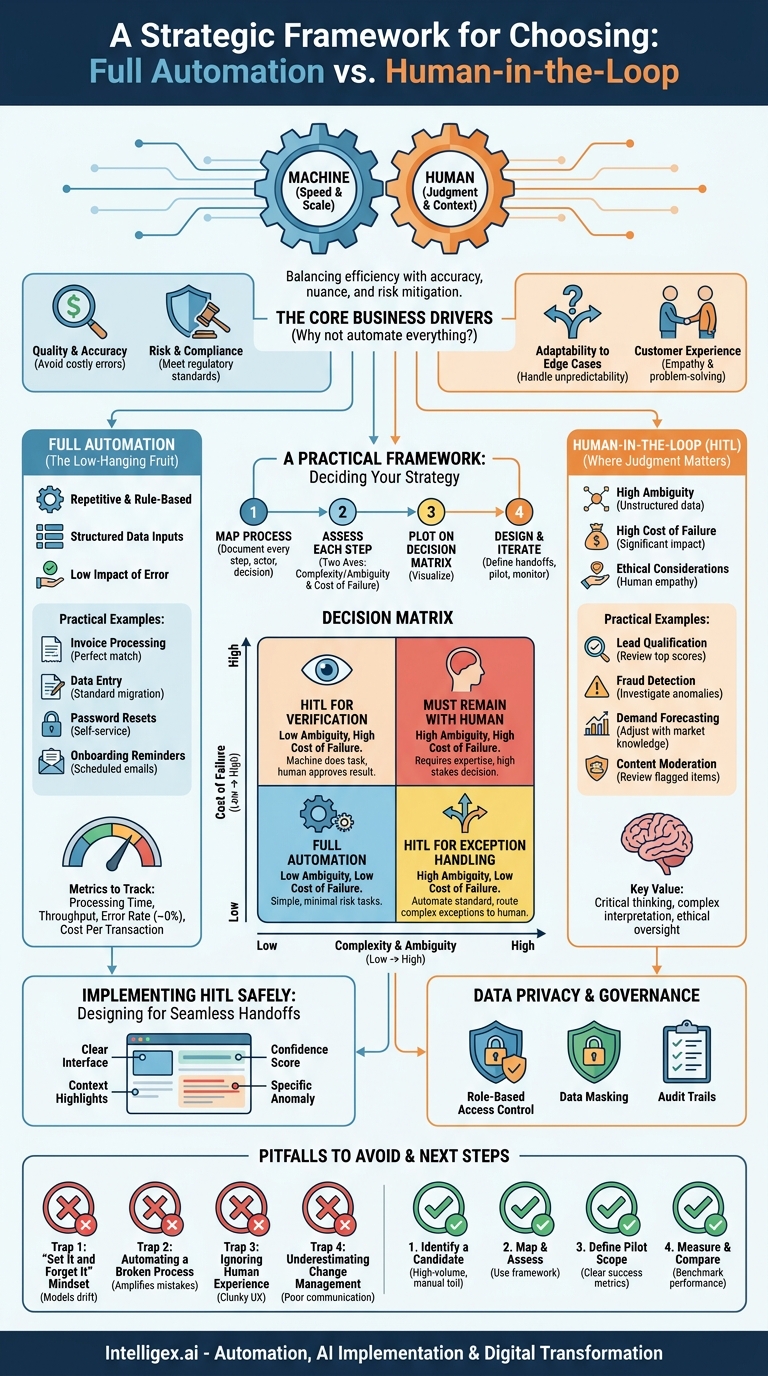
A Practical Framework: Deciding Your Automation Strategy
To move from theory to action, you need a structured way to evaluate your existing processes. This five-step method helps you dissect any workflow and determine the optimal mix of human and machine involvement.
- Map the Current Process: Before you automate anything, you must understand it. Document every single step in the workflow from start to finish. Identify who does what, what information is needed at each stage, and what decisions are made.
- Assess Each Step on Two Axes: For every individual step you mapped, ask two critical questions:
- Complexity and Ambiguity: How much interpretation, judgment, or expertise is required? Rate it as Low, Medium, or High. A low-ambiguity step is something like “copy data from field A to field B.” A high-ambiguity step is “determine customer sentiment from an angry email.”
- Cost of Failure: What is the business impact if this specific step is done incorrectly? Consider financial, legal, customer, and reputational costs. Rate it as Low, Medium, or High. A low-cost failure is sending an internal reminder email to the wrong person. A high-cost failure is approving a multi-million dollar wire transfer to the wrong account.
- Plot the Steps on a Decision Matrix: Visualize where each step falls.
- Low Ambiguity / Low Cost of Failure: These are prime candidates for Full Automation. The task is simple and the risk is minimal.
- High Ambiguity / High Cost of Failure: These steps Must Remain with a Human, at least for the final decision. The task requires expertise and the stakes are too high.
- Low Ambiguity / High Cost of Failure: This is a perfect fit for HITL for Verification. Let the machine perform the task, but require a human to review and approve the result before it is finalized. Example: An automated system generates a payroll file, but an HR manager must give final approval before payments are sent.
- High Ambiguity / Low Cost of Failure: This is a great use case for HITL for Exception Handling. Automate the process for all the standard, simple cases, and route the complex or unusual exceptions to a human for resolution.
- Design the New Hybrid Workflow: Based on your analysis, redesign the process. Clearly define the automated steps, the human intervention points, and the triggers for handoffs. What information must the system provide to the human to make an effective decision? How does the human’s decision get fed back into the system?
- Implement, Monitor, and Iterate: Start with a pilot project. Implement the new workflow for a small team or a subset of transactions. Track the key metrics (speed, quality, cost) to measure the impact. Gather feedback from the team and refine the process over time.
Implementing HITL Safely and Effectively
A successful HITL system isn’t just about technology; it’s about designing a seamless and secure collaboration between people and software. Rushing implementation without considering the human experience or data governance can undermine the entire effort.
Designing for Seamless Handoffs
The interface where the human interacts with the system is critical. If it’s confusing or inefficient, you’ll lose all the time you gained from the automation. The system should present information to the reviewer in a way that makes their job easy. For instance, instead of just flagging an invoice as “unusual,” it should highlight the specific line item that triggered the flag and provide a confidence score, like “85% likely to be an incorrect vendor code.” This context allows the human to make a faster, more informed decision.
Data Privacy and Governance
When you automate processes involving sensitive information, you must build in safeguards from day one. This is non-negotiable.
- Role-Based Access Control (RBAC): Ensure that human reviewers can only see the data necessary for their specific task. An accounts payable clerk reviewing an invoice doesn’t need access to sensitive HR files.
- Data Masking: Automatically hide or redact Personally Identifiable Information (PII) except where absolutely essential for the decision.
- Audit Trails: Log every single action, both automated and human. Record what decision was made, who made it, and when. This is crucial for compliance, accountability, and troubleshooting. Systems like Amazon Augmented AI (A2I) are built to help manage these human review workflows and their associated governance.
A short checklist for your HITL implementation:
- Is the handoff trigger from machine to human clearly defined?
- Does the user interface give the human reviewer all the context needed to act?
- Is there a feedback loop for the human’s decision to help improve the AI model over time?
- Are strict access controls and data privacy measures in place?
- Is there an immutable audit trail for every decision?
Pitfalls to Avoid: Common Automation Traps
As you embark on your automation journey, be aware of these common mistakes that can derail even the most well-intentioned projects.
Trap 1: The “Set It and Forget It” Mindset. An automated system is not a one-time project. Business rules change, software gets updated, and AI models can “drift” over time, becoming less accurate. You need a plan for ongoing monitoring, maintenance, and refinement to ensure the system continues to deliver value.
Trap 2: Automating a Broken Process. Automation is an amplifier. If you automate a flawed, inefficient, or illogical workflow, you are simply making mistakes at a much faster rate. Always take the time to streamline and optimize a process before you write a single line of code or configure a bot.
Trap 3: Ignoring the Human Experience (UX). If the tools for human reviewers are clunky, slow, or confusing, they will become a bottleneck. People will make more errors, work slower, or even try to find workarounds that bypass the system entirely, defeating the purpose of HITL.
Trap 4: Underestimating Change Management. You are not just introducing new software; you are changing how people work. You must communicate clearly why the change is happening, what the benefits are, and how their roles will evolve. Provide thorough training and support to ensure a smooth transition.
Your Next Steps: Putting This into Action
The choice between full automation and a human-in-the-loop approach is not a technical detail; it is a fundamental business strategy. The right balance delivers speed without sacrificing quality and achieves scale while managing risk. The goal is not a “lights-out” operation, but an intelligent one where technology handles the repetitive and humans tackle the exceptional.
Ready to get started? Don’t try to boil the ocean. Begin with a small, manageable pilot.
- Identify a Candidate: Pick one process in your department that is high-volume and a known source of manual toil or errors.
- Map and Assess: Use the decision framework from this post to map the process and evaluate each step for its ambiguity and cost of failure.
- Define a Pilot Scope: Choose one or two steps from your map that are clear candidates for either full or HITL automation. Define what “success” looks like with clear metrics.
- Measure and Compare: Before you start, benchmark your current performance. After implementing the pilot, measure again. Let the data on speed, cost, and quality prove the value.
By starting small and demonstrating clear business value, you can build the momentum needed for a truly transformative and intelligent automation program.
Your Next Read:
Category:
Get a FREE
Proof of Concept
& Consultation
No Cost, No Commitment!
