

We’ve all been there. You’re on the phone, listening to a repetitive loop of hold music, punctuated by a synthesized voice assuring you that “your call is very important to us.” Minutes feel like hours. You’re checking your email, scrolling through social media, doing anything to distract from the mounting frustration. When an agent finally picks up, you’re already on edge. This experience is so universal that it has become a cultural touchstone for poor service. But what’s really happening behind the scenes? Why are these delays so common, and is “unusually high call volume” the only reason?
The truth is that customer support delays are rarely the fault of a single cause. Instead, they are often the result of a complex interplay of systemic issues, technological shortcomings, and human factors. While a sudden product recall or service outage can certainly create a genuine spike in customer inquiries, the chronic, day-to-day delays that plague many support centers stem from deeper, more predictable problems. Understanding these root causes is the first step for any business that wants to move beyond apologies and start building a truly efficient and customer-centric support operation.
Breaking Down the “Unusually High Call Volume” Excuse
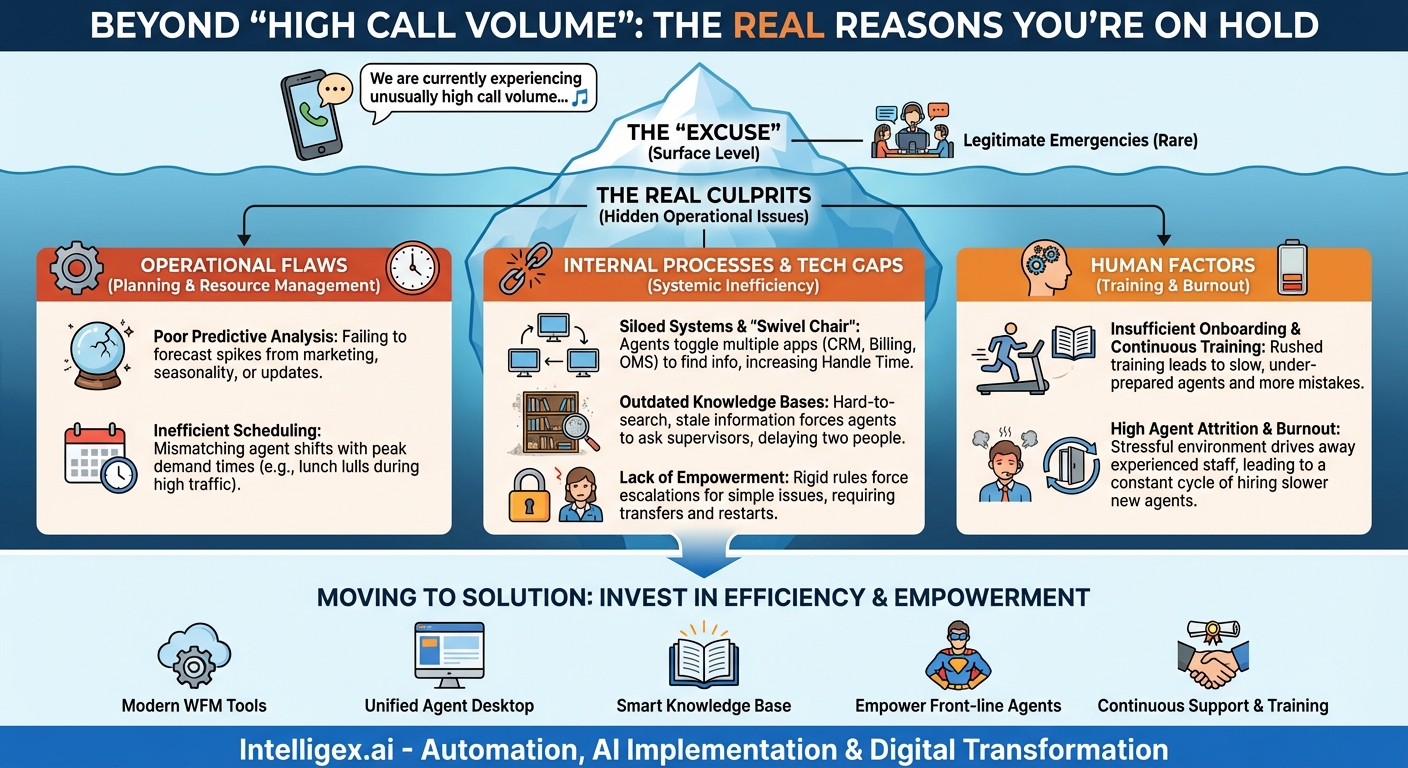
The phrase “we are currently experiencing unusually high call volume” is perhaps the most overused and least believed in the customer service lexicon. While it can be true during legitimate emergencies, more often than not, it’s a convenient catch-all for a failure in planning and resource management. When this becomes the standard message, it points to a couple of core operational flaws.
Inadequate Staffing and Forecasting
At its most basic level, a queue forms when the rate of incoming requests exceeds the rate at which they can be handled. The most direct cause is often a simple mismatch between the number of agents available and the number of customers needing help. This isn’t just bad luck; it’s a failure of workforce management (WFM).
- Poor Predictive Analysis: Modern WFM relies on historical data and predictive analytics to forecast contact volume. Companies that fail to invest in or properly utilize these tools are essentially flying blind. They don’t account for seasonality (e.g., a retailer before the holidays), marketing campaigns (a new promotion driving inquiries), or product lifecycles (a software update that introduces bugs).
- Reactive vs. Proactive Staffing: A common mistake is to staff based on past averages without looking forward. For example, if a marketing email is scheduled to go out to a million customers on a Tuesday morning, the support team should be proactively scaled up to handle the inevitable spike in questions about the offer. When they don’t, the “high call volume” becomes a self-fulfilling prophecy.
Inefficient Scheduling
Even with the right number of total agents, delays can occur if they aren’t scheduled effectively. Customer demand isn’t evenly distributed throughout the day or week. There are predictable peaks—such as Monday mornings, lunch hours, and right after 5 PM—and lulls. Inefficient scheduling ignores these patterns. If half the team is scheduled for their lunch break during the peak 12-1 PM customer call-in hour, queues will inevitably lengthen, leading to delays that were entirely preventable.
The Hidden Culprits: Internal Processes and Technology Gaps
Often, the delay isn’t caused by a lack of agents, but by the inefficiency of the agents themselves—an inefficiency forced upon them by broken processes and clunky technology. The time an agent spends with a customer, known as Average Handle Time (AHT), is a critical metric. When internal systems slow down the agent, AHT skyrockets, and the entire queue grinds to a halt.
Siloed Information and Disconnected Systems
Imagine a customer calls with a question about a recent bill for an order that arrived damaged. To solve this single issue, the support agent may need to access three or four different systems that don’t talk to each other:
- The Customer Relationship Management (CRM) system to view the customer’s contact history.
- The billing platform to look up the invoice in question.
- The order management system (OMS) to check the shipping status and delivery notes.
- A separate returns portal to process a refund or replacement.
This “swivel chair” effect, where agents must constantly switch between applications, copy-pasting information and trying to piece together a complete picture, is a massive time sink. Each screen change, each new login, adds precious seconds and minutes to the interaction. The customer is put on hold while the agent hunts for information, growing more frustrated with each passing moment. A unified agent desktop, where all relevant customer data is presented in a single interface, can drastically cut down AHT and, by extension, wait times.
Outdated or Inaccessible Knowledge Bases
When a customer asks a tricky question, the agent’s best friend should be their internal knowledge base (KB). This is the centralized repository of product information, troubleshooting steps, and company policies. However, in many organizations, the KB is a neglected mess. Information is outdated, articles are poorly written, and the search function is ineffective. When agents can’t quickly find the right answer, they are forced to put the customer on hold while they ask a supervisor or a more experienced colleague. This not only delays the current customer but also takes two employees out of commission, creating a ripple effect of inefficiency.
Lack of Agent Empowerment and Rigid Escalation Paths
Nothing frustrates a customer more than hearing, “I can’t help you with that, I’ll have to transfer you to another department.” This often happens because front-line agents are given very little authority. They may be unable to process a refund over a certain small amount, apply a discount to make up for a service failure, or override a simple system error.
This creates a mandatory escalation process. The customer has to be put on hold, transferred to a Tier 2 agent or a supervisor (who is likely also busy), and then must re-explain their entire issue from the beginning. This process is a significant source of delay and a primary driver of poor customer satisfaction. Empowering agents to resolve more issues at the first point of contact—a metric known as First Contact Resolution (FCR)—is one of the most effective ways to reduce overall wait times and improve the customer experience.
The Human Element: Agent Training and Burnout
Finally, we cannot ignore the human side of the equation. The support agents are the ones on the front lines, and their ability to perform effectively is directly tied to the training they receive and the environment they work in.
Insufficient Onboarding and Continuous Training
Customer support is a demanding job that requires a complex mix of soft skills (empathy, patience) and hard skills (product knowledge, system navigation). When companies rush the onboarding process, they put under-prepared agents on the floor. These agents are slower, less confident, and more likely to make mistakes or escalate issues unnecessarily.
Furthermore, training shouldn’t be a one-time event. As products are updated, policies change, and new issues emerge, agents need continuous education to stay effective. Without it, their knowledge becomes stale, their AHT increases, and they become a source of delays rather than a solution.
High Agent Attrition and Burnout
The role of a customer support agent is notoriously stressful. They deal with frustrated or angry customers all day, often while struggling with the inefficient systems mentioned earlier. This combination is a perfect recipe for burnout, which leads to high rates of agent attrition (turnover).
High attrition is a silent killer of support team efficiency. When experienced agents leave, they take their valuable tribal knowledge with them. The company then has to spend time and resources hiring and training replacements. This means that at any given time, a significant portion of the team may be composed of inexperienced new hires who are naturally slower and less effective. This constant cycle of hiring and training creates a permanent drag on the team’s overall capacity, making it harder to keep up with incoming volume and leading directly to longer wait times for customers.
Moving from Diagnosis to Solution
Customer support delays are far more than just an inconvenience; they are a clear signal of underlying operational dysfunction. The “high call volume” message, while sometimes true, more often masks deeper issues of poor forecasting, disconnected technology, restrictive processes, and inadequate support for the agents themselves.
The path to reducing wait times and improving customer satisfaction isn’t about simply hiring more agents. It’s about working smarter. It requires a holistic approach that includes:
- Investing in modern WFM tools to accurately predict demand and schedule staff accordingly.
- Integrating disparate systems into a unified agent desktop to eliminate wasted time.
- Building and maintaining a comprehensive knowledge base that empowers agents to find answers quickly.
- Empowering front-line agents to resolve more issues on the first contact, reducing the need for frustrating escalations.
- Committing to thorough, continuous training and creating a supportive work environment to reduce agent burnout and attrition.
By shifting focus from reacting to queues to proactively fixing the systems that create them, companies can transform their customer support from a source of frustration into a powerful engine for building loyalty and creating a lasting competitive advantage.
Related Posts
Category:
Get a FREE
Proof of Concept
& Consultation
No Cost, No Commitment!