
In the world of business technology, there’s a recurring, high-stakes question that every leader, from a startup founder to a Fortune 500 CIO, must face: when presented with a new software need, do we build it ourselves, buy an existing solution, or integrate various tools to create the capability we need? This isn’t just a technical puzzle; it’s a fundamental strategic decision with long-lasting consequences for your budget, your team’s focus, and your competitive position in the market. Making the wrong choice can lead to bloated budgets, missed deadlines, and a clunky tech stack that hinders rather than helps. Making the right one can unlock efficiency, foster innovation, and create a powerful engine for growth.
The traditional “Build vs. Buy” debate is now outdated. The rise of API-first software and robust integration platforms has introduced a powerful third contender: “Integrate.” This hybrid approach often presents the best of both worlds, but it also adds another layer of complexity to the decision-saking process. To navigate this crucial crossroads, you need more than a simple pro/con list. You need a structured framework—a decision matrix that forces you to evaluate the options against the factors that truly matter to your business. This guide will walk you through the three paths and provide the critical criteria for your decision matrix, empowering you to make an informed, strategic choice every time.
The Three Contenders: A Deeper Look
Before we can build our matrix, we need to have a crystal-clear understanding of what each option truly entails, including its ideal use cases and inherent trade-offs.
The “Build” Path: Forging Your Own Solution
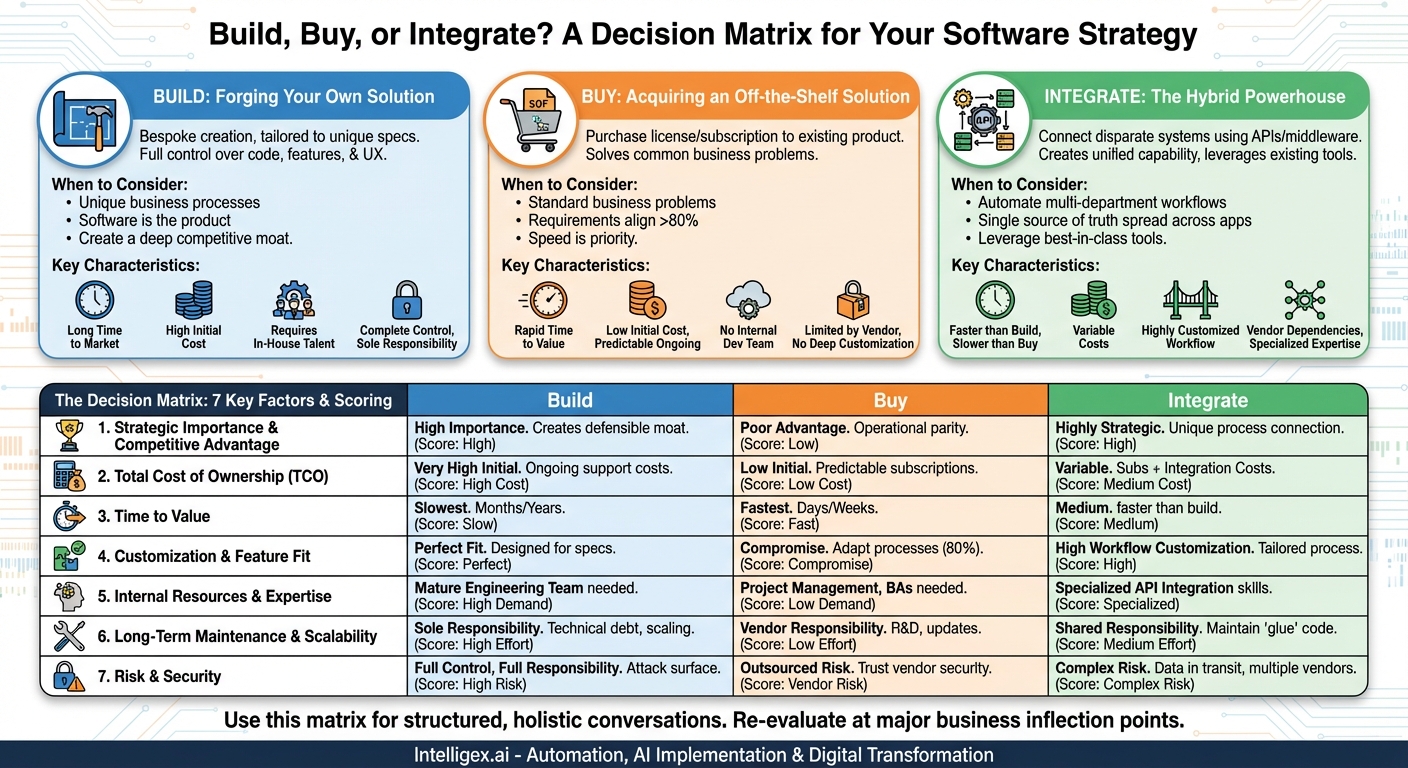
Building means committing your internal or hired resources to create a custom software solution from the ground up. This is the path of bespoke creation, tailored precisely to your unique specifications. You control every line of code, every feature, and the entire user experience. This path is most often considered when the required functionality is directly tied to your company’s core intellectual property or provides a significant, sustainable competitive advantage that off-the-shelf products cannot replicate.
- When to consider it: Your business processes are so unique that no existing software can support them; the software itself is the product you sell; the functionality will create a deep competitive moat that differentiates you from everyone else.
- Key Characteristics: High initial cost and long time to market. Requires significant in-house technical talent (developers, project managers, QA). Provides complete control and a perfect feature fit. You are solely responsible for all future maintenance, security, and updates.
The “Buy” Path: Acquiring an Off-the-Shelf Solution
Buying involves purchasing a license or subscription to a pre-existing software product, often a SaaS (Software-as-a-Service) platform. This is the go-to choice for solving common business problems that are not unique to your organization. Think about functions like Customer Relationship Management (CRM), Human Resources (HR) management, accounting, or project management. Companies have been solving these problems for decades, and a mature market of excellent solutions exists.
- When to consider it: You need to solve a standard business problem quickly and cost-effectively. Your requirements align with 80% or more of what an existing product offers. Speed of implementation is a top priority.
- Key Characteristics: Low initial cost and rapid time to value. Predictable ongoing costs (subscriptions). No internal development team is needed for core functionality. You are limited by the vendor’s feature set and roadmap, and deep customization is often impossible.
The “Integrate” Path: The Hybrid Powerhouse
The “Integrate” path is the sophisticated middle ground. It acknowledges that you likely already have powerful systems in place (perhaps a mix of built and bought solutions). Instead of starting from scratch or buying yet another monolithic platform, you use APIs (Application Programming Interfaces) and middleware to connect these disparate systems. This creates a new, unified capability by allowing data to flow seamlessly between them. For example, you might integrate your e-commerce platform with your CRM and your marketing automation tool to create a single, 360-degree view of your customer.
- When to consider it: You need to automate a workflow that spans multiple departments and existing systems. The “single source of truth” for your data is spread across different applications. You want to leverage the strengths of best-in-class tools without being locked into a single vendor’s ecosystem.
- Key Characteristics: Can be faster and cheaper than a full build. Avoids reinventing the wheel by leveraging existing software. The final result is highly customized to your specific workflow. It does, however, create dependencies on multiple vendors and their APIs, and requires specialized integration expertise.
Crafting Your Decision Matrix: The 7 Key Factors
Now, let’s translate these concepts into a practical decision-making tool. Your matrix should weigh each option (Build, Buy, Integrate) against a set of critical business factors. Score each option on a scale of 1-5 for each factor, and the highest total score will point you toward the most logical path.
1. Strategic Importance & Competitive Advantage
This is the most important question. Is this software part of your “secret sauce”? Will it directly help you win customers and outperform competitors?
- Build: The ideal choice for high strategic importance. A custom solution is how you build a defensible moat.
- Buy: Poor for strategic advantage. You’re using the same tool as your competitors, creating operational parity, not superiority.
- Integrate: Can be highly strategic. Your competitive advantage isn’t the individual tools, but the unique, efficient, and intelligent way you connect them to create a superior business process.
2. Total Cost of Ownership (TCO)
Don’t just look at the upfront price tag. TCO includes the initial cost plus all ongoing expenses for maintenance, support, upgrades, and internal staff time over a 3-5 year period.
- Build: Very high initial cost. Ongoing costs for hosting, maintenance, bug fixes, and the salaries of the team that supports it are entirely on you.
- Buy: Low initial cost. TCO is predictable through subscription fees, but can escalate with user-based pricing and premium feature tiers.
- Integrate: Variable. Costs include software subscription fees, potential API access fees, development costs for the integration “glue,” and potentially a subscription to an iPaaS (Integration Platform as a Service) platform.
3. Time to Value
How quickly can you get the solution implemented and delivering tangible business value? In today’s market, speed is often a competitive weapon in itself.
- Build: Slowest. A full development lifecycle (discovery, design, development, testing, deployment) can take many months or even years.
- Buy: Fastest. A SaaS product can often be up and running in a matter of days or weeks, requiring only configuration and data import.
- Integrate: Medium. Faster than building from scratch, but slower than a simple purchase. It requires development and testing of the connections, which depends heavily on the quality of the APIs involved.
4. Customization & Feature Fit
How closely will the final solution match your ideal requirements? Are you willing to change your processes to fit the software, or must the software bend to you?
- Build: Perfect fit. The solution is designed from the ground up to meet your exact specifications and workflows.
- Buy: Compromise is required. You’ll likely get 80% of what you want and will need to adapt some of your processes to fit the tool’s prescribed “best practices.”
- Integrate: High degree of workflow customization. While the individual components (the “bought” parts) are not customizable, the way they interact is entirely up to you, allowing for a highly tailored end-to-end process.
5. Internal Resources & Expertise
Honestly assess your team’s skills and availability. Do you have the right people to execute the plan?
- Build: Demands a mature and available engineering team with expertise in development, DevOps, and security. If you don’t have this in-house, you’ll need to hire or contract, adding cost and risk.
- Buy: Requires strong project management, vendor management, and business analysts to lead implementation and training, but not deep technical coding skills.
- Integrate: Requires a specialized skillset. You need engineers who are experts in API integration, data mapping, and security for data in transit. This is a different talent profile than typical application developers.
6. Long-Term Maintenance & Scalability
The project isn’t over at launch. How will the solution be supported, updated, and scaled for years to come?
- Build: Your sole responsibility. You own all technical debt, bug fixes, security patches, and infrastructure scaling. This offers control but is a significant, perpetual resource drain.
- Buy: The vendor’s responsibility. You benefit from their R&D budget, continuous updates, and professional support. The risk is that the vendor could be acquired, change their product direction, or go out of business.
- Integrate: A shared responsibility. You maintain the “glue” code and the integration logic, while the vendors of the connected systems maintain their respective products. If one vendor makes a breaking API change, it’s on you to fix the integration.
7. Risk & Security
Where are the potential points of failure, and who is responsible for security?
- Build: You have full control over the security architecture, but you are also 100% responsible for any breaches or vulnerabilities. The attack surface is entirely of your own making.
- Buy: You outsource much of the risk to the vendor. It’s critical to perform due diligence on their security posture (e.g., SOC 2 compliance, penetration testing reports). Their breach becomes your breach.
- Integrate: The risk profile is complex. You are securing not only your custom integration code but also the data as it moves between systems. Each API endpoint is a potential vulnerability, and you must trust the security of all connected vendors.
Beyond the Matrix: A Strategic Decision
The Build vs. Buy vs. Integrate decision matrix isn’t a magic formula that spits out a perfect answer. Its true value lies in forcing a structured, holistic conversation among business, product, and technology stakeholders. By walking through these seven factors, you move the debate away from gut feelings and personal biases toward a data-informed, strategic analysis.
The “right” answer today may not be the right answer in two years. A startup might initially buy a CRM to get to market quickly. As it scales and its sales process becomes a key differentiator, it might integrate that CRM with other tools to create a custom workflow. Eventually, it might even build its own proprietary customer platform when it becomes a core strategic asset. The key is to re-evaluate this decision at every major inflection point in your business. Use this matrix as your guide to ensure that your technology stack isn’t just a collection of tools, but a thoughtfully architected system that actively drives your business forward.
Your Next Read:
Category:
Get a FREE
Proof of Concept
& Consultation
No Cost, No Commitment!