

Automation is no longer a futuristic concept discussed in boardrooms. It’s a practical tool that teams are using right now to streamline work, reduce errors, and focus on what matters most. Yet, a cloud of misunderstanding still surrounds it. Many leaders see it as either an impossibly complex, budget-draining overhaul or a simple switch to flip for instant efficiency. The reality is more nuanced and far more accessible.
The most successful automation initiatives don’t start with a desire for “AI” or “bots.” They start with a real business problem: a bottleneck in finance, a repetitive task in marketing, or an error-prone process in operations. By grounding automation in reality, you can move past the myths and start unlocking tangible value in the form of greater speed, higher quality, and better scalability.
Myth: Automation Is Only for Huge, Repetitive Tasks
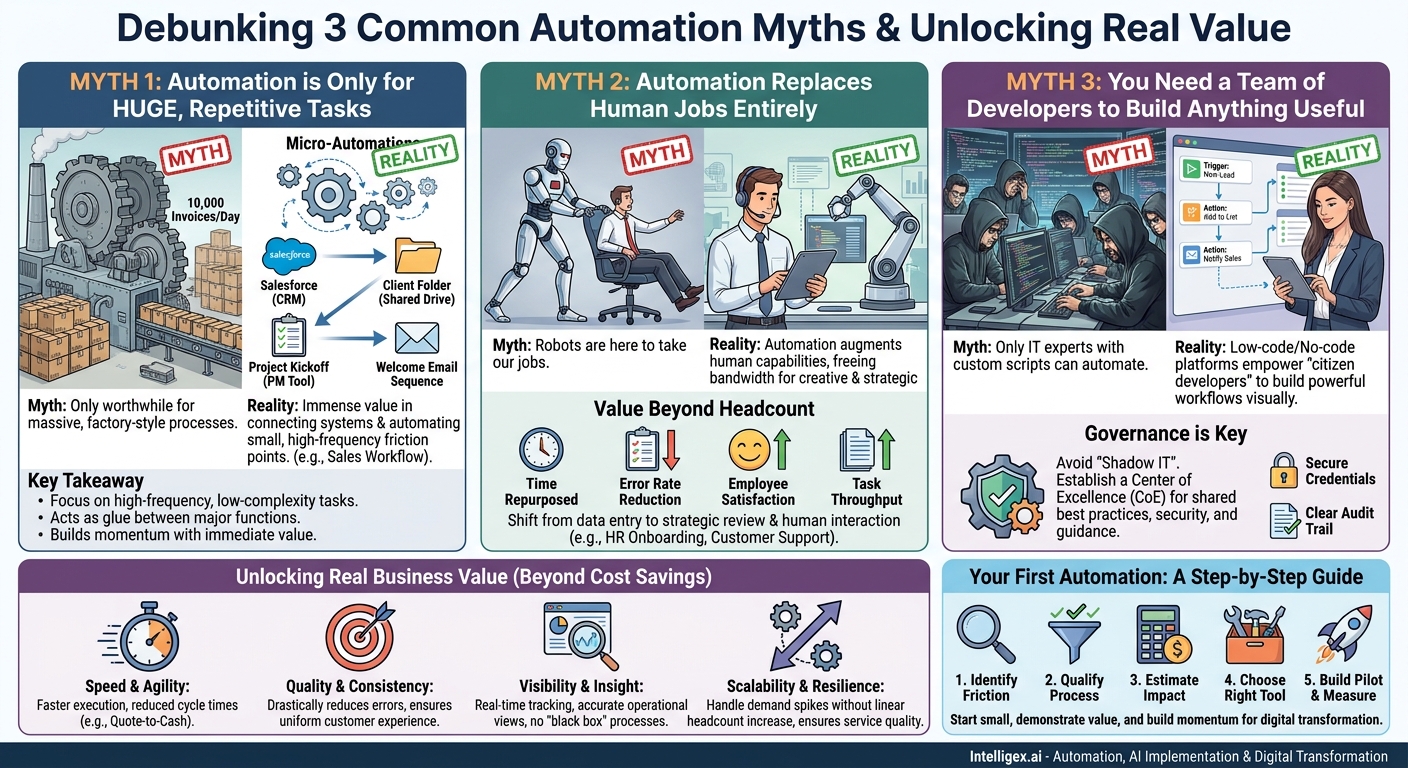
One of the most persistent myths is that automation is only worthwhile for massive, factory-style processes like processing ten thousand invoices a day. While it certainly excels there, this all-or-nothing thinking causes businesses to overlook the immense value of automating smaller, more frequent tasks. The collective impact of these “micro-automations” can be transformative.
Think of the daily friction points that slow your teams down. These are the small, repetitive actions that, on their own, seem insignificant. But when multiplied across a team and over a year, they represent a significant drain on productivity and morale.
The Power of Connecting Systems
Modern automation isn’t about a single, monolithic system. It’s often about creating smart, resilient bridges between the applications you already use. Instead of replacing your entire tech stack, you’re making it work together seamlessly.
- Sales Example: When a salesperson marks a deal as “Closed-Won” in your CRM like Salesforce, an automation can instantly trigger several actions. It can create a new client folder in your shared drive with the standard template, generate a project kickoff task in your project management tool, and send a welcome email sequence to the new client. This eliminates manual setup, ensures consistency, and accelerates the transition from sales to delivery.
- Finance Example: Instead of manually downloading bank statements and comparing them to accounting software entries, a simple automation can fetch the data daily. It can automatically match 90% of transactions based on clear rules (like vendor name and amount) and flag only the exceptions for human review. This doesn’t replace the accountant; it turns them into a strategic reviewer instead of a data entry clerk.
The takeaway: Don’t hunt for a single, massive process to automate. Instead, look for the high-frequency, low-complexity tasks that act as glue between your major business functions. Solving these smaller problems first builds momentum and delivers immediate value.
Myth: Automation Replaces Human Jobs Entirely
The narrative of “robots taking our jobs” is compelling, but it largely misses the point of modern business automation. The goal is not replacement, but augmentation. Automation excels at tasks that are rule-based, repetitive, and data-intensive, which are precisely the tasks that humans find tedious and are prone to making errors in.
By delegating this work to software, you free up your team’s cognitive bandwidth for activities that require creativity, critical thinking, and empathy. This is not about reducing headcount; it’s about elevating the capabilities and value of your existing team.
From Task-Doer to Strategic Thinker
Consider the impact on different roles:
- Human Resources: Onboarding a new employee involves dozens of small, repetitive tasks: creating system accounts, ordering equipment, and sending informational emails. An automation can orchestrate this entire workflow, ensuring nothing is missed. This allows the HR partner to spend their time on the human elements: checking in with the new hire, facilitating team introductions, and ensuring they feel welcomed and supported.
- Customer Support: A support agent might spend a significant amount of time gathering customer history from three different systems before they can even begin to solve a problem. An automation can collate this information and present it to the agent the moment a ticket is opened. The result is a faster resolution for the customer and a more empowered, less frustrated agent.
What to Measure Beyond Headcount
Instead of focusing on job elimination, track metrics that show how automation is enhancing your workforce:
- Time Repurposed: Calculate the hours saved from manual tasks and map them to the higher-value activities employees are now performing.
- Error Rate Reduction: Measure the decrease in errors for processes like data entry, order processing, or financial reporting.
- Employee Satisfaction: Survey employees in roles affected by automation. Often, you’ll find higher job satisfaction as tedious work is removed.
- Task Throughput: Measure the volume of work a team can handle. An augmented team can often process significantly more requests or transactions without a drop in quality.
Myth: You Need a Team of Developers to Build Anything Useful
A decade ago, automation was largely the domain of IT departments and software developers who could write custom scripts and complex integrations. Today, the landscape has changed dramatically with the rise of low-code and no-code automation platforms. These tools use visual, drag-and-drop interfaces that allow business users, often called “citizen developers,” to build powerful workflows without writing a single line of code.
An operations manager can connect their project management tool to their team’s chat application. A marketing specialist can build a workflow that adds new webinar registrants to a specific email list and notifies the sales team. This democratization of technology is powerful, but it comes with a critical caveat: it requires governance.
The Pitfall of Ungoverned Automation
When anyone can build an automation, you risk creating a “shadow IT” environment. Workflows may be built without proper oversight, using insecure methods to store credentials, or without any documentation. When an employee leaves, their undocumented automations can fail, causing disruptions that are difficult to diagnose. The key is to empower users within a structured framework.
A practical approach is to establish a small Center of Excellence (CoE) or at least a set of shared best practices. This group can provide guidance on which tools to use, how to manage credentials securely, and when a process is complex enough that it should be handed over to the IT team for a more robust implementation.
Finding Your First Automation Opportunity: A Step-by-Step Guide
Starting with automation can feel overwhelming. The best way to begin is by choosing one small, high-impact process to serve as your pilot project. This allows you to learn, demonstrate value quickly, and build the confidence to tackle more complex challenges. Follow these steps to identify and launch your first initiative.
- Identify the Friction: The best candidates for automation are the tasks that your team dislikes the most. Listen for complaints about “manual data entry,” “copy-pasting between spreadsheets,” or “always having to check on the status of things.” Shadow a team member for an hour and watch for these patterns. Where are they toggling between windows? Where are they re-typing the same information?
- Qualify the Process: Not every frustrating task is a good fit for automation. A strong candidate has a few key characteristics:
- It is rule-based. The decisions within the process follow clear “if-then” logic.
- It uses structured digital input. The process starts with data from a predictable source, like an email, a web form, or a system API.
- It is high-frequency or high-volume. It happens many times a day or involves a large amount of data.
- It is stable. The process doesn’t change significantly from week to week.
- Estimate the Impact: Before you build anything, define what success looks like. Calculate a simple return on investment. If a task takes 10 minutes and is performed 15 times a day by two people, you’re looking at 5 hours of work per day. Also consider the “soft” benefits. What is the business cost of a data entry error in this process? How would faster completion improve the customer experience?
- Choose the Right Tool for the Job: The complexity of the process determines the tool. A simple data sync between two cloud apps might be perfect for a no-code platform. A process that interacts with an old desktop application might require a Robotic Process Automation (RPA) tool. A task that requires complex data transformation might be best handled by a small script written by a developer. Don’t try to force every problem into the same solution.
- Build a Pilot and Measure: Automate only a small, self-contained part of the process first. Run it in a test environment and validate that it works as expected. Once you’re confident, deploy it and immediately start tracking the metrics you defined in step three. This data will be your best asset when making the case for further automation investment.
The Business Value Isn’t Just Cost Savings
While reducing manual effort is a primary driver for automation, focusing solely on cost savings misses a much larger story. The true value of a well-implemented automation strategy is measured across several dimensions that directly impact revenue, customer satisfaction, and your ability to compete.
Speed and Agility
Automation collapses the time it takes to get work done. This isn’t just about doing things faster; it’s about reducing the latency between steps in a process. A faster quote-to-cash cycle means improved cash flow. A quicker customer support resolution means a happier, more loyal customer. In a competitive market, the ability to execute faster is a significant advantage.
Quality and Consistency
Humans make mistakes, especially when performing repetitive tasks. An automation executes a process the exact same way every single time. This drastically reduces errors in financial reporting, order fulfillment, and data management. This consistency also translates to the customer experience. When every customer receives the same timely, accurate communication during their onboarding, it builds trust and sets a professional tone for the relationship.
Visibility and Insight
Many business processes are a “black box.” A request goes in, and an outcome eventually comes out, but it’s difficult to know where things stand in the middle. Automation can provide unprecedented visibility. By orchestrating a process, the automation platform knows the status of every task. This data can be fed into real-time dashboards, giving leaders an accurate view of operational performance, from supply chain movements to sales pipeline velocity, without having to manually request status updates from their teams.
Scalability and Resilience
Automation allows your operations to scale without a linear increase in headcount. A software bot can process 100 invoices or 10,000 with the same level of effort. This makes your business more resilient and able to handle sudden spikes in demand, such as a holiday sales rush or a successful marketing campaign, without overwhelming your team or degrading the quality of service.
Implementing Automation Safely and Responsibly
As you begin to automate processes, especially those involving sensitive customer or financial data, it is critical to build on a foundation of security and governance. Empowering your teams is important, but it must be balanced with guardrails that protect your business and your customers. A “move fast and break things” approach is not suitable for enterprise automation.
Focus on these key principles for safe implementation:
- Use Principle of Least Privilege: When an automation needs to access a system, such as your ERP or CRM, it should use a dedicated service account, not an employee’s personal credentials. This account should be granted the minimum permissions necessary to perform its specific task and nothing more.
- Protect Sensitive Data: Ensure all automation workflows are designed in compliance with data privacy regulations like GDPR and CCPA. Passwords, API keys, and other credentials should be stored in a secure vault, not in plain text within a script or workflow diagram.
- Incorporate a Human in the Loop: For decisions that are high-stakes or require judgment, automation should assist, not decide. The system can flag a transaction for potential fraud, analyze a candidate’s resume against a job description, or identify a contract clause that deviates from the standard. However, the final decision to block the transaction, reject the candidate, or approve the contract must be made by a human expert.
- Maintain a Clear Audit Trail: Every action taken by an automation should be logged. If an automated process makes an error, you need a clear, accessible record to understand what went wrong, what data was affected, and how to correct it.
Your Next Steps: From Myth to Momentum
Moving past the myths is the first step. The next is to take small, deliberate action. Don’t try to draft a five-year enterprise-wide automation strategy. Instead, focus on delivering a single, tangible win within the next quarter. This will build the skills, confidence, and business case you need to scale your efforts effectively.
Here is a simple plan to get started:
- Assemble a Small, Cross-Functional Team: Bring together one person from business operations and one from IT. This partnership ensures that what you build is both technically sound and solves a real business problem.
- Identify One High-Friction Process: Use the guide from earlier to find a single process that is rule-based, repetitive, and a known source of frustration. Choose something low-risk but highly visible.
- Define Success and Go: Clearly define what you want to improve. Is it reducing processing time from 4 hours to 15 minutes? Is it cutting the error rate to zero? Set a clear target, build your pilot, and measure the result.
By focusing on real-world problems and practical solutions, you can harness automation to create a more efficient, resilient, and innovative organization. The journey starts not with a massive technological leap, but with a single, well-chosen step.
Your Next Read:
Category:
Get a FREE
Proof of Concept
& Consultation
No Cost, No Commitment!
