

The conversation around Artificial Intelligence has shifted. No longer is it a question of if a business should adopt AI, but how and when. The initial wave of excitement, fueled by futuristic demos and bold promises, is now meeting the pragmatic reality of the C-suite: What is the return on investment? Business leaders, department heads, and project managers are tasked with building a compelling business case, and that case must be built on a solid, quantifiable foundation. Simply stating that AI will “drive innovation” or “create efficiencies” is no longer enough. You need a robust model to prove it.
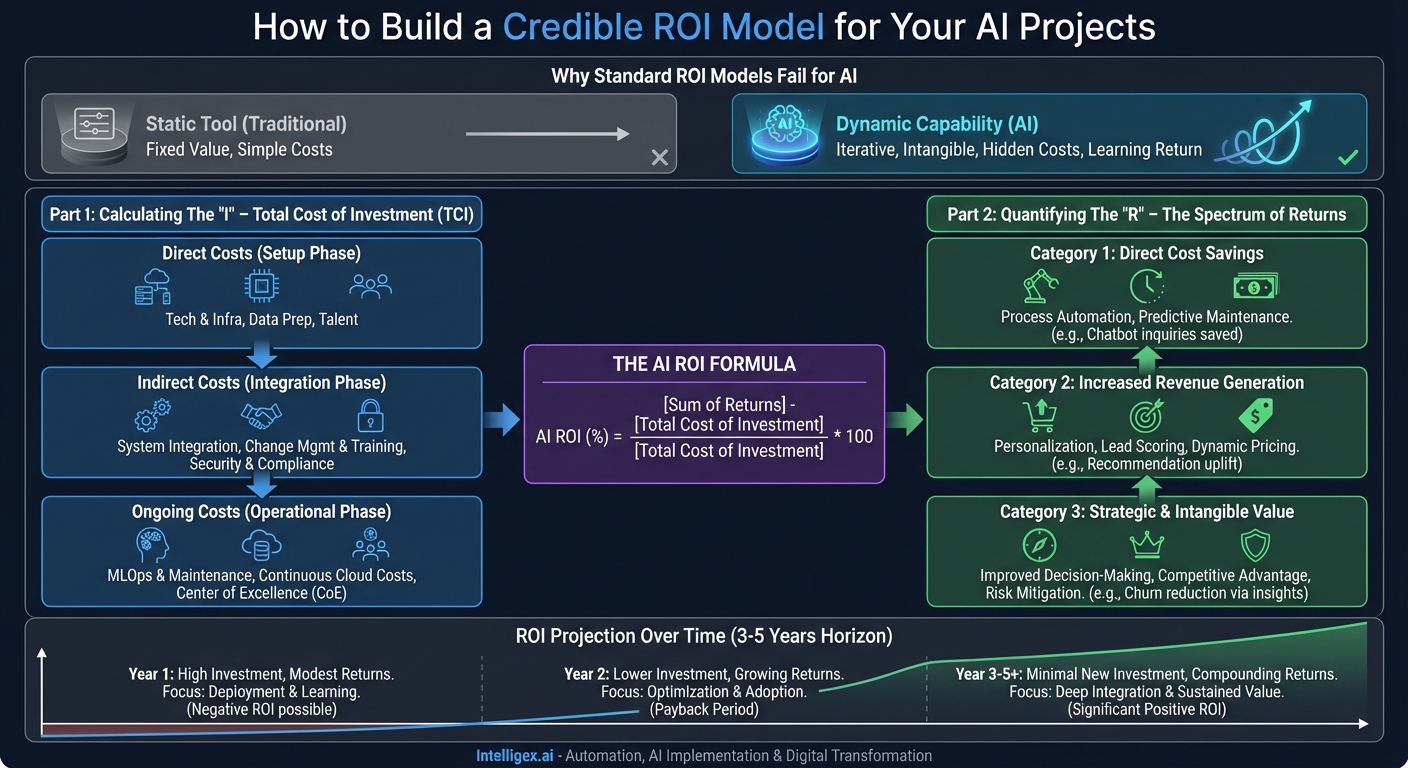
Traditional ROI models, often used for standard software implementation or capital expenditure, frequently fall short when applied to AI integration. This is because AI is not a static tool; it’s a dynamic capability. Its value evolves, its costs can be complex, and many of its most profound benefits are not immediately obvious on a balance sheet. A specialized ROI model for AI isn’t just a “nice-to-have” — it’s an essential framework for making informed decisions, securing budgets, and measuring success in a way that truly reflects the technology’s impact.
Why Standard ROI Models Don’t Work for AI
Before building a new model, it’s crucial to understand why the old ones are insufficient. AI projects have unique characteristics that defy simple cost-benefit analysis:
- Iterative and Evolving Value: Unlike a new CRM system that has a fixed functionality on day one, an AI model learns and improves. Its accuracy, efficiency, and impact can increase over time with more data and retraining. A static ROI snapshot taken at month three fails to capture the compounding value at month twelve or twenty-four.
- Significant Intangible Benefits: How do you assign a precise dollar value to a 20% improvement in employee morale because tedious tasks were automated? Or the brand uplift from a hyper-personalized customer experience? These strategic benefits, such as enhanced decision-making, competitive differentiation, and improved risk mitigation, are core to AI’s value but are notoriously difficult to quantify.
- Complex and Hidden Costs: The initial software license or cloud compute cost is just the tip of the iceberg. The true Total Cost of Investment (TCI) for AI includes data acquisition and cleaning, specialized talent acquisition, extensive employee training, change management, and the ongoing operational costs of monitoring and maintaining models (MLOps).
- The “Return on Learning”: Often, the first AI project’s most significant return isn’t financial. It’s the organizational knowledge gained—the new skills, data infrastructure, and understanding of what’s possible. This foundational learning accelerates the ROI of all future AI initiatives, a factor completely absent from traditional models.
A proper AI ROI model must account for this complexity, blending quantifiable metrics with structured estimates for strategic value, all projected over a realistic time horizon.
Building a Comprehensive AI ROI Model: The Core Components
A robust model is built on two primary pillars: a comprehensive understanding of the full investment and a multi-faceted view of the returns. Let’s break down what to include in each.
Part 1: Calculating the “I” – The Total Cost of Investment (TCI)
To get an accurate picture, you must look beyond the initial price tag. Your investment calculation should be exhaustive, categorizing costs into direct, indirect, and ongoing buckets.
Direct Costs (The Setup Phase)
- Technology & Infrastructure: This includes licensing for AI platforms (e.g., TensorFlow, PyTorch, vendor-specific solutions), specialized hardware like GPUs if on-premise, and, most commonly, cloud computing credits (e.g., AWS SageMaker, Google AI Platform, Azure ML).
- Data Acquisition & Preparation: Data is the fuel for AI. Costs here can include purchasing third-party datasets, and the significant man-hours required for data cleaning, labeling, and annotation to make it usable for training models. This is often the most underestimated cost.
- Talent & Development: This covers the salaries of the team building the solution—data scientists, machine learning engineers, data engineers, and project managers. If you’re using external consultants, their fees fall into this category.
Indirect Costs (The Integration Phase)
- Integration with Existing Systems: The AI model is useless in isolation. There are real costs associated with the engineering work required to connect the AI’s outputs (e.g., a prediction, a classification) to your existing CRM, ERP, or operational software.
- Change Management & Training: Your team needs to trust and effectively use the new AI-powered tool. This requires investment in training programs, documentation, and communication campaigns to drive adoption and overcome resistance.
- Security & Compliance: Integrating AI introduces new data privacy and security considerations. Budget for security audits, legal reviews (especially concerning GDPR, CCPA), and implementing new compliance protocols.
Ongoing Costs (The Operational Phase)
- Model Maintenance & MLOps: AI models are not “set it and forget it.” They require continuous monitoring to detect “model drift” (where performance degrades as real-world data changes). This MLOps (Machine Learning Operations) function includes costs for retraining, redeploying, and versioning models.
- Continuous Cloud/Infrastructure Costs: The model needs to run somewhere. These are the ongoing compute and storage costs for keeping the AI operational in a production environment.
- Center of Excellence (CoE): For larger organizations, this includes the overhead of a dedicated team that governs AI usage, shares best practices, and supports various business units.
Part 2: Quantifying the “R” – The Spectrum of Returns
The return side of the equation is where a nuanced approach is most critical. We can categorize returns into three types, moving from the most concrete to the most strategic.
Category 1: Direct Cost Savings
This is the most straightforward category to measure and is often the primary driver for initial AI projects. These are efficiencies that directly reduce operational expenditures.
Example: Implementing an AI-powered chatbot to handle 40% of tier-1 customer service inquiries.
Calculation: (Number of inquiries handled by AI) x (Average cost per human-handled inquiry) = Annual Cost Saving.
Other examples include:
- Process Automation: Automating data entry, invoice processing, or report generation. The ROI is calculated based on employee hours saved.
- Predictive Maintenance: Using AI to predict machinery failure in a factory, reducing costly unplanned downtime and emergency repair expenses.
- Supply Chain Optimization: AI models that optimize delivery routes to reduce fuel consumption and driver time.
Category 2: Increased Revenue Generation
This category focuses on how AI can be used to drive top-line growth. These gains are often realized by improving sales effectiveness and customer value.
Example: An e-commerce site using an AI recommendation engine to personalize product suggestions.
Calculation: (Average uplift in order value from recommended products) x (Number of transactions with recommendations) = Incremental Revenue.
Other examples include:
- Lead Scoring & Prioritization: AI models that analyze customer data to identify leads most likely to convert, allowing the sales team to focus their efforts more effectively.
- Dynamic Pricing: Algorithms that adjust prices in real-time based on demand, competition, and customer behavior to maximize revenue.
- Churn Prediction: Identifying customers at high risk of leaving and targeting them with proactive retention offers, thus preserving a revenue stream.
Category 3: Strategic & Intangible Value
This is the most challenging category to quantify but often holds the greatest long-term value. While you can’t always assign a direct dollar figure, you can use proxy metrics to estimate the financial impact.
Example: Using AI to analyze customer feedback from thousands of sources to identify key drivers of dissatisfaction.
Proxy Metric: The project leads to a product improvement that reduces customer churn by 1%.
Calculation: (1% of annual revenue from retained customers) = Quantified Strategic Value.
Other examples include:
- Improved Decision-Making: AI-powered dashboards provide faster, more accurate insights. Proxy: Tie this to a reduction in costly errors or faster time-to-market for a new product.
- Competitive Advantage: Being the first in your industry to offer an AI-powered feature. Proxy: Model a conservative estimate of increased market share over two years.
- Risk Mitigation: An AI fraud detection system that reduces fraudulent transactions. This has a direct, measurable financial return in a cost-saving category but also the strategic value of protecting brand reputation.
The AI ROI Formula and Time Horizon
Once you have cataloged your investments and returns, you can bring them together. The fundamental formula remains the same, but the inputs are far more detailed:
AI ROI (%) = ( [Sum of Cost Savings + Sum of Revenue Gains + Sum of Quantified Strategic Value] – Total Cost of Investment ) / Total Cost of Investment * 100
Crucially, this calculation should not be a single number. It must be projected over a time horizon, typically 3 to 5 years. Why? Because the TCI is often front-loaded in Year 1, while the returns (especially revenue and strategic value) may take longer to materialize and will grow as the AI model improves.
Your ROI analysis should be a timeline that shows:
- Year 1: High investment, modest returns. ROI may even be negative. The focus is on deployment and learning.
- Year 2: Lower investment (mostly maintenance), growing returns as the system is optimized and adoption increases. Payback period is often reached here.
- Year 3-5: Minimal new investment, compounding returns as the AI capability becomes deeply embedded in business processes, driving significant and sustained value.
Viewing ROI over time tells a much more realistic and compelling story. It acknowledges the initial investment runway and highlights the long-term, compounding power of artificial intelligence. It transforms the conversation from a short-term cost center to a long-term strategic investment, which is precisely what AI is.
Your Next Read:
Category:
Get a FREE
Proof of Concept
& Consultation
No Cost, No Commitment!