

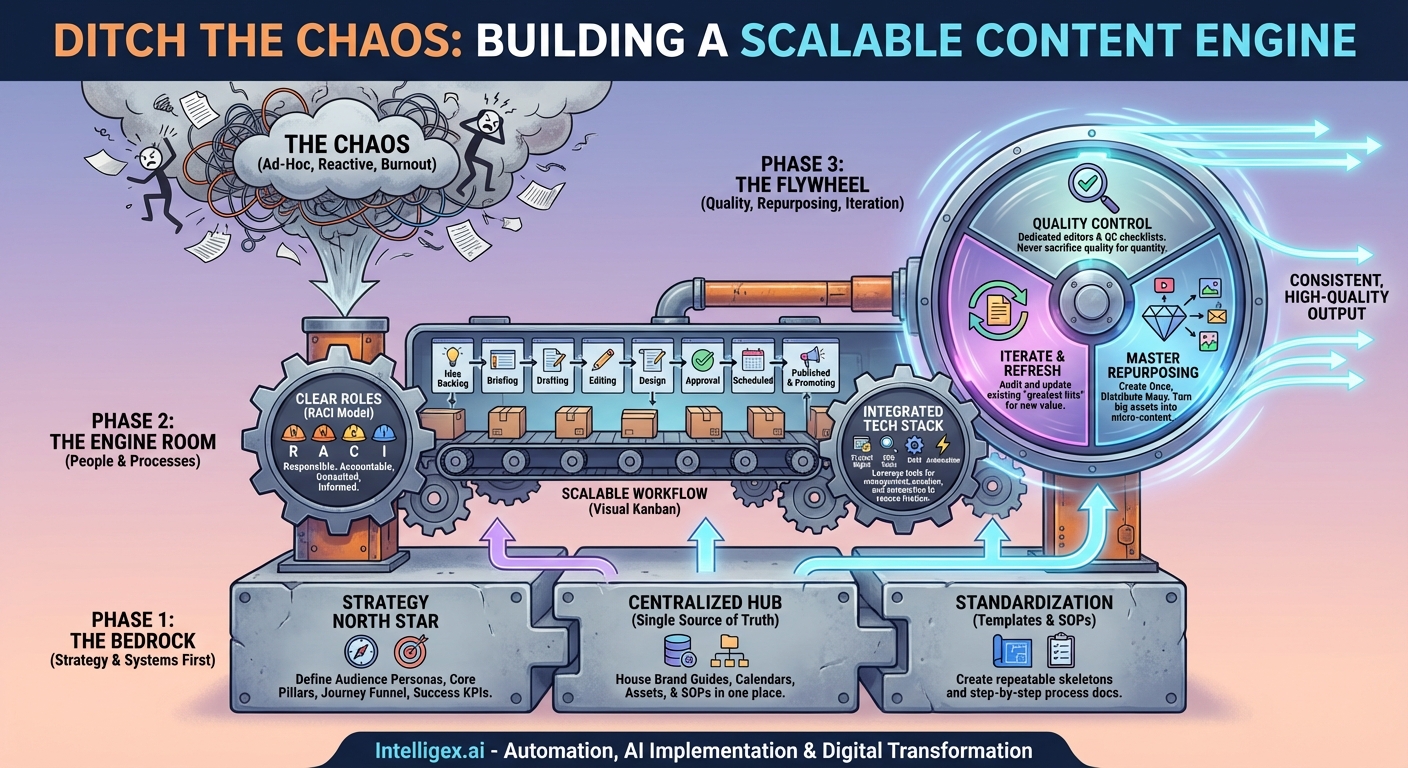
The pressure is constant: create more. More blog posts, more social media updates, more videos, more case studies. In a world where content is the engine of growth, the demand to scale production feels like an inevitability. But for many teams, the attempt to ramp up output results in a predictable and painful explosion of chaos. Deadlines are missed, the brand voice becomes a cacophony of different styles, quality plummets, and the team burns out trying to keep the runaway train on the tracks.
Scaling content isn’t about simply hitting “publish” more often. It’s about building a sophisticated, resilient engine that can increase output without sacrificing quality or sanity. It’s about moving from a frantic, reactive mode to a calm, proactive system. The good news is that this isn’t a mythical state reserved for mega-corporations. With the right foundation, processes, and mindset, you can scale your content production gracefully and effectively. It’s not about working harder; it’s about working smarter within a well-defined framework.
The Bedrock: Strategy and Systems First
You wouldn’t build a skyscraper on a foundation of sand, yet many teams try to scale content without a solid strategic base. Before you hire another writer or invest in a new tool, you must lock down the “why” and “how” of your content operation. This foundational work is the single most important factor in preventing future chaos.
Solidify Your Content Strategy as the North Star
If you don’t know who you’re talking to, what you want to say, and what you want them to do, creating more content will only amplify your confusion. A documented content strategy is your non-negotiable North Star. It ensures that every single piece of content, whether it’s the first or the five-hundredth, serves a purpose.
Your documented strategy should clearly define:
- Target Audience Personas: Go beyond demographics. What are their pain points, goals, and watering holes? What questions are they asking at each stage of their journey?
- Core Messaging & Content Pillars: What are the 3-5 key themes your brand owns? Every piece of content should tie back to one of these pillars, ensuring consistency and reinforcing your expertise.
- The Customer Journey Funnel: Map out what content is needed for Top-of-Funnel (Awareness), Middle-of-Funnel (Consideration), and Bottom-of-Funnel (Decision) stages. This prevents you from creating ten “Ultimate Guides” when what you really need is a compelling case study.
- Success Metrics & KPIs: How do you define a win? Is it traffic, leads, conversions, or brand mentions? Knowing this prevents you from churning out content that looks busy but achieves nothing.
Create a Centralized Content Hub: Your Single Source of Truth
Chaos thrives in information silos. When brand guidelines are in one person’s inbox, topic ideas are in a scattered spreadsheet, and final assets are on someone’s desktop, you’re doomed to fail at scale. A centralized content hub, or “single source of truth,” is essential.
Think of this as your content operation’s mission control. It’s a living repository where anyone involved in the content process can find what they need, instantly.
This hub, which can be built in tools like Notion, Asana, Confluence, or even a highly organized Google Drive, should house:
- The Brand & Style Guide: Detailed rules on tone of voice, grammar (e.g., Oxford comma yes/no), formatting, and brand personality.
- Audience Personas: Easy access for every creator to reference who they are writing for.
- Content Assets: Logos, approved imagery, brand colors, and font files.
- The Master Editorial Calendar: A view of all content in progress and planned across all channels.
- SOPs and Templates: The “blueprints” for how you create, which we’ll cover next.
Standardize Everything with Templates and SOPs
Creativity needs structure to flourish, especially at scale. Templates and Standard Operating Procedures (SOPs) are not about stifling creativity; they are about eliminating repetitive, low-value decisions so your team can focus on high-impact creative work.
Templates provide a repeatable skeleton for your content formats. A blog post template, for example, might include:
- A pre-built structure (Introduction, Body Paragraphs, Conclusion).
- An SEO checklist (target keyword, meta description, internal linking reminders).
- A call-to-action (CTA) placeholder.
- Prompts for including quotes, images, or data points.
SOPs document the entire process from start to finish. Create a clear, step-by-step document for your entire content lifecycle: from idea submission and keyword research to drafting, editing, design, final approval, publishing, and promotion. This ensures everyone knows what their role is, what happens next, and what “done” looks like at each stage.
The Engine Room: People and Processes
With a solid foundation in place, you can now focus on building the operational engine that will power your content scaling. This is where you define who does what, how they do it, and what tools they use to make it happen seamlessly.
Define Crystal-Clear Roles and Responsibilities
One of the fastest routes to chaos is ambiguity. When people aren’t sure who owns a task, it either doesn’t get done or five people try to do it at once. The RACI model is a powerful framework for bringing clarity:
- Responsible: The person(s) who does the work (e.g., the writer drafting the blog post).
- Accountable: The one person who owns the final outcome and has veto power (e.g., the Content Marketing Manager). There can only be one “A”.
- Consulted: The experts whose input is needed (e.g., a subject matter expert, the legal team).
- Informed: The people who need to be kept in the loop (e.g., the sales team, the social media manager).
Map this out for your entire content workflow. Who is responsible for keyword research? Who is accountable for the editorial calendar? Who needs to be consulted before a technical whitepaper is published? Documenting this eliminates bottlenecks and endless “just checking in” emails.
Implement a Scalable Production Workflow
Your SOP document describes the process; your workflow is where it comes to life. A visual, stage-based workflow is critical for managing a higher volume of content. A Kanban-style board (popularized by tools like Trello, Asana, and Jira) is perfect for this.
Create columns representing each stage of your content process:
- Idea Backlog: A repository of vetted ideas.
- To Do / Briefing: Ideas that have been approved and are ready for a creative brief.
- In Progress / Drafting: The content is actively being written.
- In Review / Editing: The draft is with the editor for review.
- Design / Assets: The piece is with a designer for custom graphics or formatting.
- Final Approval: A final check by the accountable owner.
- Scheduled: Ready to go, scheduled in your CMS or social media tool.
- Published & Promoting: It’s live! Now the promotion checklist kicks in.
This visual system gives everyone on the team immediate visibility into the status of every single content piece, preventing things from falling through the cracks.
Leverage the Right Technology Stack
Technology should be an accelerator, not an anchor. The goal is to build an integrated tech stack that reduces friction and automates manual tasks.
Key categories to consider:
- Project Management: Asana, Trello, ClickUp, or Monday.com to manage your workflow.
- Content Creation & Optimization: SEO tools like SEMrush or Ahrefs for research, writing assistants like Grammarly and Clearscope for quality and optimization.
- Collaboration & Asset Management: Google Workspace or Microsoft 365 for document collaboration. A Digital Asset Management (DAM) system to organize and distribute approved images and videos.
- Publishing & Automation: Your CMS (like WordPress or HubSpot), social media schedulers (Buffer, Sprout Social), and automation tools like Zapier to connect different apps and automate repetitive tasks (e.g., when a card moves to “Published,” automatically create a task for the social media team).
The Flywheel: Quality, Repurposing, and Iteration
Scaling successfully isn’t a one-time project; it’s about creating a self-sustaining flywheel. Once your engine is built, the focus shifts to maintaining quality and maximizing the value of every piece of content you create.
Never Sacrifice Quality for Quantity
This is the cardinal rule. Scaling content is pointless if what you’re producing is mediocre. As you increase velocity, you must also heighten your commitment to quality. A dedicated editor is not a luxury; it’s a necessity at scale. They are the guardians of your brand voice, style guide, and overall quality bar. Implement a multi-point quality control checklist that is used during the final review stage. It’s always better to publish three excellent, high-impact articles than ten forgettable ones.
Master the Art of Repurposing
The single most powerful tactic for scaling without chaos is to stop thinking in terms of “one-off” content pieces. Every major piece of content you create is a potential goldmine of smaller assets. This “create once, distribute many” approach is the ultimate efficiency hack.
Consider how a single, in-depth webinar can be atomized into:
- A long-form blog post summarizing the key takeaways.
- 5-7 short video clips for social media.
- A multi-part email nurture sequence.
- A beautiful infographic visualizing the core data.
- A slide deck for SlideShare.
- Quote graphics from the speaker.
By building repurposing directly into your workflow, you can multiply your content output without exponentially increasing the creation effort.
Refresh and Republish Your Greatest Hits
Not all new content has to be created from scratch. Your existing content is a valuable asset. Regularly audit your content to identify posts that are still relevant but could use an update. Refreshing them with new data, updated examples, and better SEO can bring a massive return in traffic and engagement for a fraction of the effort of creating a new piece from the ground up.
Scaling content creation isn’t a dark art; it’s a discipline. It’s a conscious shift away from chaotic, ad-hoc efforts toward a deliberate, system-driven operation. By investing time upfront to build a foundation of strategy, standardized processes, and clear roles, you create an environment where your team can do their best work. You build not just a content calendar, but a true content engine—one that can accelerate and scale, producing more value, not more chaos.
Your Next Read:
Category:
Get a FREE
Proof of Concept
& Consultation
No Cost, No Commitment!
