

The energy surrounding a new marketing campaign launch is electric. Ideas are flowing, creative assets are taking shape, and the entire team is buzzing with the potential for massive success. But beneath this excitement often lies a complex web of dependencies, deadlines, and communication channels that can quickly become tangled. A brilliant campaign concept can fall flat, not because the idea was flawed, but because a critical step was missed, a key team was left out of the loop, or a simple handoff was fumbled. In today’s interconnected business environment, a marketing launch is never a solo mission; it’s a full-scale, cross-departmental operation.
Silos are the silent killers of great campaigns. When the marketing team works in a vacuum, the sales team receives leads they weren’t prepared for, customer support is blindsided by questions about a new promotion, and the web team is scrambling to fix a broken form that went unnoticed. This is where a comprehensive, cross-team launch checklist becomes your most valuable asset. It transforms potential chaos into a coordinated, strategic execution. It’s the master plan that ensures every department—from creative and sales to legal and product—is aligned, informed, and moving in unison toward a shared goal. This checklist is your blueprint for turning a high-stakes launch into a smooth, successful, and repeatable process.
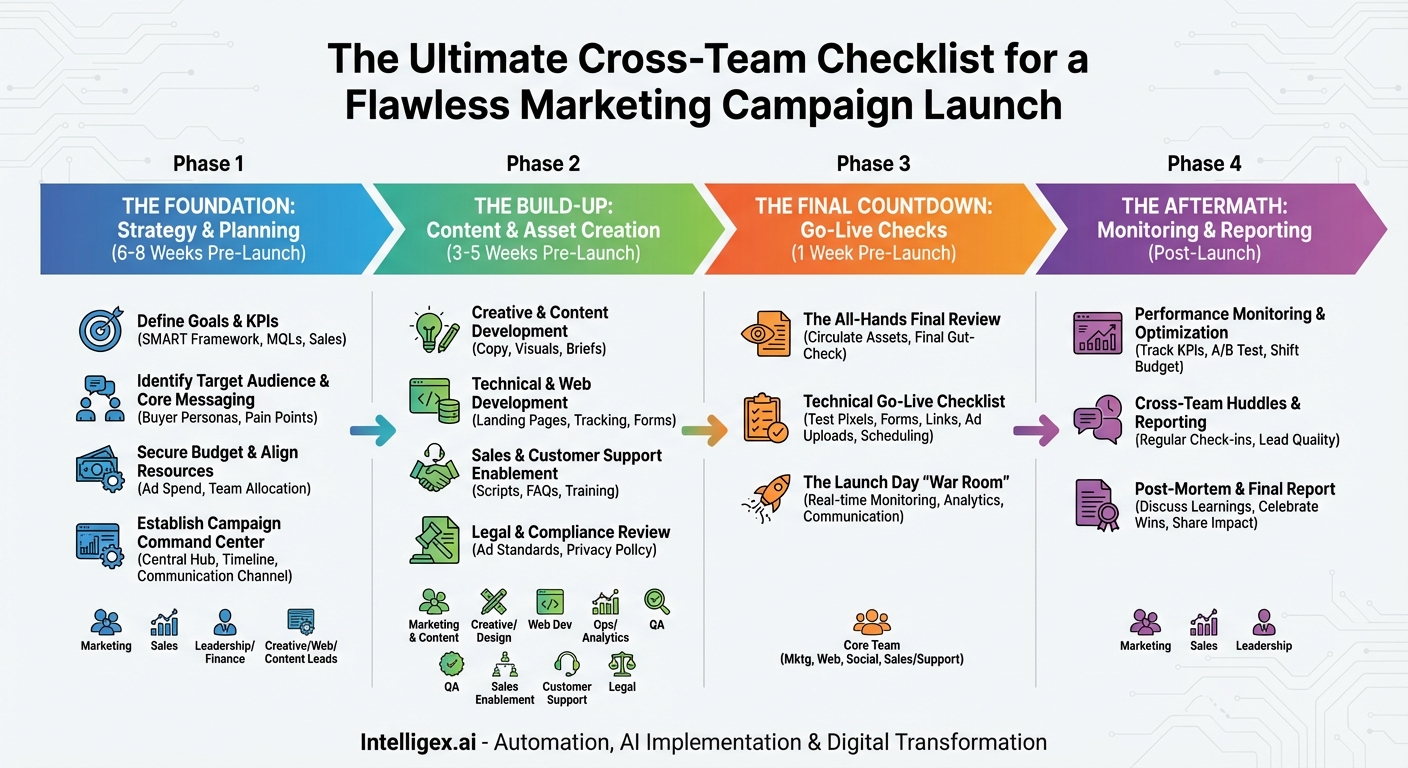
Phase 1: The Foundation – Strategy & Planning (6-8 Weeks Pre-Launch)
Long before the first ad is designed or the first line of copy is written, the strategic foundation must be laid. This phase is about defining the ‘why’ and ‘what’ of your campaign. Getting alignment here is non-negotiable, as every subsequent decision will build upon these initial agreements. Rushing this stage is like building a house on sand; it’s bound to crumble under pressure.
Define Goals & Key Performance Indicators (KPIs)
You can’t hit a target you haven’t defined. The first step is to establish crystal-clear objectives. Are you aiming to generate marketing qualified leads (MQLs), drive direct sales, increase free trial sign-ups, or boost brand awareness and share of voice? Use the SMART framework to ensure your goals are Specific, Measurable, Achievable, Relevant, and Time-bound.
- Marketing Team: Leads the definition of campaign goals, such as “Generate 500 MQLs from the new eBook with a 15% conversion rate on the landing page within Q3.”
- Sales Team: Provides crucial input on lead quality. They must agree on the MQL definition to ensure the leads marketing generates are valuable and actionable for them. This alignment prevents friction later.
- Leadership/Finance: Approves the high-level goals and connects them to broader business objectives, such as revenue targets.
Identify Target Audience & Core Messaging
Who, exactly, are you trying to reach? Generic messaging appeals to no one. Dive deep into your buyer personas, understanding their pain points, motivations, and the channels where they spend their time. Once you know your audience, you can craft a compelling core message and value proposition that resonates.
- Product Marketing Team: This is their sweet spot. They work to translate product features into customer-centric benefits that form the core of the campaign’s messaging. They ensure the story you’re telling is authentic to the product.
- Marketing Team: Develops the campaign narrative and tailors the core message for different channels (e.g., social media vs. email).
- Sales & Customer Support Teams: Offer invaluable, on-the-ground insights. They speak with customers every day and know the exact language, questions, and objections that come up. Use their knowledge to refine your messaging.
Secure Budget & Align Resources
A campaign is fueled by two things: money and people. You need a clear budget breakdown for ad spend, content creation, freelance support, and any new software or tools required. Just as important is knowing who is responsible for each component of the campaign.
- Marketing Leadership: Works with the finance department to secure the overall budget for the campaign.
- Team Leads (Creative, Web, Content): Provide estimates for the resources required from their teams. This helps in identifying potential bottlenecks early. Do you have enough design capacity? Will the web team be able to build the landing page in time?
Establish the Campaign Command Center
Coordination requires a single source of truth. Choose a project management tool (like Asana, Monday.com, Trello, or Jira) to house the master plan. This central hub should include:
- A detailed timeline with all major milestones, tasks, dependencies, and owners.
- A central location for key documents like the campaign brief, messaging guide, and approved budget.
- A dedicated communication channel (e.g., a Slack or Microsoft Teams channel) for all campaign-related discussions to keep conversations organized and out of cluttered inboxes.
Phase 2: The Build-Up – Content & Asset Creation (3-5 Weeks Pre-Launch)
With a solid strategy in place, it’s time to bring the campaign to life. This is the “production” phase where ideas are transformed into tangible assets. Constant communication and structured feedback loops are critical to keeping this intricate process on track.
Creative & Content Development
This is where the copy is written, the visuals are designed, and all the customer-facing materials are produced. It starts with a comprehensive creative brief that outlines the campaign goals, audience, messaging, and specifications for each deliverable.
- Marketing & Content Team: Drafts all written materials: email copy, landing page content, blog posts, social media updates, ad copy, press releases, and scripts for videos.
- Creative/Design Team: Develops the visual identity of the campaign. This includes ad creatives, social media graphics, email templates, landing page designs, infographics, and any video production.
- Key Stakeholders: A designated group (e.g., Head of Marketing, Product Marketing Manager) must be responsible for reviewing and approving assets to prevent delays caused by too many conflicting opinions.
Technical & Web Development
The most beautiful landing page is useless if the form doesn’t work. The technical build is the backbone of your campaign’s conversion path.
- Web Development Team: Builds and develops landing pages, thank you pages, and any necessary website pop-ups or banners. They ensure pages are mobile-responsive and load quickly.
- Marketing Operations/Analytics Team: Sets up all tracking infrastructure. This includes creating unique UTM parameters for every link to track traffic sources accurately, installing tracking pixels (e.g., Meta Pixel, LinkedIn Insight Tag), and configuring goals in Google Analytics. They also build the forms and automation workflows in the marketing automation platform (e.g., HubSpot, Marketo).
- QA/Testing: A cross-functional group from marketing and web should rigorously test all pages and forms across different browsers and devices to catch bugs before launch.
Sales & Customer Support Enablement
Your internal teams are your campaign’s front line. They need to be equipped and trained to handle the inquiries and leads the campaign will generate. A launch should never be a surprise to them.
- Sales Enablement/Product Marketing: Creates materials for the sales team, including call scripts, email templates for follow-up, battle cards detailing the offer and competitive positioning, and a one-pager summarizing the campaign.
- Customer Support Leadership: Works with marketing to develop a comprehensive FAQ document to prepare the support team for anticipated questions. They also prepare canned responses for live chat and email to ensure consistent and accurate answers.
- Training: A mandatory training session should be held for both sales and support teams a week before launch to walk them through the campaign, the offer, the target audience, and the new resources available to them.
Legal & Compliance Review
This is a critical, often overlooked step that can halt a campaign in its tracks. All public-facing materials must be reviewed to ensure they comply with advertising standards, data privacy laws (like GDPR and CCPA), and company policies.
- Legal Team: Reviews ad copy for misleading claims, checks the rules for any contests or giveaways, and approves the privacy policy language on lead capture forms.
- Marketing Team: Must build time for legal review into the project timeline from the very beginning. Submitting 50 pages of copy to the legal team the day before launch is a recipe for failure. Provide assets in batches as they are finalized.
Phase 3: The Final Countdown – Go-Live Checks (1 Week Pre-Launch)
The final days before launch are all about double-checking, triple-checking, and ensuring every single element is perfectly in place. This is not the time for new ideas or strategic shifts; it’s about meticulous execution of the plan.
The All-Hands Final Review
Circulate a final “package” of all campaign assets to the primary stakeholder from each involved team. This is a final gut-check to catch any glaring errors, typos, or broken links. Set a clear, firm deadline for feedback.
Technical Go-Live Checklist
The technical team runs through a final pre-flight checklist to confirm everything is operational.
- Confirm all tracking pixels are firing correctly using browser extensions like the Meta Pixel Helper.
- Submit a test lead through every form to ensure it’s captured correctly in the CRM/marketing automation platform and that the follow-up automation (e.g., a “thank you” email) is triggered.
- Double-check that all links in emails, social posts, and on the landing page are correct and tagged with the proper UTMs.
- Verify that ad campaigns are fully uploaded into the ad platforms, correctly targeted, and ready to be activated.
- Schedule all emails and social media posts in their respective platforms.
The Launch Day “War Room”
On launch day, don’t just press “go” and walk away. Assemble a core team to monitor the launch in real-time.
- Core Team: This should include the campaign manager (marketing), a representative from the web team, a social media manager, and a point of contact from sales/support.
- Monitoring: Watch the analytics dashboards as the first wave of traffic comes in. Check for any unusual bounce rates or error messages.
- Communication: The campaign manager should send a company-wide announcement once the campaign is officially live. The “war room” team should stay in constant communication on their dedicated channel to quickly flag and address any issues that arise.
Phase 4: The Aftermath – Monitoring & Reporting (Post-Launch)
The launch is just the beginning. The real work of managing and optimizing the campaign happens in the days and weeks that follow.
Performance Monitoring & Optimization
Continuously track your campaign KPIs against the goals you set in Phase 1. Don’t wait until the end of the campaign to check the results.
- Marketing Team: Monitors dashboards daily. Are ad click-through rates low? Maybe the creative needs a refresh. Is the landing page conversion rate below target? It might be time to A/B test a new headline. Be prepared to shift budget from underperforming channels to those that are driving the best results.
Cross-Team Huddles & Reporting
Maintain the lines of communication that you worked so hard to build. Schedule regular, brief check-ins.
- Marketing & Sales Huddle: Meet regularly to review lead quality. Is sales happy with the MQLs being generated? Are they converting to opportunities? This feedback loop is essential for optimizing targeting and messaging.
- Post-Mortem Meeting: Once the campaign concludes, hold a formal post-mortem with representatives from all involved teams. Discuss what went well, what challenges were encountered, and what could be improved next time. Document these learnings.
- Final Report: Compile a comprehensive report that details the campaign’s performance against its goals. Share this with leadership and the entire company to celebrate wins and showcase the impact of a truly collaborative effort.
A successful marketing campaign is a complex symphony with many moving parts. By replacing assumptions and last-minute scrambles with a structured, cross-team checklist, you empower every department to play its part perfectly. This methodical approach not only minimizes errors and reduces stress but also fosters a culture of collaboration and shared ownership, ensuring that your next great idea gets the flawless launch it truly deserves.
Related Posts
Category:
Get a FREE
Proof of Concept
& Consultation
No Cost, No Commitment!
