

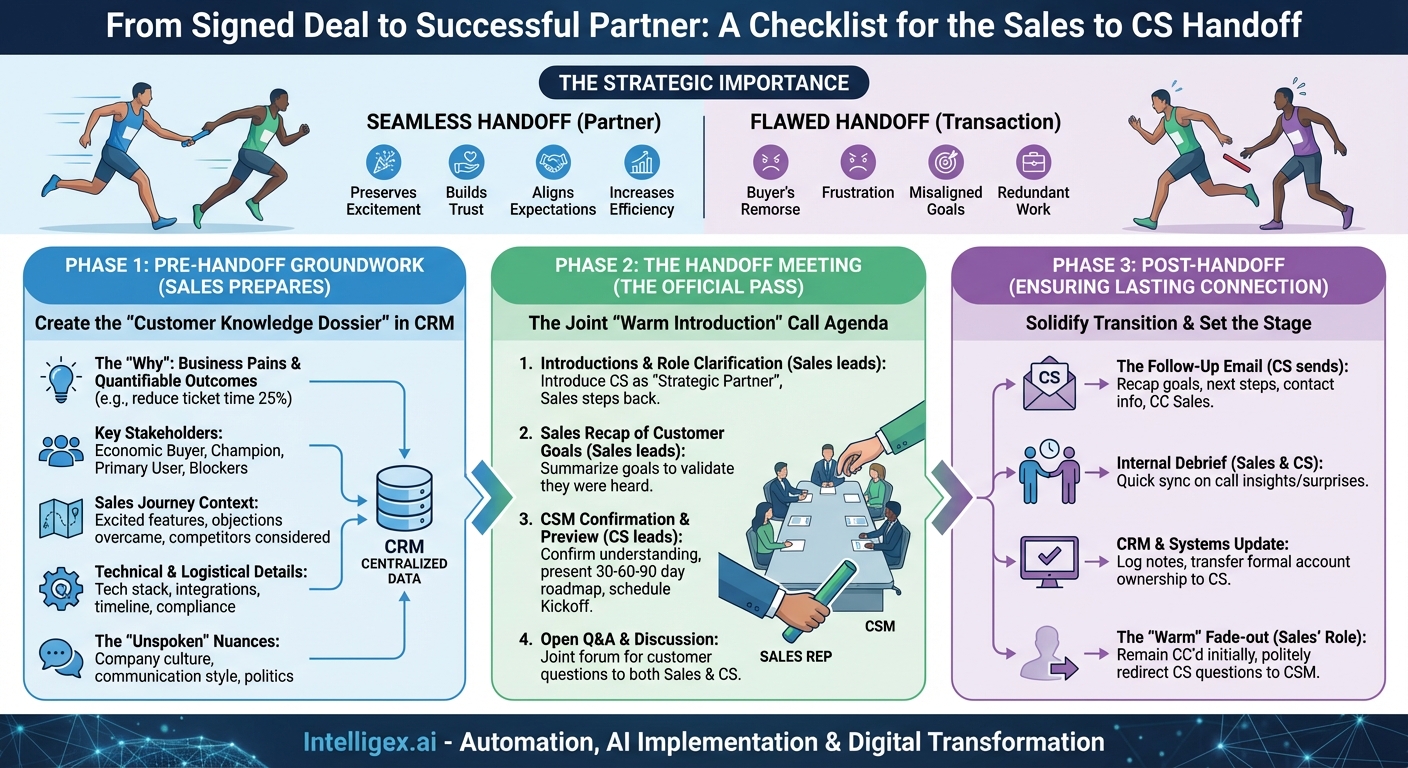
The ink is dry, the contract is signed, and the sales team is celebrating a hard-won victory. For them, a chapter has closed. But for the customer, the story is just beginning. This pivotal moment—the transition from a prospective buyer to a valued partner—is one of the most fragile and critical points in the entire customer lifecycle. It’s the moment where the promises of the sales cycle must begin their transformation into the reality of the customer experience. A clumsy, disorganized, or incomplete handoff from Sales to Customer Success (CS) can shatter the excitement and momentum you’ve worked so hard to build, planting seeds of doubt and paving the way for future churn. Conversely, a seamless, well-orchestrated handoff validates the customer’s decision, builds immediate trust, and sets the foundation for a long and profitable relationship.
Too often, this handoff is treated as a simple administrative task: an email with a few attachments, a quick note in the CRM, or a hurried internal chat message. This approach is a strategic failure. The handoff isn’t a baton pass; it’s a carefully choreographed relay where both runners are in sync, ensuring the baton is transferred securely without losing speed. It’s the first real test of your company’s promise to be a partner, not just a vendor. This comprehensive checklist is designed to move your organization from a transactional handoff to a transformational one, ensuring your new customers feel welcomed, understood, and confident from day one.
The Strategic Importance of a Seamless Handoff
Before diving into the checklist itself, it’s essential to understand why this process deserves so much attention. A flawed handoff creates downstream problems that can plague a customer relationship for its entire duration. Investing time and resources into perfecting this process yields significant returns by:
- Preserving Customer Excitement: The moment a customer signs, they are at their peak of optimism and excitement. They are eager to start seeing the value you promised. A slow or confusing handoff immediately deflates this enthusiasm and replaces it with frustration and anxiety, a phenomenon often called “buyer’s remorse.” A smooth process, in contrast, channels their excitement directly into a productive onboarding experience.
- Building Trust and Confidence: A structured handoff demonstrates that your company is organized, professional, and customer-centric. When the Customer Success Manager (CSM) enters the first conversation already knowing the customer’s key challenges, goals, and stakeholders, it sends a powerful message: “We listen, we communicate internally, and we value your time.”
- Aligning Expectations: Misaligned expectations are the number one killer of customer satisfaction. The handoff is the primary mechanism for ensuring that the expectations set during the sales process are accurately understood and documented for the team responsible for delivering on them. It prevents the dreaded phrase, “But the salesperson told me it could do this…”
- Increasing Internal Efficiency: A comprehensive handoff saves countless hours of redundant work. The CSM doesn’t have to re-discover information the sales representative already spent months gathering. This allows the CSM to focus their time on strategic activities like implementation planning and value creation, rather than administrative fact-finding.
Phase 1: Pre-Handoff Groundwork – What Sales Must Prepare
A successful handoff begins long before the introduction email is sent. It starts with the diligent and systematic collection of information by the sales team. The goal is to create a “Customer Knowledge Dossier” that arms the CSM with all the context they need to succeed. This information should be centrally located, ideally within your CRM, and standardized across the team.
The Customer Knowledge Dossier: Arming CS for Success
This dossier is more than just contact information. It’s a narrative that tells the customer’s story. Here are the essential components:
-
The “Why”: Business Pains and Desired Outcomes. This is the most critical piece of information.
- What specific pain points drove them to seek a solution? Were they losing money, wasting time, or falling behind competitors?
- What are their explicit business goals? Go beyond “they want to improve efficiency.” Get to the quantifiable metric: “They want to reduce average support ticket resolution time by 25% within six months,” or “They need to increase marketing-qualified leads from their website by 15% in Q3.”
- What was the “aha!” moment in the sales process where they understood your value?
-
Key Stakeholders and Their Motivations. A map of the people involved.
- Economic Buyer: Who holds the budget and signed the contract? What is their primary concern (e.g., ROI, cost savings)?
- Champion: Who fought for your solution internally? What are their personal and professional motivations for its success? This person is the CSM’s most important initial ally.
- Primary Day-to-Day Contact/User: Who will the CSM be working with most closely? What are their technical capabilities and what does a “win” look like for them in their role?
- Potential Blockers or Skeptics: Was there anyone on the team who was hesitant or preferred a competitor? Knowing this allows the CSM to proactively address their concerns and win them over.
-
The Sales Journey and Product Context. The story of how they got here.
- What specific features or use cases generated the most excitement?
- Were there any features they asked about that you don’t have? Were any workarounds discussed?
- What were the key objections raised during the sales process and how were they overcome?
- Which competitors were they seriously considering? Knowing this helps the CSM position your value against alternatives.
-
Technical and Logistical Details. The practical information.
- What is their current tech stack? Note any systems that will need to integrate with your product.
- Are there any non-standard terms, unique pricing structures, or specific service-level agreements (SLAs) in the contract?
- What is the agreed-upon timeline for implementation and launch?
- Are there any known security or compliance requirements that need to be addressed during onboarding?
-
The “Unspoken” Nuances. The crucial context that never makes it into a contract.
- What is their company culture like? Formal and process-driven, or agile and fast-moving?
- Are they a demanding customer? Are they highly communicative or more hands-off?
- Are there any internal politics or upcoming organizational changes the CSM should be aware of (e.g., a key contact going on maternity leave, a potential re-org)?
Phase 2: The Handoff Meeting – The Official Baton Pass
Once the Customer Knowledge Dossier is complete, the next step is a formal handoff meeting. This can be an internal meeting first, followed by a joint call with the customer. The “warm introduction” call with the customer is non-negotiable; it’s the centerpiece of a world-class handoff process.
Crafting the Perfect Handoff Meeting Agenda
This meeting should be scheduled by the sales representative and positioned as an exciting next step in the customer’s journey. It solidifies the relationship and formally transfers ownership in a way that feels seamless to the customer.
-
Introductions and Role Clarification (5-10 mins):
- The sales representative introduces the Customer Success Manager, not as a “support contact,” but as a “strategic partner” dedicated to helping the customer achieve their business goals.
- The CSM briefly explains their role, focusing on partnership, strategy, and value realization.
- Clearly articulate the transition: The sales rep explains they will be stepping back but will remain connected, while the CSM will now be the primary point of contact for onboarding, strategy, and ongoing success.
-
Sales Recap of Customer Goals (5 mins):
- The sales rep briefly summarizes their understanding of the customer’s primary goals and reasons for purchasing. This is incredibly powerful. It shows the customer that they were heard and that the information they shared has been passed on internally. It’s the ultimate validation.
- Example: “John, when we first spoke, you mentioned the key challenge was the 10 hours per week your team was spending on manual reporting. Our main goal here is to get that time back for you by automating that entire workflow.”
-
CSM Confirmation and Onboarding Preview (10-15 mins):
- The CSM takes the lead, confirming their understanding of the goals: “Thanks, Sarah. And John, my understanding is that beyond saving time, the goal is to use that automated report to present a clear ROI of your team’s efforts to the board. Is that right?”
- The CSM then lays out a clear, high-level plan for the next 30-60-90 days. This isn’t a detailed project plan, but a roadmap that shows the customer what to expect. This manages expectations and builds confidence.
- This is the time to schedule the official onboarding kickoff call.
-
Open Q&A and Discussion (5-10 mins):
- Create space for the customer to ask questions. They may have questions for both Sales (about the contract) and CS (about the process). Having both parties on the call prevents delays and confusion.
Phase 3: Post-Handoff – Ensuring a Lasting Connection
The work isn’t over when the meeting ends. The immediate follow-up actions are what solidify the transition and set the stage for a successful onboarding.
- The Follow-Up Email: Within a few hours of the call, the CSM should send a summary email to the customer, CC’ing the sales rep. This email should thank the customer, reiterate their primary goals, confirm the next steps and scheduled meetings, and provide relevant contact information.
- Internal Debrief: The sales rep and CSM should have a quick 15-minute debrief. Did anything new or surprising come up on the call? Are there any updated concerns or priorities? This closes the internal loop.
- CRM and Systems Update: All notes from the handoff call should be logged in the CRM, and the official account ownership should be transferred to the CSM. All systems should reflect the CSM as the new primary point of contact.
- The “Warm” Fade-out: For the first few weeks, the sales rep should remain CC’d on key communications. If the customer reaches out to them directly with a CS-related question, the sales rep should reply promptly and loop in the CSM, reinforcing the CSM’s role. Example: “Great question! I’ve copied our Customer Success expert, Alex, who is the best person to help you with that. Alex, can you take it from here?” This gently and professionally redirects the relationship.
From Transaction to Partnership
A meticulous Sales to Customer Success handoff is more than just a process; it’s a statement of a company’s culture. It signals that you see your customers as partners, not just transactions. It’s the first and most important delivery on the promises your brand makes. By treating this moment with the strategic importance it deserves, you stop the leaks in your customer lifecycle, reduce early-stage churn, and build the strong, trusting foundations necessary for true, long-term customer success.
Your Next Read:
Category:
Get a FREE
Proof of Concept
& Consultation
No Cost, No Commitment!
