

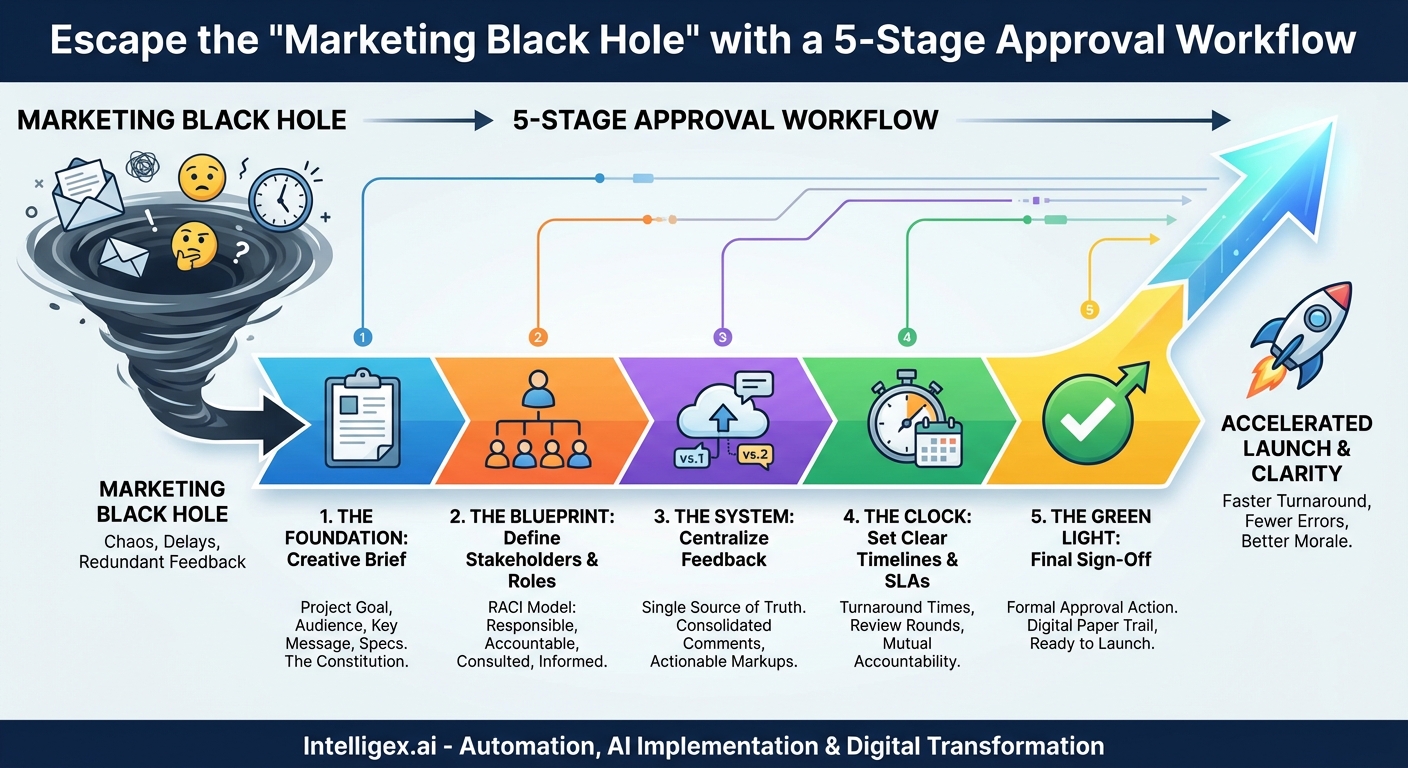
Every marketing team knows the feeling. A brilliant campaign is conceived, the creative is compelling, and the strategy is sound. But then it enters the approval process—a frustrating, opaque vortex where good ideas go to face endless delays. It’s a common bottleneck where momentum dies, deadlines are missed, and team morale plummets. This “marketing black hole” isn’t a necessary evil; it’s a symptom of a broken, or non-existent, workflow. The constant back-and-forth over email, conflicting feedback from different stakeholders, and the dreaded “Final_v3_for_review_FINAL.psd” file name are all signs that you’re losing time, money, and competitive advantage. The solution isn’t to work harder or faster within a flawed system. The solution is to build a better system: a clear, structured marketing approval workflow designed for speed, clarity, and efficiency.
Why Your Current “Approval Process” Is Costing You More Than Just Time
If your approval process feels more like a chaotic scramble than a streamlined system, you’re not alone. Many teams operate on an ad-hoc basis, relying on shoulder taps, instant messages, and sprawling email chains. This approach might feel flexible, but it’s incredibly inefficient and creates significant problems that ripple across the entire department.
The Hallmarks of a Broken Workflow
- Undefined Roles and Responsibilities: When it’s unclear who needs to review what and who has the final say, chaos ensues. A junior designer gets strategic feedback from a sales manager, while the CMO, the ultimate decision-maker, isn’t looped in until the last minute. This leads to redundant feedback and late-stage changes that derail the entire project.
- Decentralized Communication: Feedback arrives from every direction—email, Slack, Microsoft Teams, a project management tool, and comments on a shared document. It’s impossible for the creative team to consolidate this feedback, prioritize changes, and ensure nothing is missed. Conflicting advice from different stakeholders forces creatives to become diplomats instead of creators.
- Vague and Unactionable Feedback: Comments like “I don’t like it,” “make it pop more,” or “can we give this more ‘wow’ factor?” are frustratingly common and entirely unhelpful. Without a structured process that requires specific, objective feedback tied to the project brief, review rounds become subjective guessing games.
- Version Control Nightmares: Without a single source of truth, team members are left wondering if they’re working on the latest version. Time is wasted cross-referencing files and tracking down the most recent edits, and the risk of publishing an outdated or incorrect asset is dangerously high.
- The Bottleneck Effect: Often, the entire process grinds to a halt waiting for one key person to provide their input. This individual may be busy or unaware of the urgency, but their delay holds up the entire team and jeopardizes the campaign timeline.
The Five Essential Stages of a High-Speed Marketing Approval Workflow
Building an effective workflow isn’t about adding bureaucracy; it’s about creating a clear path from creation to launch. By standardizing the process, you eliminate ambiguity and empower your team to move forward with confidence. A truly efficient workflow can be broken down into five distinct, sequential stages.
Stage 1: The Foundation – The Creative Brief
An approval process can’t be fast if the project starts on shaky ground. The creative brief is the single most important document in the entire lifecycle of a marketing asset. It is the constitution for your project, and all feedback and approvals should be measured against it. A weak brief guarantees a painful review process.
A rock-solid creative brief must include:
- Project Objective: What is the business goal? What are we trying to achieve? (e.g., “Generate 200 MQLs from the finance sector.”)
- Target Audience: Who are we speaking to? What are their pain points and motivations?
- Key Message: What is the single most important thing we need to communicate?
- Mandatories and Constraints: What must be included? (e.g., logo, tagline, specific CTA, legal disclaimer).
- Deliverables and Specs: A clear list of every asset needed, including dimensions, file types, and channels.
- Stakeholders: A preliminary list of who will be involved in the review process.
Stage 2: The Blueprint – Define Stakeholders and Roles
Not everyone needs a say on everything. Involving too many people creates “design by committee,” while involving the wrong people leads to irrelevant feedback. Use a simplified RACI model (Responsible, Accountable, Consulted, Informed) to clarify everyone’s role before the first draft is even created.
- Responsible: The person or team doing the work (e.g., the graphic designer, the copywriter).
- Accountable: The single person who owns the project and has final sign-off authority (e.g., the Marketing Manager, the CMO). This is crucial—there can only be one “A.”
- Consulted: Subject matter experts whose input is needed (e.g., a product expert for feature accuracy, a legal advisor for compliance). Their feedback is a suggestion, not a directive.
- Informed: People who need to be kept in the loop but are not active reviewers (e.g., the Head of Sales). They receive the final asset but don’t participate in the review rounds.
Defining these roles in the project’s kickoff phase prevents confusion and empowers the “Accountable” individual to filter and prioritize feedback.
Stage 3: The System – Centralize Feedback and Revisions
This is where email chains go to die. To achieve speed, you must have a single source of truth for all feedback. Using a dedicated online proofing tool or a robust project management platform with proofing capabilities is non-negotiable for modern marketing teams.
Your centralized system should enable:
- Consolidated Comments: All reviewers leave feedback on the same file, at the same time. They can see each other’s comments, which reduces redundant or conflicting notes.
- Actionable Markups: Reviewers can pinpoint specific areas on a design or in a video and leave a direct comment, eliminating guesswork.
- Version Stacking: New versions are “stacked” on top of old ones, making it easy to compare changes and ensure feedback was implemented correctly.
- Automated Routing: Once one reviewer or group finishes, the asset is automatically sent to the next person in the chain.
Stage 4: The Clock – Set Clear Timelines and SLAs
A workflow without deadlines is just a list of suggestions. Service Level Agreements (SLAs) for review cycles are essential for maintaining momentum. These aren’t meant to be punitive; they’re meant to create mutual accountability and predictability.
Establish clear expectations for turnaround times, such as:
- Creative Team: 48 hours to turn around a new version after receiving consolidated feedback.
- Reviewers: 24 hours to provide feedback once a new version is submitted.
- Rounds of Review: Cap the standard process at two or three rounds of review. Any more suggests a problem with the initial brief.
These timelines should be communicated and agreed upon at the start of the project. If a reviewer can’t meet the deadline, they must proactively communicate this so the project manager can adjust the schedule.
Stage 5: The Green Light – The Final Sign-Off
The final approval should be a formal, decisive action, not a casual “looks good” in a chat message. This is the point of no return. The “Accountable” stakeholder gives the official sign-off, confirming that the asset has met all requirements of the brief and is ready for launch. In your system, this should be a clear action, like clicking an “Approve” button. This creates a digital paper trail, confirms that the review process is officially complete, and gives the production team the unambiguous green light to publish or ship the asset.
Best Practices for a Seamless Implementation
Defining the workflow is half the battle; successfully implementing it is the other. Here’s how to ensure your new process sticks.
- Leverage the Right Technology: While you can start with a simple project management tool like Asana or Trello, dedicated online proofing platforms like Ziflow, Filestage, or PageProof are game-changers. They are built specifically to handle the complexities of creative review and approval.
- Standardize with Templates: Create templates for everything: your creative briefs, your project plans, and your feedback guidelines. Templates reduce mental overhead and ensure consistency across all projects.
- Over-Communicate During Rollout: Don’t just send an email with the new process. Hold a training session. Explain the “why” behind the change—how it will reduce frustration and help everyone do their best work.
- Empower Your Project Manager: A strong project manager or traffic manager is the engine of this workflow. Empower them to enforce the process, chase down approvals, and act as the central point of communication. They are not nags; they are protectors of the timeline and the sanity of the creative team.
- Review and Iterate: Your workflow is a living document. Schedule a quarterly review to discuss what’s working and what isn’t. Gather feedback from the team and be willing to make adjustments to optimize the process further.
The Payoff: More Than Just Faster Turnaround
Implementing a structured marketing approval workflow does more than just get campaigns out the door faster. It transforms the way your team works. The benefits are profound: a dramatic reduction in team frustration, fewer errors and costly last-minute changes, greater creative consistency across all channels, and a renewed focus on producing high-impact work. By replacing chaos with clarity, you give your brilliant marketing ideas the streamlined path to execution they deserve, turning the dreaded approval process from a bottleneck into a competitive advantage.
Your Next Read:
Get a FREE
Proof of Concept
& Consultation
No Cost, No Commitment!