
You’ve done the hard work. The research is complete, the subject matter expert has been interviewed, and the first draft is a masterpiece of insight and clarity. Your content is 90% of the way to the finish line, ready to engage audiences and drive results. Yet, this final 10%—the gauntlet of reviews, formatting, and publishing—often consumes an outsized amount of time and energy, turning the triumphant home stretch into a frustrating crawl. This “last mile” problem is one of the most common and corrosive issues in content production. It’s where momentum dies, deadlines are missed, and team morale takes a hit. The culprits are almost always the same: a tangled review cycle, a chaotic formatting process, and a perilous final upload. These aren’t just minor inconveniences; they are systemic bottlenecks that signal a breakdown in your content operations. Addressing them isn’t just about moving faster; it’s about reclaiming control over your content lifecycle and ensuring your brilliant work actually sees the light of day when it matters most.
The Review Roundabout: When Feedback Becomes a Bottleneck
The content review process is intended to be a quality-control gate, a collaborative step to refine and elevate the final product. Too often, however, it devolves into an endless loop of conflicting opinions, vague suggestions, and unresponsive stakeholders. This “review roundabout” is arguably the single biggest source of delay in the entire content production workflow.
Common Symptoms of a Broken Review Process
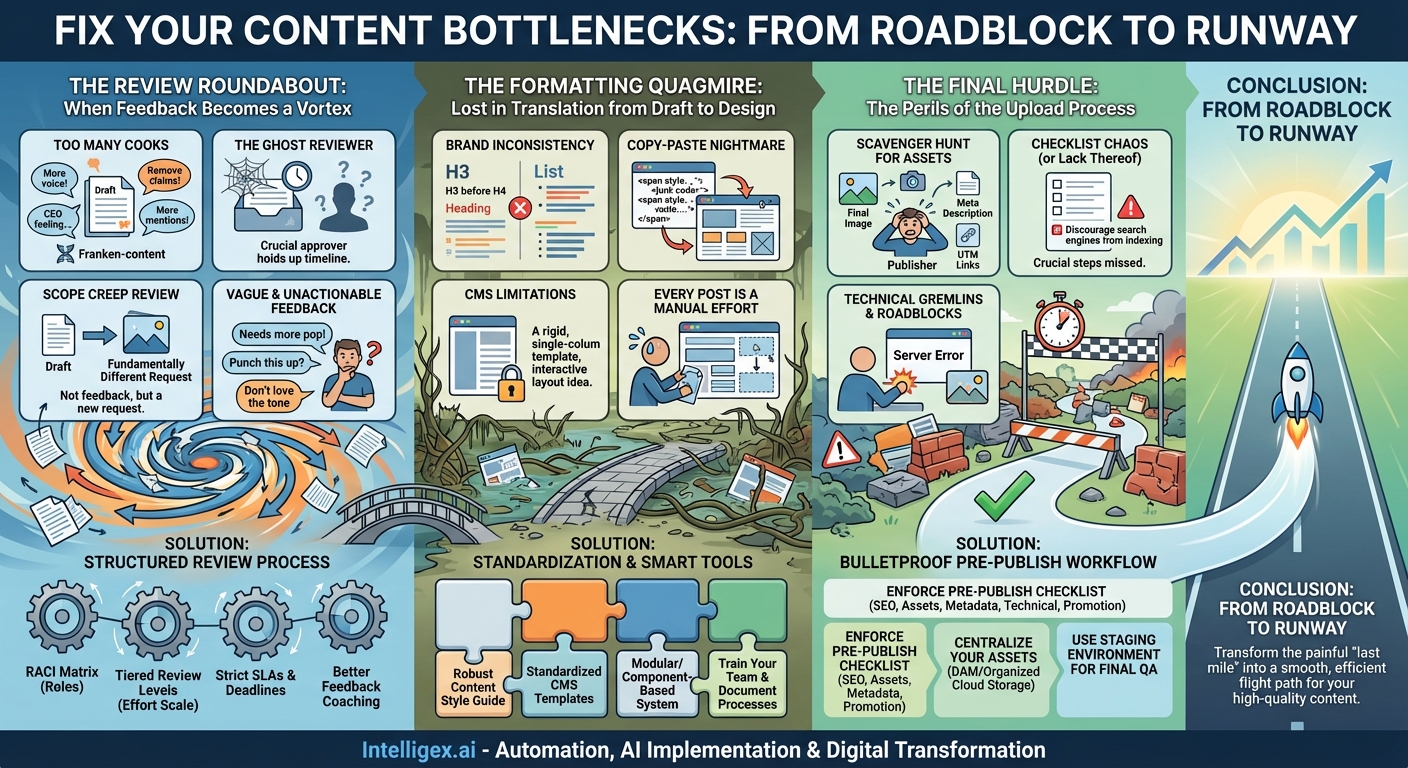
- The “Too Many Cooks” Syndrome: A draft is sent to a long list of stakeholders, each with their own perspective and authority. The marketing director wants more brand voice, the sales lead wants more product mentions, the legal team wants to remove any definitive claims, and the CEO just has a “feeling” about the opening paragraph. The content creator is left trying to reconcile contradictory feedback, resulting in a watered-down, Franken-content that pleases no one.
- The “Ghost Reviewer”: There’s always one crucial person whose sign-off is non-negotiable, but who is notoriously difficult to pin down. The content sits in their inbox for days, or even weeks, holding up the entire production line. Gentle nudges escalate to frantic pleas, and the entire project timeline is held hostage by a single, silent stakeholder.
- The “Scope Creep” Review: The feedback provided goes far beyond the scope of a typical review. Instead of refining the existing content, a reviewer requests a fundamental change in direction, angle, or target audience. This isn’t feedback; it’s a request for a new piece of content, disguised as a revision.
- Vague and Unactionable Feedback: Comments like “This needs more pop,” “Can we punch this up?” or “I don’t love the tone” are common but utterly useless. They leave the creator guessing at the reviewer’s intent, leading to multiple rounds of revisions that fail to hit a constantly moving target.
How to Escape the Roundabout and Streamline Reviews
Fixing your review process requires shifting from an informal, ad-hoc approach to a structured, transparent system with clear rules of engagement. Here’s how to start:
1. Establish a RACI Matrix: Before a single word is written, define who is Responsible, Accountable, Consulted, and Informed. The “Accountable” person is the single approver with final say. The “Consulted” group provides input, but their feedback is not a gate for publication. This simple chart clarifies roles, limits the number of cooks in the kitchen, and empowers the “Accountable” party to make the final call.
2. Implement Tiered Review Levels: Not all content is created equal. A tweet does not require the same level of scrutiny as a formal whitepaper. Create tiers for your content types. A blog post might only require review from an editor and a single subject matter expert (SME). A major e-book, however, might need additional review from the head of marketing and the legal department. Tiering the process ensures that resources and time are allocated appropriately.
3. Enforce Strict Timelines with SLAs: Ambiguous deadlines invite delays. Set clear Service Level Agreements (SLAs) for feedback—for example, 48 hours for a standard blog post. Use a project management tool to assign review tasks with firm due dates. Crucially, you must also introduce a consequence for missing the deadline. A common and effective rule is: “If feedback is not provided by the deadline, we will assume you have no changes and move forward.” This creates urgency and respects the project timeline.
4. Coach Your Team on Giving Better Feedback: Guide your stakeholders on how to provide constructive, actionable feedback. Ask them to tie their comments directly to the goals outlined in the content brief. Encourage them to use suggesting mode or comments in tools like Google Docs to propose specific changes rather than offering vague critiques. For highly critical or complex pieces, consider scheduling a 30-minute “live review” session where all key reviewers can discuss their feedback in real-time to quickly reach a consensus.
The Formatting Quagmire: Lost in Translation from Draft to Design
Once a piece of content finally escapes the review roundabout, it enters the next potential swamp: formatting. This is the stage where a clean, well-structured text document is transformed into a visually appealing, on-brand, and web-friendly published page. The disconnect between the drafting environment (like a Google Doc) and the publishing environment (your Content Management System) is where chaos often ensues.
Signs Your Formatting Process is a Mess
- Brand Inconsistency is Rampant: You visit five different blog posts on your site and find five different styles for blockquotes, three different shades of your primary brand color used for links, and inconsistent heading hierarchy (e.g., an H4 appearing before an H3).
- The “Copy-Paste Nightmare”: When content is pasted from a word processor into your CMS, it brings along a mess of junk code (`` tags, inline styles) that breaks the website’s styling. This forces someone to manually clean up the HTML for every single post, a tedious and error-prone task.
- CMS Limitations Cause Creative Bottlenecks: Your team has a great idea for an interactive layout or a unique visual element, but your rigid CMS can’t support it without custom development. Instead of innovating, you’re forced to fall back on the same tired, single-column template for everything.
- Every Post is a Manual Effort: There are no standardized templates. Each new piece of content requires a team member to manually build the page, format the text, place images, and add CTAs from scratch, wasting valuable time and introducing the potential for human error.
Paving a Smoother Path from Draft to Publish
An efficient formatting process relies on standardization, smart tools, and a proactive approach to design systems. It’s about building a framework that makes doing the right thing the easy thing.
1. Build a Robust Content Style Guide: Your brand guide likely covers logos and colors, but a content style guide goes deeper. It should be a technical and editorial rulebook that dictates heading usage (H2 for main sections, H3 for sub-sections), the specific design for bulleted lists, how to format image captions, the style of pull quotes, and the approved CTA button designs. This guide becomes the single source of truth for consistency.
2. Create Standardized CMS Templates: Work with your development team to build pre-designed templates within your CMS for your most common content types—blog posts, case studies, landing pages, etc. These templates should have the core structure and styling already built-in, so content creators only need to populate the fields with their text and images. This is the most effective way to scale production while maintaining brand integrity.
3. Embrace a Modular or Component-Based System: Modern CMS platforms often use a block-based or component-based editor (like WordPress’s Gutenberg editor). Leverage this by creating a library of pre-styled, reusable content blocks. Imagine having a “Testimonial Block,” a “Key Statistics Block,” or a “Product Feature Block” that anyone on your team can drop into a page. This empowers creators to build beautiful, complex layouts without needing to write a single line of code, ensuring consistency and dramatically speeding up the formatting process.
4. Train Your Team and Document Processes: Don’t assume everyone understands the nuances of your CMS or the importance of clean formatting. Hold regular training sessions and create clear, accessible documentation (e.g., video tutorials, checklists) on how to use the templates and components you’ve built. An empowered team is an efficient team.
The Final Hurdle: The Perils of the Upload Process
The content is approved. It’s been formatted beautifully in a staging environment. All that’s left is to hit “Publish.” This should be a moment of celebration, but it’s often a frantic, stressful scramble. The final upload is a minefield of small but critical details that are easy to forget but can have major consequences for performance and user experience.
Why the Final Step is So Often a Stumble
- The Scavenger Hunt for Assets: The post is ready to go live, but the final featured image is still with the design team, the meta description hasn’t been written, and no one has generated the UTM tracking links for the campaign. The publisher is forced to chase down missing pieces from multiple people, causing last-minute delays.
- Checklist Chaos (or a Lack Thereof): Without a standardized process, crucial steps are easily missed. A junior team member might forget to add alt text to images. Someone else might forget to set the canonical URL for a syndicated piece. The most dreaded error? Forgetting to uncheck the “Discourage search engines from indexing this site” box after a site migration, rendering your content invisible to Google.
- Technical Gremlins and Permission Roadblocks: The person tasked with publishing discovers they don’t have the right user permissions in the CMS. Or, they hit publish only to find a server error or a broken image link on the live page, triggering a fire drill for the development team.
Building a Bulletproof Pre-Publish Workflow
A smooth launch is not about luck; it’s about process. A rigorous, standardized pre-publish routine turns a chaotic art into a calm science.
1. Create and Enforce a Pre-Publish Checklist: This is non-negotiable. Develop a comprehensive checklist that must be completed before any piece of content goes live. It should cover everything:
- SEO: Meta title, meta description, URL slug, internal links, image alt text, schema markup.
- Assets: Final images uploaded and compressed, video embeds working, all links checked.
- Metadata: Correct author, publication date, categories, and tags assigned.
- Technical: Canonical URL set, redirects in place (if needed), mobile-friendliness checked.
- Promotion: Social media posts scheduled, UTM tracking links generated, email newsletter copy prepared.
2. Centralize Your Assets: Use a Digital Asset Management (DAM) platform or a highly organized cloud storage system (like Google Drive or Dropbox) with a clear folder structure. All final, approved assets for a piece of content should be placed in a designated folder so the publisher has everything they need in one place.
3. Use a Staging Environment for a Final QA: Never do your final review on the live site. A staging or preview environment is a private replica of your website where you can test how the content looks and functions before the public sees it. This is the perfect place to run through your pre-publish checklist and catch any formatting errors, broken links, or technical glitches in a safe space.
From Roadblock to Runway
The delays caused by convoluted reviews, inconsistent formatting, and haphazard publishing are more than just frustrating—they represent a significant operational drag that throttles your content engine. They are symptoms of a reactive workflow rather than a proactive, strategic content operation. By implementing structured processes like RACI charts, creating standardized templates, and enforcing rigorous pre-publish checklists, you can systematically dismantle these bottlenecks. You can transform the painful “last mile” from a source of friction and anxiety into a smooth, efficient runway, ensuring your high-quality content takes flight on time, every time.
Your Next Read:
Category:
Get a FREE
Proof of Concept
& Consultation
No Cost, No Commitment!