

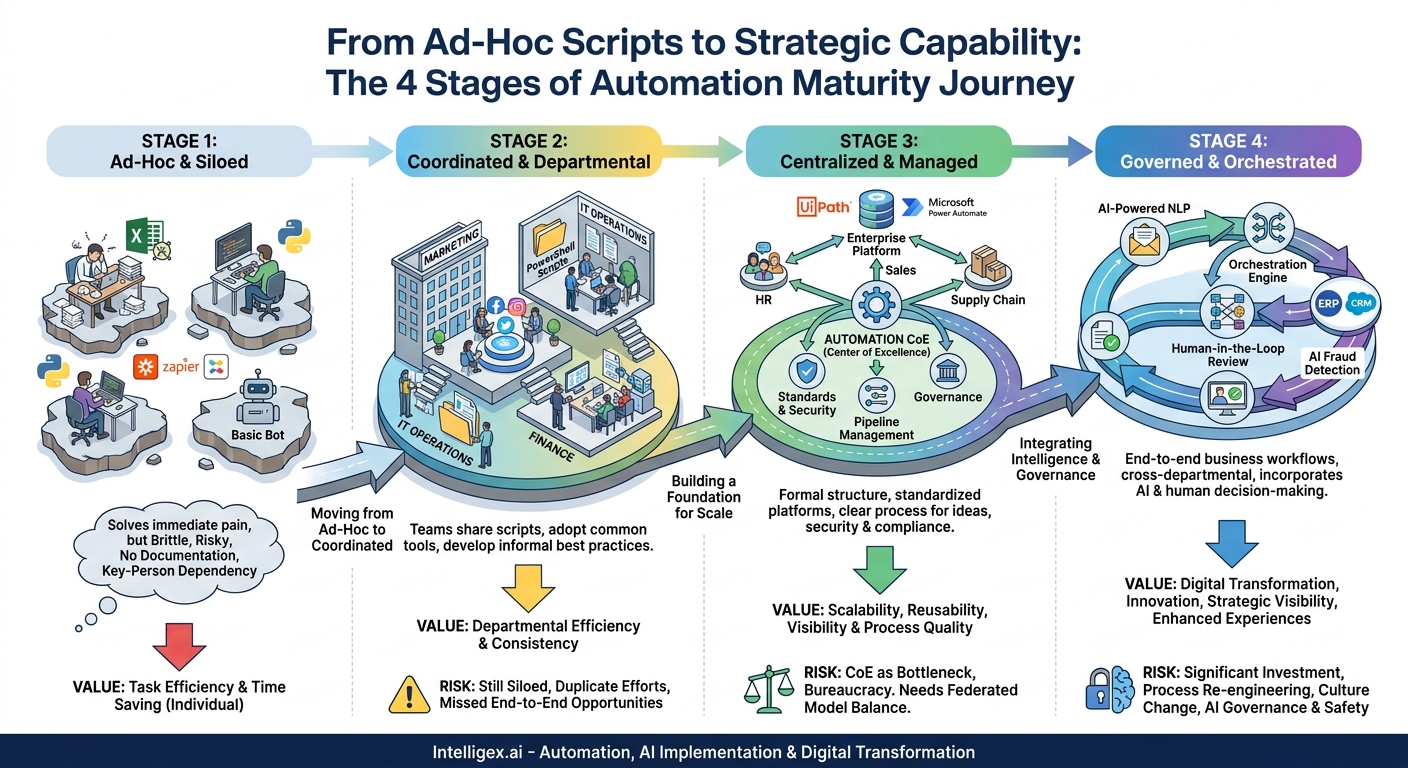
Almost every organization has automation. The finance team has elaborate Excel macros, a lone developer has a Python script that cleans up customer data, and the marketing department uses a tool to schedule social media posts. These are all valuable, solving immediate problems and saving time. But they are also disconnected, fragile, and impossible to scale. This isn’t a failure. It’s the first step on a journey from isolated scripts to a strategic, enterprise-wide capability. This journey is the path of automation maturity.
Understanding where you are on this path is the key to unlocking the next level of business value. Moving from one stage to the next is not just about buying new technology. It’s about changing how you think about processes, governance, and collaboration. It’s how you go from saving a few hours a week on a single task to fundamentally transforming how your business operates, delivering value faster, at a lower cost, and with higher quality.
The Four Stages of Automation Maturity
Most organizations progress through four distinct stages. Recognizing your company’s current stage helps you identify the specific challenges you face and the concrete steps needed to advance. Each stage unlocks a different level of business value, from simple task efficiency to true operational transformation.
Stage 1: Ad-Hoc and Siloed
This is where most automation begins. It’s characterized by individual or small-team efforts to solve a local, specific problem. These are the scrappy, often undocumented solutions that keep a department running.
- What it looks like: Excel macros for financial reporting, individual scripts for data extraction, simple Zapier connections between two personal apps, or basic Robotic Process Automation (RPA) bots built by a single user.
- Business Value: Solves an immediate pain point, saving time for an individual or a small team. It’s fast and requires no formal approval.
- The Risks: These automations are incredibly brittle. When a system interface changes or a process is updated, they break. There is often no documentation, and the automation stops working entirely if its creator leaves the company, creating significant key-person dependency.
Stage 2: Coordinated and Departmental
At this stage, teams begin to recognize the power of their ad-hoc automations and start to coordinate. They share scripts, adopt common departmental tools, and develop informal best practices. The focus is on making a specific business function more efficient.
- What it looks like: A marketing team centralizes on a single marketing automation platform. An IT operations team develops a shared library of PowerShell scripts for server maintenance. A finance department uses a shared RPA bot for invoice data entry into a single system.
- Business Value: Delivers measurable efficiency gains within a department. It reduces redundant work and establishes some consistency.
- The Risks: While better than Stage 1, this approach is still siloed. The marketing team’s platform doesn’t talk to the sales team’s CRM, and the finance team’s bots can’t access data from the supply chain’s ERP. This leads to duplicate automation efforts between departments and missed opportunities for end-to-end process improvement.
Stage 3: Centralized and Managed
This is a major turning point. The organization recognizes automation as a strategic priority and establishes a formal structure to manage it. This often takes the form of an Automation Center of Excellence (CoE), a central team responsible for setting standards, providing tools, and managing a pipeline of automation projects.
- What it looks like: A formal CoE helps business units build and deploy bots on a central enterprise platform like UiPath or Microsoft Power Automate. There is a defined process for submitting and prioritizing automation ideas. Development follows clear standards for security, logging, and error handling.
- Business Value: This is where you achieve true scalability, reusability, and visibility. Central management ensures automations are robust, secure, and compliant. You can tackle more complex, higher-value processes and measure ROI across the enterprise.
- The Risks: A poorly managed CoE can become a bottleneck, slowing down innovation with bureaucracy. The key is to find the right balance between centralized governance and empowering business users (a federated model).
Stage 4: Governed and Orchestrated
The final stage of maturity is when automation transcends simple tasks and processes to orchestrate complex, end-to-end business workflows that cross multiple departments and systems. Automation is no longer just a back-office efficiency tool. It is a core part of how the business delivers its products and services, often incorporating AI and human-in-the-loop decision-making.
- What it looks like: A “hire-to-retire” workflow that seamlessly manages employee onboarding, role changes, and offboarding across HR, IT, Finance, and Facilities systems. An “order-to-cash” process that automates everything from order entry in a CRM like Salesforce, to fulfillment in the ERP, to invoicing in the accounting system, with AI-powered fraud detection at key steps.
- Business Value: This is digital transformation. It provides unprecedented visibility into core business operations, dramatically accelerates cycle times, enhances customer and employee experiences, and creates a platform for continuous innovation.
- The Risks: Reaching this stage requires significant investment in technology platforms (iPaaS, process orchestration tools), process re-engineering, and a culture that embraces cross-functional collaboration.
Diagnosing Your Current Stage: A Practical Checklist
Answering these questions honestly will give you a clear picture of your organization’s current automation maturity. Where do most of your answers fall?
- Who builds automations? Is it anyone with a problem, designated people within a department, a central IT team, or a hybrid of a central CoE and trained business users?
- What tools are used? Is it a free-for-all of personal tools and scripts, a few department-approved applications, or a single, enterprise-wide automation platform?
- How are automations documented? Is documentation non-existent, informal and stored locally, or managed centrally in a standardized format?
- What happens when an automation fails? Does the user who built it get an email, does a departmental support person investigate, or does an alert automatically go to a central monitoring dashboard with a defined support protocol?
- How do you decide what to automate next? Is it based on who complains the loudest, a departmental priority list, or a formal intake process with a business case and ROI calculation?
- Do your automations cross departmental boundaries? For example, does a process that starts in HR automatically trigger an action in an IT system?
If most of your answers align with the first option in each question, you are likely in Stage 1. If they align with the last, you are moving toward Stage 3 or 4.
Moving from Ad-Hoc to Coordinated (Stage 1 to 2)
The jump from Stage 1 to Stage 2 is about making the invisible visible. It’s about finding all the hidden “shadow automation” and creating a foundation for collaboration. The goal is not to stifle individual initiative but to harness it.
Key Steps:
- Create an Automation Inventory: Start a simple spreadsheet or registry. Ask team leads and known “power users” to list the scripts, macros, and simple bots they use. For each, capture what it does, who built it, how critical it is, and how often it breaks.
- Identify and Empower Champions: Find the people who are already building things. Don’t see them as a risk. See them as your future automation leaders. Give them a forum to share what they’ve built and learn from each other.
- Introduce Shared Storage: The first step away from “it lives on my laptop” is creating a shared, version-controlled space. This could be a designated SharePoint folder or, for more technical teams, a Git repository. The goal is simply to have a single, backed-up location for automation assets.
- Standardize on Simple Tools: You don’t need a massive enterprise platform yet. Instead, look at the tools people are already using. Can the department standardize on a single, low-cost tool for simple integrations or a specific version of a scripting language? This reduces complexity and makes it easier for people to help each other.
A Practical Example: The finance team at a mid-sized company realized three different analysts had built their own complex macros for the monthly variance report. They were slightly different and produced inconsistent results. By moving to Stage 2, the department manager had the analysts collaborate on a single, “master” version. They documented its logic, tested it together, and stored it on a shared network drive where the whole team could access it. The result was a faster, more reliable report and the elimination of redundant work.
Building a Foundation for Scale (Stage 2 to 3)
Moving to Stage 3 requires a deliberate, strategic investment. This is where you build the formal structures that allow automation to scale reliably and securely across the organization. It’s about treating automation like any other critical business capability.
Establishing Your Automation Program:
- Secure Executive Sponsorship: You need a champion at the leadership level who understands the business value of automation and can advocate for the necessary resources. Frame the initiative not as a technology project, but as a business transformation program.
- Form a Pilot Center of Excellence (CoE): You don’t need a 20-person team overnight. Start with a small, cross-functional “CoE Lite” consisting of someone from IT (for technical governance), a business analyst (for process discovery), and a representative from a business unit that is enthusiastic about automation (like Finance or HR).
- Select a Central Platform: Now is the time to evaluate and choose a scalable automation platform. This could be an RPA platform, an integration platform as a service (iPaaS), or a low-code application platform. The key is to select a tool that can serve the needs of multiple departments and provide central management, security, and monitoring.
- Define Your Intake and Prioritization Process: How will you decide which of the 100 potential automation ideas to work on first? Create a simple template for a business case. It should outline the problem, the proposed solution, the expected benefits (hours saved, errors reduced, etc.), and the estimated effort. This allows you to prioritize projects based on business impact.
- Develop Initial Governance Rules: Start with the basics. Define clear naming conventions for automations. Create a standard for how automations should handle errors and log their activity. Establish security guidelines for how bots and workflows access sensitive data and systems.
A Critical Pitfall to Avoid: The CoE should be an enabler, not a gatekeeper. Its mission is to make it easier, safer, and faster for the business to automate. If the CoE becomes a bureaucratic bottleneck, people will simply revert to building ad-hoc automations in the shadows, and you’ll be back at Stage 1.
Integrating Intelligence and Governance (Stage 3 to 4)
Reaching Stage 4 means evolving from automating siloed tasks to orchestrating end-to-end business value streams. This is where you connect your islands of automation and begin infusing them with intelligence to handle more complex scenarios.
Consider an order processing workflow. In a Stage 3 company, you might have a bot that automates data entry from purchase orders into the ERP. In a Stage 4 company, that bot is just one step in a larger, orchestrated workflow. The workflow might start by using AI-powered Natural Language Processing (NLP) to read an incoming customer email, extract the order details, and then pass that structured data to the bot for ERP entry. It could then automatically check inventory, trigger a fulfillment request in the warehouse system, and finally, create an invoice in the finance system, all while providing real-time status updates in a central dashboard.
Implementing AI-Powered Automation Safely
As you incorporate AI components like NLP or machine learning models into your workflows, governance becomes even more critical. AI is not magic. It’s a powerful tool that requires a framework of trust and safety.
- Access Control and Permissions: Clearly define who can build, deploy, and manage AI models and the automations that use them. Sensitive models, such as one that predicts customer churn, should have stricter access controls than a simple document classification model.
- Data Privacy and Security: AI models are trained on data. Ensure that any sensitive customer or employee data is anonymized or handled in accordance with privacy regulations like GDPR or CCPA. Workflows that process this data must be secure and have auditable logs.
- Human-in-the-Loop Review: For high-stakes decisions, never allow a fully autonomous process. If an AI model is used to flag a potentially fraudulent transaction or screen a job applicant, the final decision should always be made by a human. The automation should present the recommendation and all the relevant data to a person for review and approval.
- Monitoring and Explainability: Continuously monitor the performance of your AI models. Are their predictions still accurate? Have they developed a bias? Log the inputs and outputs of AI-driven decisions so you can explain *why* a particular decision was made if audited.
The Escalating Business Value of Maturity
Why go through this effort? Because the value you unlock at each stage is an order of magnitude greater than the last. The metrics you use to measure success will also evolve as you mature.
- In Stages 1 and 2, you measure tasks. The primary business value is cost savings and speed on an individual level. The key metric is often “hours saved per week” or “reduction in data entry errors for process X.”
- In Stage 3, you measure processes. The value shifts to quality and scalability. You measure success by tracking “end-to-end process cycle time,” “improvement in compliance audit scores,” or “percentage increase in transactions processed with the same headcount.”
- In Stage 4, you measure business capabilities. The value is strategic, focusing on visibility and transformation. Success metrics become “time-to-market for a new service,” “improvement in Customer Satisfaction (CSAT) scores” due to faster response times, or “revenue gained from new opportunities enabled by automation.”
Your Next Steps on the Maturity Journey
Advancing your organization’s automation maturity is a continuous journey, not a one-time project. You don’t need a massive, multi-year plan to get started. You just need to take the next logical step.
- Assess Your Position: Use the checklist in this article to have an honest conversation with your team and stakeholders. Where are you today? Be specific about the characteristics you observe.
- Identify a Target: Find one high-impact, low-complexity business process that is causing pain. This could be a manual report that is always late or an onboarding process that involves too much paperwork. This will be your pilot.
- Apply the Next Stage’s Principles: Don’t try to jump from Stage 1 to Stage 4. If you’re in Stage 1, your goal for this pilot is to apply Stage 2 principles: document the process, get a few people to collaborate on a better solution, and store it centrally. If you’re in Stage 2, your goal might be to run it through a pilot CoE process to apply Stage 3 governance.
- Measure and Communicate: Before you start, define what success looks like for your pilot. Is it a 50% reduction in processing time? Zero errors? After you’re done, measure the outcome and communicate it widely. Success builds momentum and creates the business case for further investment.
By taking these deliberate, incremental steps, you can guide your organization along the automation maturity curve, moving from isolated scripts to a powerful engine for growth and operational excellence.
Your Next Read:
Category:
Get a FREE
Proof of Concept
& Consultation
No Cost, No Commitment!
