

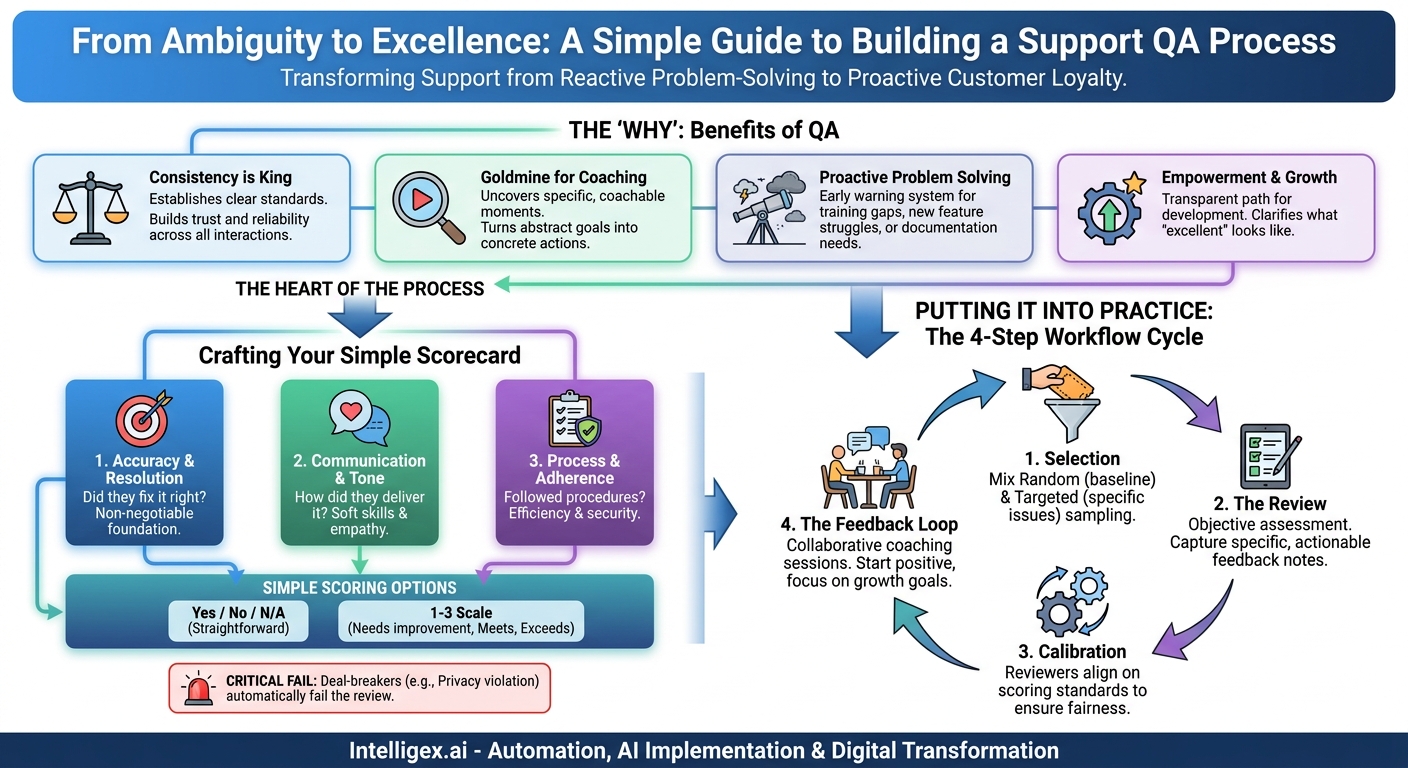
In the whirlwind of a busy customer support team, it’s easy to lose sight of the forest for the trees. You’re closing tickets, answering calls, and putting out fires. But are the interactions any good? Is Agent A providing the same level of care as Agent B? Is the advice your team gives consistently accurate and helpful? If you can’t answer these questions with confidence, you’re not alone. Many support leaders operate on gut feelings and the occasional glance at a CSAT score, hoping for the best. This approach, however, leaves quality to chance, and in the world of customer experience, chance is a risky bet.
The solution isn’t a complex, multi-layered bureaucracy that stifles your team. It’s a straightforward, effective Support QA (Quality Assurance) review process. Think of it not as a system for catching people doing things wrong, but as a framework for coaching them to be consistently great. It’s the compass that ensures your entire team is heading in the same direction—towards exceptional customer service. By systematically reviewing a sample of interactions, you can turn ambiguity into actionable insight, transforming your support team from a reactive problem-solving unit into a proactive engine for customer loyalty.
The ‘Why’: Beyond Just Checking Boxes
Implementing any new process requires effort, so it’s fair to ask: why bother? The benefits of a QA program extend far beyond a simple pass/fail grade on a ticket. It’s a foundational element that elevates your entire support operation.
- Consistency is King: Your brand promise shouldn’t be a lottery depending on which agent a customer connects with. A QA process establishes a clear standard for what a “good” interaction looks like. It defines your team’s voice, tone, and problem-solving approach. This consistency builds trust and reliability, ensuring every customer receives a dependably high-quality experience, which is the bedrock of customer loyalty.
- A Goldmine for Coaching: Vague feedback like “be more empathetic” is rarely helpful. A QA review, however, uncovers specific, coachable moments. Instead of a general critique, you can say, “In this ticket, when the customer expressed frustration about the delay, a great next step would have been to validate their feeling by saying, ‘I understand how frustrating that must be.’ Let’s practice that.” It turns abstract goals into concrete actions, making your 1-on-1s infinitely more productive. It’s like a sports coach reviewing game tape with a player—pinpointing the exact moments for improvement.
- Proactive Problem Solving: QA reviews are your early warning system. You might discover that multiple agents are struggling with a new feature, indicating a gap in training. You might find customers are repeatedly asking a question that isn’t covered in your help center, revealing a need for new documentation. By spotting these trends early, you can address root causes before they snowball into widespread frustration, reducing ticket volume and improving the customer experience at scale.
- Empowerment and Career Growth: A well-run QA program provides a clear and transparent path for agent development. It removes subjectivity from performance reviews and gives agents a precise understanding of what “excellent” looks like and how they can get there. When agents know exactly what is expected of them and receive targeted coaching to help them meet those expectations, they become more engaged, confident, and motivated in their roles.
The Heart of the Process: Crafting Your Simple Scorecard
The QA scorecard is the rubric you’ll use to evaluate interactions. The temptation can be to create a complex spreadsheet with dozens of criteria, but simplicity is your greatest ally, especially when you’re starting out. An overly complicated scorecard is difficult to use consistently and can lead to reviewers getting bogged down in minutiae. Your goal is to focus on the things that truly matter to the customer experience. A great, simple scorecard can be built around three core categories.
Start with Core Categories
Instead of listing 20 different things to check, group your criteria into broader themes. This makes the review process more intuitive and the feedback more focused.
-
Accuracy & Resolution: This is the foundation of any support interaction. If the answer is wrong, nothing else matters. This category is non-negotiable and should be weighted heavily. Ask questions like:
- Did the agent correctly identify the customer’s issue?
- Was the information provided technically accurate and complete?
- Did the agent provide a solution that fully resolved the customer’s problem?
- If a full resolution wasn’t possible, were the correct next steps set and communicated clearly?
-
Communication & Tone: This is about how the agent delivered the solution. It covers the soft skills that separate a transactional experience from a memorable one. This is where you define your brand’s voice. Ask questions like:
- Was the agent’s tone professional, empathetic, and friendly?
- Was the communication clear, concise, and easy to understand (free of jargon)?
- Did the agent actively listen or read carefully to understand the context?
- Did the agent personalize the interaction and build rapport?
-
Process & Adherence: This category ensures that internal procedures are being followed, which is crucial for efficiency, security, and data integrity. Be careful not to make this a long list of nit-picky rules. Focus only on the most critical processes. Ask questions like:
- Did the agent correctly categorize or tag the ticket?
- Did the agent follow necessary security and verification procedures?
- Was the correct macro or canned response (if applicable) used appropriately?
- Did the agent adhere to the defined escalation process?
Defining the Scoring
Once you have your categories, you need a simple way to score them. Avoid a 1-100 point system, which invites subjective debates over minor point differences. Stick to something simpler:
- Yes / No / N/A: This is the most straightforward method. For each criterion, the agent either did it (Yes), didn’t do it (No), or the situation wasn’t relevant (N/A). It’s black and white, which makes it fast and easy to maintain consistency among reviewers.
- A Simple 3-Point Scale: If you want a little more nuance, a scale like 1 = Needs Improvement, 2 = Meets Expectations, 3 = Exceeds Expectations works well. This allows you to recognize when an agent went above and beyond, while still keeping the scoring simple and easy to understand.
Finally, consider the concept of a Critical Fail. These are deal-breakers—errors so significant that they automatically fail the entire review, regardless of how well the agent did in other areas. Examples could include a major privacy violation, abusive language, or providing dangerously incorrect information. This ensures that the most serious issues are always given the highest level of attention.
Putting It Into Practice: A Simple 4-Step Workflow
A great scorecard is useless without a consistent process for using it. A simple, repeatable workflow ensures that your QA program runs smoothly and delivers value without becoming a time-consuming burden.
Step 1: Selection – What to Review
You can’t review every interaction, so you need a strategy for selecting a representative sample. A good approach is to use a mix of random and targeted sampling.
- Random Sampling: The bread and butter of your QA process. Randomly select 3-5 interactions per agent per week (or a similar cadence that works for your team’s volume). This gives you a baseline understanding of an agent’s typical performance.
- Targeted Sampling: Use this to dig deeper into specific areas. You might choose to review tickets that received a low CSAT score, interactions that involved a complex technical topic, conversations handled by a new hire, or tickets that took an unusually long time to resolve. This helps you diagnose specific challenges or training needs.
Step 2: The Review – Performing the Assessment
During the review itself, objectivity is paramount. The reviewer—whether it’s a manager, a team lead, or a peer—must evaluate the interaction based solely on the criteria defined in the scorecard. The most important part of this step isn’t just assigning a score; it’s capturing specific, actionable feedback. Instead of writing “Good empathy,” write “Excellent use of empathy when you said, ‘I can see how that would be frustrating.’ It showed the customer you were listening.” Conversely, instead of “Grammar needs work,” point to the specific sentence and offer the correct phrasing.
Step 3: Calibration – Staying on the Same Page
If you have more than one person performing reviews, you need to ensure they are all scoring in the same way. This is called calibration, and it’s essential for fairness. A simple way to calibrate is to have all reviewers independently score the exact same three customer interactions. Afterwards, they meet to compare their scores and discuss any discrepancies. Did one reviewer score something as “Meets Expectations” while another scored it as “Needs Improvement”? The discussion that follows—about why they scored it that way—is where you build a shared understanding of your quality standards. This process ensures that an agent’s QA score doesn’t depend on the luck of who happens to be their reviewer that week.
Step 4: The Feedback Loop – Closing the Circle
This is the most critical step of all. A QA score that just sits in a spreadsheet is worthless. The entire purpose of the process is to fuel productive coaching conversations. Schedule regular 1-on-1s with your agents to discuss their QA results. Frame these meetings as collaborative coaching sessions, not punitive reviews.
- Start with the positive. Celebrate what the agent did well, using specific examples from the reviewed tickets.
- Address areas for improvement. Focus on one or two key behaviors to work on. Don’t overwhelm the agent with a long list of critiques. Ask open-ended questions like, “How did you feel that call went?” or “Walking through this ticket, is there anything you’d do differently next time?”
- Collaborate on a plan. Work together to set a small, achievable goal for the coming week. For example, “This week, let’s focus on confirming the customer’s issue by restating it before you jump into troubleshooting.”
- Follow up. In your next 1-on-1, check in on the goal from the previous week. This accountability closes the loop and drives real, lasting improvement.
Start Simple, Evolve Over Time
Building a support QA review process doesn’t require expensive software or a dedicated team of analysts. It starts with a commitment to consistency and a desire to help your team grow. Don’t let the pursuit of the “perfect” process stop you from starting a “good enough” one today. Create a simple scorecard in a spreadsheet. Block off a few hours on your calendar each week to review a handful of tickets. Start having more focused, data-informed coaching conversations.
By implementing this simple framework, you’re not just inspecting your team’s work—you’re investing in it. You’re building a culture of continuous improvement, where every agent has a clear understanding of what success looks like and a supportive path to achieve it. Over time, this consistent, coached approach will do more than just improve a few metrics; it will fundamentally elevate the quality of your customer service, turning your support team into one of your company’s greatest assets.
Your Next Read:
Category:
Get a FREE
Proof of Concept
& Consultation
No Cost, No Commitment!