

In the world of sales, the pipeline is everything. It’s the roadmap from initial contact to a closed deal, the lifeblood of your revenue engine. Yet for many organizations, this critical roadmap is shrouded in fog. Sales leaders squint at their dashboards, trying to make sense of incomplete data. Reps operate in their own silos, with progress known only to them. Marketing pumps leads into what feels like a black hole, with little insight into their ultimate fate. This pervasive lack of clarity is more than just an inconvenience; it’s a direct threat to growth, efficiency, and accurate forecasting. This is the pipeline visibility problem, and it’s one of the most common and costly challenges modern businesses face.
But what does “pipeline visibility” truly mean? It’s not just about having a list of deals in a CRM. True visibility means having a clear, accurate, and real-time understanding of every opportunity at every stage. It’s about knowing not just what’s in the pipeline, but understanding its health. Which deals are moving? Which are stalled? What’s the conversion rate from one stage to the next? How long does the average deal take to close? When you have this level of insight, your pipeline transforms from a mysterious, unpredictable force into a powerful, data-driven tool for strategic decision-making.
The Common Culprits: Diagnosing Your Visibility Problems
Before you can fix the problem, you have to understand its root causes. The fog that obscures your pipeline isn’t a single entity; it’s a collection of smaller issues that compound over time. Pinpointing these culprits is the first step toward achieving the clarity your team desperately needs.
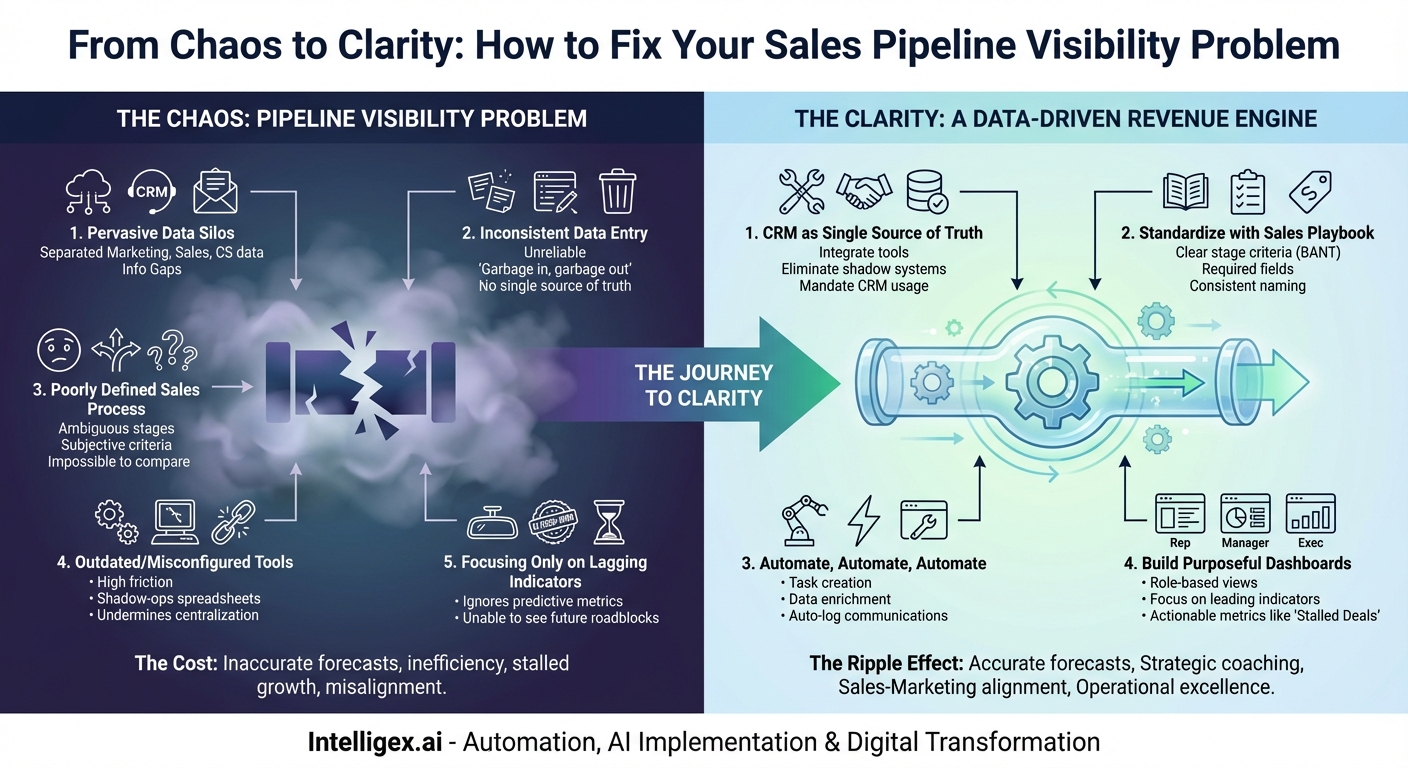
Problem 1: Pervasive Data Silos
Your marketing team lives in their automation platform, meticulously tracking email opens, click-through rates, and MQLs. Your sales team lives in the CRM, logging calls and updating deal stages (sometimes). Your customer success team uses a separate platform to manage onboarding and support tickets. Each department has a piece of the customer journey, but these pieces rarely connect seamlessly. This separation creates critical information gaps. Sales might not know that a key prospect just downloaded a bottom-of-funnel whitepaper, and marketing has no idea which of their campaigns are generating leads that actually close. The customer’s journey is continuous, but your data about it is fractured.
Problem 2: Inconsistent (or Non-Existent) Data Entry
This is perhaps the most frequent and frustrating cause of poor visibility. A CRM is only as good as the data within it, and busy sales reps often view data entry as a secondary, administrative task. One rep might log every call and email, while another only updates a deal when it’s about to close. Some might use the “Notes” field as a personal diary, while others leave it blank. Without a standardized process and consistent enforcement, your CRM becomes a collection of unreliable anecdotes rather than a single source of truth. This is the classic “garbage in, garbage out” scenario, and it makes accurate forecasting nearly impossible.
Problem 3: A Poorly Defined Sales Process
What does “Qualified” actually mean at your company? What specific criteria must be met for a deal to move from “Discovery” to “Proposal”? If you ask five different sales reps, you might get five different answers. When your sales stages are ambiguous, your pipeline data becomes subjective. One rep’s 80% confident deal might be another’s 30% long shot. This ambiguity makes it impossible to compare deals, understand conversion rates between stages, or identify where opportunities are getting stuck. Your pipeline stages should represent concrete, verifiable milestones in the buyer’s journey, not just a rep’s gut feeling.
Problem 4: Outdated or Misconfigured Tools
While the tool is rarely the sole problem, it can certainly be a major contributor. Many companies use a powerful CRM but have never taken the time to configure it to their specific sales process. They use the out-of-the-box deal stages, generic fields, and clunky dashboards. This creates friction. If the tool is hard to use or doesn’t align with how your team actually sells, they will inevitably find workarounds—like tracking their “real” pipeline in a personal spreadsheet. This shadow-ops behavior immediately undermines any hope of centralized visibility.
Problem 5: Focusing Only on Lagging Indicators
Many sales leaders are hyper-focused on one metric: closed-won revenue. While this is the ultimate goal, it’s a lagging indicator—it tells you what has already happened. A lack of visibility often stems from a failure to track leading indicators, which are the predictive metrics that signal future success. These include things like the number of new opportunities created, the conversion rate between early stages, the average deal velocity, and the number of discovery calls booked. By only looking in the rearview mirror (at closed deals), you lose the ability to see the roadblocks and opportunities up ahead.
Simple Fixes: Bringing Clarity to the Chaos
The good news is that you don’t need a multi-million dollar digital transformation project to solve these problems. Real, meaningful improvements can be made by implementing a few foundational changes focused on process, people, and platform optimization.
Fix 1: Establish Your CRM as the Single Source of Truth
This is non-negotiable. Declare that if it’s not in the CRM, it doesn’t exist. This means all calls, emails, meetings, and changes in deal status must be logged in the system. To make this stick, you must make it easy.
- Integrate Key Tools: Connect your marketing automation platform, email client (like Outlook or Gmail), and calendar directly to your CRM. This automates much of the data entry, reducing the burden on reps.
- Leadership Buy-In: Pipeline reviews and forecasting meetings should be conducted directly from CRM dashboards. When reps know that this is the only data leadership will look at, they are far more likely to keep it updated.
- Eliminate Shadow Systems: Actively discourage the use of personal spreadsheets for pipeline tracking. Provide training and create CRM dashboards that give reps the visibility they need, so they don’t feel the need to build their own.
Fix 2: Standardize Everything with a Sales Playbook
Ambiguity is the enemy of visibility. Create a simple, clear sales playbook that defines your process from end to end. This document should be the go-to resource for your entire team.
- Define Your Sales Stages: For each stage in your pipeline (e.g., Prospecting, Qualification, Needs Analysis, Proposal, Negotiation), clearly define the entry and exit criteria. For example, to exit the “Qualification” stage, a rep must have confirmed budget, authority, need, and timeline (BANT).
- Standardize Data Fields: Determine what information is critical at each stage and make those fields required in your CRM. This ensures you capture consistent data for every single deal.
- Create a Naming Convention: Simple things like a standard way to name opportunities (e.g., “CompanyName – Product – Q4 2024”) can dramatically improve reporting and make your pipeline easier to scan.
Fix 3: Automate, Automate, Automate
The less manual work your reps have to do, the more likely they are to comply with the process. Leverage the automation capabilities within your CRM and other tools to handle repetitive tasks.
- Task Creation: Set up workflows that automatically create follow-up tasks when a deal moves to a new stage or when a certain amount of time has passed without any activity.
- Data Enrichment: Use tools that automatically enrich contact and company records with data like job titles, company size, and industry, saving reps from manual research.
- Email and Call Logging: As mentioned earlier, plugins that automatically log communications from your inbox and calendar are a game-changer for ensuring a complete activity history on every deal.
Fix 4: Build Dashboards That Actually Matter
A wall of charts and numbers is just as bad as no data at all. The key is to build a few simple, powerful dashboards tailored to different roles (Sales Rep, Sales Manager, Executive).
- The Rep Dashboard: Should focus on their individual pipeline, upcoming tasks, and progress toward their quota. It’s their personal command center.
- The Manager Dashboard: Should provide an overview of the team’s pipeline health, key leading indicators (like new opportunities created), and identify at-risk deals. This is a coaching tool.
- The Executive Dashboard: Should focus on high-level forecasting, overall pipeline value by stage, and key conversion rates over time. This is a strategic planning tool.
Focus on metrics that drive action. Instead of just showing the total value of the pipeline, show the “Stalled Deals” report—opportunities that haven’t had any activity in over 14 days. This gives managers a specific list to address in their next one-on-one.
The Ripple Effect of a Clear Pipeline
Solving your pipeline visibility problems does more than just make your sales meetings more efficient. The positive impact is felt across the entire organization. When you have a clear, data-driven view of your pipeline, you unlock a new level of operational excellence. Your sales forecasts become dramatically more accurate, allowing finance and operations to plan resources with confidence. Sales and marketing alignment skyrockets because both teams are working from the same data set and can clearly see how marketing activities translate into revenue.
Furthermore, sales managers can transform from “deal inspectors” into true coaches. Instead of spending their one-on-ones asking for status updates, they can use the data to identify skill gaps, pinpoint bottlenecks in the sales process, and provide targeted, effective coaching that actually improves performance. Most importantly, a visible pipeline empowers your team with a sense of clarity and purpose. Reps know exactly what is expected of them, managers know where to focus their energy, and leadership can steer the ship with a clear view of the waters ahead.
The journey from a foggy, unpredictable pipeline to a crystal-clear revenue engine doesn’t have to be a monumental undertaking. It begins with a commitment to process, a focus on consistency, and the smart application of the tools you already have. By tackling the common culprits of poor visibility with these simple, actionable fixes, you can lift the fog and unlock the full potential of your sales organization.
Your Next Read:
Category:
Get a FREE
Proof of Concept
& Consultation
No Cost, No Commitment!
