

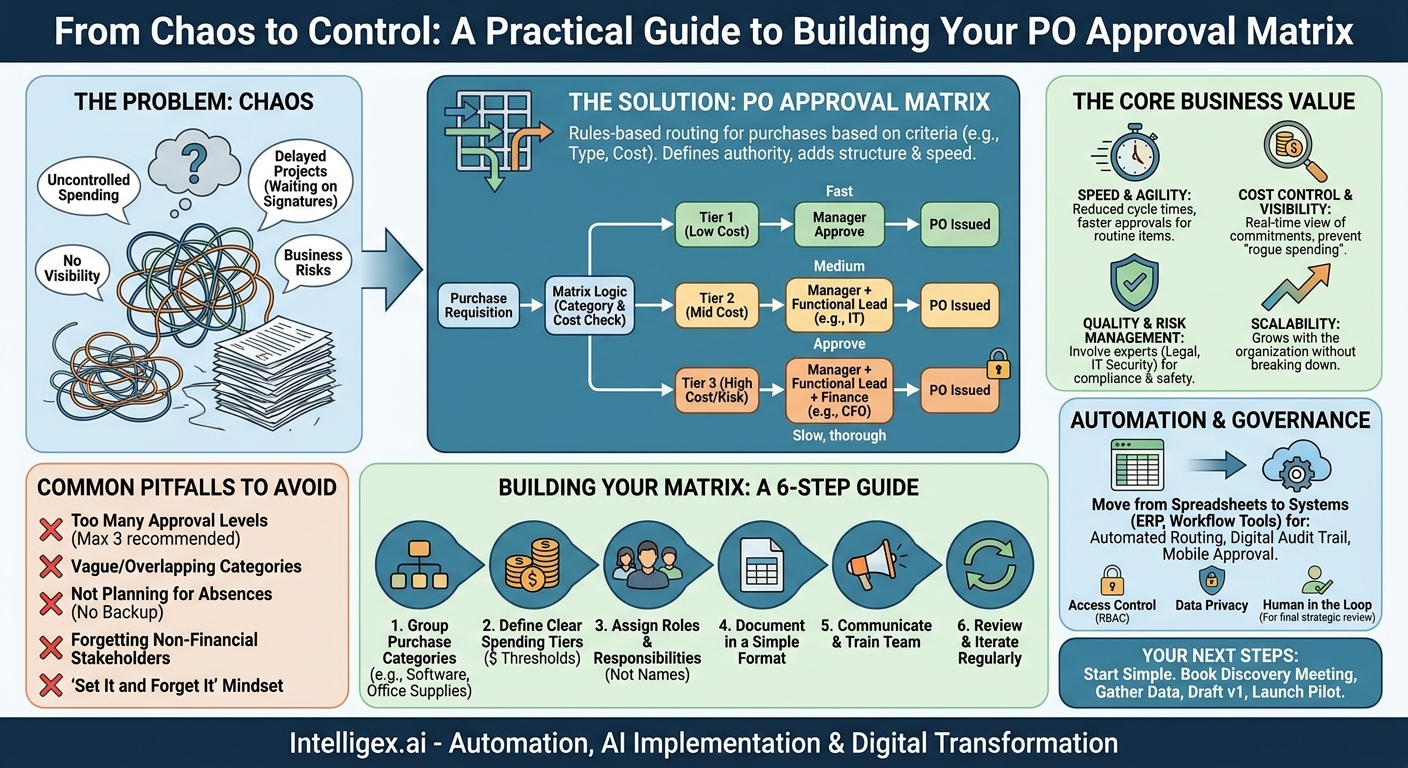
Uncontrolled spending, delayed projects waiting on a signature, and a complete lack of visibility into where company money is going. These are not minor operational headaches; they are significant business risks that stifle growth and eat into profits. When your team has to ask, “Who needs to approve this?” for every purchase, you’re losing valuable time and momentum. The solution is often simpler than you think: a clear, logical Purchase Order (PO) approval matrix.
A PO approval matrix is a foundational internal control that defines who has the authority to approve purchases on behalf of the company. It’s a simple framework, but its impact is profound, bringing much-needed structure, speed, and accountability to the entire procurement process.
What is a Purchase Order Approval Matrix? (And Why It’s Not Just for Finance)
At its core, a PO approval matrix is a set of rules that directs a purchase requisition to the right people for approval based on a few key criteria, most commonly the purchase type and its total cost. Think of it as a routing system for spending. Instead of every request going to the same overwhelmed manager or getting stuck in email chains, the matrix automatically determines the correct workflow.
For example, a simple matrix might state that:
- Any team member can purchase office supplies up to $250 without approval.
- A Marketing Manager can approve software subscriptions up to $5,000.
- Any IT hardware purchase over $10,000 requires approval from both the Head of IT and the Chief Financial Officer (CFO).
This isn’t just a financial policing tool. When designed correctly, it empowers your entire organization. It gives team leads the autonomy to acquire the resources they need quickly while ensuring that high-value, high-risk purchases receive the strategic oversight they deserve. It transforms procurement from a bureaucratic bottleneck into a streamlined business enabler that involves stakeholders from Operations, IT, and other departments at the right moments.
The Core Business Value: Beyond Just Saying “No”
Implementing an approval matrix delivers tangible benefits that extend far beyond simply controlling costs. It enhances speed, improves data quality, mitigates risk, and builds a scalable foundation for future growth.
Speed and Agility
The most immediate benefit is a dramatic reduction in procurement cycle times. When the rules are clear and pre-defined, employees no longer waste time hunting down the correct approver. Requisitions for routine, low-cost items can be approved in minutes by a direct manager, not days. This agility is a competitive advantage. It means your sales team gets the software they need to close deals faster, and your engineers get the components they need to build products without delay.
Cost Control and Visibility
While speed is crucial, control is paramount. An approval matrix is the first line of defense against “rogue spending” and unbudgeted expenses. By routing every purchase through a formal process, you gain a complete, real-time view of financial commitments before they hit your books. This visibility is critical for accurate forecasting and cash flow management. It also prevents common issues like different departments unknowingly buying duplicate software licenses or paying different prices for the same service. Over time, the data collected provides powerful insights for negotiating better vendor contracts.
Key metrics to watch:
- Requisition-to-PO Cycle Time: How long does it take from the moment a request is made until a PO is issued? A well-designed matrix will shrink this time significantly for standard purchases.
- Percentage of Spend Under Management: What portion of your company’s spending goes through the formal approval process? The goal is to get this as close to 100% as possible.
Quality and Risk Management
Not all approvals are about the dollar amount. A robust matrix incorporates reviews from functional experts to mitigate non-financial risks. For instance, a rule can mandate that any new software purchase, regardless of cost, must be reviewed by the IT security team. A request for a new marketing vendor handling customer data might require a sign-off from the legal department. This ensures that purchases comply with security protocols, data privacy regulations, and other internal policies, protecting the company from potential liabilities.
Scalability
A manual, informal approval process may work for a team of ten, but it breaks down completely at fifty and becomes a liability at one hundred. A PO approval matrix is built to scale. As your organization grows, adds new departments, and increases spending, the logic of the matrix remains the same. You can easily adjust thresholds, add new approvers, or create new categories without having to reinvent your entire procurement process. This operational stability is essential for sustainable growth.
Building Your First Approval Matrix: A Step-by-Step Guide
Creating an approval matrix doesn’t need to be an overly complex, months-long project. You can start with a simple version and refine it over time. The key is to begin with a clear, logical structure that is easy for everyone to understand and follow.
- Identify and Group Purchase Categories. Start by analyzing your recent spending. Group purchases into logical categories that reflect how your business operates. Avoid being too generic. Instead of one large “IT” category, consider breaking it down into “IT Hardware,” “Software Subscriptions,” and “IT Professional Services.” Other common categories include “Office Supplies,” “Marketing & Advertising,” “Travel & Entertainment,” and “Facilities.”
- Define Clear Spending Tiers (Thresholds). Establish simple, unambiguous dollar value ranges. A good starting point is to create three or four tiers. For example: Tier 1 ($0 – $1,000), Tier 2 ($1,001 – $10,000), Tier 3 ($10,001 – $50,000), and Tier 4 (Over $50,000). The right thresholds will depend on your company’s size and spending habits. The goal is to give teams autonomy for small purchases while increasing oversight as the value and risk increase.
- Assign Roles and Responsibilities. This is the core of the matrix. For each combination of purchase category and spending tier, define the required approvers. Map these to roles, not specific individuals (e.g., “Department Manager,” not “Jane Smith”). This makes the matrix easier to maintain as people change roles. Consider multiple levels of approval:
- Level 1: The requestor’s direct manager or department head. This person verifies the business need.
- Level 2: A functional expert or senior leader (e.g., Head of IT, VP of Operations). This person verifies compliance and strategic fit.
- Level 3: Finance (e.g., CFO or Controller). This person provides the final financial check for high-value purchases.
- Document the Matrix in a Simple Format. Create a clear, accessible document that lays out the rules. A simple table is often the most effective tool. The columns should include: Purchase Category, Amount Threshold, Level 1 Approver, Level 2 Approver, and any other required reviewers (like Legal or IT Security). Make this document readily available to everyone in the company via your intranet or shared knowledge base.
- Communicate and Train Your Team. A new process is only effective if people use it. Announce the new approval matrix and, more importantly, explain why it’s being implemented. Focus on the benefits of speed and clarity for them, not just control for the company. Hold a short training session to walk through the process and answer questions.
- Review and Iterate Regularly. Your business is not static, and neither should your approval matrix be. Schedule a review every six months to a year. Are there bottlenecks? Are the thresholds too low, causing unnecessary bureaucracy? Are they too high, allowing too much un-reviewed spend? Use feedback from your team and data from your purchasing system to make adjustments.
A Simple Matrix Example in Action
Let’s see how this works with a practical scenario. Imagine a company has documented the following rules for its software purchases:
- Category: Software & Subscriptions
- Tier 1 ($0 – $1,000): Requires approval from the Department Manager.
- Tier 2 ($1,001 – $20,000): Requires approval from the Department Manager and the Head of IT.
- Tier 3 (Over $20,000): Requires approval from the Department Manager, Head of IT, and the CFO.
Scenario 1: A New Project Management Tool
The marketing team wants to purchase a new project management tool that costs $7,500 per year. The Marketing Manager submits a purchase requisition. The system (or the manager following the documented process) identifies that this request falls into Tier 2. The workflow is automatically routed first to the Marketing Manager’s superior (the Director of Marketing) for business need approval. Once approved, it is then automatically sent to the Head of IT for a technical and security review. After both have signed off, the PO is cleared for issuance. The process is clear, efficient, and ensures the right experts are involved.
Scenario 2: A Minor Software Utility
A graphic designer on the same marketing team needs a font management utility that costs $99. They submit a requisition. This request falls into Tier 1. It is routed directly to their Department Manager for a single approval. The PO is issued almost immediately, and the designer can get the tool they need to do their job without delay.
In both cases, the process was fast, appropriate for the level of risk, and fully documented without confusion.
Common Pitfalls and How to Avoid Them
While the concept is simple, implementation can have challenges. Being aware of common mistakes can help you design a more effective and user-friendly process from the start.
- Pitfall: Creating Too Many Approval Levels. A ten-level approval workflow for a $5,000 purchase will bring your operations to a halt. Do: Start with a maximum of three approval levels (e.g., Manager, VP/Functional Head, Finance). You can always add more complexity later if necessary.
- Pitfall: Using Vague and Overlapping Categories. If your categories are unclear, employees won’t know how to classify their requests, leading to errors and delays. Do: Define specific, mutually exclusive categories. For example, separate “IT Hardware” from “Office Equipment.”
- Pitfall: Not Planning for Absences. A critical purchase can get stuck for a week if the sole approver is on vacation. Do: Implement a delegation system. Your process or software should allow approvers to designate a backup who can approve requests in their absence.
- Pitfall: Forgetting Non-Financial Stakeholders. A purchase may be small in value but have significant legal or security implications. Do: Build rules that loop in departments like Legal, HR, or IT Security based on the purchase category, not just the dollar amount.
- Pitfall: The “Set It and Forget It” Mindset. An approval matrix designed for a 50-person startup will not work for a 500-person company. Do: Schedule periodic reviews of your matrix to ensure the thresholds, roles, and categories still align with your business structure and goals.
From Spreadsheet to System: Automation and Governance
Managing an approval matrix via email and spreadsheets is a good first step, but it has its limits. Manual tracking is prone to human error, lacks a reliable audit trail, and requires constant follow-up. To truly unlock the benefits of speed and visibility, the logic of your matrix should be embedded directly into your business systems.
Modern ERP systems, procurement platforms like Coupa, and other workflow automation tools can fully automate your approval matrix. When an employee creates a requisition, the system automatically routes it to the correct sequence of approvers based on your pre-defined rules. Approvers are notified, can review all necessary information in one place, and can approve or reject with a single click, even from their mobile device. This creates a complete, time-stamped digital audit trail for every single purchase, which is invaluable for financial audits and compliance with regulations like Sarbanes-Oxley (SOX).
A Note on Automation and Safe Implementation
As you move toward automation, it’s essential to maintain strong governance. Digital workflows handle sensitive financial data and grant authority to spend company money, so they must be implemented carefully.
- Access Control: Use role-based access control (RBAC) to ensure that only authorized administrators can create or change approval workflows. The ability to modify approval rules should be tightly restricted.
- Data Privacy: Procurement data includes vendor information, negotiated pricing, and details about internal projects. Ensure any system you use complies with relevant data protection laws and that access to this information is limited on a need-to-know basis.
- Human in the Loop: Automation is there to enforce the rules and speed up the process, not to replace critical thinking. For particularly large, strategic, or unusual purchases, maintain a final human review. AI-powered tools can be used to flag anomalies, such as an invoice that is 20% higher than the original PO, but a person should make the final decision on how to proceed.
Your Next Steps: Putting the Matrix to Work
You don’t need a massive digital transformation project to get started. Building a foundational PO approval matrix is an achievable goal that can deliver value within weeks. The key is to start simple and build momentum.
Here is a short plan to get started today:
- Schedule a meeting. Book a 30-minute discovery session with key stakeholders from Finance, Operations, and one other department head to discuss current procurement pain points.
- Gather some data. Pull a report of your last 100 purchase orders or invoices. Manually categorize them and analyze the dollar amounts to get a rough idea for your initial categories and thresholds.
- Draft version one. Create a simple table with no more than five broad categories and three spending tiers. Don’t strive for perfection; aim for a “good enough” starting point.
- Launch a pilot. Choose one department to test the new matrix for one month using your current manual process (e.g., email and spreadsheets). Gather their feedback to refine the rules before a company-wide rollout.
By taking these small, practical steps, you can begin to build the financial discipline and operational velocity your business needs to scale effectively.
Your Next Read:
Category:
Get a FREE
Proof of Concept
& Consultation
No Cost, No Commitment!
