

Your organization has identified a new technology or process poised to deliver significant value. The strategy is approved, the tool is selected, and the teams are briefed. Now you face a critical implementation crossroads: do you launch it across the entire enterprise in a full rollout, or do you start with a controlled, small-scale pilot program? This isn’t just a project management detail; it’s a strategic decision that directly impacts cost, risk, and the ultimate success of your transformation.
A full rollout promises speed and immediate, widespread impact. A pilot program offers a safer path, allowing you to learn, adapt, and prove value before committing significant resources. Choosing the right path requires a clear-eyed assessment of the technology’s maturity, its potential impact on your operations, and your organization’s appetite for risk.
Understanding the Core Trade-Off: Speed vs. Certainty
The decision between a pilot and a full rollout hinges on a fundamental business trade-off. You are balancing the desire for rapid value realization against the need for operational stability and predictable outcomes. Neither approach is universally superior; the optimal choice depends entirely on the context of your project.
The Case for a Full Rollout: High Velocity, High Stakes
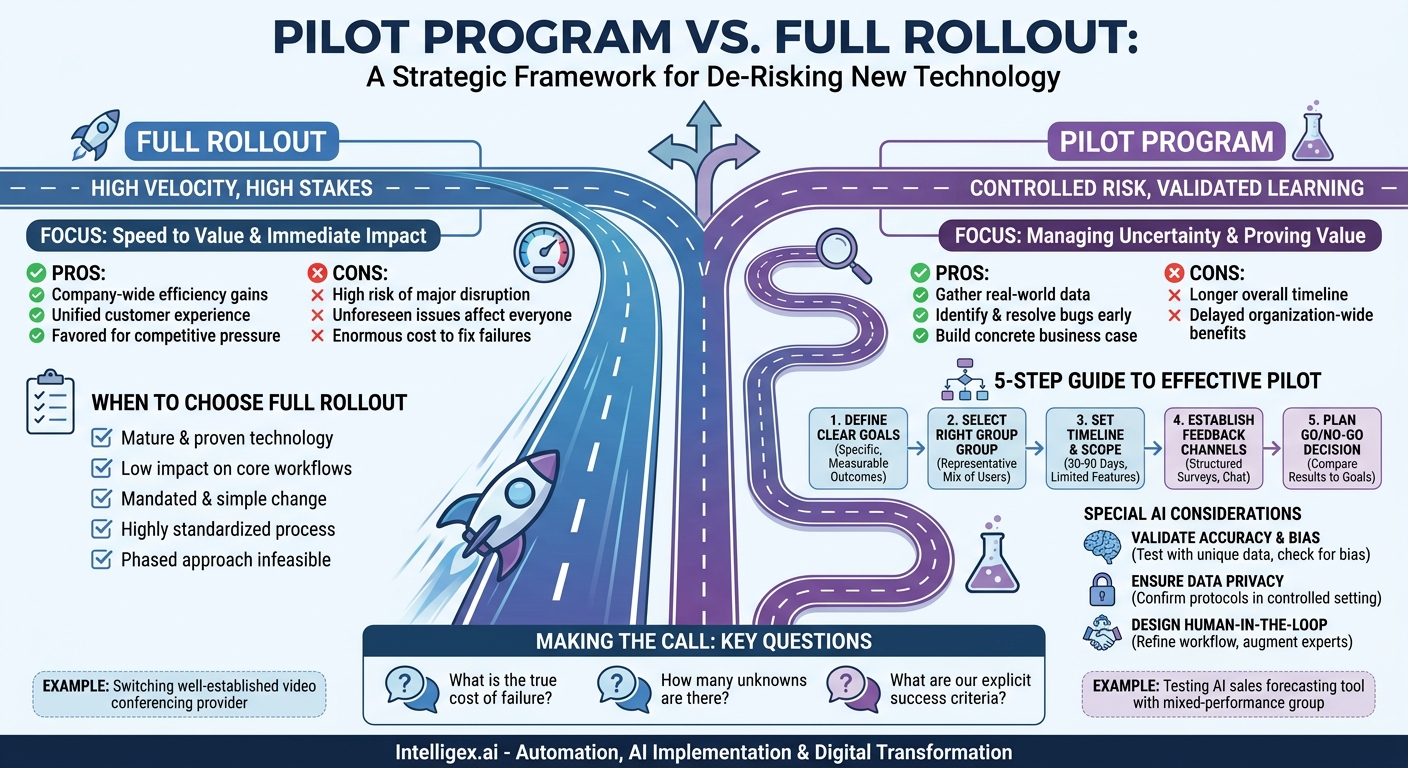
A full rollout, sometimes called a “big bang” implementation, involves deploying a new system or process to all users and departments simultaneously. It prioritizes speed to value. By getting the new capability into everyone’s hands at once, you can begin realizing benefits like company-wide efficiency gains or a unified customer experience almost immediately. This approach is often favored when there is intense competitive pressure or when the cost of running old and new systems in parallel is prohibitively high.
However, the velocity comes with significant risk. If unforeseen technical glitches, user adoption challenges, or process flaws emerge, they affect the entire organization at once. The potential for major business disruption is high, and the cost of fixing problems at this scale can be enormous. A failed rollout can damage internal trust in leadership and technology initiatives for years to come.
The Case for a Pilot Program: Controlled Risk, Validated Learning
A pilot program is a limited, time-bound trial with a select group of users. It is a strategic tool for managing uncertainty. By testing the new solution in a controlled environment, you can gather real-world data on its performance, usability, and business impact before making a large-scale investment. This de-risks the project significantly.
The primary benefit is validated learning. A pilot allows you to identify and resolve bugs, refine training materials based on actual user feedback, and build a concrete business case supported by tangible metrics. It uncovers the “unknown unknowns” that are impossible to predict in planning meetings. The trade-off is time. The overall project timeline is longer, and the organization-wide benefits are delayed. However, the final, scaled-up deployment is far more likely to succeed.
When a Full Rollout Is the Right Move
While a pilot is often the prudent choice, there are specific situations where a direct, full rollout is not only viable but preferable. These scenarios are typically characterized by low risk and high certainty. If your initiative aligns with most of the points below, a full rollout may be the most efficient path forward.
Consider a full rollout if:
- The Technology is Mature and Proven. This is not a brand-new, unproven platform. It’s an established solution, perhaps a newer version of software your team already uses, like an update to your organization’s primary cloud productivity suite or CRM.
- The Impact on Core Workflows is Low. The change primarily affects non-critical or ancillary processes. For example, implementing a new internal directory or a corporate social media scheduling tool. A failure would be inconvenient, not catastrophic.
- The Change is Mandated and Simple. The deployment is a top-down requirement with little room for process variation, such as a company-wide security update or a mandatory compliance training module. User adoption is not optional.
- The Business Process is Highly Standardized. The workflow being changed is identical across all teams and departments. There are no complex regional or functional variations that could introduce unexpected complications.
- A Phased Approach is Technically Infeasible. In some rare cases, running old and new systems in parallel is impossible. This is a technical constraint that forces a “big bang” approach, though it requires exceptionally thorough planning and testing.
Example Scenario: A 5,000-employee company is switching from one mainstream video conferencing provider to another. Both tools offer similar core features and are well-established in the market. The IT team can configure the new system centrally, and the change has minimal impact on core revenue-generating activities. In this case, a company-wide cutover on a specific date, accompanied by clear communications and training resources, is a logical and efficient approach.
Designing an Effective Pilot Program: A 5-Step Guide
For most transformative projects, especially those involving new AI capabilities or core process redesign, a well-designed pilot is the key to success. It’s more than just a trial run; it’s a structured experiment designed to answer critical business questions. A poorly planned pilot can produce misleading results, while a rigorous one provides the data and confidence needed for a successful large-scale deployment.
-
Define Clear, Measurable Goals.
Before you begin, you must define what success looks like in concrete terms. These goals must go beyond simple technical validation (“Does the tool work?”) to focus on business outcomes. Your success criteria should be specific, measurable, and agreed upon by all stakeholders before the pilot starts. These metrics will form the basis of your go/no-go decision.
Business Scenario (Finance): An accounts payable team is piloting an AI-powered invoice processing platform.
Weak Goal: “See if the new tool is faster.”
Strong Goal: “During the 60-day pilot, the tool must achieve 95% data extraction accuracy on our standard invoice formats, reduce the average manual processing time per invoice from 4 minutes to under 1 minute, and integrate successfully with our existing ERP system.” -
Select the Right Pilot Group.
The participants in your pilot can make or break its effectiveness. The group should be large enough to generate meaningful data but small enough to manage closely. Critically, the group should be representative of your broader user base. Avoid the common pitfall of selecting only your most enthusiastic, tech-savvy employees. While their feedback is valuable, they may not encounter the same challenges as the rest of the organization. A good pilot group includes a mix of champions, skeptics, and everyday users.
Business Scenario (Sales): A company is testing a new AI sales forecasting tool. Instead of giving it only to the top-performing sales team, they create a pilot group with representatives from the top, middle, and lower-performing tiers to see how the tool helps each segment.
-
Set a Realistic Timeline and Scope.
A pilot program is not a permanent state. It needs a clearly defined start date, end date, and scope. A typical pilot runs for 30 to 90 days, which is long enough to overcome initial learning curves but short enough to maintain focus and urgency. The scope should also be limited. Do not try to test every single feature of a new platform. Focus on the 2-3 features that promise the most significant business value.
-
Establish Robust Feedback Channels.
The primary output of a pilot is learning, which requires a systematic way to capture feedback. Do not rely on ad-hoc emails or conversations. Set up structured channels from the start. This could include short weekly surveys, a dedicated chat channel for immediate questions, scheduled 30-minute feedback sessions, and a simple system for users to report bugs or suggest improvements. This ensures you capture both quantitative data (metrics) and qualitative insights (user experience).
-
Plan the Go/No-Go Decision Point.
At the end of the pilot, you will face three potential outcomes:
- Go: The pilot met or exceeded its goals. Proceed with a full rollout.
- Iterate: The pilot showed promise but revealed critical issues. The project needs modification, and perhaps another, different pilot, before a rollout is considered.
- No-Go: The pilot failed to meet its core objectives. The solution is not a good fit, and the project should be stopped, saving the company from a costly, large-scale failure.
This decision should be made by comparing the pilot results directly against the goals you defined in Step 1. Having these criteria established beforehand prevents the decision from being influenced by emotion or “sunk cost” thinking.
Special Considerations for AI and Data-Driven Projects
When implementing artificial intelligence, machine learning, or other complex data-driven systems, the argument for a pilot program becomes overwhelming. These technologies introduce unique challenges that are best addressed in a controlled environment. A full rollout of an unproven AI system is a recipe for operational, financial, and reputational disaster.
Validating Accuracy and Bias
An AI model’s performance in a vendor demo is not a guarantee of its performance with your unique data. A pilot is the only way to validate a model’s real-world accuracy and, just as importantly, to check for unintended bias. For example, an AI tool for screening résumés might inadvertently favor candidates from certain backgrounds if it was trained on a biased historical dataset. A pilot allows an HR team to audit the AI’s recommendations against human decisions and identify these critical flaws before they impact the entire hiring process.
Ensuring Data Privacy and Governance
AI systems often require access to large amounts of sensitive customer or employee data. A pilot provides a controlled setting to test and confirm that all data handling protocols, access controls, and security measures are working as intended. You can verify compliance with regulations like GDPR without putting the entire company’s data at risk. For a list of foundational services for building secure applications, you can review official documentation from major cloud providers like Amazon Web Services.
Designing the Human-in-the-Loop Workflow
Most successful AI implementations in the enterprise do not replace humans. They augment them. The pilot phase is crucial for designing and refining the workflow between the human expert and the AI tool. For example, a marketing team piloting a generative AI tool for writing ad copy will use the pilot to determine the best process for prompt engineering, fact-checking, and ensuring the AI’s output matches the brand’s voice. This human oversight is a critical component of responsible AI implementation.
Your Next Steps: Making the Call
The choice to pilot or roll out is a defining moment in any technology initiative. It sets the tone for the project and has a lasting impact on its outcome. A full rollout is a powerful accelerator for low-risk, well-understood changes. A pilot program is an essential strategic tool for de-risking innovation and ensuring complex transformations deliver on their promise.
Before you commit to a path, step back with your team and answer these three questions:
- What is the true cost of failure? If this implementation goes wrong, what is the impact on revenue, customer trust, and daily operations? The higher the cost, the stronger the case for a pilot.
- How many unknowns are there? Be honest about what you don’t know. Are you certain how users will react? Are you confident the tool will integrate with your other systems? Every “unknown” is a point in favor of a pilot.
- What are our explicit success criteria? Write down, on one page, the 3-5 measurable business outcomes that will define this project as a success. If you can’t define them clearly, you are not ready for a full rollout.
By answering these questions honestly, you can move beyond a simple choice between speed and safety. You can make a deliberate, strategic decision that maximizes your chances of success and delivers lasting value to your organization.
Your Next Read:
Category:
Get a FREE
Proof of Concept
& Consultation
No Cost, No Commitment!
