

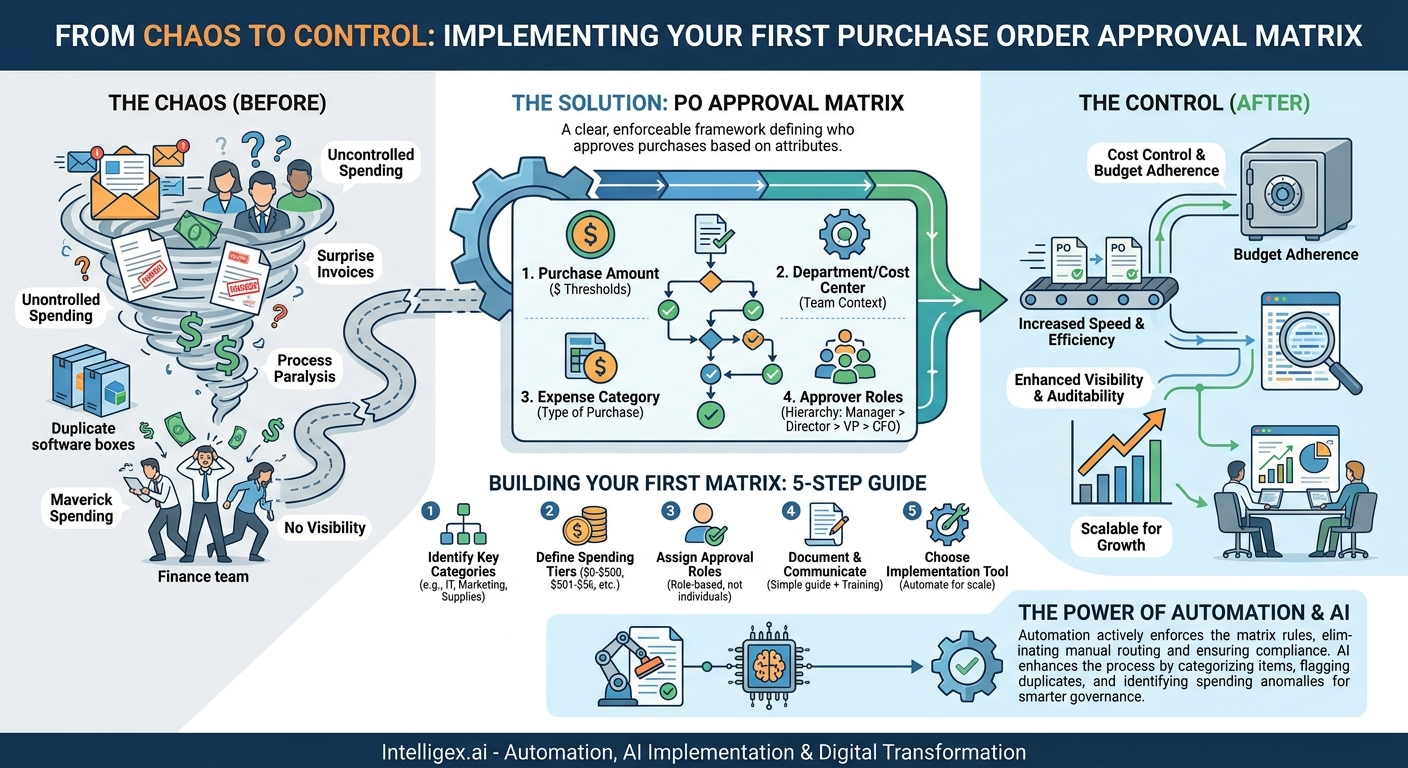
Uncontrolled spending is a silent growth killer. It shows up as surprise invoices, duplicate software subscriptions, and budget overruns that leave finance teams scrambling at the end of every quarter. The problem often stems from a lack of clarity. When an employee needs to buy something, they face a frustrating series of questions: Who needs to approve this? Is this even in the budget? How do I submit this request? The result is often process paralysis or worse, “maverick spending” where employees bypass the rules just to get their work done.
The solution is not more red tape. It is a clear, simple, and enforceable framework for purchasing. This is where a Purchase Order (PO) approval matrix becomes one of the most powerful foundational tools in your operational arsenal. It is a straightforward document that transforms procurement from a chaotic black box into a predictable, transparent, and efficient process. By defining the rules of engagement for spending, you empower your teams to act decisively while giving leadership the control and visibility it needs.
What is a Purchase Order Approval Matrix?
At its core, a PO approval matrix is a charter that defines who has the authority to approve a purchase. It is a set of rules that automatically determines the required approval workflow based on a request’s specific attributes. Think of it as a decision tree for company spending. Instead of relying on guesswork or shoulder taps, everyone in the organization has a clear guide for what needs to happen before a purchase is made.
While matrices can become complex, a simple and effective one is built on a few key components:
- Purchase Amount: This is the most common factor. The higher the dollar value of the purchase, the higher the level of authority required to approve it.
- Department or Cost Center: The team making the purchase is critical. A marketing team’s spending on advertising services will have a different context and budget than the IT team’s spending on new servers.
- Expense Category: What is being purchased matters. A recurring software subscription has different implications than a one-time capital expenditure on heavy machinery. Categories might include software, hardware, professional services, office supplies, or travel.
- Approver Levels: These are the specific roles, not individuals, who have sign-off authority. This typically follows the organizational hierarchy, such as Manager, Director, Vice President (VP), and Chief Financial Officer (CFO).
For example, a very basic matrix structure might look like this:
For the Marketing Department:
- Purchases under $1,000: Requires approval from the direct Marketing Manager.
- Purchases from $1,001 to $10,000: Requires approval from the Marketing Manager, then the Marketing Director.
- Purchases from $10,001 to $50,000: Requires approval from the Marketing Director, then the VP of Finance.
- Purchases over $50,000: Requires approval from the VP of Finance, then the CFO.
This simple logic immediately removes ambiguity from the process. Everyone on the marketing team knows exactly who needs to sign off on their request based on its value.
The Business Value: Why Bother with an Approval Matrix?
Implementing a formal approval process might seem like it slows things down, but a well-designed matrix does the exact opposite. It creates a system that delivers value across several key business dimensions.
Cost Control and Budget Adherence
This is the most direct benefit. An approval matrix is your first line of defense against uncontrolled spending. It ensures every purchase is reviewed by the appropriate budget holder before any commitment is made to a vendor. This systematic review prevents employees from accidentally making purchases that are not budgeted for, reduces the risk of buying duplicate services that already exist elsewhere in the company, and gives finance a proactive tool for managing cash flow rather than a reactive one for paying unexpected bills.
Increased Speed and Operational Efficiency
Clarity accelerates business. Without a matrix, a purchase request can get stuck in an endless loop of emails, with the requester asking, “Who else needs to see this?” The approval matrix provides a definitive answer. When automated in a procurement system, the request is instantly routed to the correct approvers in the correct order. This eliminates manual follow-up and guesswork. Furthermore, it empowers employees by setting clear thresholds for autonomous spending. A rule allowing managers to self-approve small purchases under $500 means your team isn’t waiting a week for a VP to sign off on office supplies.
Enhanced Visibility and Auditability
Every transaction that follows the matrix creates a clear, digital audit trail. You can instantly see who requested a purchase, who approved it, and when. This transparency is invaluable. For leadership, it provides a real-time view of financial commitments across the organization. For finance and procurement teams, it makes closing the books at the end of the month dramatically simpler. When internal or external auditors arrive, you can provide them with a complete, documented history of spending approvals, turning a stressful, weeks-long process into a routine check.
Scalability for Growth
The ad-hoc, “ask your manager” approval process that works for a 10-person startup will completely break down at 100 or 1,000 employees. As your company adds new teams, departments, and management layers, a defined approval matrix scales effortlessly. Adding a new department is as simple as defining its approval rules within the existing framework. Adjusting spending thresholds as the company’s revenues grow takes only a few minutes. This structured approach provides a stable foundation for financial governance that supports, rather than hinders, rapid growth.
Building Your First Approval Matrix: A Step-by-Step Guide
Creating your first matrix does not need to be a massive, complex project. The key is to start simple, focusing on the most common scenarios, and iterate over time. Follow these steps to build a practical and effective framework.
- Identify Key Purchase Categories
Begin by analyzing your company’s recent spending. Group purchases into broad, logical categories. Do not aim for perfection or exhaustive detail at this stage. Good starting points often include: IT Hardware, Software and Subscriptions, Marketing Services, Professional Services (e.g., consultants, legal), Office Supplies, and Capital Expenditures (larger, long-term assets). - Define Your Spending Tiers
Establish clear and distinct dollar-value thresholds. These tiers will determine how many levels of approval are required. A common starting point for a mid-sized business might be four or five tiers. For example: Tier 1: $0 – $500, Tier 2: $501 – $5,000, Tier 3: $5,001 – $25,000, and Tier 4: Over $25,000. Ensure there are no gaps or overlaps between the tiers. - Assign Approval Roles and Authority
This is the core of the matrix. Map organizational roles to your spending tiers and categories. Critically, you should always assign approvals to roles (e.g., “Director of IT”), not to specific individuals (e.g., “John Smith”). This ensures the matrix remains valid even when people change roles or leave the company. Decide on the approval logic. For most cases, a sequential workflow (Manager, then Director) is simplest. For certain high-value or high-risk purchases, you may require multiple approvals, such as the department head and the head of finance. - Document and Communicate the Matrix
Create a simple, easy-to-read document, like a spreadsheet or a page on your company intranet, that clearly lays out the rules. Once documented, communication is key to adoption. Hold a short training session with managers to explain the matrix and, more importantly, the business reasons behind it. When people understand that the goal is to empower them and make the business run more smoothly, they are far more likely to embrace the new process. - Choose Your Implementation Tool
You can start by managing this process with a simple spreadsheet and email. However, you will quickly find that a manual approach is prone to error and lacks a proper audit trail. The true power of an approval matrix is unlocked when it is embedded in a system that automates the workflow. This could be part of an ERP system like NetSuite, a dedicated procurement platform like Coupa, or integrated into modern financial operations tools that connect with your accounting software.
A Simple Example in Practice
Let’s walk through a common scenario to see how a matrix provides clarity and speed. Imagine the sales team needs a new license for a customer relationship management (CRM) add-on tool. The annual subscription costs $12,000.
The Old Way (Without a Matrix):
The Sales Operations Manager is not sure who needs to approve this. They email their direct manager, the Sales Director. The Director thinks the VP of Sales should see it, so they forward the email. The VP of Sales is busy and does not reply for two days. When they do, they ask if Finance has approved the budget. The Sales Ops Manager now has to send a new email to someone in Finance, who then has to confirm the budget availability. The entire process takes over a week, filled with follow-up emails and uncertainty.
The New Way (With an Approval Matrix):
The Sales Operations Manager creates a purchase request in the company’s procurement system for a “$12,000 software subscription for the Sales department.”
- The system automatically reads these details and consults the PO approval matrix.
- It determines that a purchase of this value for the Sales department falls into the tier requiring two levels of approval: the Sales Director and the VP of Finance.
- The request is instantly routed to the Sales Director’s approval queue. They receive a notification, review the business case, and approve it with a single click.
- Immediately upon the Director’s approval, the system routes the request to the VP of Finance’s queue.
- The VP of Finance reviews it, confirms it aligns with the overall budget, and approves it.
- Once the final approval is given, a formal PO is automatically generated and sent to the sales team, who can now complete the purchase.
The entire process is transparent, trackable, and completed in a fraction of the time, with zero ambiguity about who needed to do what.
Common Pitfalls and How to Avoid Them
While the concept is simple, a few common mistakes can undermine the effectiveness of your approval matrix. Being aware of these can help you design a more robust process from the start.
- The Matrix is Too Complex. It is tempting to create dozens of rules for every possible edge case. This leads to a matrix that is impossible to understand and manage. The Fix: Start with a simple framework that covers 80% of your purchases. You can always add more specific rules later if you find they are truly necessary.
- Assigning Approvers by Name. Tying approvals to specific individuals is a recipe for constant maintenance. When that person goes on vacation, changes roles, or leaves the company, the workflow breaks. The Fix: Always use role-based assignments (e.g., “IT Manager”). Your system should allow you to easily update who holds that role.
- Forgetting to Define Backups. A key approver is on vacation for two weeks, and now all purchasing for their department is frozen. This is a common and completely avoidable bottleneck. The Fix: For every primary approver role, define a designated backup or delegate. Good systems allow for temporary delegation rules to be set up automatically.
- Poor Communication and Training. You can design the world’s best approval process, but if no one knows it exists or how to use it, they will revert to the old ways. The Fix: Announce the new process, provide clear documentation, and hold brief training sessions. Emphasize how it helps employees get what they need faster.
Measuring Success: What Metrics Matter?
How do you know if your approval matrix is actually improving your procurement process? You need to track a few key performance indicators (KPIs). Look at these metrics before and after you implement your matrix to measure the impact.
- Purchase Order Cycle Time: This is the average time elapsed from when a purchase request is first submitted to when the final PO is generated. A primary goal of your matrix is to reduce this time for compliant, in-budget requests.
- Maverick Spend Percentage: This measures the amount of spending that happens outside the official procurement process (e.g., invoices that show up without a corresponding PO). Your goal is to drive this number as close to zero as possible.
- Approver Touch Time: How long does a request sit in an approver’s queue before they take action? If this is high, it may indicate that your approvers are a bottleneck, and you may need to simplify the rules or provide them with better tools.
- Rate of “After-the-Fact” POs: This is the number of POs created for an invoice that has already been received from a vendor. It is a key indicator of a broken process. A successful matrix implementation should see this metric decline sharply.
The Role of Automation and Governance
An approval matrix on a spreadsheet is a good start, but it is still a passive guide. The real transformation happens when you use technology to actively enforce these rules. This is where the matrix becomes the core logic inside an automated procurement or accounts payable system.
Automation platforms can ingest a purchase request, parse the key data (submitter, department, amount, vendor), and instantly apply the matrix logic to create the correct approval workflow. This eliminates the need for manual routing and ensures 100% compliance with your defined process. No request can be advanced or paid without the required digital approvals.
Looking ahead, artificial intelligence can further enhance this process. For example, AI-powered tools can help by automatically categorizing line items on a request, flagging duplicate requests for the same product across different departments, or analyzing spending patterns to identify anomalies that might require an extra level of human review. The matrix provides the rules, and AI can provide the intelligence to ensure those rules are applied smartly.
From a governance perspective, this automation is critical. A digital system enforces access control, ensuring that employees can only see and approve requests within their designated scope of authority. It creates an immutable, timestamped record of every action, providing a strong foundation for financial controls and data security. The key is to maintain a “human in the loop” philosophy. The system automates the workflow and can flag exceptions, but the final approval decisions, especially for significant expenditures, rightly remain with your designated leaders.
Your Next Steps: Putting This into Action
Implementing a PO approval matrix is a high-impact project that delivers immediate clarity and control. It is a foundational step in building a scalable financial operation. Here is how to get started.
- Form a Small, Cross-Functional Team: Get buy-in by involving the key players from the start. This should include someone from Finance or Accounts Payable, a Procurement lead if you have one, and a manager from a department with significant spending, like IT or Marketing.
- Analyze Your Past Spending: Pull the last six months of accounts payable data. This will give you a clear picture of your actual purchase categories and value ranges, allowing you to design a matrix based on reality, not theory.
- Draft Version 1.0 of Your Matrix: Resist the urge to make it perfect. Start with a simple grid covering your main departments and three to five spending tiers. Document it in a shared spreadsheet.
- Pilot the Process with One Department: Before rolling it out company-wide, test your new matrix and manual workflow with a single, willing team. This will help you identify any confusing rules or process gaps in a controlled environment.
- Explore Automation Technology: Once your logic is validated, begin evaluating tools that can automate the enforcement of your matrix. A system that can digitize requests, route approvals, and generate POs will be the key to scaling the benefits across the entire organization.
Related Posts
Category:
Get a FREE
Proof of Concept
& Consultation
No Cost, No Commitment!