

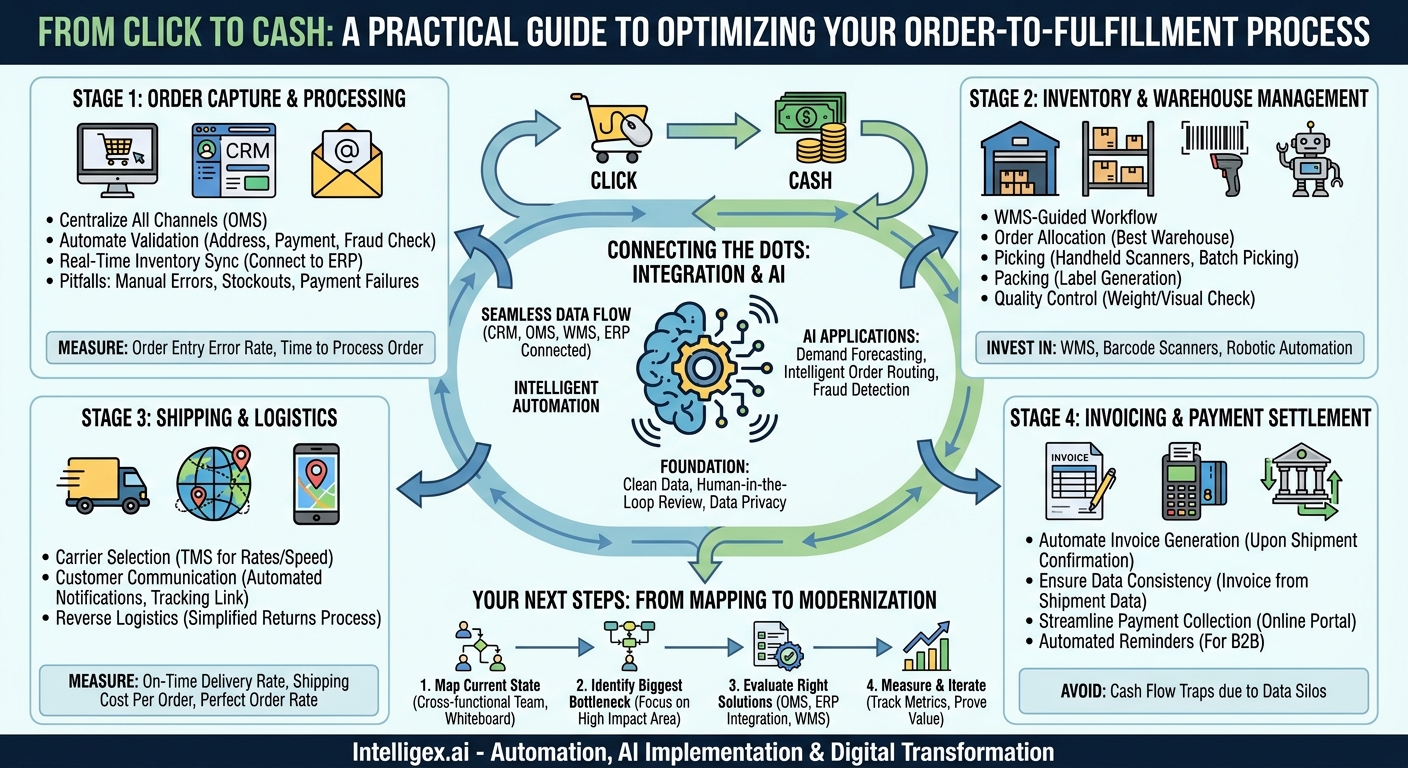
The journey an order takes from a customer’s click to their doorstep is the lifeblood of your business. Far from a simple “ship it” task, the order-to-fulfillment process is a complex relay race involving sales, finance, operations, and customer service. When the handoffs are smooth, your company runs efficiently, customers are happy, and cash flow is healthy. When they are fumbled, you face costly errors, frustrating delays, and a damaged reputation. Understanding and optimizing this entire flow is one of the most impactful initiatives any business can undertake.
Mapping this process is the first step toward transforming it. By visualizing each stage, you uncover hidden inefficiencies and identify clear opportunities for improvement. This is not just about moving boxes faster; it is about building a scalable, resilient, and customer-centric operational backbone that directly drives business value in five key areas: speed, cost, quality, visibility, and scalability.
What Is the Order-to-Fulfillment Process? A Shared Language for Your Teams
At its core, the order-to-fulfillment process (sometimes called order-to-cash or O2C) is the complete sequence of business activities that occur from the moment a customer places an order until the product is delivered and payment is complete. Viewing it as a single, interconnected process is crucial, because in reality, every department sees a different part of the elephant.
- Sales and Marketing see the beginning: a successful conversion. Their primary concern is that the order is captured correctly and the customer’s initial experience is positive.
- Supply Chain and Operations see the middle: the physical logistics. They focus on inventory availability, warehouse efficiency, and shipping performance.
- Finance and Accounting see the end: the financial transaction. They need accurate invoicing, timely payment collection, and clean reconciliation in the books.
- Customer Service sees the exceptions: the questions and the problems. They need real-time visibility into order status to answer “Where is my order?” and resolve issues quickly.
Without a shared map and language, these teams operate in silos. Sales might make promises that operations cannot keep. Operations might make a shipping change that finance does not see, leading to an incorrect invoice. A customer service agent might have no information to give a customer because the warehouse system does not communicate with the CRM. Creating a clear process map forces these teams to speak the same language and understand how their actions impact one another, the customer, and the bottom line.
Stage 1: Order Capture and Processing
This is where it all begins. An order can arrive from multiple channels: your e-commerce website, a B2B portal, a sales representative entering it into a CRM, or even an email. The goal of this stage is to capture all necessary information accurately, validate it, and prepare it for the warehouse.
Common Pitfalls to Avoid
Friction at this initial stage has a ripple effect throughout the entire process. The most common problems are almost always preventable.
- Manual Data Entry Errors: A typo in a shipping address or an incorrect SKU entered from a phone order can lead to a mis-shipment, a costly return, and a very unhappy customer.
- Inventory Discrepancies: A customer buys a product that your website showed as “in stock,” only to receive a backorder notification hours later. This happens when your e-commerce platform is not synchronized with your actual warehouse inventory in real time.
- Payment and Fraud Issues: Processing an order with a failed payment authorization or, worse, a fraudulent one, costs you both time and money. Automated checks are essential.
Practical Steps for a Rock-Solid Order Intake
Strengthening this first step is about automation and centralization. Your goal is to create a “touchless” process where valid orders flow through to the warehouse without manual intervention.
- Centralize All Channels: Use an Order Management System (OMS) to act as a central hub for orders from all sources. This ensures consistency and prevents orders from getting lost in email inboxes.
- Automate Validation: Your system should automatically perform key checks upon order submission. This includes address verification (using services like the USPS API), credit card authorization, and basic fraud screening based on order patterns.
- Synchronize Inventory in Real Time: Connect your OMS directly to your inventory management system or ERP. When an item is sold on any channel, the available quantity should be updated across all other channels instantly.
What to Measure Here: Two simple metrics can tell you a lot about the health of your order capture process. First, Order Entry Error Rate, which is the percentage of orders requiring manual correction after submission. Second, Time to Process Order, the duration from when the customer submits the order until it is formally released to the warehouse for fulfillment.
Stage 2: Inventory and Warehouse Management
Once an order is validated, it is sent to the fulfillment center. This is the physical heart of the process, where digital orders become tangible packages. Efficiency here is a game of seconds and inches. The core activities involve finding the items, packing them correctly, and preparing them for shipment.
The Anatomy of Warehouse Fulfillment
A modern warehouse does not run on guesswork. It follows a precise, system-guided workflow, typically managed by a Warehouse Management System (WMS).
- Order Allocation: The system intelligently assigns the order to the best warehouse. This decision can be based on which facility is closest to the customer, has all the required items in stock, and offers the lowest shipping cost.
- Picking: A warehouse associate receives a “pick list” on a handheld scanner. The WMS directs them along the most efficient path through the warehouse aisles to retrieve the items for one or multiple orders at once (a strategy known as batch picking).
- Packing: At a packing station, the items are scanned one last time to ensure accuracy. They are then placed in an appropriately sized box with protective material. The system generates and prints the correct shipping label, which is applied to the package.
- Quality Control: This is a final check. It might be a quick verification of the items against the packing slip or a weight check to flag any significant discrepancies before the package leaves the building.
Investing in a robust WMS and tools like barcode scanners dramatically reduces human error and increases throughput. For high-volume operations, robotic automation for picking and sorting can further accelerate the process, allowing your team to scale without a linear increase in headcount.
Stage 3: Shipping and Logistics
The package is sealed and labeled. Now, it must get to the customer on time and in perfect condition. This stage involves selecting the right shipping carrier, managing the handoff, and providing visibility to the customer while the package is in transit.
Navigating the Complexities of Transit
This is more than just putting a stamp on a box. Logistics involves a series of critical decisions that impact both cost and customer experience.
- Carrier Selection: The cheapest carrier is not always the best. A Transportation Management System (TMS) can help you automate this choice by comparing rates, delivery speeds, and performance history for different carriers based on the package size, weight, and destination.
- Customer Communication: This is non-negotiable. Customers expect proactive communication. You should automate email or SMS notifications for key events: “Shipped,” “In Transit,” “Out for Delivery,” and “Delivered.” Include a tracking link in every message.
- Reverse Logistics (Returns): A difficult returns process can permanently lose you a customer. Your fulfillment process must also include a clear, simple, and efficient way to handle returns, inspect the items, and process refunds or exchanges.
What to Measure Here: The key performance indicators in logistics are straightforward. On-Time Delivery Rate measures your (and your carrier’s) ability to meet the delivery promise made to the customer. Shipping Cost Per Order helps you manage one of your biggest variable expenses. Finally, Perfect Order Rate is a powerful composite metric that measures the percentage of orders delivered on time, complete, and damage-free, with correct documentation.
Stage 4: Invoicing and Payment Settlement
The customer has their product, but the process is not over. The final stage is ensuring you get paid accurately and on time. This is where the operational side of the house meets the financial side, and where seamless data flow is critical for a healthy cash conversion cycle.
Connecting Operations to Cash Flow
For B2C e-commerce, payment is usually captured at the time of order. For B2B or more complex sales, invoicing often happens after shipment. Any mismatch between what was ordered, what was shipped, and what is on the invoice can lead to a dispute, delaying payment by weeks or even months.
Imagine a B2B scenario: a customer issues a purchase order for 100 units. Due to an inventory shortage, your warehouse ships only 95 units. If your accounting system is not automatically updated with the final shipment data, it might generate an invoice for the original 100 units. The customer’s accounts payable department will flag the discrepancy, reject the invoice, and halt payment until a corrected version is sent. This single data silo has just directly delayed your revenue.
Checklist for a Smoother Financial Close
To avoid these cash flow traps, integrate your financial systems with your fulfillment operations.
- Automate Invoice Generation: Configure your ERP or accounting software to automatically create and send an invoice as soon as the WMS confirms an order has shipped.
- Ensure Data Consistency: The invoice line items should be pulled directly from the shipment record, not the original order record, to reflect what was actually delivered.
- Streamline Payment Collection: Offer customers an online portal to view invoices and make payments, which is faster and easier to track than paper checks.
- Implement Automated Reminders: For B2B accounts, use your accounting system to automatically send polite reminders for upcoming and overdue invoice payments.
Connecting the Dots: The Power of Integration and AI
The four stages we have outlined are not independent tasks. They are interconnected links in a single value chain. The greatest source of inefficiency, cost, and customer frustration comes from the gaps between these stages. The solution is integration, powered by intelligent automation.
When your CRM, OMS, WMS, and ERP systems are not connected, you rely on manual processes to bridge the gaps. This looks like exporting CSV files, re-keying data, and sending internal emails to confirm information. Each manual step is an opportunity for delay and error. True digital transformation means creating a seamless flow of data from the first click to the final payment.
Where AI Can Make a Practical Difference
Artificial intelligence is not about magic; it is about using data to make better, faster decisions. Within the order-to-fulfillment process, AI can be applied in very specific, high-impact ways. For example, instead of relying on generic CRM platforms, you can use specialized tools like a Salesforce Commerce Cloud that has AI capabilities built-in.
- Demand Forecasting: AI models can analyze historical sales data, seasonality, and market trends to predict how much of each product you are likely to sell. This allows you to optimize inventory levels, reducing both stockouts and costly excess inventory.
- Intelligent Order Routing: Instead of using simple rules to assign orders to warehouses, AI can make dynamic decisions in real time. It can factor in inventory levels, labor capacity at each facility, and real-time shipping rates to find the absolute optimal fulfillment path for every single order.
- Fraud Detection: Machine learning algorithms can analyze thousands of data points for each order (like IP address, time of day, and order size) to flag suspicious transactions with a much higher degree of accuracy than simple rule-based systems.
A Note on Safe and Governed Implementation
Leveraging these advanced capabilities requires a thoughtful approach. AI is a powerful tool, but it must be built on a solid foundation of data governance.
First, ensure your source data is clean, accurate, and structured. An AI model trained on messy or incomplete data will produce unreliable results. Second, implement a “human-in-the-loop” review process for critical decisions. An AI can flag a potentially fraudulent order, but a trained analyst should make the final call to cancel it. Finally, maintain strict data privacy and access controls, ensuring that sensitive customer and financial information is protected across all integrated systems.
Your Next Steps: From Mapping to Modernization
Optimizing your order-to-fulfillment process is a journey, not a one-time project. It starts with understanding where you are today and taking a methodical approach to improvement. Here is a simple plan to get started.
- Map Your Current State: Assemble a cross-functional team with members from sales, operations, finance, and IT. On a whiteboard or with virtual tools, map out every single step of your current process. Note every system used, every manual action taken, and every handoff between teams. Be honest about the pain points.
- Identify the Biggest Bottleneck: Do not try to fix everything at once. Analyze your map and find the one area that causes the most frequent delays, errors, or customer complaints. Is it manual order entry? Is it picking inefficiency in the warehouse? Focus your initial efforts there for the biggest impact.
- Evaluate the Right Solutions: Once you have clearly defined the problem, you can search for the right solution. This might be implementing a dedicated OMS, integrating your e-commerce store with your ERP, or adopting a WMS to organize your warehouse operations.
- Measure and Iterate: After implementing a change, use the metrics discussed earlier to measure its impact. Track your on-time delivery rate, your order error rate, and your cost per order. Use that data to prove the value of your improvements and identify the next bottleneck to tackle.
By treating your order-to-fulfillment workflow as the strategic asset it is, you build more than just an efficient operation. You build a resilient, scalable engine for growth that consistently delivers on the promise you make to your customers.
Your Next Read:
Category:
Get a FREE
Proof of Concept
& Consultation
No Cost, No Commitment!