

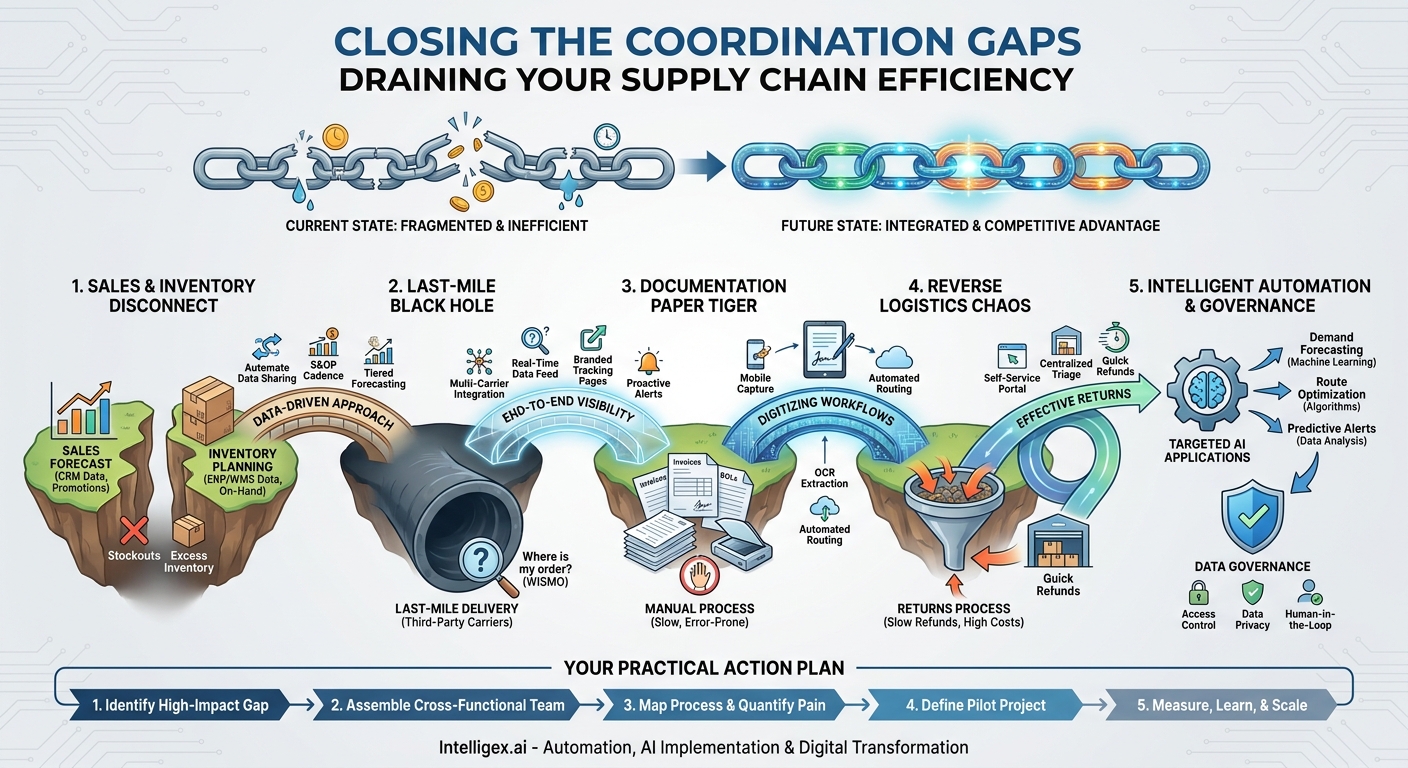
In a global supply chain, efficiency is not defined by a single, perfectly executed shipment. It is the sum of thousands of small, interconnected handoffs. When these connections weaken, they create coordination gaps. These are not catastrophic system failures, but subtle, persistent points of friction that silently drain resources, delay deliveries, and frustrate customers. They are the manual data entry that adds an hour to processing time, the sales forecast that never reaches the warehouse, and the customer service agent who has no answer to “Where is my order?”
Closing these gaps is not about a single, massive overhaul. It is about a targeted, systematic approach to improving communication, visibility, and automation across your logistics network. By identifying and addressing these common points of failure, you can unlock significant gains in speed, cost efficiency, and customer satisfaction, transforming your supply chain from a cost center into a competitive advantage.
The Disconnect Between Sales Forecasts and Inventory Planning
One of the most common and costly gaps exists at the very beginning of the logistics cycle: the chasm between what the sales team expects to sell and what the operations team has on hand. A marketing team might launch a successful promotion without fully briefing the inventory planners, leading to immediate stockouts that disappoint new customers and halt the campaign’s momentum. Conversely, an overly optimistic sales forecast can lead to warehouses filled with slow-moving products, tying up capital and incurring high carrying costs.
This misalignment directly impacts the bottom line. For the finance team, it means unpredictable cash flow tied up in excess inventory or lost revenue from stockouts. For operations, it means expensive expedited shipping to meet unexpected demand or inefficient use of warehouse space.
Bridging the Gap: A Data-Driven Approach
The solution lies in creating a single source of truth by integrating disparate systems. Your Customer Relationship Management (CRM) platform, like Salesforce, holds invaluable data on sales pipelines and promotional calendars. Your Enterprise Resource Planning (ERP) or Warehouse Management System (WMS) contains the reality of on-hand inventory and supply chain lead times. Integrating these systems allows for a more dynamic and responsive planning process.
Practical Steps:
- Automate Data Sharing: Set up automated workflows that feed sales forecast data from your CRM directly into your inventory planning tools.
- Establish a Sales & Operations Planning (S&OP) Cadence: Schedule regular, cross-functional meetings between sales, marketing, and operations to review forecasts against actuals and plan for upcoming events.
- Use Tiered Forecasting: Instead of a single number, create forecasts with best-case, worst-case, and most-likely scenarios. This helps operations plan for a range of outcomes and build appropriate inventory buffers.
What to Measure:
- Forecast Accuracy: The percentage difference between the forecast and actual sales. Aim for continuous improvement.
- Inventory Turnover: How many times inventory is sold and replaced over a period. Higher turnover indicates better alignment.
- Stockout Rate: The frequency of out-of-stock events for key products.
The Black Hole of Last-Mile Delivery
For most customers, the entire supply chain is invisible until the final stage: the last-mile delivery. This is also where an organization’s control is often weakest. Once a package is handed off to a third-party carrier, it can enter a “black hole” of visibility. This creates a significant burden on customer service teams, who spend their time reactively answering “Where is my order?” (WISMO) inquiries instead of focusing on higher-value activities.
This lack of proactive communication erodes trust and damages the customer experience. A single late delivery without any notification can negate an otherwise perfect purchasing journey. For the business, it means higher customer service costs, lower customer loyalty, and a tarnished brand reputation.
Achieving End-to-End Visibility
The goal is to provide customers and internal teams with a single, unified view of an order’s journey from the warehouse to the front door. This requires consolidating tracking data from multiple carriers into a centralized platform and using that data to power proactive, automated communications.
A checklist for evaluating a last-mile visibility solution:
- Multi-Carrier Integration: Can the platform easily connect to all your current and future shipping partners via APIs?
- Real-Time Data Feed: Does it provide true real-time updates, or is there a significant lag in tracking information?
- Branded Tracking Pages: Can you provide a tracking experience on your own website, keeping the customer within your brand ecosystem?
- Proactive Event-Based Alerts: Can you configure automated email or SMS notifications for key events like “Out for Delivery,” “Delivery Attempted,” or, most importantly, “Potential Delay Detected”?
- Analytics and Performance Reporting: Does the tool provide dashboards to track carrier performance, on-time delivery rates, and average transit times?
By investing in visibility, you shift your customer service posture from reactive to proactive, reducing inbound calls and increasing customer satisfaction.
Taming the Paper Tiger of Documentation
International logistics runs on a mountain of paperwork: commercial invoices, bills of lading (BOLs), packing lists, certificates of origin, and customs declarations. In many organizations, these documents are still handled manually. They are printed, physically signed, scanned, and emailed. This process is not only slow but also incredibly prone to human error. A single typo on a customs form can leave a multi-million dollar shipment sitting on a dock for weeks, incurring demurrage fees and jeopardizing customer relationships.
This bottleneck directly impacts operational speed and financial health. Finance teams struggle with delayed invoicing because they are waiting on a signed proof of delivery (POD). The supply chain team faces unpredictable delays that disrupt production schedules. The entire process is fragile, opaque, and inefficient.
A Step-by-Step Guide to Digitizing a Key Workflow
Let’s take the proof of delivery process as an example. Automating it can dramatically shorten your order-to-cash cycle. Here is a simplified, five-step process to get started:
- Map the Current State: Physically walk through the current POD process. Who touches the document? Where are the delays? Note every step, from the driver getting a signature to the finance team receiving the scanned copy.
- Select the Right Tools: You do not need a massive new system. Start with existing technology. Modern mobile devices can capture signatures and GPS-tagged photos. Optical Character Recognition (OCR) tools can extract data from scanned documents, and workflow automation platforms can route the documents automatically.
- Design the Digital Workflow: Create a new process map. For example: a driver captures a signature on a mobile app. The app instantly transmits the signed POD with a timestamp and location data to a central repository. A workflow rule then automatically validates the data, attaches the POD to the correct invoice in the ERP system, and notifies the finance team that the invoice is ready to be sent.
- Run a Small Pilot: Choose a single route or a cooperative customer to test the new digital process. This allows you to identify and fix issues on a small scale before a full rollout. Gather feedback from drivers, back-office staff, and the pilot customer.
- Measure, Refine, and Scale: Track key metrics from your pilot. Compare the old “document transit time” to the new “data transit time.” Measure the reduction in data entry errors. Use these results to build a business case for scaling the solution across your entire network.
Reverse Logistics: More Than Just Returns
Reverse logistics, the process of managing returns, is often treated as an unavoidable cost of doing business. But a poorly managed returns process is a significant coordination gap that leaks value at every step. It creates a negative customer experience through slow refunds. It clogs warehouses with uninspected products. And it results in perfectly good inventory being written off because it takes too long to process, inspect, and restock.
An efficient reverse logistics process, however, can be a source of value. It builds customer loyalty through a hassle-free experience and recovers maximum value from returned goods. Finance benefits from faster asset recovery, and operations can get sellable products back into inventory more quickly.
Do’s and Don’ts for an Effective Returns Process
Do:
- Make it Easy for the Customer: Provide a self-service online portal for initiating returns and printing labels. A simple, clear process encourages loyalty.
- Centralize Returns Processing: Designate a specific area in your warehouse or a dedicated facility for handling returns to ensure consistency and efficiency.
- Triage Items upon Receipt: Immediately sort items based on their condition and potential disposition (restock, refurbish, liquidate, or recycle). The faster this decision is made, the more value is retained.
- Link Returns Data to Product Quality: Analyze reasons for returns. Is one product failing more than others? Feed this data back to the product development and procurement teams.
Don’t:
- Delay Refunds: Do not wait until an item is fully restocked to issue a refund. Process the refund as soon as the return is received and verified at the warehouse.
- Treat All Returns Equally: The process for a high-value electronic item should be different from that for a low-cost apparel item. Customize workflows based on product value and category.
- Ignore the Cost of “Touches”: Every time an employee handles a returned item, it costs money. Design your process to minimize unnecessary movement and handling.
Using Automation Intelligently
The term “AI” is often used as a cure-all, but its real value in logistics comes from specific, targeted applications that solve concrete coordination problems. Intelligent automation is not about replacing human experts; it is about equipping them with better tools to make faster, more informed decisions. It bridges gaps by processing vast amounts of data to identify patterns and predict outcomes that are impossible to see manually.
Instead of thinking in terms of generic AI, focus on the business problem you need to solve.
- For Demand Forecasting: Machine learning models can analyze not only historical sales data but also external factors like weather patterns, public holidays, and even social media trends to create more accurate forecasts. This provides inventory planners with a much richer dataset than a simple historical average.
- For Route Optimization: Modern routing algorithms can consider dozens of variables in real time, including traffic, delivery windows, vehicle capacity, and even known road closures. This goes beyond what a human dispatcher can calculate, resulting in lower fuel costs and more reliable delivery times. You can explore services on platforms like AWS through their extensive official documentation.
- For Predictive Alerts: By analyzing data from carriers, traffic, and weather, an intelligent system can predict potential delays before they happen. This allows a logistics coordinator to proactively reroute a critical shipment or notify a customer of a delay, turning a negative event into a positive customer service interaction.
The key is to start with a well-defined problem and clean data. The most sophisticated algorithm is useless if it is fed inaccurate or incomplete information.
A Note on Safe Implementation and Data Governance
As you integrate systems and deploy automation, you are centralizing sensitive information. Logistics data includes customer names and addresses, shipment contents, and commercial values. Protecting this data is not just a technical requirement; it is a critical component of maintaining trust with your customers and partners.
When implementing new logistics technologies, especially those involving AI, keep these principles in mind:
- Access Control: Not everyone in your organization needs to see the commercial value of a shipment or a customer’s full delivery history. Implement role-based access controls to ensure employees can only view the data necessary for their specific job function.
- Data Privacy: Be transparent with customers about what data you are collecting and how you are using it, particularly for tracking and notifications. Ensure your data handling practices comply with regulations like GDPR or CCPA.
- Human in the Loop: Automation is a powerful tool, but it should not operate without oversight. For critical decisions, such as rerouting a high-value shipment or changing a carrier contract based on performance data, ensure a human expert reviews and approves the system’s recommendation. The goal is to augment human intelligence, not replace it entirely.
Your Next Steps: A Practical Action Plan
Closing logistics coordination gaps can feel like a daunting task, but progress is made through focused, incremental improvements. You do not need to solve every problem at once. Instead, build momentum by targeting the most significant points of friction first.
Here is a simple plan to get started:
- Identify One High-Impact Gap: Choose one of the areas discussed above that represents the biggest pain point for your organization. Is it customer complaints about delivery? Or perhaps high carrying costs from inaccurate forecasts? Pick one.
- Assemble a Small, Cross-Functional Team: Get one person from operations, one from IT, and one from a business unit (like sales or customer service) in a room. A small, dedicated team can move much faster than a large committee.
- Map the Process and Quantify the Pain: Ask the team to map the current process from start to finish. Identify every manual step and every point of delay. Attach metrics to it. How many WISMO calls do you get per week? What is your current order-to-cash cycle time in days?
- Define a Pilot Project: Scope a small, manageable pilot project to address the identified gap. It could be digitizing one document type for one shipping lane or implementing proactive alerts for your top 10 customers.
- Measure, Learn, and Scale: Define what success looks like for the pilot before you begin. Once it is complete, measure the results against your initial baseline. Use this success story, complete with hard data, to justify a wider rollout.
By taking this structured and measured approach, you can systematically close the gaps in your logistics network, building a more resilient, efficient, and customer-focused supply chain.
Your Next Read:
Category:
Get a FREE
Proof of Concept
& Consultation
No Cost, No Commitment!
