

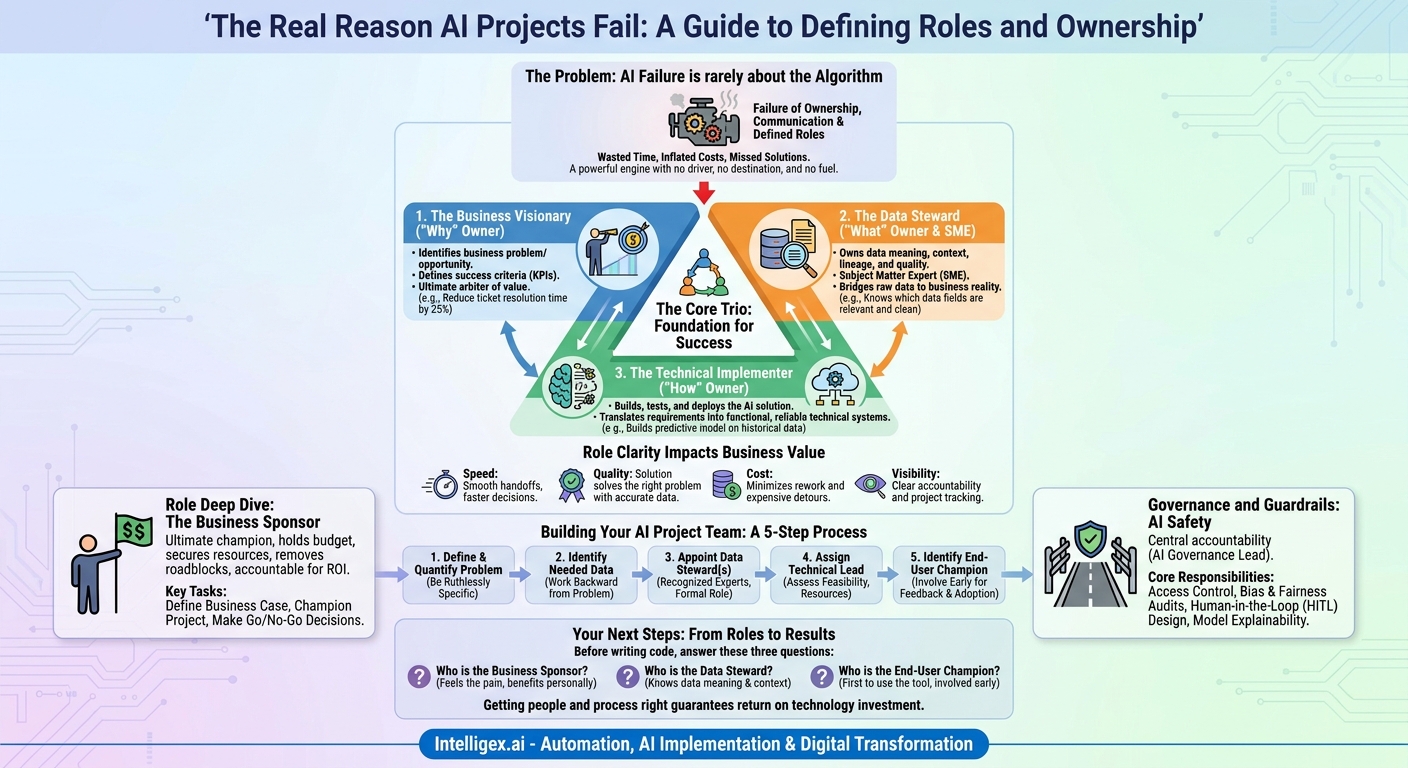
An AI project is not just a technology initiative. It is a fundamental business transformation project that happens to use sophisticated technology. This distinction is the single most important factor determining success or failure. When projects stall, exceed budgets, or fail to deliver a return on investment, the root cause is rarely the algorithm itself. More often, it is a failure of ownership, communication, and clearly defined roles. Without knowing who owns what, you risk building a powerful engine with no driver, no destination, and no fuel.
Defining roles isn’t about creating bureaucracy. It’s about creating accountability and velocity. When your team knows exactly who is responsible for defining the business problem, who curates the data, who builds the solution, and who validates the outcome, decisions are made faster. Obstacles are removed more efficiently. The project moves from a vague concept to a tangible business asset that delivers measurable value in the form of cost savings, revenue growth, or operational efficiency.
Why Role Clarity is Non-Negotiable in AI Projects
Launching an AI initiative without defined roles is like setting sail without a captain, a navigator, or an engineer. You might have a great ship, but you have no clear direction and no one responsible for keeping it afloat. In business terms, this ambiguity translates directly into wasted time, inflated costs, and solutions that miss the mark.
Consider a common scenario: a supply chain team wants to use AI to predict inventory shortages. The data scientists are ready to build a model, but they need historical sales data, supplier lead times, and warehouse capacity information. Who has the authority to grant access? Who can verify that the data is accurate and complete? Is it the IT department, the head of logistics, or a specific warehouse manager? If no one is assigned the role of Data Steward, the data scientists can spend weeks just trying to acquire the necessary inputs, bringing the project to a halt before it even begins. This friction is expensive, not just in salary costs but in lost opportunity.
Clear roles create a framework for accountability that directly impacts business value:
- Speed: When everyone knows their responsibilities, handoffs are smooth and decision-making is decentralized. The project lead doesn’t become a bottleneck for every minor question about data access or business logic.
- Quality: Assigning an owner to the business problem ensures the final solution actually solves it. Assigning an owner to data quality prevents the classic “garbage in, garbage out” problem that plagues so many AI projects.
- Cost: Role clarity minimizes rework. Building a model based on misunderstood requirements or flawed data is a costly mistake that requires going back to square one. A well-defined team structure avoids these expensive detours.
- Visibility: With clear owners, project sponsors and executives know who to talk to for updates on progress, risks, and results. This transparency builds trust and secures ongoing support for the initiative.
The Core Trio: Business, Data, and Technology
While AI projects can involve many stakeholders, success typically hinges on a core trio of functional owners representing three critical domains. These are not necessarily job titles but rather essential roles that must be filled, whether by one person wearing multiple hats in a small company or by entire teams in a large enterprise.
1. The Business Visionary
This is the “why” owner. This person or group is responsible for identifying the business problem or opportunity and defining what success looks like. They don’t need to know how an algorithm works, but they must deeply understand the business process they want to improve. They are the ultimate arbiters of value. If the final solution does not meet their predefined success criteria, the project has failed, no matter how technically elegant it is.
Example: In a project to automate customer support ticket routing, the Business Visionary is the Head of Customer Service. Their goal is not “to use AI” but “to reduce average ticket resolution time by 25% and improve customer satisfaction scores.”
2. The Data Steward
This is the “what” owner. AI models are powered by data, and this role owns the data itself. The Data Steward is a subject matter expert who understands the data’s meaning, context, lineage, and limitations. They are responsible for ensuring the data used to train the model is accurate, relevant, and accessible. They act as the bridge between the raw information sitting in databases and the business reality it represents.
Example: For a financial fraud detection model, the Data Steward might be a senior risk analyst. They know which transaction fields are most indicative of fraud, can explain anomalies in the data, and can provide the crucial context that a data scientist lacks.
3. The Technical Implementer
This is the “how” owner. This role is filled by the data scientists, ML engineers, and developers who build, test, and deploy the AI solution. They are responsible for translating the business requirements from the Visionary and the data context from the Steward into a functional, reliable, and scalable technical system. Their job is not just to build a model, but to build a solution that integrates into existing workflows and systems.
Example: In a project to optimize marketing spend, the Technical Implementer takes the CMO’s goal (the “why”) and the historical campaign data (the “what”) to build a predictive model that recommends the most effective allocation of the budget across different channels.
A breakdown in any one of these areas jeopardizes the entire project. Without the Business Visionary, you build a solution for a non-existent problem. Without the Data Steward, you build an inaccurate solution on a faulty foundation. Without the Technical Implementer, the vision never becomes a reality.
Role Deep Dive: The Business Sponsor
The Business Sponsor is the project’s ultimate champion and is often the same person as the Business Visionary, especially in smaller initiatives. This individual holds the budget, secures resources, and removes organizational roadblocks. Their primary responsibility is to ensure the project remains aligned with strategic business objectives. They are accountable for the project’s return on investment (ROI).
Key Responsibilities Checklist:
- Define the Business Case: Clearly articulate the problem and the expected value of solving it. This includes defining the key performance indicators (KPIs) that will measure success.
- Secure Funding and Resources: Advocate for the project at an executive level to get the necessary budget for people, tools, and infrastructure.
- Appoint the Core Team: Formally assign the key roles, ensuring that the individuals involved have the authority and bandwidth to fulfill their duties.
- Champion the Project: Communicate the project’s vision and progress across the organization to build support and manage expectations.
- Make Go/No-Go Decisions: Based on project milestones and performance against KPIs, make the final call on whether to proceed, pivot, or terminate the project.
- Own the Final Outcome: Ultimately, the sponsor is accountable to the business for the results delivered by the AI solution.
Pitfall to Avoid: The “absentee sponsor.” A sponsor who funds a project and then disappears is a major red flag. Effective sponsors are actively engaged, attending key meetings, asking tough questions about business value, and using their political capital to clear pathways for the project team.
Role Deep Dive: The Data Steward and Subject Matter Expert
This is arguably the most underestimated role in AI projects. Many organizations assume that data is a purely technical asset managed by IT. In reality, data’s value comes from its business context, and that context lives with the people who work with it every day. The Data Steward is often not a technical person; they are an operational expert.
What to Measure for This Role’s Success:
The success of the Data Steward is not measured in lines of code, but in the quality and usability of the data provided to the technical team. Key indicators include:
- Data Discovery Time: How quickly can the project team identify and access the required data sources? A good Data Steward reduces this from weeks to days.
- Data Quality Metrics: The percentage of complete and accurate records in the training dataset. The Steward’s work should directly lead to improvements in these metrics.
- Time Spent on Data Cleaning: A well-curated dataset from a knowledgeable Steward can significantly reduce the 60-80% of time data scientists often spend just cleaning and preparing data.
A Practical Example: An HR department wants to build a model to predict employee attrition. The Business Sponsor (CHRO) sets the goal: reduce voluntary turnover by 15%. The Technical Implementer (a data scientist) requests data. An HR Business Partner is assigned as the Data Steward. This person knows that “last promotion date” is a messy field because of a system change three years ago. They can provide the context to clean it correctly. They also know that performance review scores are calibrated differently across departments, a crucial piece of information that prevents the model from unfairly penalizing employees in a division with a “tougher” grading curve. Without this subject matter expert, the model would be built on flawed assumptions, leading to inaccurate and potentially biased predictions.
Building Your AI Project Team: A 5-Step Process
Forming the right team is a deliberate process, not an afterthought. Rushing this stage leads to misalignment and confusion down the road. Follow these steps to establish a solid foundation for your project.
- Step 1: Define and Quantify the Business Problem. Before assigning anyone, be ruthlessly specific about the problem you are solving. “Improve efficiency” is a wish. “Reduce the average time for processing a new client application from 3 days to 4 hours by automating document verification” is a project. This definition should come from the Business Sponsor.
- Step 2: Identify the Data You Need. Work backward from the problem. To automate document verification, what data is required? You will need the documents themselves, historical examples of approved and rejected applications, and the business rules that govern those decisions. This exercise will immediately point you toward the people who work with this data.
- Step 3: Appoint the Data Steward(s). Based on the data identified in Step 2, find the person or people who are the recognized experts. This could be a senior underwriter in an insurance company or a logistics coordinator in a shipping business. Formally give them this role and allocate a portion of their time to the project. Do not treat it as an informal, “when you have time” request.
- Step 4: Assign the Technical Lead. Now that you have a clear business goal and an owner for the data, bring in the technical leadership. This person will assess the feasibility, outline the technical approach, and define the resources needed (e.g., cloud infrastructure, specific software). Their first task should be to work closely with the Data Steward to perform an initial data quality assessment. Platforms like Amazon Web Services or Microsoft Azure provide tools for this, but the interpretation requires both technical and business expertise.
- Step 5: Identify the End-User Champion. Who will actually use this new tool every day? It is a mistake to wait until the end to involve them. Appoint a respected member of the end-user team to participate throughout the process. This person provides continuous feedback on usability and workflow integration, ensuring the final product is not just technically functional but also practically useful. They become a critical advocate for adoption when the solution is rolled out.
Governance and Guardrails: Who Owns AI Safety?
In the rush to innovate, it is easy to overlook the critical aspects of governance, privacy, and ethical implementation. A powerful AI model built with sensitive data is a significant asset, but it is also a significant liability if managed improperly. Ownership here cannot be an afterthought; it must be designed into the project from day one.
Responsibility for AI safety is shared, but it needs a central point of accountability. This role is often called the AI/ML Governance Lead or can be part of an existing Data Governance or Compliance office. This person or committee is not there to slow things down, but to put guardrails in place that enable the team to move fast, safely.
Core Governance Responsibilities:
- Access Control: Who can see the raw data? Who can access the trained model? The Governance Lead works with IT and the Data Steward to define and enforce role-based access controls, ensuring sensitive customer or employee data is only used for its intended purpose.
- Bias and Fairness Audits: The Governance Lead ensures that a process is in place to check the model for unintended biases. For example, a hiring model cannot be allowed to discriminate based on gender or ethnicity. This involves testing the model’s outputs against different demographic segments.
- Human-in-the-Loop (HITL) Design: For high-stakes decisions (e.g., loan approvals, medical diagnoses, critical system alerts), the AI should recommend, not decide. The Governance Lead, in collaboration with the Business Sponsor and End-User Champion, defines the workflow for human review and final approval.
- Model Explainability: The team must be able to answer the question: “Why did the model make this decision?” The Governance Lead ensures that the Technical Implementers are using techniques and tools that provide transparency into the model’s logic, which is crucial for troubleshooting, auditing, and building user trust.
Ownership of safety is not just a legal or ethical requirement. It is a core component of business risk management. A model that produces biased or incorrect results can cause reputational damage, customer churn, and regulatory fines. Clear governance ownership protects the business and its stakeholders.
Your Next Steps: From Roles to Results
Understanding these roles is the first step. The next is to put them into practice on your next AI initiative, no matter how small. A pilot project is an excellent way to test and refine this team structure within your organization’s unique culture.
Start by asking these three questions before you write a single line of code:
- Who is the Business Sponsor? Who feels the pain of the current process most acutely and will personally benefit from a successful outcome?
- Who is the Data Steward? Who can we call that knows not just where the data is, but what it actually means?
- Who is the End-User Champion? Who will be the first person to use this tool, and are they in the room with us from the beginning?
If you can answer these three questions with specific names, you have moved beyond the hype and are on the path to building an AI solution that delivers real, measurable business value. Getting the people and the process right is the most effective way to guarantee a return on your technology investment.
Related Posts
Category:
Get a FREE
Proof of Concept
& Consultation
No Cost, No Commitment!
