

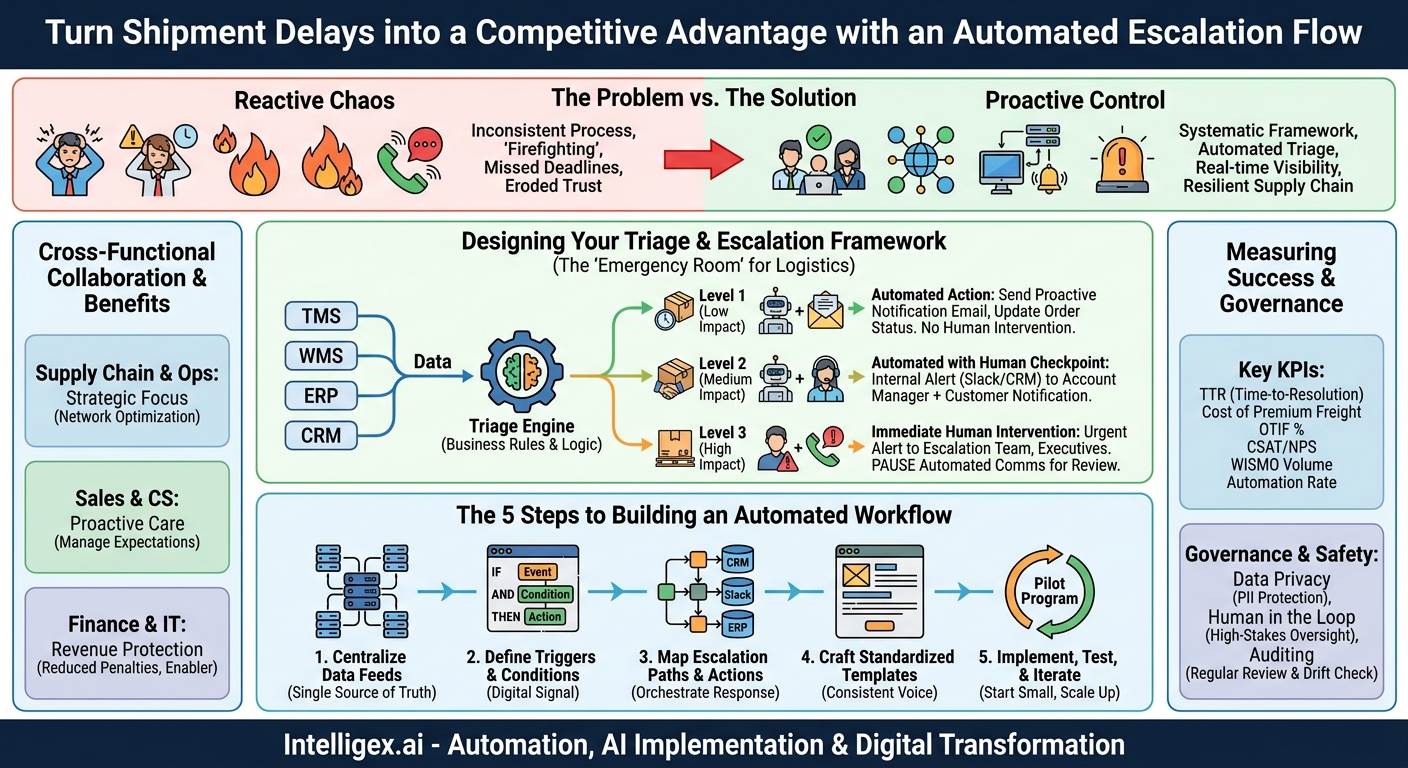
Every shipment delay is more than a logistical hiccup. It is a moment where customer trust hangs in the balance. A poorly handled delay can erode brand loyalty, trigger costly penalties, and consume your team’s time with frantic, manual firefighting. The problem is not that delays happen; they are an inevitable part of modern supply chains. The problem is the chaotic, inconsistent, and invisible process most companies use to respond. When your customer knows about a problem before your support team does, you have already lost control.
A well-defined shipment delay escalation flow transforms this vulnerability into a competitive advantage. It is a systematic, automated framework for identifying, triaging, and resolving delivery exceptions before they become full-blown crises. By replacing reactive chaos with proactive control, you can reduce operational costs, enhance customer satisfaction, and create a more resilient supply chain. This is not about adding more software. It is about integrating your existing systems and data to work smarter, giving your teams the visibility and tools they need to protect both your revenue and your reputation.
The Hidden Costs of a Disjointed Escalation Process
An ad-hoc approach to shipment delays creates cascading problems that ripple across the entire organization. Without a clear plan, every exception forces teams to reinvent the wheel, leading to inconsistent outcomes and wasted resources. This operational drag is expensive, but the true costs are often hidden within departmental budgets and performance reports.
For the Supply Chain and Operations teams, a lack of process means constant firefighting. Instead of focusing on strategic carrier management or network optimization, they spend their days chasing tracking numbers and sending one-off emails. Productivity plummets, and employee burnout climbs. Minor issues that could have been resolved with an automated message quickly spiral into complex problems requiring multiple manual interventions.
The Sales and Customer Service departments feel the impact most directly. They are on the front lines, dealing with frustrated customers who demand answers they do not have. This lack of information undermines their ability to manage relationships proactively. Apologizing for a problem is far less effective than communicating a solution before the customer is even aware of the issue. This reactive posture can jeopardize renewals, stall new deals, and damage the brand’s reputation for reliability.
Meanwhile, the Finance team grapples with the financial fallout. Unexpected costs for expedited shipping to fix a delay eat into profit margins. Retail partners may issue chargebacks or penalties for missed delivery windows. Furthermore, revenue recognition can be delayed if proof of delivery is not secured on time, impacting cash flow and financial forecasting. Without a centralized view of these exceptions, it is nearly impossible to quantify the true cost of delivery failures or identify recurring patterns with specific carriers or routes.
Designing Your Triage and Prioritization Framework
Not all shipment delays are created equal. A one-day delay for a low-value B2C order requires a different response than a critical, pallet-sized B2B shipment stuck in customs for a key account. A robust escalation flow begins with a clear triage framework that categorizes issues based on business impact. This allows you to allocate resources effectively, automating low-priority responses and flagging high-priority issues for immediate human attention.
The goal is to create predefined levels of severity, each with its own set of automated actions and manual intervention points. Think of it as an emergency room for your logistics. Issues are assessed and prioritized the moment they are detected, ensuring the most critical cases receive immediate care.
For example, a simple framework might look like this:
- Level 1 (Low Impact): A minor delay (e.g., less than 24 hours) for a standard, non-critical shipment. The action is fully automated: send a proactive notification email to the customer and update the internal order status. No human intervention is needed.
- Level 2 (Medium Impact): A significant delay (e.g., 24-72 hours) or an exception for a high-value customer or an order with a strict service-level agreement (SLA). The action is automated with a human checkpoint: an internal alert is sent to the account manager or customer service lead via Slack or a CRM case, while an automated notification still goes to the customer.
- Level 3 (High Impact): A critical failure. This could be a lost shipment, significant damage, or a delay that threatens a major project or product launch. The action requires immediate human intervention: an urgent alert is sent to a dedicated logistics escalation team, the regional sales director, and potentially even executive leadership. All automated customer communications are paused pending manual review.
Checklist for Defining Your Triage Rules
To build this framework, you need to define the business rules that determine an issue’s priority. Gather stakeholders from Sales, Operations, and Finance to assess the following criteria for any given shipment:
- Customer Value: Is this a new customer, a strategic enterprise account, or a high-volume partner? Prioritize based on lifetime value (LTV) or strategic importance.
- Order Contents & Value: Does the shipment contain perishable goods, high-value electronics, or custom-manufactured parts? The monetary value and sensitivity of the contents should heavily influence priority.
- Service-Level Agreements (SLAs): Are there contractual obligations for delivery time? A breach of an SLA should automatically elevate an issue’s priority.
- Downstream Impact: Will this delay halt a customer’s production line, delay a marketing campaign, or impact a retail store opening? Understanding the ripple effect is crucial.
- Carrier and Route History: Are delays common for this specific carrier or shipping lane? Historical performance data can help predict the likelihood of a minor issue becoming a major one.
The 5 Steps to Building an Automated Escalation Workflow
Once you have a triage framework, the next step is to build the automated workflow that brings it to life. This involves connecting your systems, defining the logic, and creating the communication pathways that enable a swift, consistent response every time. This is where integration and digital transformation create tangible business value by turning a manual, error-prone process into a scalable, intelligent system.
-
Centralize Your Data Feeds
An effective escalation flow depends on a single source of truth. You cannot act on information you cannot see. The first step is to integrate data from all relevant systems. This includes your Transportation Management System (TMS) for carrier tracking data, your Warehouse Management System (WMS) for fulfillment status, your Enterprise Resource Planning (ERP) system (like those from SAP) for order details, and your Customer Relationship Management (CRM) platform (such as Salesforce) for customer information. Using integration platforms or cloud services, like those offered by Amazon Web Services, you can create a unified data stream that provides a complete, real-time picture of every order’s journey.
-
Define Your Triggers and Conditions
A trigger is the specific event that initiates the workflow. It is the digital signal that something is wrong. Triggers should be precise and based on the real-time data you have centralized. Vague triggers lead to false alarms and user fatigue. Examples of effective triggers include: a carrier status changing to “Exception,” a package showing no new tracking scan for over 48 hours, or a customs hold notification appearing in a carrier feed. For each trigger, you then apply conditional logic based on your triage framework. For instance: IF the trigger is “no scan for 48 hours” AND the customer tier in the CRM is “Strategic,” THEN initiate the Level 3 escalation path.
-
Map Escalation Paths and System Actions
This is where you define what happens next. For each priority level, map out the sequence of events. This goes beyond simple notifications. A well-designed path orchestrates actions across multiple systems. For example, a Level 2 escalation could trigger the following sequence automatically:
1. Create a new case in your CRM and assign it to the customer’s dedicated account manager.
2. Post a message in a specific Slack channel (#logistics_alerts) with the order number and tracking link.
3. Update a custom field in your ERP to flag the order as “At Risk.”
4. Send a pre-approved, templated email to the customer informing them of a potential delay and setting expectations.
This orchestration ensures that everyone who needs to know is informed simultaneously through the tools they already use, eliminating the need for manual copy-pasting and internal phone tag. -
Craft and Standardize Communication Templates
Inconsistent communication is a primary driver of customer frustration. Your workflow should use pre-approved templates for every scenario to ensure a consistent tone, brand voice, and level of detail. Good communication is clear, concise, and honest. Avoid vague language. Instead of saying “Your order may be delayed,” provide specific information: “Your package has experienced a transit delay in Memphis, TN. We are working with the carrier to resolve it and the new estimated delivery date is Friday, October 26th. We will send another update within 24 hours.” Store these templates within your automation platform and use personalization tokens to pull in customer and order details automatically.
-
Implement, Test, and Iterate
Never launch a new workflow company-wide on day one. Start with a pilot program. Select a specific shipping lane, a single carrier, or a particular customer segment to test the process. This allows you to identify gaps in your logic, broken data connections, or confusing notifications in a controlled environment. Monitor the pilot closely, gather feedback from the teams involved, and measure the results. Did the time-to-resolution for issues decrease? Did customer inquiries about shipment status go down? Use this data to refine the workflow before rolling it out more broadly. A great escalation process is never truly “finished.” It should be reviewed and improved quarterly as your business, carriers, and customer expectations evolve.
Connecting the Dots: Cross-Functional Collaboration
An automated escalation flow is not just an operational tool; it is a catalyst for cross-functional collaboration. By breaking down data silos and providing a shared, real-time view of logistics exceptions, it aligns departments around a common goal: protecting the customer experience. When systems are integrated, teams can stop debating whose data is correct and start collaborating on solutions.
For the Supply Chain team, automation frees them from reactive, low-value tasks. Instead of manually tracking at-risk shipments, they can focus on higher-level activities like analyzing carrier performance data surfaced by the system. They can answer questions like, “Which carrier consistently fails to meet delivery ETAs on the West Coast?” or “Are customs delays increasing in a specific international lane?” This shifts their role from problem-solver to strategic partner, using data to optimize the network and prevent future issues.
The Sales and Customer Service teams are empowered with proactive information. When an alert about a key customer’s shipment appears in their CRM, they can call the customer before the delay becomes a problem. This transforms a negative event into a positive touchpoint, demonstrating proactive care and strengthening the relationship. They are no longer apologizing for past failures but managing future expectations. This builds immense trust and can be a key differentiator against competitors.
Finally, the IT department becomes a strategic enabler of business value, not just a support function. Their work in building and maintaining the data integrations and automation platforms directly contributes to revenue protection and operational efficiency. A well-executed escalation system showcases the power of a modern, integrated tech stack, making IT a vital partner in the company’s digital transformation journey.
Measuring Success: Metrics That Matter
To justify the investment in building an automated escalation flow and to drive continuous improvement, you must measure its impact. Focus on business outcomes rather than vanity metrics. It is less important how many alerts were sent and more important how those alerts affected costs, speed, and customer satisfaction.
Key Performance Indicators (KPIs) to Track:
- Time-to-Resolution (TTR): How long does it take, on average, to resolve a shipment exception from the moment it is detected? A decreasing TTR is a primary indicator of improved efficiency.
- Cost of Premium Freight: Track the monthly or quarterly spend on expedited shipping used to fix delivery errors. A successful escalation system should reduce the need for these expensive interventions.
- On-Time In-Full (OTIF) Percentage: While the goal is to manage delays, a good system helps you identify root causes. Use exception data to improve your overall OTIF rate over time.
- Customer Satisfaction (CSAT) / Net Promoter Score (NPS): Survey customers specifically about their delivery experience. Correlate scores with whether they experienced a proactively managed delay versus an unmanaged one.
- Volume of Inbound “Where Is My Order?” (WISMO) Inquiries: Proactive notifications should naturally lead to a reduction in customers needing to call or email for status updates. Track this volume in your customer service platform.
- Automated vs. Manual Exception Handling Rate: Measure what percentage of total exceptions are resolved through a fully automated (Level 1) flow versus those requiring human touch. An increasing automation rate demonstrates scalability.
Governance and Safe Implementation in an AI-Driven World
Automating workflows that handle customer data and trigger business actions requires a thoughtful approach to governance and security. While the efficiency gains are significant, they must be balanced with controls that protect privacy and ensure human oversight where it matters most. As you incorporate more advanced logic or even predictive AI to anticipate delays, these principles become even more critical.
First, prioritize data privacy and security. Shipment data contains Personally Identifiable Information (PII) like names, addresses, and contact details. Ensure that your integrated systems handle this data according to regulations like GDPR or CCPA. Use role-based access controls to restrict who can view sensitive customer information. Data should only be visible to employees who need it to perform their jobs, such as an account manager viewing their own client’s shipment status.
Second, maintain a human in the loop. Automation is designed to assist, not completely replace, human expertise and judgment. For high-stakes scenarios, such as a multi-million dollar order for a strategic partner, the system’s role should be to detect the issue, gather all relevant data, and present it to the right person for a final decision. The workflow should never automatically cancel a critical order or authorize an enormous expedited shipping fee without human approval. The goal is to empower your team with better information, faster.
Finally, establish a clear process for auditing and review. Regularly review the decisions and actions taken by the automated system. Are certain rules creating too many false positives? Are communication templates clear and effective? If you are using predictive models to forecast delays, they must be monitored for accuracy and “model drift” to ensure their recommendations remain reliable over time. Transparent governance builds trust in the system and ensures it remains aligned with your business goals.
Your Next Steps: From Plan to Action
Building a sophisticated, automated escalation flow is a journey, not a weekend project. However, the path to a more resilient and responsive supply chain is clear, and the rewards in cost savings, scalability, and customer loyalty are substantial. The key is to start small, prove value, and build momentum.
Begin by mapping your current, informal process. Get key stakeholders from different departments in a room and whiteboard what happens today when a critical shipment is delayed. You will likely uncover surprising inefficiencies and communication gaps. Next, identify your most critical data sources. Focus on connecting your order management system and your primary carrier tracking feeds first. This simple integration alone can provide enormous visibility.
With this foundation, launch a pilot program focused on your most valuable customer segment or your most problematic shipping lane. Define a simple, two-level triage framework and automate the basic notifications. Measure the results, celebrate the wins, and use the data to make the case for expanding the program. By taking an iterative, value-driven approach, you can move from a state of reactive chaos to one of proactive control, turning inevitable shipment delays into opportunities to demonstrate your commitment to your customers.
Your Next Read:
Category:
Get a FREE
Proof of Concept
& Consultation
No Cost, No Commitment!