

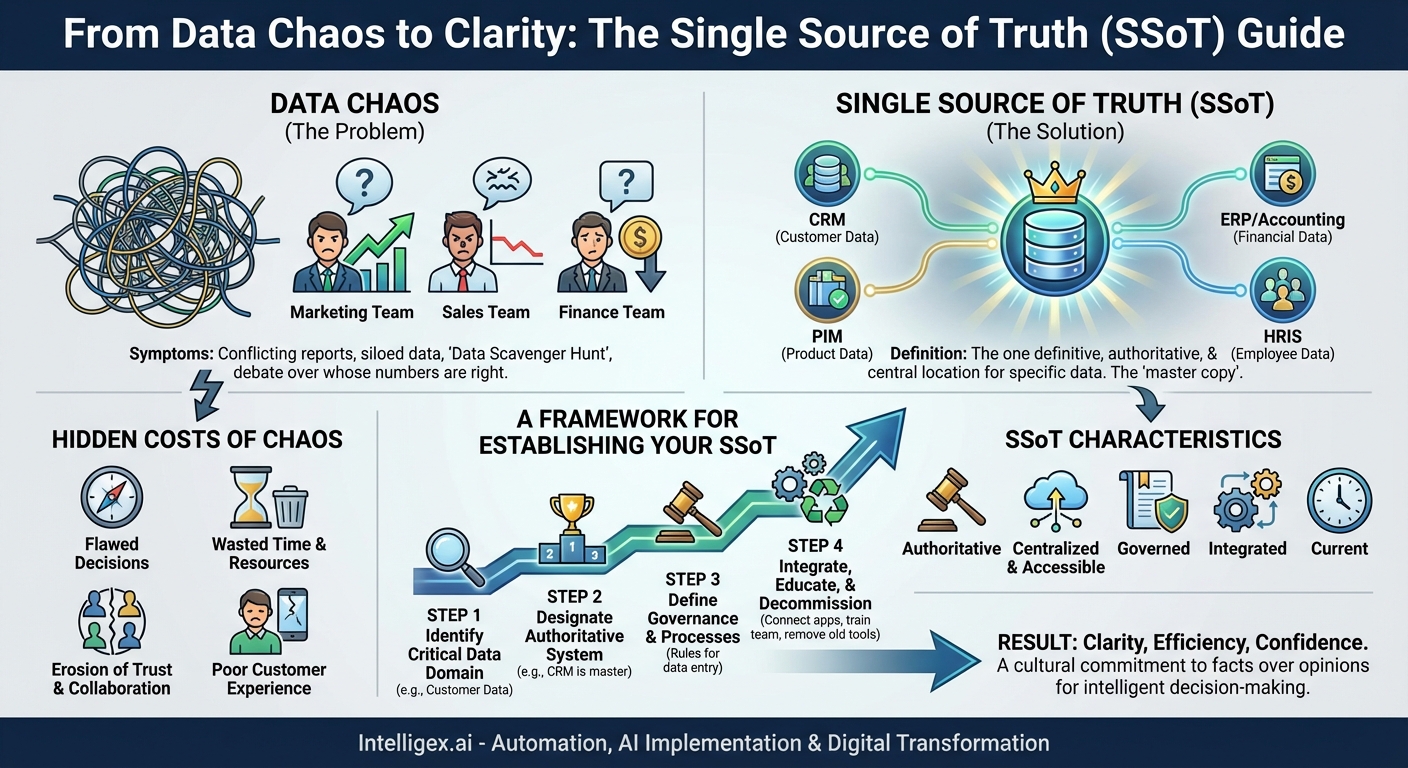
Picture a Monday morning meeting. The marketing team presents a chart showing a 20% increase in qualified leads from last quarter’s campaign. Everyone smiles. Then, the sales team presents their own data, showing that new customer acquisition from that same campaign is flat. The smiles fade. Finally, the finance department chimes in, reporting that the cost-per-acquisition for the period actually went up, making the campaign a net loss. The meeting descends into a confusing debate, not about strategy, but about whose numbers are “right.” Sound familiar? This common business nightmare is a direct symptom of not having a Single Source of Truth (SSoT).
In a world drowning in data, the concept of a source of truth isn’t just a technical term for IT departments; it’s a fundamental strategic asset for any business that wants to operate with clarity, efficiency, and confidence. It’s the antidote to data chaos, the foundation for intelligent decision-making, and the quiet engine behind a seamless customer experience. But what does it actually mean, and how can you achieve it without a multi-million dollar tech overhaul?
What Exactly Is a “Source of Truth”? More Than Just a Database
At its core, a Source of Truth is the one, single, universally recognized location where a specific piece of data or information is considered definitive and authoritative. Think of it as the master copy. If you were writing a book with several co-authors, you wouldn’t all work on separate Word documents and hope they match up at the end. You’d use a single, shared document—a Google Doc or a central file on a server—that everyone agrees is the “real” version. Any changes made there are the official changes. That shared document is your source of truth for the book’s manuscript.
In a business context, this applies to every critical data point. For customer contact information, the source of truth might be your Customer Relationship Management (CRM) system. For product specifications and pricing, it might be your Product Information Management (PIM) system. For official revenue numbers, it’s almost certainly your accounting software.
A true SSoT has a few non-negotiable characteristics:
- Authoritative: When there’s a disagreement, the data from the SSoT is the final word. No arguments.
- Centralized & Accessible: Everyone in the organization who needs the data knows exactly where to find it. It’s not hidden in a personal spreadsheet on someone’s laptop.
- Governed: There are clear rules and processes for how the data is entered, updated, and maintained. Not just anyone can change a customer’s official address or alter a financial record.
- Integrated: Other systems and applications pull data *from* the SSoT rather than creating their own versions. The marketing email platform should get its customer list from the CRM, not from a separate, manually uploaded list.
- Current: The data within the SSoT is kept as up-to-date as possible, ensuring decisions are based on the latest reality, not on last month’s old news.
It’s crucial to distinguish a Source of Truth from a “System of Record.” A System of Record is often where data is first created (e.g., a new lead is entered into the CRM). The SSoT is the curated, cleaned, and trusted version that the entire organization agrees to use for reporting and analysis. Often they are the same system, but the SSoT implies a layer of governance and company-wide agreement that a simple System of Record does not.
The Hidden Costs of Data Chaos: Why You Can’t Afford to Ignore This
Operating without a clear SSoT is like trying to navigate a city where every citizen has a different map. The resulting inefficiency and friction can cripple a company’s growth. The costs are real, even if they don’t always show up as a line item on a profit and loss statement.
Flawed and Slow Decision-Making
This is the most obvious and damaging consequence. When leaders are presented with conflicting reports, they can’t make good decisions. They either become paralyzed, delaying action until the data can be reconciled, or they make a gut call based on incomplete or incorrect information. Imagine a retail company trying to decide which products to discontinue. If the sales team’s report on top-sellers (based on their own spreadsheets) conflicts with the inventory system’s data on what’s actually moving, the company could end up axing a popular product while reordering a shelf-warmer.
Massive Wasted Time and Resources
Think about the cumulative hours your employees spend in what’s often called the “data scavenger hunt.” An analyst might spend 80% of their week just trying to find, clean, and validate data from five different sources before they can even begin their actual analysis. Salespeople waste time arguing with marketing about lead quality. IT teams are bogged down with constant requests to pull custom reports to settle departmental disputes. This is time and talent that could be spent on innovation, customer service, and revenue-generating activities.
Erosion of Trust and Collaboration
When nobody can agree on the basic facts, inter-departmental trust evaporates. A culture of blame can emerge. “Sales never updates the CRM, so our marketing data is useless.” “Finance’s numbers are always three weeks old, so we can’t be agile.” This friction creates silos, where each department hoards its own data and trusts only its own reports. Collaboration becomes impossible because there is no shared reality to work from. Instead of a unified team rowing in the same direction, you have a collection of factions, each with its own compass.
Poor Customer Experience
Your customers feel the effects of your internal data chaos directly. A customer calls support with an issue, but the support agent is looking at an outdated record and doesn’t know about the customer’s recent large purchase. A long-time client receives a generic “introductory” marketing email. A VIP is contacted by a new salesperson who has no history of their previous interactions. These experiences, born from disconnected data systems, make your business look disorganized and incompetent, damaging loyalty and brand reputation.
Examples of a Source of Truth Across Business Functions
The concept of a SSoT isn’t abstract. It has a tangible home in different parts of your business. Here are a few common examples:
- Customer Data: The undisputed SSoT for all information related to a customer (contact details, communication history, purchase records) should be your Customer Relationship Management (CRM) platform, like Salesforce, HubSpot, or Zoho. Your email marketing tool, your customer support software, and your billing system should all sync with the CRM. If a customer’s phone number needs to be updated, it’s updated *once* in the CRM, and that change propagates everywhere else.
- Financial Data: The SSoT for all things revenue, expenses, and profitability is the Enterprise Resource Planning (ERP) or Accounting System (e.g., NetSuite, QuickBooks, SAP). When the CEO asks “How much revenue did we make last quarter?” there is only one correct answer, and it comes from this system. Sales and marketing cannot invent their own revenue figures for their reports.
- Product Data: For an e-commerce or manufacturing business, the SSoT for product information (SKUs, descriptions, dimensions, images, pricing) is a Product Information Management (PIM) system. This single source feeds the company website, mobile app, print catalogs, and third-party marketplaces like Amazon. This ensures a consistent and accurate product representation everywhere.
- Employee Data: The official record for every employee—their name, title, department, hire date, and salary—resides in the Human Resources Information System (HRIS) like Workday or BambooHR. This system is the source of truth for payroll, organizational charts, and performance management systems.
A Simple Framework for Establishing Your Source of Truth
Creating an SSoT doesn’t require you to halt your business for a year. It’s a strategic process of bringing order to chaos, and it can be done incrementally.
Step 1: Identify Your Most Critical Data Domain
Don’t try to fix everything at once. Start with the area that causes the most pain or holds the most opportunity. Is the conflict between sales and marketing numbers slowing down growth? Then start with customer and lead data. Are inconsistencies in product information leading to high return rates? Start there. Pick one domain, like “Customer Data,” and commit to establishing a source of truth for it.
Step 2: Designate the Authoritative System (The “Container”)
For your chosen domain, you must pick a winner. Which system will be the master record? For customer data, it’s likely your CRM. You must officially declare this system as the SSoT. This decision needs to be communicated and enforced from the top down. It means telling your teams, “If the data isn’t in Salesforce, it doesn’t exist.” This forces the adoption and proper use of the chosen system.
Step 3: Define Governance and Processes
Technology alone is not the solution. You need to establish the human processes around the data. Who is responsible for data quality? What are the rules for data entry? For example, you might create a rule that a new contact cannot be created without a valid email address and phone number. Who has the permission to merge duplicate records or delete old information? These rules, known as data governance, are the constitution that protects the integrity of your SSoT.
Step 4: Integrate, Educate, and Decommission
Once your SSoT and its rules are in place, the real work begins. You need to connect your other business applications to it. Set up integrations so that data flows *from* the SSoT to secondary systems, not the other way around. Train your employees on the new processes and the importance of using the SSoT. Finally, and most critically, you must actively decommission the old ways of doing things. This means eliminating the use of those conflicting spreadsheets, legacy databases, and standalone reports. You have to remove the old, inaccurate maps from circulation so that everyone is forced to use the new, official one.
Establishing a Single Source of Truth is less of a one-time project and more of a cultural commitment to clarity. It’s a declaration that as an organization, you value alignment over autonomy and facts over opinions. By moving from data chaos to data clarity, you empower your teams to stop arguing about whose numbers are right and start collaborating on the strategic decisions that will truly drive your business forward.
Related Posts


Category:
Get a FREE
Proof of Concept
& Consultation
No Cost, No Commitment!