

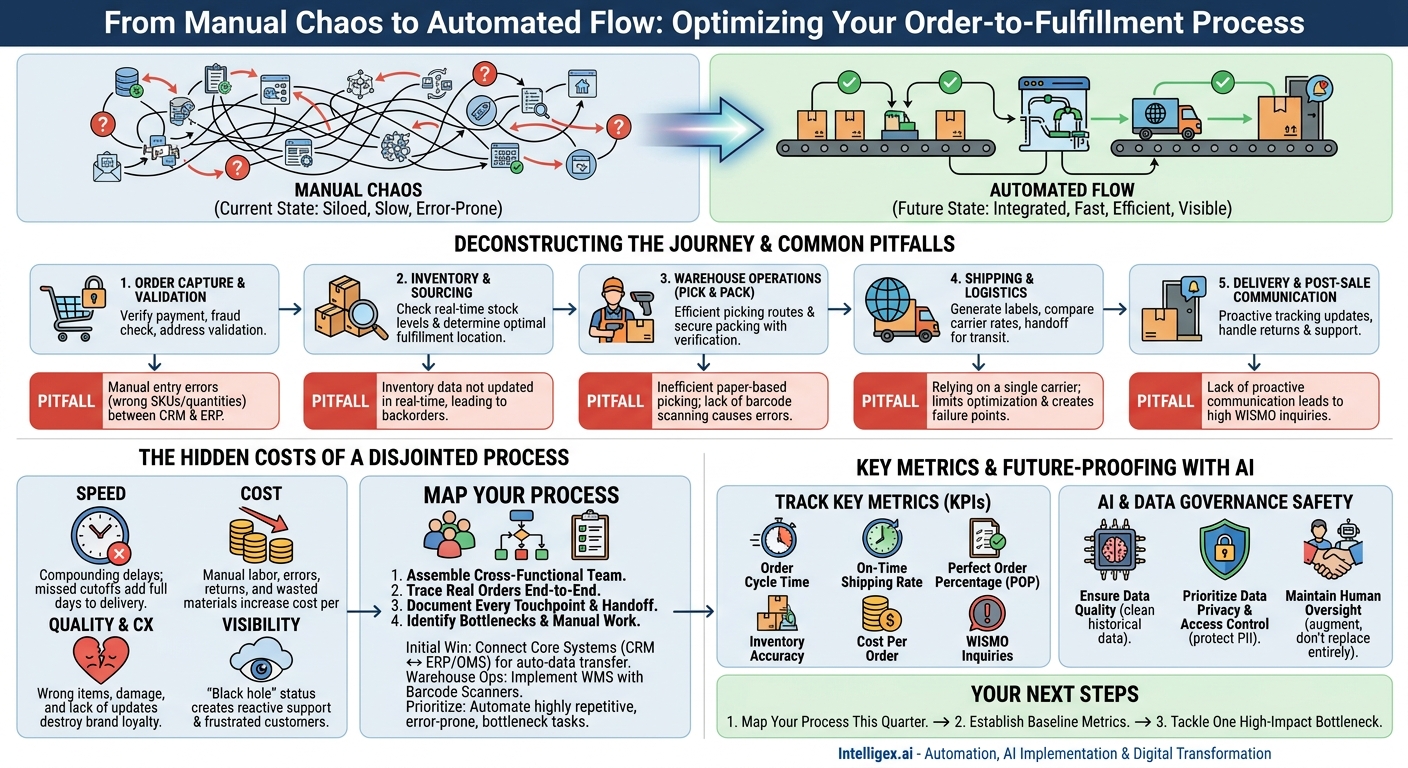
A customer clicks “buy.” In that single moment, a promise is made. But delivering on that promise involves a complex chain of events hidden from view: the order-to-fulfillment process. This journey, from the initial order to the package on the doorstep, is the operational backbone of any business that sells a physical product. When it runs smoothly, it’s an invisible engine of growth. When it’s broken, it becomes a major source of spiraling costs, frustrated teams, and, worst of all, unhappy customers.
Many businesses treat this process as a series of disconnected tasks managed by different departments. Sales takes the order, finance processes the payment, and the warehouse ships the product. This siloed approach creates friction, delays, and errors at every handoff. By mapping and optimizing this entire workflow as a single, integrated system, you can unlock significant gains in speed, cost-efficiency, and customer satisfaction. It’s not just about shipping faster; it’s about building a more resilient and scalable business.
Deconstructing the Order-to-Fulfillment Journey
Before you can improve your process, you must first understand its fundamental stages. While the specifics vary by industry, nearly every fulfillment journey consists of five core phases. Understanding the role and potential pitfalls of each is the first step toward optimization.
1. Order Capture and Validation
This is the starting line. An order is created through one of your sales channels, whether it’s an e-commerce website, a point-of-sale (POS) system, or a manual entry by a sales representative into a CRM like Salesforce. But simply receiving the order isn’t enough. This stage involves critical validation steps:
- Payment Processing: Verifying the payment method and ensuring funds are secured. A failure here stops the entire process before it begins.
- Fraud Check: Automated systems often scan orders for signs of fraudulent activity to prevent chargebacks and losses.
- Address Validation: Confirming the shipping address is valid and properly formatted to avoid costly delivery failures and returns.
Common Pitfall: Manual order entry from one system to another (e.g., a sales rep re-typing order details from an email into the ERP). This is a primary source of data errors, such as incorrect SKUs or quantities, that cause problems downstream.
2. Inventory and Sourcing
Once an order is validated, the system must answer a crucial question: Do we have the product, and where is it? This stage involves checking inventory levels in your Enterprise Resource Planning (ERP) or Inventory Management System (IMS). For businesses with multiple warehouses or distribution centers, this step also includes sourcing logic to determine the optimal location to fulfill the order from, balancing factors like shipping cost, delivery speed, and available stock.
Common Pitfall: Inventory data that isn’t updated in real time. If your e-commerce site shows an item as “in stock” but it has already sold out in the warehouse, you’ve created a backorder situation and a negative customer experience.
3. Warehouse Operations: Picking and Packing
This is where the digital order becomes a physical reality. The warehouse team receives instructions, typically as a “pick list,” to retrieve the items for the order. The process generally involves:
- Picking: A warehouse associate locates and gathers the correct items from their designated storage locations (bins, shelves, or pallets).
- Packing: The picked items are brought to a packing station, checked for accuracy, and securely packaged in an appropriately sized box with necessary dunnage (filler material) to prevent damage.
Common Pitfall: Inefficient picking routes that force workers to wander aimlessly through the warehouse, wasting significant time. A lack of barcode scanning for verification can also lead to a high rate of picking errors, where the wrong item or quantity is selected.
4. Shipping and Logistics
With the order packed and ready, it enters the logistics phase. A shipping label is generated, containing the customer’s address and tracking information. The system may compare rates and delivery times across multiple carriers (like FedEx, UPS, or USPS) to select the best option. Finally, the package is handed off to the carrier for transit. This is a critical handoff point, and a missed carrier pickup can delay an order by an entire day.
Common Pitfall: Relying on a single carrier for all shipments. This removes your ability to optimize for cost and speed based on package size, weight, and destination. It also creates a single point of failure during peak seasons or carrier disruptions.
5. Delivery and Post-Sale Communication
The final mile. The carrier transports the package to the customer’s address. A modern fulfillment process doesn’t end when the truck leaves the warehouse. It includes proactive communication, such as sending automated email or SMS notifications with tracking updates. This final stage also encompasses handling any post-delivery issues, such as processing returns or answering support inquiries about the order.
Common Pitfall: A lack of proactive communication. If the customer has to contact you to ask, “Where is my order?”, your process has a visibility gap. This increases the burden on your customer service team and creates anxiety for the customer.
Why a Disjointed Process Costs You More Than Money
The tangible costs of a broken fulfillment process, such as expenses from shipping errors or wasted packing materials, are easy to spot. However, the indirect and strategic costs are often far more damaging. A poorly managed order-to-fulfillment cycle erodes business value across four key areas.
Speed: In today’s on-demand world, customers expect fast delivery. Delays at any stage have a compounding effect. A one-hour delay in payment processing can cause an order to miss the warehouse’s daily cutoff, which in turn means it misses the carrier pickup, ultimately adding a full day or more to the total delivery time. These small, internal delays are invisible to you but painfully obvious to your customer.
Cost: Inefficiency is expensive. Manual data entry not only invites errors but also consumes valuable employee hours that could be spent on higher-value activities. Picking mistakes lead to returns, which are notoriously costly to process. Inefficient packing wastes materials and can increase shipping costs due to larger dimensional weight. Every manual touchpoint, every error, and every redundant step adds to your cost per order.
Quality and Customer Experience: A fulfillment error is a broken promise. Shipping the wrong item, delivering a damaged product due to poor packing, or failing to communicate a delay directly degrades the customer experience. These are the moments that destroy brand loyalty and lead to negative reviews. The perfect order, one that is correct, on time, and undamaged, should be the goal for every transaction.
Visibility: When a customer, a sales rep, and a support agent all have different or no information about an order’s status, it creates a “black hole.” This lack of visibility forces your support team into a reactive, inefficient cycle of tracking down information. It prevents sales from setting accurate expectations and leaves the customer feeling powerless and frustrated.
Mapping Your Current Process: A Practical Guide
You cannot fix what you do not understand. The most crucial step toward improvement is to map your existing order-to-fulfillment process exactly as it is today, not as you think it is. This exercise will reveal hidden bottlenecks, redundant tasks, and communication gaps. Follow these steps to create a clear and honest picture of your current state.
-
Assemble a Cross-Functional Team
This is not a task for a single department. Your mapping team should include representatives from every group that touches an order: Sales or e-commerce (how orders are placed), Finance (how payments are processed), Warehouse Operations (how orders are picked, packed, and shipped), IT (who manages the underlying systems), and Customer Service (who handles post-delivery issues). This ensures you capture the complete, end-to-end reality.
-
Trace Several Real Orders, End-to-End
Don’t rely on theoretical process documents. Pick a few recent orders and follow their journey from start to finish. Choose a variety: a simple, single-item order; a complex, multi-item order; and an order that you know went wrong. Literally walk the path of the order. Talk to the sales rep who entered it, the finance clerk who approved it, and the warehouse associate who picked it. Ask them to show you what they do, what systems they use, and where they encounter frustration.
-
Document Every Touchpoint, Handoff, and System
As you trace each order, document the details. For each step, record the following:
- The Task: What action is being performed? (e.g., “Verify shipping address.”)
- The Person/Role: Who performs the action? (e.g., “Customer Service Rep.”)
- The System: What software or tool is used? (e.g., “NetSuite ERP,” “a shared spreadsheet,” “pen and paper pick list.”)
- Time Taken: How long does this step typically take? (e.g., “5 minutes,” “up to 4 hours.”)
- Information Handoff: How does information move to the next step? (e.g., “Automated API call,” “manual data entry,” “an email is sent.”)
-
Identify Bottlenecks, Breakdowns, and Manual Work
Once your map is documented, the problem areas will become obvious. Look for specific patterns. Where do orders frequently get stuck waiting for approval or information? Where does manual data entry occur, creating a risk of errors? Which steps generate the most questions or complaints from staff? These are your primary targets for improvement.
Example finding: “The API transferring orders from our CRM to our ERP fails about 5% of the time. When it does, the order must be manually re-entered by the finance team, which delays fulfillment by an average of six hours and sometimes results in incorrect SKUs being entered.”
Key Metrics to Track for Continuous Improvement
A process map shows you the “how,” but metrics tell you how well you’re doing. Tracking the right Key Performance Indicators (KPIs) is essential for measuring the impact of your changes and identifying new areas for optimization. Start with a few foundational metrics that provide a balanced view of speed, cost, and quality.
Order Processing and Fulfillment Metrics
- Order Cycle Time: This is the master metric. It measures the total time from when a customer places an order to when they receive it. Breaking it down into sub-metrics (e.g., time-to-process, time-to-ship) can help pinpoint where delays are occurring.
- On-Time Shipping Rate: The percentage of orders that are shipped on or before the promised date. This is a direct measure of your ability to meet customer expectations.
- Perfect Order Percentage (POP): A powerful composite metric that measures the percentage of orders delivered without any issues. A “perfect” order is delivered on time, with the right items, undamaged, and with the correct invoice. It’s a holistic measure of fulfillment quality.
Inventory and Cost Metrics
- Inventory Accuracy: The degree to which your system’s inventory records match the physical inventory in the warehouse. Low accuracy leads to stockouts and backorders. This is often measured as a percentage.
- Cost Per Order: A calculation of the total fulfillment costs (including labor, packing materials, and shipping fees) divided by the total number of orders shipped. This helps you track the financial efficiency of your operations.
Customer-Facing Metrics
- “Where Is My Order?” (WISMO) Inquiries: The number of times customers contact your support team to ask for an order status update. A high volume of WISMO inquiries is a clear sign that your proactive communication and order visibility are poor.
From Manual Chaos to Automated Flow: Where to Start
With your process mapped and your key metrics identified, you can begin to make targeted improvements. The goal is to move from a series of manual, disconnected tasks to an integrated, automated flow. Don’t try to fix everything at once. Focus on changes that will deliver the highest impact with manageable effort.
Initial Wins: Connecting Your Core Systems
One of the most common and damaging bottlenecks is manual data transfer between systems. The single most impactful automation project for many businesses is integrating their CRM with their ERP or order management system. When an order is finalized in the CRM, it should flow automatically and instantly to the system that manages inventory and warehouse operations. This single change can eliminate hours of manual data entry, drastically reduce data errors, and cut your order processing time from hours to minutes.
Warehouse Operations: Beyond the Printed Pick List
The warehouse floor is ripe for optimization. Moving from paper-based pick lists to a digital system using barcode scanners (a core feature of most Warehouse Management Systems, or WMS) can revolutionize your operations. Scanners validate that the correct item is being picked, dramatically improving order accuracy. A WMS can also optimize picking paths, guiding associates on the most efficient route through the warehouse to collect all the items for an order, reducing travel time and increasing picks per hour.
A Quick Checklist for Prioritizing Automation
When looking for automation opportunities, ask yourself if the task meets these criteria. If the answer is “yes” to several, it’s a strong candidate for automation.
- Is the task highly repetitive, frequent, and rule-based?
- Is it a major source of human error?
- Does it require toggling between multiple systems to copy and paste data?
- Is it a significant time bottleneck where work piles up?
- Does its manual nature prevent you from having real-time visibility into the process?
AI and Data Governance: A Note on Safe Implementation
As you advance, you may explore using Artificial Intelligence (AI) to further optimize your fulfillment process, perhaps for demand forecasting to manage inventory or for optimizing shipping routes in real time. While powerful, implementing these technologies requires a thoughtful approach to data governance and safety.
First, recognize that the effectiveness of any AI model is entirely dependent on the quality of your data. If your historical order data is riddled with errors from years of manual entry, an AI-powered forecasting tool will produce unreliable predictions. Cleaning and structuring your data is a critical prerequisite.
Second, you must be rigorous about data privacy and access control. Order data contains Personally Identifiable Information (PII) like names, addresses, and contact details. Ensure that access to this data is restricted to authorized personnel and systems. When using third-party AI tools, understand their data handling and privacy policies.
Finally, always maintain human oversight. AI can provide powerful recommendations, but it lacks real-world context. An AI might recommend a shipping route that doesn’t account for a sudden local weather event. The goal is to use technology to augment your team’s decision-making, not to replace it entirely. Implement processes where a human can easily review and override automated decisions when necessary.
Your Next Steps: Building a Resilient Fulfillment Engine
Optimizing your order-to-fulfillment process is not a one-time project; it’s a continuous commitment to operational excellence. A streamlined, visible, and efficient process is a powerful competitive advantage that directly impacts your bottom line and your brand’s reputation. By starting small and focusing on the most significant points of friction, you can build momentum and transform this critical business function from a cost center into a growth driver.
Here is a simple, actionable plan to get started:
- Map Your Process This Quarter. Assemble your cross-functional team and use the guide above to create a detailed map of your current order journey. Don’t wait for the perfect time; the insights you gain will be immediately valuable.
- Establish Your Baseline Metrics. Choose two or three key metrics, such as Order Cycle Time and Perfect Order Percentage, and begin tracking them now. This baseline will be your benchmark for measuring all future improvements.
- Identify and Tackle One High-Impact Bottleneck. Review your process map and metrics to find the single biggest point of friction. It might be manual order entry, inventory inaccuracies, or shipping errors. Focus your initial efforts on solving that one problem. A quick win will build momentum for the journey ahead.
Your Next Read:
Category:
Get a FREE
Proof of Concept
& Consultation
No Cost, No Commitment!