

The worlds of accounts payable (AP) and accounts receivable (AR) have long been defined by paper trails, overflowing inboxes, and the monotonous click-clack of manual data entry. For many finance teams, navigating this landscape feels like trying to solve a complex labyrinth without a map. Each invoice, whether incoming or outgoing, represents a path fraught with potential bottlenecks, human error, and costly delays. This manual approach doesn’t just slow down operations; it actively drains resources, strains vendor and customer relationships, and obscures the real-time financial visibility needed for strategic decision-making. But what if you had a map? A clear, detailed guide that transforms this confusing maze into a streamlined, efficient superhighway. This is the promise of AP/AR automation. This post will serve as your guide, charting the course from the initial invoice to final payment and reconciliation, revealing how technology creates a clear path to financial excellence.
The Manual Labyrinth: Acknowledging the Starting Point
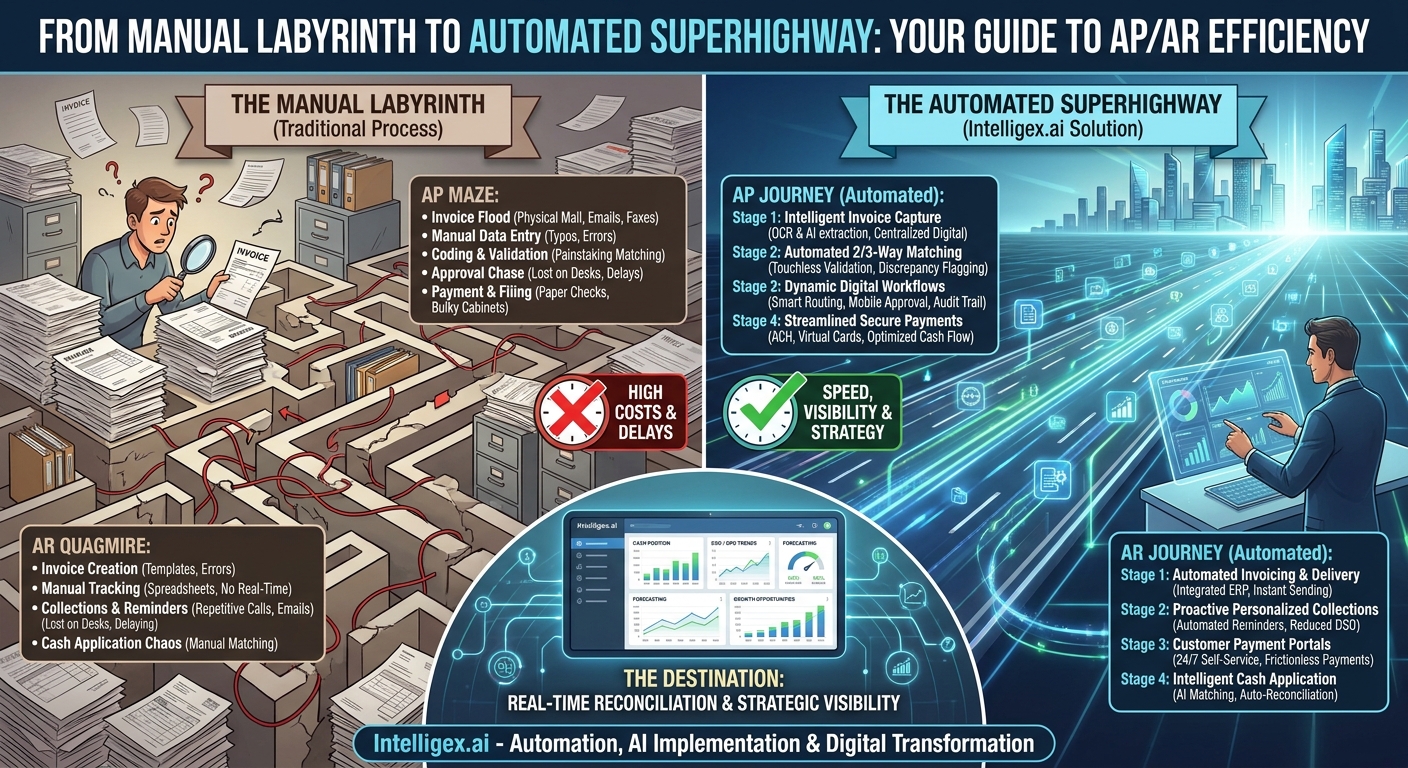
Before embarking on the automation journey, it’s crucial to understand the terrain of the traditional, manual process. This is the world many businesses still inhabit, a landscape characterized by friction and inefficiency. By acknowledging these pain points, the value of a new map becomes crystal clear.
The Accounts Payable (AP) Maze
On the payables side, the journey of a single invoice is often long and convoluted:
- Invoice Arrival: Invoices flood in through various channels—physical mail, multiple email inboxes, faxes—with no centralized system for capture.
- Manual Data Entry: A team member must manually key in every piece of data from the invoice into the accounting system or an Excel spreadsheet. This step is a notorious breeding ground for typos and errors.
- Coding & Validation: The invoice must be manually coded to the correct general ledger (GL) account and, if applicable, painstakingly matched against a purchase order (PO) and receiving report.
- The Approval Chase: The physical invoice or an email attachment is routed for approval. It can get lost on a desk, buried in an inbox, or held up if an approver is out of the office, creating significant delays.
- Payment & Filing: Once approved, a payment is manually processed, often by cutting a paper check. The invoice and all related documents are then physically filed away in bulky cabinets.
–
–
–
–
The Accounts Receivable (AR) Quagmire
The receivables process is the mirror image, equally plagued by manual burdens:
- Invoice Creation: Invoices are created one by one, often using templates that are prone to errors. They are then manually attached to emails and sent out.
- Manual Tracking: The AR team relies on spreadsheets to track which invoices have been sent, which are due, and which are overdue. This “system” is difficult to maintain and provides zero real-time insight.
- Collections & Reminders: Chasing payments involves a repetitive cycle of sending reminder emails and making phone calls, a time-consuming task that pulls focus from more strategic work.
- Cash Application Chaos: When a payment (especially a check) arrives, a team member must manually figure out which invoice or invoices it corresponds to and apply it in the accounting system. This is especially challenging with partial or bundled payments.
–
–
–
The consequences of this manual labyrinth are severe: high processing costs, an increased risk of fraud and duplicate payments, late payment fees, strained vendor relationships, and a dangerously long cash conversion cycle. It’s a reactive, labor-intensive model that holds businesses back.
The Automation Map: Charting the AP Journey
AP automation provides a clear, illuminated path through the payables process. It leverages technology to handle the repetitive, rule-based tasks, freeing your team to focus on exceptions and strategic financial management. Let’s trace the new route.
Stage 1: Intelligent Invoice Capture
The journey begins the moment an invoice arrives. Instead of landing in a chaotic inbox or a physical mail tray, invoices are directed to a centralized digital channel. Here, Optical Character Recognition (OCR) and Artificial Intelligence (AI) take over. The system instantly scans the document—whether a PDF, image, or even a paper scan—and intelligently extracts key data with incredible accuracy. This includes vendor name, invoice number, date, amount, and even line-item details. The era of manual data entry is over, and the risk of human error is virtually eliminated from the very first step.
Stage 2: Automated 2-Way and 3-Way Matching
Once the data is captured, the system acts as a digital gatekeeper. For invoices associated with a purchase order, it performs an automatic 2-way or 3-way match. It instantly cross-references the invoice data against the corresponding PO and, if applicable, the goods receipt note. If all the details—quantities, prices, totals—align perfectly, the invoice is “touchless.” It’s validated and passed straight through for approval without any human intervention. If a discrepancy is found, the system immediately flags it and routes it to the appropriate person for review, complete with all the necessary documents attached.
Stage 3: Dynamic & Digital Approval Workflows
The frustrating “approval chase” is replaced by a smart, automated workflow. Based on pre-set, customizable rules (such as invoice amount, department, or vendor), the system automatically routes the invoice to the designated approver or sequence of approvers. These individuals receive a notification and can review and approve the invoice with a single click from their desktop or a mobile app, no matter where they are. This not only accelerates the approval cycle from weeks to hours but also creates an ironclad, digital audit trail for every single invoice.
Stage 4: Streamlined & Secure Payments
With a batch of approved invoices ready, the final step is payment. An AP automation platform offers a wide range of payment methods, including ACH, virtual cards, wire transfers, and even automated check-printing services. This flexibility allows you to choose the most cost-effective and secure method for each vendor. You can schedule payments to optimize cash flow and strategically capture early payment discounts. The system also automates remittance advice, ensuring vendors know exactly which invoices are being paid, which significantly reduces follow-up inquiries.
The Automation Map: Navigating the AR Journey
On the other side of the ledger, AR automation charts an equally efficient course, transforming the process from a collections chore into a strategic cash flow engine.
Stage 1: Automated Invoicing & Delivery
Speed is essential in receivables. AR automation integrates with your ERP or accounting system to generate and deliver invoices automatically the moment a sales order is fulfilled or a billing cycle begins. Invoices are sent to customers through their preferred channel, whether it’s email or a dedicated online portal. This ensures invoices are accurate, professional, and in the customer’s hands without delay, officially starting the payment clock as early as possible.
Stage 2: Proactive & Personalized Collections
Instead of manually tracking due dates in a spreadsheet, the automation platform does it for you. It serves as your tireless collections assistant, sending out automated yet personalized reminders. You can configure a cadence of communications—a friendly reminder a few days before the due date, a firm notice on the due date, and escalating alerts for overdue invoices. This proactive approach dramatically reduces the number of late payments and shrinks your Days Sales Outstanding (DSO), all while maintaining a positive customer relationship.
Stage 3: Empowering Customer Payment Portals
The easiest way to get paid on time is to make it easy for your customers to pay you. AR automation often includes a branded, self-service online portal. Here, your customers can log in 24/7 to view all their open and paid invoices, ask questions, raise disputes, and, most importantly, make payments. Offering a variety of payment options like credit card and ACH transfer directly within the portal removes friction and accelerates your cash collection significantly.
Stage 4: Intelligent Cash Application
Reconciling payments with open invoices, known as cash application, is one of the most painful manual AR tasks. AI-powered automation solves this. The system intelligently ingests remittance information from various sources—email, EDI, payment portals, bank files—and automatically matches incoming payments to the correct open invoices. Even complex scenarios involving bundled payments for multiple invoices or short-pays are handled with high accuracy. This eliminates hours of manual work and ensures your AR aging report is always clean and up-to-date.
The Destination: Real-Time Reconciliation & Strategic Visibility
The true power of an integrated AP/AR automation map is how it brings both sides of the financial journey together at a single destination: clarity. Because these systems are constantly syncing data with your core accounting system, the monthly close and bank reconciliation processes are transformed. Transactions are already coded, matched, and verified. The process becomes a matter of review rather than a painstaking investigation.
Furthermore, this continuous flow of data powers insightful dashboards and reports. Finance leaders are no longer looking at outdated information. They have a real-time, 360-degree view of the company’s cash position. They can track key metrics like DSO and Days Payable Outstanding (DPO), forecast cash flow with greater accuracy, and identify trends and opportunities. This elevates the finance function from a back-office administrative department to a strategic advisor to the business, using the data-rich map to guide the company toward growth and profitability.
The journey from a manual, paper-based labyrinth to a streamlined, automated financial operation is a transformative one. It replaces ambiguity with clarity, friction with flow, and reaction with strategy. An AP/AR automation platform is the map that makes this journey possible, providing a clear and direct route to greater efficiency, stronger financial controls, and a healthier bottom line.
Related Posts
Get a FREE
Proof of Concept
& Consultation
No Cost, No Commitment!
