

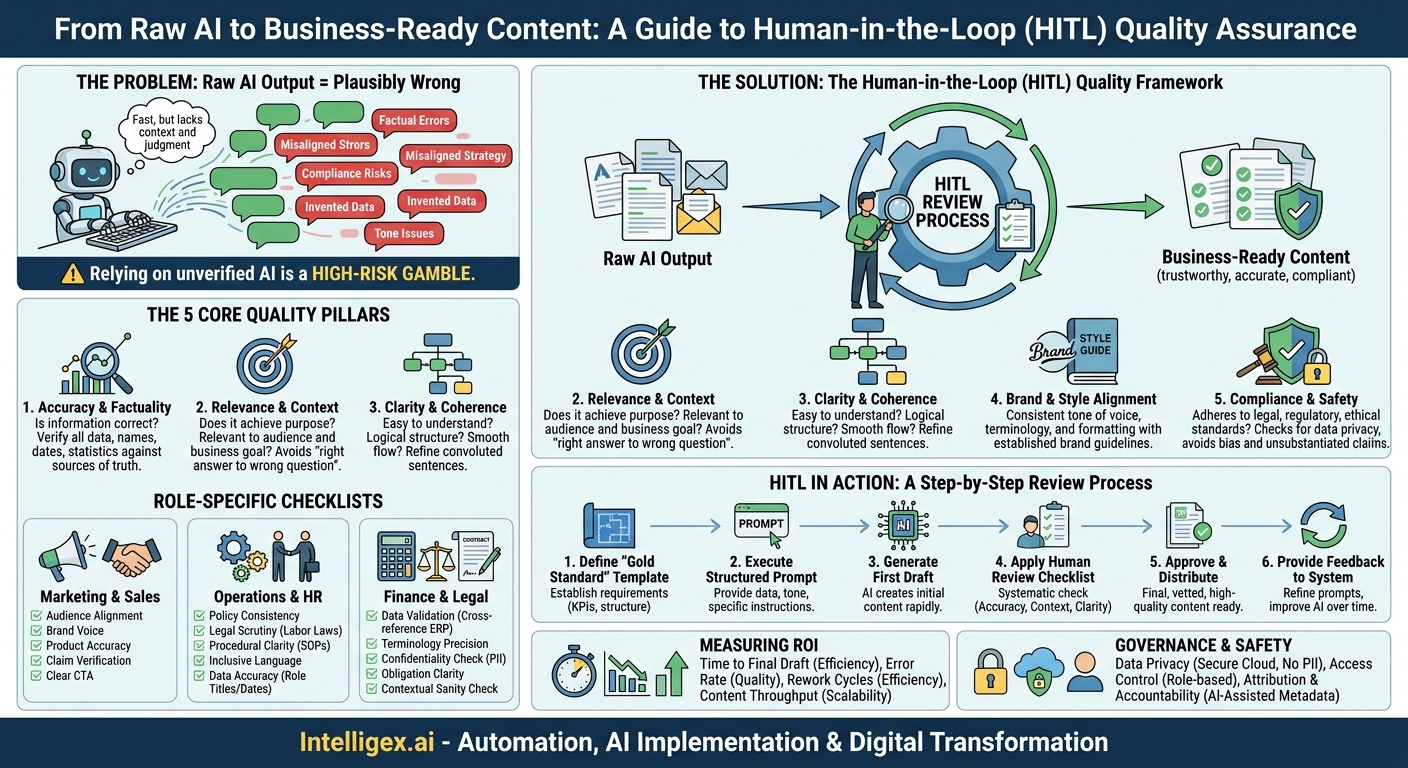
Generative AI is producing first drafts of reports, emails, contracts, and marketing copy at a scale we’ve never seen before. This incredible speed is a competitive advantage, but only if the final output is accurate, trustworthy, and ready for business use. Relying on raw, unverified AI output is a high-risk gamble. Errors in a financial summary, a misstatement in a sales proposal, or a compliance oversight in an HR policy can have significant consequences.
This is where a Human-in-the-Loop (HITL) quality assurance process becomes essential. A structured HITL workflow is not a bottleneck that slows down innovation. It is a strategic accelerator. By implementing a systematic human review, you build a reliable engine for content and document creation that combines the speed of AI with the judgment and accountability of your expert teams. This process drives real business value by improving final quality, reducing costly rework, and enabling you to scale content production confidently.
Why “Good Enough” from an AI Isn’t Good Enough for Business
Large Language Models (LLMs) are masters of syntax and structure. They can produce text that reads perfectly, yet is factually incorrect or strategically misaligned. This phenomenon, often described as creating content that is “plausibly wrong,” is one of the biggest challenges for enterprise adoption. A document that looks right on the surface can hide critical flaws that only a subject matter expert can identify.
Consider these common business scenarios:
- Marketing and Sales: An AI generates a case study that sounds compelling but invents a customer quote or misrepresents a product feature. Without human verification, this damages brand credibility and could mislead customers.
- Finance and Operations: An AI is asked to summarize a long chain of supply chain incident reports. It might miss the nuance in a specific report, incorrectly downplaying a recurring issue with a critical supplier that a human analyst would immediately flag as a major risk.
- Legal and HR: An AI drafts an addendum to a standard employment contract. It might use a generic clause that is perfectly valid in one jurisdiction but conflicts with local labor laws in another, creating a significant compliance risk.
The core issue is that AI models do not “understand” content in the way a person does. They predict the next most likely word based on patterns in their training data. They lack real-world context, strategic intent, and the ability to critically assess the information they generate. A human reviewer provides this missing layer, transforming a plausible draft into a reliable and valuable business asset.
The Core Pillars of a HITL Quality Framework
To move from ad-hoc proofreading to a systematic quality process, it helps to structure your review around a few core principles. A comprehensive HITL framework evaluates an AI-generated document against five key pillars. Every piece of content, from an internal email to a formal report, should be checked against these criteria before it is finalized and distributed.
Here are the five pillars that form the foundation of a robust quality checklist:
- Accuracy and Factuality: Is the information correct? Can all data points, names, dates, and statistics be verified against a trusted source of truth? This is the most fundamental check.
- Relevance and Context: Does the document actually achieve its intended purpose? Is the information presented relevant to the target audience and the specific business goal? An accurate report that answers the wrong question is useless.
- Clarity and Coherence: Is the content easy to understand for its intended audience? Is the structure logical? Does the argument flow from one point to the next without confusion? AI can sometimes produce convoluted sentences or disjointed paragraphs that need human refinement.
- Brand and Style Alignment: Does this sound like it came from our company? The review must ensure the tone of voice, terminology, and formatting are consistent with your established brand guidelines and internal style guides.
- Compliance and Safety: Does the content adhere to all relevant legal, regulatory, and ethical standards? This includes checking for data privacy issues, avoiding unsubstantiated claims, and ensuring the language is inclusive and appropriate.
By building your review process around these five areas, you ensure a comprehensive and repeatable evaluation that goes far beyond a simple grammar check.
Building Your Role-Specific Quality Checklist
The five pillars provide a general framework, but their practical application varies by department. A marketer is looking for different things than a financial analyst. The key to an efficient HITL process is to create tailored checklists that focus reviewers on the risks and requirements most relevant to their domain.
For Marketing and Sales Teams
Content created for external audiences carries significant brand risk. The review process must be rigorous to protect the company’s reputation and ensure messaging is effective.
- Audience Alignment: Does the content directly address the pain points of the target persona defined in the creative brief?
- Brand Voice: Is the tone (e.g., formal, conversational, technical) consistent with our brand guidelines?
- Product Accuracy: Are all product names, feature descriptions, and pricing details 100% correct and up to date?
- Claim Verification: Are all claims (e.g., “reduces costs by X%”) substantiated with approved data or case studies? Avoid superlative language like “best-in-class” unless it can be proven.
- Call to Action (CTA): Is the CTA clear, compelling, and linked to the correct landing page or resource?
For Operations and HR Teams
Internal documents shape company culture, operations, and legal obligations. Clarity and precision are paramount.
- Policy Consistency: Does this new policy document or update conflict with any existing company policies or procedures?
- Legal Scrutiny: For job descriptions or policy manuals, does the language align with local labor laws and regulations?
- Procedural Clarity: For training guides or standard operating procedures (SOPs), are the steps unambiguous, sequential, and easy for a new employee to follow?
- Inclusive Language: Is the language free of jargon, bias, and exclusionary terms?
- Data Accuracy: Are all names, dates, and role titles in the document correct?
For Finance and Legal Teams
For these teams, the tolerance for error is zero. The HITL review is a critical control for mitigating financial and legal risk.
- Data Validation: Has every number and calculation been cross-referenced with the source system of record (e.g., the ERP, accounting software, or data warehouse)?
- Terminology Precision: Is financial and legal terminology used with exacting correctness? For example, the distinction between “revenue” and “income” or “indemnify” and “guarantee.”
- Confidentiality Check: Does the document inadvertently expose any confidential information, customer data, or PII that should not be included?
- Obligation Clarity: In contracts or agreements, are the obligations, deliverables, and dates for all parties stated without ambiguity?
- Contextual Sanity Check: Do the numbers and statements make sense in the broader business context? An AI might correctly calculate a 500% increase in a metric, but a human analyst is needed to question if that figure is plausible or indicates an error in the source data.
A Step-by-Step HITL Review Process in Action
Theory is useful, but a defined process ensures consistency. Let’s walk through a common scenario: a Sales Operations manager is using an AI assistant to draft a weekly sales performance summary for regional VPs. Here is how they can apply a structured HITL workflow.
- Define the “Gold Standard” Template: Before even approaching the AI, the manager defines what a perfect summary includes. It must contain a top-line summary, key performance indicators (KPIs) like pipeline growth and win rate, a list of the top 5 deals closed, and a section for key risks or blockers. This template becomes the basis for the prompt and the review.
- Execute a Structured Prompt: The manager provides the AI with access to the raw data from their CRM, such as a Salesforce report. The prompt is highly specific: “Summarize the attached sales data for the week of Oct 2-6. Follow the standard weekly sales summary template. Use a formal, data-driven tone. Calculate the week-over-week percentage change for new pipeline value and closed-won deals. List the top 5 largest closed-won deals by value, including customer name, deal value, and account executive.”
- Generate the First Draft: The AI processes the data and generates the summary document in seconds.
- Apply the Human Review Checklist: The manager now acts as the human in the loop. They do not just skim the document. They review it systematically:
- Accuracy Check: They open the source CRM report and spot-check the numbers generated by the AI. Is the total pipeline value correct? Are the top 5 deals listed accurately?
- Contextual Check: The AI lists a key risk as “low lead volume.” The manager, knowing the context, adds a crucial piece of information: “…due to the annual industry conference this week, which is an expected seasonal dip.” This context prevents executives from overreacting.
- Clarity Check: The AI wrote a sentence that was grammatically correct but awkward. The manager rewrites it for better flow and readability.
- Approve and Distribute: After a few minutes of review and refinement, the manager now has a high-quality, fully vetted report ready for distribution. The entire process took a fraction of the time it would have taken to create manually.
- Provide Feedback to the System: If the tool allows, the manager can give a thumbs-up or thumbs-down on the output. More importantly, they refine their prompt for the next week based on the edits they had to make, continuously improving the quality of the AI’s first draft.
Measuring the ROI of Your HITL Process
Implementing a new process requires justification. The value of a HITL workflow can be measured through clear, tangible metrics that demonstrate improvements in efficiency, quality, and scalability. Instead of relying on vague promises, track these KPIs to quantify the business impact.
- Time to Final Draft: This is the most critical efficiency metric. Measure the total time from initial request to a fully approved document. Compare the combined time of (AI generation + human review) against the time it took with the previous, fully manual process.
- Error Rate in Published Content: Track the number of factual, stylistic, or formatting errors found in documents after they have been published or distributed. A successful HITL process should drive this number down significantly over time.
- Rework Cycles: How many versions or rounds of edits does a typical document go through before it is approved? A structured, checklist-driven review aims to catch all issues in a single, efficient pass, reducing the number of back-and-forth cycles.
- Content Throughput: Measure the number of documents (reports, articles, summaries) a single employee or team can produce and finalize in a given period. HITL should allow your experts to scale their output without sacrificing quality.
Governance and Safe Implementation
As you integrate AI into document workflows, especially with sensitive information, establishing clear governance rules is critical for safety and compliance. A well-designed HITL process is your primary control mechanism.
Data Privacy and Security: First, understand your AI tool’s data handling policies. When using a public cloud-based AI service, you must have a strict policy against including any customer PII, financial secrets, or other confidential information in your prompts. For sensitive use cases, leverage enterprise-grade AI platforms that run within your own secure cloud environment, such as on AWS or Azure, which offer better data isolation and control.
Access Control: Not everyone in the company should be using AI to generate every type of document. Implement role-based access controls. For instance, only pre-approved members of the legal team should be authorized to use AI for drafting contracts, while the entire marketing team might have access to a tool for social media posts.
Attribution and Accountability: Maintain a clear line of accountability. The AI is a tool; the human reviewer is ultimately responsible for the final output. Consider implementing a simple, non-intrusive way to tag or apply metadata to content that was AI-assisted. This transparency is useful for internal auditing and for tracking the effectiveness of your AI tools over time.
Your Next Steps to Building a HITL Workflow
Getting started with a HITL quality process does not require a massive, company-wide initiative. You can build momentum and demonstrate value by taking a measured, iterative approach.
- Start with a High-Volume, Low-Risk Task: Pick one document type that is produced frequently but has low external risk. Examples include internal project status updates, summaries of meeting notes, or first drafts of knowledge base articles. Avoid starting with something high-stakes like a press release or a customer-facing legal document.
- Create a “Version 1” Checklist: Work with the team responsible for that document to create a simple checklist based on the five pillars (Accuracy, Relevance, Clarity, Brand, Compliance). Keep it to 10 bullet points or fewer to start.
- Run a Small Pilot: Select a small group of 2-3 people to pilot the new AI-assisted workflow for a few weeks. Have them use the checklist and track their time and the quality of the output.
- Measure and Iterate: After the pilot, gather feedback. What worked well? What was confusing? Use their input and the metrics you collected to refine the checklist and the process. Once you have demonstrated success with one use case, you have a powerful story to share as you expand the HITL methodology to other teams and more complex documents.
By treating AI as a powerful assistant that produces a first draft, not a final product, you can harness its incredible speed while safeguarding your organization’s standards for quality and accuracy. A well-designed HITL process is the key to unlocking scalable, responsible, and high-impact AI adoption.
Your Next Read:
Category:
Get a FREE
Proof of Concept
& Consultation
No Cost, No Commitment!