

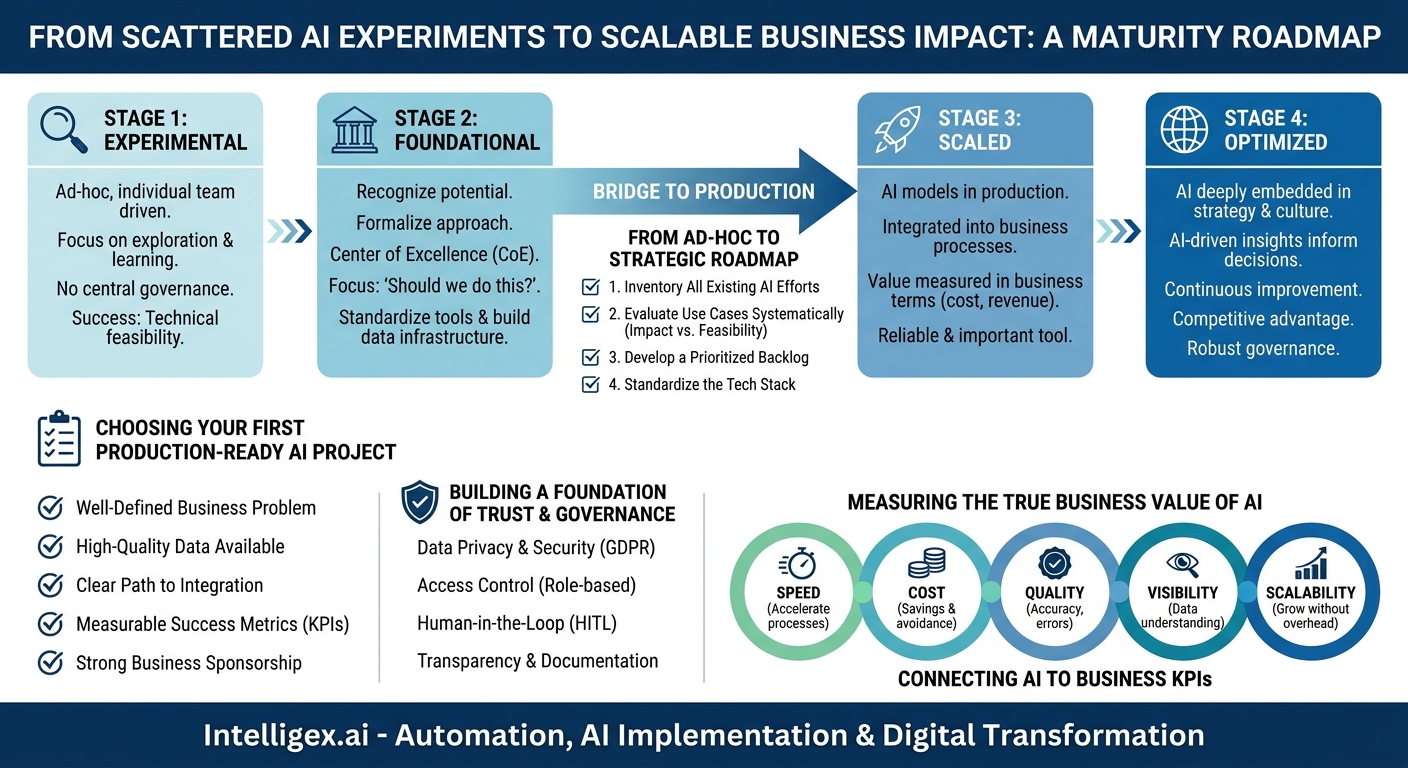
Most organizations today are experimenting with artificial intelligence. A marketing team might be testing a generative AI tool for ad copy, while the finance department pilots an anomaly detection model for expense reports. These isolated experiments are valuable learning experiences, but they often fail to deliver scalable business impact. The real challenge is not starting with AI, but moving beyond these small-scale tests to integrate AI into core business operations where it can drive significant value.
This journey from scattered experiments to strategic, production-level AI is a process of maturation. It requires a shift in thinking from treating AI as a series of disconnected science projects to managing it as a core business capability. Doing so unlocks transformative improvements in operational speed, cost efficiency, product quality, and strategic visibility. This guide provides a practical framework for navigating that journey, moving your AI initiatives from the lab to the production line.
The Four Stages of AI Adoption Maturity
Understanding where you are is the first step toward figuring out where you need to go. While every organization’s path is unique, most progress through four distinct stages of AI maturity. Recognizing your current stage helps you identify the specific challenges you need to overcome and the opportunities you should pursue next.
Stage 1: Experimental
This is the entry point. Activities are often ad-hoc, driven by individual teams or curious employees. The focus is on exploration and learning. Teams might be using freely available tools or running small proofs of concept. There is little to no central governance, shared infrastructure, or strategic direction. Success is measured by technical feasibility, not business impact.
Stage 2: Foundational
Organizations at this stage recognize the potential of AI and begin to formalize their approach. They start identifying high-value use cases and may form a small, centralized team or “Center of Excellence” (CoE) to provide guidance. The focus shifts from “can we do this?” to “should we do this?”. Efforts are made to standardize tools and processes and to build the initial data infrastructure required for more serious work.
Stage 3: Scaled
At this stage, AI is no longer just an experiment. Several AI models are in production, integrated directly into key business processes. The value of AI is being measured in concrete business terms, such as cost savings or revenue growth. The organization has established processes for model development, deployment, and monitoring. AI is seen as a reliable and important tool for achieving business goals.
Stage 4: Optimized
Here, AI is deeply embedded in the organization’s strategy and culture. AI-driven insights inform major business decisions, and a virtuous cycle of data, models, and business outcomes drives continuous improvement. The company leverages AI for a competitive advantage, continuously optimizing operations and creating new AI-powered products or services. Governance is robust, and the entire organization is aligned on how to leverage AI responsibly and effectively.
From Ad-Hoc Experiments to a Strategic Roadmap
Moving from the Experimental stage to the Foundational stage is about imposing order on chaos. Without a coordinated strategy, you risk duplicated effort, wasted resources on dead-end projects, and a collection of siloed tools that do not work together. The goal is to create a clear, prioritized plan that aligns AI initiatives with core business objectives.
The most effective way to do this is by establishing a cross-functional AI steering committee or a formal Center of Excellence. This group should include representatives from business units (like Operations, Finance, and Marketing), IT, and data science. Their first mandate is to move from a reactive to a proactive stance.
- Inventory All Existing AI Efforts: Create a simple catalog of every AI-related project, tool, and experiment currently underway. For each, document the team involved, the technology used, the intended goal, and the current status. You might be surprised by how much is already happening.
- Evaluate Use Cases Systematically: For each inventoried project and any new ideas, assess them against two simple axes: potential business impact and technical feasibility. High-impact, high-feasibility projects are your prime candidates for initial investment. High-impact, low-feasibility projects may require longer-term research, while low-impact projects should be deprioritized, regardless of how easy they are.
- Develop a Prioritized Backlog: Based on this evaluation, create a single, shared backlog of AI projects. This backlog becomes your organization’s official AI roadmap. It provides visibility to leadership and ensures that teams are working on the most valuable initiatives first.
- Standardize the Tech Stack: The steering committee should also make initial decisions on a preferred set of tools and platforms. This prevents a fragmented ecosystem of incompatible technologies and allows teams to share knowledge and components. This doesn’t mean being overly restrictive, but rather guiding teams toward a common, supported set of cloud services (like those from AWS or Google Cloud), MLOps platforms, and data infrastructure.
For example, a steering committee might discover that both the sales and marketing teams are trying to build separate customer churn prediction models. By bringing them together, they can pool resources, share data, and build a single, more accurate model that serves both departments, saving time and money.
Choosing Your First Production-Ready AI Project
Once you have a prioritized backlog, the next step is to select a pilot project to take all the way to production. This first project is critical. Its success (or failure) will heavily influence organizational buy-in and future investment in AI. The ideal first project is not necessarily the most ambitious or technically complex. Instead, it should be a well-defined problem where you can achieve a clear, measurable win.
A great pilot project minimizes risk while maximizing business relevance. It should be complex enough to be meaningful but simple enough to be achievable within a reasonable timeframe (e.g., three to six months). Use the following checklist to evaluate your candidates.
Pilot Project Selection Checklist:
- Well-Defined Business Problem: Is the problem statement clear and specific? Avoid vague goals like “improve efficiency.” A better goal is “reduce the manual effort required to process vendor invoices by 50%.”
- High-Quality Data Available: Is the data required for the model readily accessible? Is it clean, labeled, and sufficient in volume? Data challenges are the number one reason AI projects fail, so this is a non-negotiable prerequisite.
- Clear Path to Integration: Do you know exactly how the model’s output will be used? Will it feed into an existing application, populate a dashboard, or trigger an automated workflow? If you cannot draw a clear diagram of the end-to-end process, the problem is not yet defined well enough.
- Measurable Success Metrics: Can you define a key performance indicator (KPI) that will prove the project’s value? This must be a business metric, not a technical one. Model accuracy is irrelevant if it doesn’t improve the business.
- Strong Business Sponsorship: Is there a business leader who is committed to the project’s success, willing to champion it, and prepared to drive adoption of the new process? Without an engaged sponsor, even a perfect model will fail to gain traction.
A good example for a first project could be an AI-powered lead scoring model for a sales team. The business problem is clear: prioritize sales efforts on leads most likely to convert. The data (historical lead and conversion data) likely already exists in a CRM system like Salesforce. The output (a lead score from 1 to 100) can be easily integrated back into the CRM, and success can be measured directly by the increase in the lead-to-opportunity conversion rate.
Building a Foundation of Trust and Governance
As you move projects into production, you are no longer just experimenting. You are embedding automated decision-making into your business. This introduces new risks related to data privacy, security, and operational reliability. Building a strong governance framework is not about slowing down innovation; it is about enabling you to scale AI safely and responsibly.
A practical AI governance plan does not need to be a thousand-page document. It should focus on a few key principles that can be applied to every project.
Key Pillars of AI Governance
- Data Privacy and Security: Ensure all data used for training and running models adheres to regulations like GDPR and internal privacy policies. Use techniques like data anonymization where possible and enforce strict access controls. Data for AI models should be treated with the same security rigor as any other sensitive company data.
– Access Control: Implement role-based access for AI systems. Not everyone needs to be able to deploy a new model into production. Define who can access sensitive data, who can train models, who can review model performance, and who can approve a model for production release.
– Human-in-the-Loop (HITL): For high-stakes decisions, the AI should assist, not replace, a human expert. A model can recommend which insurance claims to flag for review, but a human adjudicator should make the final decision. This approach is critical for mitigating risk, building trust with users, and providing a mechanism for correcting AI errors.
– Transparency and Documentation: Every production model should have clear documentation. This should describe the model’s purpose, the data it was trained on, its known limitations, and how its performance is measured. This transparency is essential for debugging issues, explaining outcomes to stakeholders, and ensuring the long-term maintainability of the system.
Consider an HR department using an AI tool to help screen resumes. A good governance policy would require that the data used to train the model be audited for bias, that the tool only flags candidates for review (not automatically reject them), and that a human recruiter makes the final decision on who to interview.
Measuring the True Business Value of AI
Technical metrics like “model accuracy” or “precision and recall” are important for data scientists, but they mean very little to the C-suite. To justify continued investment and demonstrate success, you must measure the impact of AI in the language of the business. The ultimate value of AI is reflected in improvements to five key business drivers: speed, cost, quality, visibility, and scalability.
When planning any AI project, start by identifying which of these drivers you intend to impact and how you will measure that impact.
Connecting AI to Business KPIs
- Speed: This is about accelerating processes and reducing cycle times.
- What to measure: Time to complete a task, lead time from order to delivery, customer response time.
- Example: A financial institution uses a natural language processing (NLP) model to automatically extract information from loan applications, reducing the document processing time from 30 minutes to under one minute per application.
- Cost: This includes direct cost savings and cost avoidance.
- What to measure: Operational expenses, cost per transaction, employee hours spent on a task, capital expenditure.
- Example: A manufacturing company implements a predictive maintenance system that analyzes sensor data from factory equipment. This reduces unplanned downtime and lowers emergency repair costs.
- Quality: This relates to improving accuracy, reducing errors, and enhancing customer satisfaction.
- What to measure: Error rates, product defect rates, customer satisfaction scores (CSAT), Net Promoter Score (NPS).
- Example: An e-commerce company uses an AI-powered recommendation engine to provide more relevant product suggestions, leading to a higher average order value and improved customer satisfaction.
- Visibility and Scalability: This is the ability to understand your business better through data and to grow without a proportional increase in operational overhead.
- What to measure: Forecast accuracy, number of transactions processed per day, ability to handle peak demand.
- Example: A supply chain company uses AI to generate more accurate demand forecasts, allowing it to optimize inventory levels across hundreds of warehouses, a task that is impossible to perform manually at scale.
Your Next Steps on the AI Maturity Journey
Moving from AI experiments to production systems that deliver real business value is a deliberate process. It requires a strategic approach that balances innovation with governance, and technology with clear business objectives. By understanding your current maturity level and focusing on a prioritized set of well-defined projects, you can build momentum and demonstrate the transformative power of AI in your organization.
The journey is iterative. Your first production model will teach you invaluable lessons that you can apply to the next. The key is to get started with a pragmatic, value-focused mindset.
Here is a simple action plan to guide your next steps:
- Assess Your Current State: Honestly evaluate where your organization sits on the four-stage maturity curve. Are you in the ad-hoc Experimental stage or have you started building a Foundational capability? Knowing your starting point clarifies your immediate priorities.
- Identify One High-Impact Project: Do not try to boil the ocean. Use the pilot project checklist to identify a single, achievable project that has a clear business sponsor and a measurable outcome. A tangible win is the best catalyst for broader change.
- Build a Cross-Functional Team: Assemble a small, dedicated team for your pilot project that includes the business process owner, an IT or data engineer, and a data scientist. Close collaboration between these roles is essential for success.
- Define Success Before You Start: Before writing a single line of code, agree on the specific business KPI you expect to move. This metric will be your north star throughout the project and the ultimate measure of its value.
By following these steps, you can start building the bridge from promising AI experiments to scalable, production-grade solutions that drive your business forward.
Your Next Read:
Category:
Get a FREE
Proof of Concept
& Consultation
No Cost, No Commitment!
