

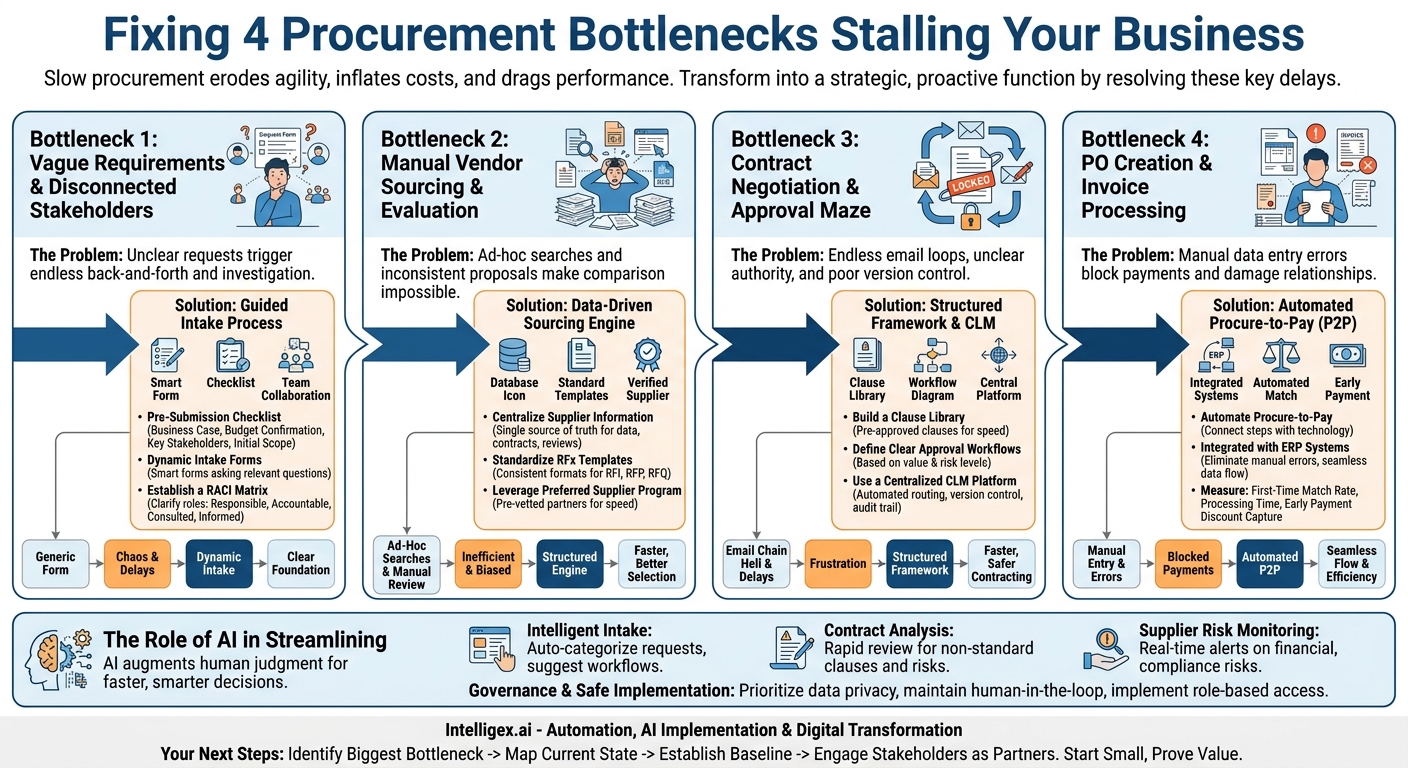
A great idea gets stalled. A critical project misses its deadline. A top candidate turns down an offer because their equipment isn’t ready. The root cause is often the same: a procurement request stuck somewhere in the internal machinery of the business. While it feels like a simple administrative hassle, these delays are strategic bottlenecks. They erode agility, inflate costs, and directly impact your ability to compete.
Slow procurement isn’t just an operational headache; it’s a tangible drag on performance. When a request disappears into a black hole for weeks, the consequences ripple across the organization. By understanding exactly where these delays happen, you can move from a reactive, frustrating process to a proactive, strategic function that accelerates the entire business.
The Hidden Costs of Waiting: Why Procurement Delays Matter
Before diving into the specific bottlenecks, it’s crucial to frame the problem in terms of business value. The impact of a slow procurement cycle goes far beyond wasted time. It affects the bottom line, team morale, and your strategic positioning in the market.
Here’s how delays directly translate into business costs:
- Speed and Agility: In today’s market, speed is a currency. When your marketing team needs a new analytics tool to respond to a competitor’s move, a six-week procurement process means you’ve already lost. Project timelines get extended, product launches are pushed back, and market opportunities are missed. The cost is not just the delay itself, but the revenue and market share you failed to capture.
- Financial Costs: Delays often mean paying more. You miss out on early-payment discounts from suppliers. In volatile markets, the price of goods or software can increase while you wait for approvals. More insidiously, consider the “soft cost” of employee time. How many hours do your team members, managers, and finance partners spend chasing statuses, resubmitting forms, and sitting in meetings to unstick a single request?
- Quality and Risk: When a process takes too long, people find workarounds. A frustrated team might use an unvetted piece of software on a personal credit card, bypassing security and legal reviews entirely. This “shadow IT” introduces significant risk. Alternatively, to make up for lost time, the final decision might be rushed, leading to the selection of an inferior vendor or agreeing to unfavorable contract terms just to get it done.
- Visibility and Trust: Perhaps the most frustrating aspect for employees is the lack of visibility. Submitting a request and having no idea where it is, who is reviewing it, or when to expect a decision erodes trust in internal processes. It forces teams to build buffer time into every project plan, creating a culture of low expectations and inefficiency.
Bottleneck 1: Vague Requirements and Disconnected Stakeholders
Nearly every significant procurement delay starts with a weak foundation: an unclear or incomplete request. A submission that simply says, “We need new project management software,” is not a request; it’s a problem that forces the procurement, finance, and IT teams into an investigative role they shouldn’t have to play.
This ambiguity immediately triggers a chain reaction of emails and meetings to define basic requirements that should have been clear from the start. The process stalls before it even begins.
The Disconnect in Action: A Common Scenario
The Operations team wants to purchase a new inventory management system. They fill out a basic form, focusing only on the features they need. Two weeks later, the request lands on IT’s desk. IT Security flags that the proposed cloud vendor doesn’t meet data residency requirements. The request is sent back. Operations finds a new vendor, and this time Finance gets involved, noting that the subscription model requires a capital expenditure approval, not an operational one. The process resets again. A month has been wasted because the key stakeholders weren’t engaged at the point of origin.
Practical Steps to Improve Request Intake
To fix this, you must shift from a generic form to a guided intake process. The goal is to collect the right information from the right people at the very beginning.
- Pre-Submission Checklist: Before a team member can even submit a request, encourage them to confirm these basics.
- Business Case: Is the “why” clearly articulated? (e.g., “to reduce inventory carrying costs by 15%”)
- Budget Confirmation: Has the budget owner been identified and confirmed the funds are available?
- Key Stakeholders: Have IT, Security, Legal, or other relevant teams been notified or consulted?
- Initial Scope: Is there a draft scope of work, a list of required features, or a clear problem statement?
- Use Dynamic Intake Forms: Instead of a one-size-fits-all PDF, use a smart form that asks different questions based on the request type. For example, a software request should automatically trigger questions about data privacy and integration points, while a request for a new consulting firm should ask about the scope of work and deliverables.
- Establish a RACI Matrix: For common, high-value purchases (like software or professional services), a simple RACI (Responsible, Accountable, Consulted, Informed) chart clarifies roles. It ensures everyone knows when they need to provide input, preventing last-minute surprises.
Bottleneck 2: Manual Vendor Sourcing and Evaluation
Once a request is properly defined, the next hurdle is finding the right partner. For many organizations, this process is surprisingly manual and inefficient. It often relies on an employee’s existing network, a few quick web searches, or a list of vendors used in the past, with little data on their actual performance.
The subsequent evaluation is just as broken. Teams receive proposals in wildly different formats, making a true side-by-side comparison nearly impossible. The result is a time-consuming, biased, and ultimately sub-optimal selection process.
How Manual Evaluation Burns Time
A marketing team needs to hire a digital agency for a new campaign. They spend a week searching for candidates and send out a brief Request for Proposal (RFP). Over the next three weeks, they receive seven proposals. One is a 50-page PDF, another is a slide deck, and a third is a simple email with a price list. The marketing manager then spends two more weeks trying to normalize the data into a single spreadsheet to compare pricing, timelines, and deliverables. The entire sourcing and evaluation phase takes over a month, delaying a time-sensitive campaign.
Building a More Efficient Sourcing Engine
The key is moving from ad-hoc searches to a structured, data-driven approach. This provides a foundation of quality and speed that benefits the entire organization.
- Centralize Supplier Information: Create a single source of truth for all current and potential suppliers. This system should house not only contact information but also contracts, performance reviews, risk assessments, and diversity certifications. This prevents different departments from vetting the same supplier repeatedly.
- Standardize RFx Templates: Develop clear, consistent templates for Requests for Information (RFI), Proposals (RFP), and Quotes (RFQ). A good template forces vendors to provide information in a structured format, making it dramatically easier to compare responses on an apples-to-apples basis.
- Leverage a Preferred Supplier Program: For commonly purchased goods and services, establish a list of pre-vetted, preferred suppliers. This allows teams to engage with trusted partners who already understand your security requirements and have master service agreements in place, enabling them to bypass the lengthy sourcing and vetting stages for most routine purchases.
What to Measure: To track improvement, monitor your Time-to-Shortlist (the time from an approved request to a list of qualified vendors) and Cycle Time per Proposal (the average time spent evaluating each vendor submission).
Bottleneck 3: The Contract Negotiation and Approval Maze
For many, this is the most notorious black hole in the entire procurement process. A deal is verbally agreed upon, but the contract gets stuck in a seemingly endless loop of email attachments labeled `MSA_v5_final_LEGAL_edits_USE_THIS_ONE.docx`.
The problem is threefold: lack of standardization, unclear approval chains, and poor version control. Every negotiation starts from scratch, every contract seems to require the same C-level approval, and nobody is ever sure they are working on the latest version.
Where Contracts Go to Die
The sales team is ready to sign a contract with a new customer data platform. The vendor sends their standard paper. Your legal team spends a week redlining it. The vendor’s legal team takes another week to respond. A debate over the limitation of liability clause stalls the process for ten more days. Meanwhile, the business sponsor has no visibility into the hold-up and repeatedly asks both their legal team and the vendor for an update. The manual, sequential nature of the review turns a three-day process into a three-week ordeal.
Practical Steps for Faster, Safer Contracting
You can dramatically accelerate contract cycles without increasing risk by implementing a structured framework.
- Build a Clause Library: Your legal team doesn’t need to reinvent the wheel for every contract. By creating a library of pre-approved clauses for common topics like confidentiality, data security, and payment terms, you can assemble standard contracts quickly. This also empowers business teams to use self-service templates for low-risk agreements.
- Define Clear Approval Workflows: Not every contract needs to be signed by the CEO. Establish clear signature authority policies based on contract value, risk level, and business unit. For example, a contract under $25,000 using a pre-approved template might only require a department director’s approval, while a multi-year, seven-figure deal rightfully requires CFO and legal review.
- Use a Centralized Platform: Contract Lifecycle Management (CLM) software is designed to solve this exact problem. Tools from providers like DocuSign or Ironclad centralize contracts, automate approval routing, manage versions, and provide a clear audit trail. This moves negotiations off of email and into a transparent, collaborative environment.
Bottleneck 4: Purchase Order (PO) Creation and Invoice Processing
The final mile of procurement is often plagued by manual data entry and reconciliation. After a contract is signed, someone must manually create a Purchase Order in the ERP system. When the invoice arrives, someone else has to manually match it against the PO and the proof of delivery, a process known as the three-way match.
Every manual step is a potential point of failure. A typo in a PO number, a misplaced decimal point on an invoice, or a missing receipt can bring the payment process to a halt, damaging supplier relationships and creating frustrating rework for your finance team.
The High Cost of Small Errors
Your IT team orders 50 new laptops. The PO is created correctly. The laptops are delivered, and a receiving report is filed. However, the invoice from the supplier accidentally references an old PO number. The accounts payable system automatically flags the mismatch, and the payment is blocked. The AP clerk emails the IT department, who is busy with other projects and doesn’t see the email for three days. Meanwhile, the supplier’s system automatically sends a “past due” notice, and their account manager calls your IT director to ask about the payment. A simple clerical error has consumed time from four different people and made your company look disorganized.
Automating Procure-to-Pay (P2P)
The solution is to connect these disparate steps with technology. Modern procure-to-pay systems, often integrated with ERPs like SAP or Oracle NetSuite, are built to automate this workflow.
What to Measure:
- First-Time Match Rate: The percentage of invoices that are processed and approved without any manual intervention. A high rate is a strong indicator of a healthy, automated process.
- Invoice Processing Time: The average time from when an invoice is received to when it is approved for payment.
- Early Payment Discount Capture Rate: An excellent metric for demonstrating direct financial ROI. Faster processing means you can take advantage of discounts offered by suppliers like “2/10 Net 30.”
By automating the three-way match and integrating your procurement platform with your finance system, you eliminate the risk of manual error and create a seamless flow of data from purchase request all the way to final payment. Procurement solutions like those from SAP, such as Ariba, are designed to manage this entire lifecycle.
The Role of AI in Streamlining, Not Just Automating
Artificial intelligence is not a magic wand, but it offers powerful tools to address these bottlenecks in ways that go beyond simple automation. When applied correctly, AI can add a layer of intelligence that helps your team make faster, smarter decisions.
- Intelligent Intake: AI can analyze a user’s free-text request (e.g., “I need a tool to help the sales team track leads”) and automatically categorize it, suggest the right purchasing workflow, and flag if critical information like budget or business impact is missing.
- Contract Analysis: Instead of a lawyer reading every word of a 40-page vendor contract, AI can perform a first-pass review in seconds. It can identify non-standard clauses, flag high-risk language, and even compare the terms against your company’s pre-defined legal playbook, allowing your legal team to focus their expertise on the most critical issues.
- Supplier Risk Monitoring: AI can continuously monitor thousands of data sources, from financial reports to news articles and social media, to provide real-time alerts about potential risks with your key suppliers. This could be an early warning of financial distress, a data breach, or a negative compliance event, giving you time to react before it impacts your business.
A Note on Governance and Safe Implementation
Integrating AI into a sensitive process like procurement requires a thoughtful approach. It is not about replacing human judgment, but augmenting it.
First, always prioritize data privacy and confidentiality, especially when using AI for contract analysis. Understand where your data is being processed and stored. Second, maintain a “human-in-the-loop” model. AI should provide recommendations and flag risks, but the final decision on vendor selection or contract approval must remain with your procurement and legal professionals. Finally, implement strong role-based access controls to ensure that employees can only view the data and perform the actions relevant to their roles.
Your Next Steps: Building a More Agile Procurement Function
Addressing years of procurement friction can feel overwhelming. The key is to start small, prove value, and build momentum. Don’t attempt to overhaul the entire process at once. Instead, adopt a methodical approach.
- Identify Your Biggest Bottleneck: Talk to your teams. Is the most significant pain point the initial request process, the contract negotiation maze, or invoice processing? Pick the one area where an improvement would deliver the most immediate and visible impact.
- Map the Current State: Get the key players from that process in a room (virtual or physical) and whiteboard the exact steps, handoffs, and systems involved today. Visually identifying the loops, delays, and manual interventions is a powerful exercise.
- Establish a Baseline: You cannot improve what you do not measure. Before you change anything, gather metrics on the current state. How long does it take to get a contract signed? What is your first-time invoice match rate? These numbers will be crucial for building a business case and demonstrating ROI later.
- Engage Stakeholders as Partners: The goal is to build a process that works for everyone. Frame this initiative not as a procurement project, but as a business-wide improvement. Involve Legal, Finance, IT, and key business units from the beginning. By making them part of the solution, you ensure the final process is one they will actually adopt and champion.
By systematically identifying and resolving these common bottlenecks, you can transform procurement from a source of friction into a strategic enabler that gives your business a durable competitive advantage.
Your Next Read:
Category:
Get a FREE
Proof of Concept
& Consultation
No Cost, No Commitment!
