

For many finance and accounting professionals, the phrase “month-end close” conjures images of long hours, cold pizza, and a mountain of spreadsheets. It’s a frantic, recurring sprint to reconcile, verify, and report on a month’s worth of financial activity, all under a tight deadline. This high-pressure cycle is often riddled with frustrating bottlenecks that slow progress, increase stress, and heighten the risk of errors. But it doesn’t have to be this way. By strategically identifying and dismantling these common chokepoints, your team can transform the month-end close from a dreaded marathon into a smooth, efficient, and predictable process.
The goal of the close is straightforward: to produce accurate and timely financial statements that provide a clear picture of the company’s health. The challenge lies in the execution. It’s a complex process involving a high volume of data from numerous sources, and any single delay can have a significant domino effect. Understanding where things get stuck is the first step toward fixing them. Let’s dive into the most common month-end close bottlenecks and explore practical ways to reduce them for good.
The Usual Suspects: Unpacking Common Month-End Bottlenecks
While every company is unique, the pain points in the closing process are remarkably similar across industries. They typically stem from a reliance on manual processes, poor communication, and a lack of standardization. By addressing these core issues, you can unlock significant efficiency gains.
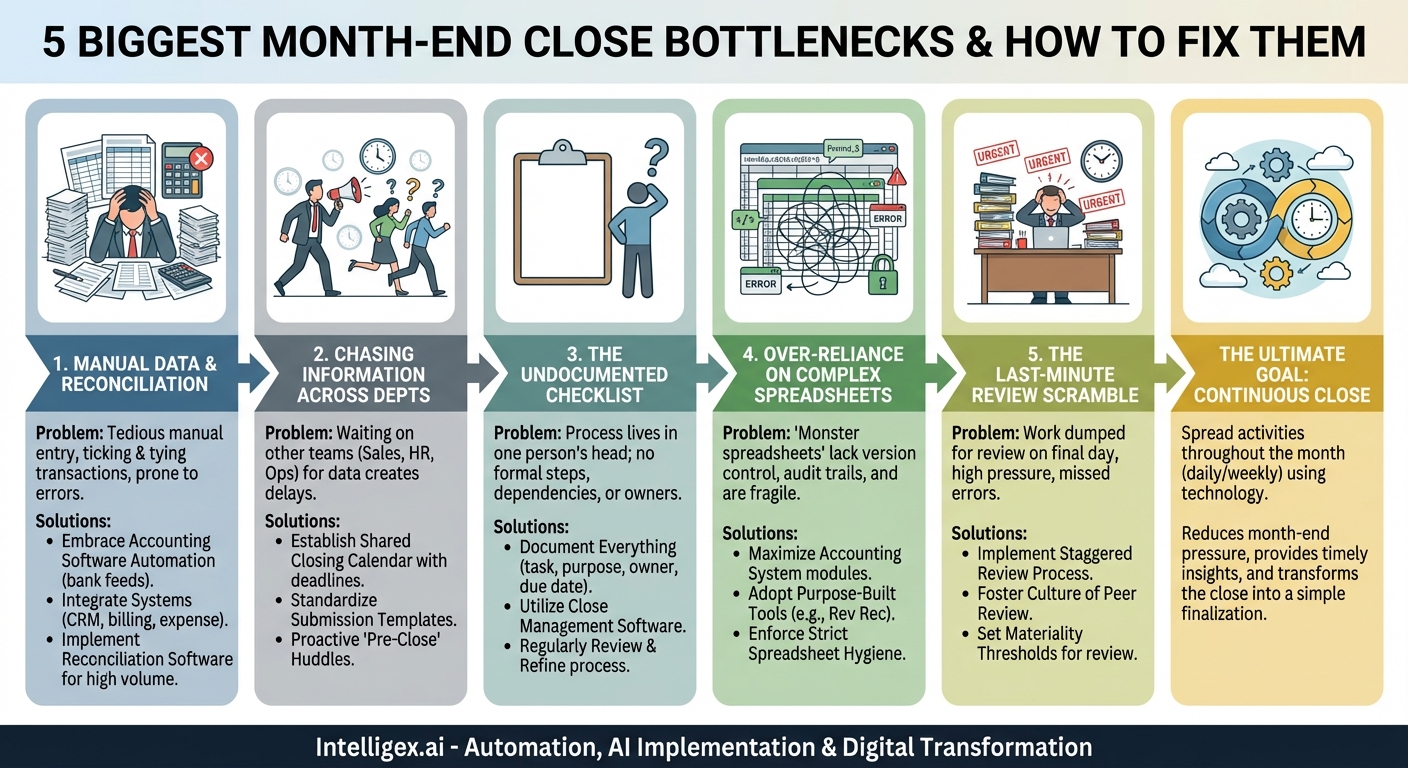
Bottleneck #1: The Manual Data and Reconciliation Quicksand
The Problem: This is arguably the biggest and most time-consuming bottleneck of all. It’s the hours spent manually keying in data from bank statements, credit card bills, invoices, and expense reports. It’s the painstaking process of ticking and tying thousands of transactions in a sprawling Excel sheet, hunting for that one tiny discrepancy that’s preventing a reconciliation from balancing.
The Impact: Beyond being incredibly tedious, manual data entry and reconciliation are a recipe for disaster. They are highly susceptible to human error—typos, transposed numbers, or copy-paste mistakes—that can compromise the integrity of your financial data. This work is not only slow and inefficient but also demoralizing for skilled accounting professionals who could be spending their time on higher-value analysis.
The Solutions:
- Embrace Automation: Modern accounting software is your greatest ally. Use features like automatic bank and credit card feeds to pull transaction data directly into your general ledger, eliminating manual entry. Set up rules to automatically categorize recurring transactions, further reducing manual effort.
- Integrate Your Systems: Create a connected ecosystem of software. Integrating your expense management platform (like Expensify or Ramp), CRM (like Salesforce), and billing system directly with your accounting software ensures data flows seamlessly without manual intervention.
- Implement Reconciliation Software: For high-volume accounts, specialized reconciliation tools can be a game-changer. These platforms can automatically match tens of thousands of transactions in minutes, flagging only the exceptions that require human review.
Bottleneck #2: Chasing Information Across Departments
The Problem: The accounting team is often the final stop for information, but it can’t close the books in a vacuum. You’re waiting on the sales team for a final list of contracts signed at month-end for revenue recognition. You need the HR department to confirm final payroll adjustments. You’re chasing the operations team for inventory counts or project completion data. Each delay pushes back your own critical tasks.
The Impact: This dependency creates a frustrating waiting game that compresses the time available for the close. It can cause friction between departments and leads to a last-minute scramble, where journal entries are rushed and the risk of inaccurate accruals or deferrals increases significantly.
The Solutions:
- Establish a Shared Closing Calendar: Don’t let deadlines be a surprise. Create and distribute a clear closing calendar at the beginning of each quarter. This calendar should outline specific deadlines for each department’s submissions, who is responsible, and what information is needed.
- Standardize Submission Templates: Make it easy for other departments to give you what you need. Provide simple, standardized templates for them to fill out. This ensures you receive data in a consistent format, eliminating the need for time-consuming reformatting and follow-up questions.
- Proactive Communication: Hold a brief, 15-minute “pre-close” huddle a few days before month-end. This serves as a friendly reminder of upcoming deadlines and allows other departments to flag any potential issues or delays ahead of time.
Bottleneck #3: The Undocumented or Vague Checklist
The Problem: The entire closing process lives inside the head of your senior accountant or controller. There’s no formal, detailed checklist that outlines every single task, its dependencies, who is responsible for it, and the deadline. New team members are left guessing, and if the key person is on vacation or leaves the company, the process grinds to a halt.
The Impact: A lack of documentation leads to inconsistency, missed steps, and duplicated effort. It makes it impossible to effectively train new staff or delegate tasks. Furthermore, you cannot improve a process that isn’t clearly defined. Without a map, every close feels like you’re navigating a maze for the first time.
The Solutions:
- Document Everything: Create a comprehensive month-end close checklist. It should be granular, listing every task from reconciling petty cash to calculating complex accruals. For each task, document the “why” (its purpose), the “how” (the steps to complete it), the “who” (the owner), and the “when” (the due date).
- Utilize Close Management Software: Tools like FloQast, BlackLine, or Vena are specifically designed to manage this process. They provide a centralized, cloud-based platform to house your checklist, track task completion in real-time, store supporting documentation, and streamline review and approval workflows.
- Regularly Review and Refine: Your close process isn’t static. After each close, hold a brief retrospective to discuss what went well and what didn’t. Use this feedback to refine your checklist and improve the process for the next month.
Bottleneck #4: Over-Reliance on Complex Spreadsheets
The Problem: While spreadsheets are powerful tools, many accounting teams rely on a fragile web of interconnected, formula-heavy workbooks for critical calculations like depreciation schedules, revenue recognition waterfalls, or loan amortizations. These “monster spreadsheets” are often built over years, with layers of complexity that only one person truly understands.
The Impact: This introduces significant “spreadsheet risk.” A single broken link, a hard-coded number in a formula, or an accidental deletion can cause errors that are incredibly difficult to find. These files lack proper version control, have no audit trail, and are nearly impossible to collaborate on effectively.
The Solutions:
- Maximize Your Accounting System: Before turning to Excel, explore the full capabilities of your existing accounting software. Many modern systems have built-in modules for fixed assets, advanced revenue management (ASC 606/IFRS 15), and lease accounting that can completely replace these risky spreadsheets.
- Adopt Purpose-Built Tools: For highly specialized areas, consider dedicated software. A dedicated capitalization table software or a revenue recognition platform will not only automate calculations but also provide robust reporting and a clear audit trail.
- Enforce Spreadsheet Hygiene: If you must use spreadsheets, implement strict best practices. Lock and protect cells containing formulas, use data validation to prevent incorrect entries, create a “checks” tab to ensure everything balances, and clearly separate input, calculation, and output sections.
Bottleneck #5: The Last-Minute Review Scramble
The Problem: The team works furiously for days to complete all their journal entries and reconciliations. Then, on the final day of the close, a massive pile of work is dumped on the desk of the controller or finance manager for a final review and approval.
The Impact: This creates a massive bottleneck for the reviewer, who is under intense pressure to review everything quickly. A thorough review becomes nearly impossible, increasing the chance that errors will slip through into the final financials. If a significant issue is discovered, it sends the team scrambling to make corrections at the eleventh hour, causing immense stress and delaying the close.
The Solutions:
- Implement a Staggered Review Process: Don’t save all reviews for the end. As soon as a major reconciliation (like cash) or a complex journal entry is completed, it should be submitted for review. This “rolling review” distributes the workload throughout the close period, giving reviewers more time to be thorough.
- Foster a Culture of Peer Review: Empower your team to review each other’s work for less critical tasks before they go to the final approver. This can catch simple mistakes early and serves as a valuable learning opportunity for the entire team.
- Set Materiality Thresholds: Clearly define what constitutes a material item that requires immediate, individual review versus smaller items that can be reviewed in a batch. This helps managers prioritize their time and focus on what matters most.
The Ultimate Goal: Shifting to a Continuous Close
Fixing individual bottlenecks is a crucial first step, but the long-term vision should be to move away from the traditional, condensed month-end sprint altogether. The concept of a “continuous close” involves spreading closing activities throughout the month instead of cramming them into a few days. Imagine reconciling your main bank accounts daily or weekly, posting accruals for recurring expenses as they are incurred, and updating schedules continuously.
By leveraging technology and embedding these tasks into your daily and weekly routines, you dramatically reduce the pressure at month-end. The close becomes less of a major event and more of a simple finalization and review process. This proactive approach not only leads to a faster, less stressful close but also provides leadership with more timely financial insights for better decision-making throughout the entire month.
Transforming your month-end close won’t happen overnight. The key is to start small. Pick one bottleneck from this list—the one that causes your team the most pain—and commit to solving it in the next quarter. By making consistent, incremental improvements, you can systematically dismantle the barriers to an efficient close, freeing up your team to focus on what they do best: providing the strategic financial insights that drive the business forward.
Your Next Read:
Category:
Get a FREE
Proof of Concept
& Consultation
No Cost, No Commitment!
