

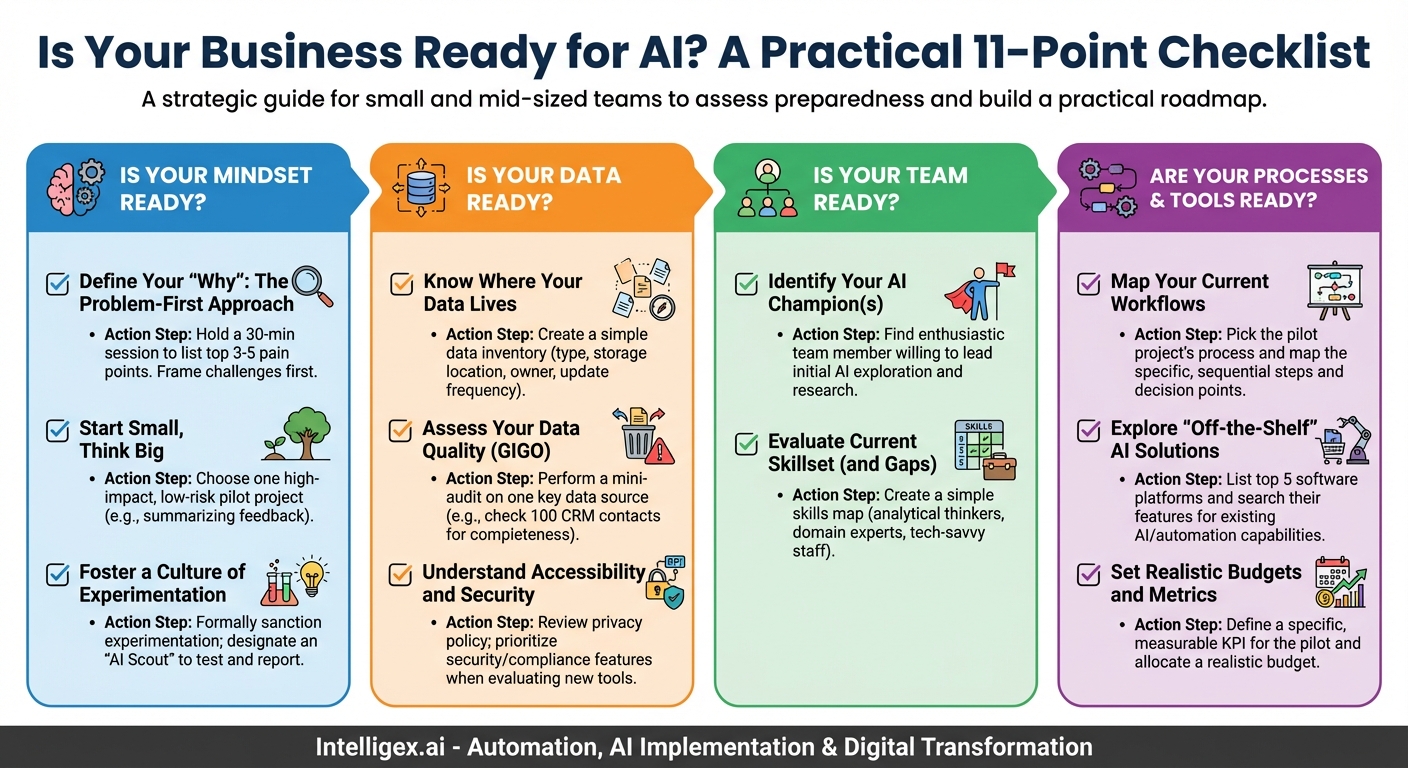
The conversation around Artificial Intelligence has moved from the abstract halls of tech conferences to the everyday reality of running a business. For small and mid-sized teams, however, this new reality can feel daunting. When you’re juggling daily operations, managing a lean team, and keeping an eye on the bottom line, the idea of implementing a complex new technology like AI can seem like a luxury reserved for enterprises with massive budgets and dedicated data science departments. But here’s the truth: AI is no longer a futuristic concept for the corporate elite. It’s a practical tool that can level the playing field, and getting started is more achievable than you think.
The key isn’t to suddenly transform into an AI-first company overnight. The key is readiness. It’s about taking a clear-eyed look at your existing strategy, data, people, and processes to see where you stand. This isn’t a pass/fail exam; it’s a strategic exercise to identify your strengths and pinpoint the most logical first step. By asking the right questions now, you can move from feeling overwhelmed by the AI hype to feeling empowered to use it as a strategic advantage. This simple checklist is designed to be your starting point—a guide to help you assess your preparedness and build a practical roadmap for your AI journey.
Is Your Mindset Ready for AI? The Strategic Foundation
Before you ever look at a single piece of software, your first check-in needs to be with your strategy and culture. Technology is just a tool; without the right mindset to wield it, even the most powerful AI is just expensive code. A solid foundation is built on clear goals and a willingness to learn.
1. Define Your “Why”: The Problem-First Approach
The single biggest mistake teams make is starting with the technology. They say, “We need to use AI,” without first asking, “What problem are we trying to solve?” This puts the cart miles ahead of the horse. AI is at its best when it’s applied to a specific, well-understood business challenge. Forget the buzzwords for a moment and think about your daily frustrations. Where are the bottlenecks? What repetitive tasks are eating up your team’s valuable time? What insights are you consistently failing to capture?
- Checklist Question: Have we clearly identified a business problem or opportunity we want to address, rather than just “implementing AI”?
- Action Step: Hold a 30-minute brainstorming session with your team. Your goal is to create a list of the top 3-5 operational pain points. Examples might include: “Our customer service team spends too much time answering the same five questions,” or “We don’t know which marketing leads are most likely to convert,” or “Manually creating weekly reports takes an entire afternoon.” Frame your challenges first; the AI solution will follow.
2. Start Small, Think Big
The temptation to launch a massive, company-wide AI overhaul is a recipe for disaster for a smaller team. You don’t have the resources to “boil the ocean.” A far more effective strategy is to identify a single, high-impact, low-risk pilot project. This gives you a safe space to learn, demonstrate value, and build momentum. A successful small win is infinitely more valuable than a spectacular, ambitious failure. It builds confidence and makes the case for further investment.
- Checklist Question: Do we have a plan to start with a manageable pilot project instead of trying to transform everything at once?
- Action Step: From your list of pain points, choose one to be your pilot. The ideal candidate is a process that is repetitive, rule-based, and where success is easy to measure. For example, using an AI tool to summarize long customer feedback emails into bullet points, or implementing a simple AI chatbot on your website to handle off-hours inquiries.
3. Foster a Culture of Experimentation
AI is not a static, plug-and-play solution. It’s an evolving field, and your implementation will be a process of testing, learning, and refining. This requires a cultural shift away from fearing failure and toward embracing experimentation. Your team needs to feel safe to try new tools, to test different approaches, and to report on what works and what doesn’t without fear of reprisal. The goal of your first few forays into AI isn’t perfection; it’s learning.
- Checklist Question: Does our team culture encourage learning and experimentation, even if it means some initiatives don’t work out?
- Action Step: Formally sanction experimentation. Designate one person as the “AI Scout” for the quarter, responsible for trying a new tool and reporting back. Or, create a shared document where anyone can post an idea for an AI-powered improvement. Acknowledge and even celebrate the learning that comes from a “failed” experiment.
Is Your Data Ready for AI? The Fuel in Your Tank
If strategy is the map, data is the fuel. AI algorithms are voracious consumers of information. The quality and accessibility of your data will directly determine the success of your initiatives. Fortunately, you don’t need petabytes of perfectly curated data to begin. You just need to know what you have.
4. Know Where Your Data Lives
Many small businesses have more data than they realize, but it’s often siloed in different places: customer information in a CRM, sales figures in spreadsheets, website analytics in a Google account, and support tickets in a helpdesk system. The first step toward leveraging this data is simply knowing where it all is. You can’t use what you can’t find.
- Checklist Question: Can we identify and locate our most critical sources of business data (customer, sales, marketing, operations)?
- Action Step: Create a simple data inventory. A basic spreadsheet will do. List the type of data (e.g., “Customer Contacts”), where it’s stored (e.g., “HubSpot CRM”), who “owns” it or is the expert on it, and how frequently it’s updated.
5. Assess Your Data Quality (The GIGO Principle)
The old computer science adage “Garbage In, Garbage Out” (GIGO) is the golden rule of AI. An AI model is only as good as the data it’s trained on. If your sales data is full of duplicate entries, missing values, and inconsistent formatting, any AI-driven sales forecast will be unreliable. You don’t need pristine data to start, but you must be honest about its condition. Awareness of data quality issues can help you choose the right project and set realistic expectations.
- Checklist Question: Do we have a basic understanding of the quality and completeness of our most important data set?
- Action Step: Perform a mini-audit on one key data source. For example, export 100 contacts from your CRM. How many are missing a phone number? How many have a “@gmail.com” address in the “company email” field? This simple exercise will give you a tangible sense of your data’s health.
6. Understand Data Accessibility and Security
Having data isn’t enough; it needs to be accessible to the tools that will use it. Can you easily export it? Does your software have an API (Application Programming Interface) that allows other tools to connect to it? Equally important is security and privacy. You have a responsibility to protect your customer and company data, and regulations like GDPR and CCPA carry heavy penalties. Any AI strategy must be built on a foundation of secure and ethical data handling.
- Checklist Question: Do we have clear procedures for accessing our data securely and in compliance with privacy regulations?
- Action Step: Review your company’s privacy policy. Identify what types of Personally Identifiable Information (PII) you collect and ensure you know the rules for handling it. When evaluating any new AI tool, make its security and compliance features a top priority.
Is Your Team Ready for AI? The People Behind the Tech
Technology doesn’t implement itself. Your people are the most critical component of your AI readiness. Their skills, their buy-in, and their curiosity will ultimately determine whether your AI initiatives succeed or fail. The good news is that you don’t need to hire a team of PhDs to get started.
7. Identify Your AI Champion(s)
Every successful new initiative needs a champion—someone within the team who is genuinely excited about the potential of AI and is willing to drive the project forward. This person doesn’t need to be the most senior person in the room or a technical genius. They just need to be curious, proactive, and a good communicator. They’ll be the one to research tools, encourage their colleagues, and keep the momentum going when challenges arise.
- Checklist Question: Is there at least one person on our team who is enthusiastic and willing to lead our initial AI exploration?
- Action Step: Send out an email or bring it up in a team meeting: “We’re looking to explore some new AI tools to help us work smarter. Who’s interested in taking the lead on some initial research?” You might be surprised who raises their hand.
8. Evaluate Your Current Skillset (and Gaps)
Be realistic about the skills you have in-house. While you may not have a data scientist, you likely have team members who are “data-curious.” Who is the Excel wizard who loves pivot tables? Who deeply understands your customer journey and the nuances of your support tickets? These domain experts are invaluable. Their knowledge, when paired with user-friendly AI tools, is a powerful combination. Modern AI is increasingly about providing powerful capabilities to non-technical users.
- Checklist Question: Have we identified team members with relevant skills, such as analytical thinking, process knowledge, or simply a high level of tech-savviness?
- Action Step: Think beyond formal job titles. Create a simple skills map. Who on the team is the best writer? They could be perfect for testing generative AI content tools. Who is the most organized project manager? They’re ideal for overseeing the pilot project.
Are Your Processes & Tools Ready for AI? The Engine and a Map
Finally, you need to look at your existing operational infrastructure. AI works best when it’s integrated into a well-defined process and supported by a compatible tech stack. This isn’t about having the latest and greatest of everything; it’s about understanding how you work now so you can intelligently apply AI to improve it.
9. Map Your Current Workflows
You cannot automate what you do not understand. Before you can apply AI to a process, you need to have that process clearly documented. What are the specific, sequential steps that take a task from start to finish? Where are the decision points? Where do handoffs between team members occur? Visualizing your workflow will immediately highlight the most logical places for AI to assist, whether it’s through automation, data analysis, or content generation.
- Checklist Question: Have we documented the key steps of the business process we want to improve?
- Action Step: Pick your pilot project’s process and map it out. Use a whiteboard, sticky notes, or a simple online tool like Miro or Lucidchart. Get the team members who actually do the work involved. This exercise alone often reveals major inefficiencies, even before you introduce any new technology.
10. Explore “Off-the-Shelf” AI Solutions
For nearly all small and mid-sized teams, the answer is not to build custom AI models. The answer is to leverage the AI that’s already built into the tools you use or to adopt new, specialized software-as-a-service (SaaS) tools. Your CRM, email marketing platform, and accounting software likely already have powerful AI features waiting to be activated. These are often the easiest and most cost-effective ways to get started.
- Checklist Question: Have we investigated the built-in AI/automation features of our existing core software?
- Action Step: Make a list of your top five most-used software platforms. Visit their websites and search their feature lists or blog for terms like “AI,” “automation,” or “machine learning.” You might discover you’re already paying for powerful capabilities you’re not even using.
11. Set Realistic Budgets and Metrics
While you don’t need an enterprise-level budget, you do need to be realistic about costs, both in terms of money and time. Many excellent AI tools offer affordable monthly plans, but the time your team spends learning and implementing them is also a significant investment. Crucially, you must define what success looks like *before* you begin. How will you know if your pilot project worked? Having a clear metric focuses your efforts and makes it easy to judge the ROI.
- Checklist Question: Have we allocated a realistic budget (for both software and team time) and defined a specific, measurable KPI for our pilot project?
- Action Step: For your chosen pilot, define a single, clear success metric. For example: “Reduce the time spent on manual report generation by 50%,” or “Increase the open rate of our email campaigns by 3% using an AI subject line writer.” Track this metric before and after you implement the tool.
From Checklist to Action: Your Next Steps
Completing this checklist isn’t about achieving a perfect score. It’s about starting a conversation and building awareness. It’s about moving from a vague sense of “we should be doing something with AI” to a concrete understanding of your specific starting point. Use your answers to build a simple roadmap. If you’re weak on data quality, make your first step a data-cleaning project. If your team is hesitant, start with a fun, low-stakes training session.
Small and mid-sized teams have a powerful secret weapon in the AI race: agility. You can make decisions, test tools, and change course far more quickly than a bureaucratic global enterprise. You don’t need a five-year plan; you need a first step. Look back over this list, pick the one action step that seems most achievable, and commit to doing it this week. The journey into AI is an incremental one, and it begins not with a giant leap, but with a single, informed step forward.
Your Next Read:
Category:
Get a FREE
Proof of Concept
& Consultation
No Cost, No Commitment!