

Accounts Payable is often seen as a cost center, a back-office function focused on processing paperwork. But this view is outdated. A modern AP department is a strategic hub of financial data, capable of optimizing cash flow, strengthening supplier relationships, and providing real-time visibility into company liabilities. The key to unlocking this potential lies in automation. However, a critical decision stands in your way: should you process invoices in real-time or in batches? The answer isn’t a simple one, and choosing the wrong path can lead to wasted investment, frustrated teams, and missed opportunities.
This decision goes beyond a simple technical preference. It directly impacts your operational efficiency, financial agility, and ability to scale. Let’s break down the practical pros, cons, and decision points to help you choose the right AP automation strategy for your business.
Understanding the Core Difference: Batch vs. Real-Time AP Processing
Before diving into the complexities, it’s crucial to understand the fundamental distinction between these two approaches. Think of it like handling your daily mail. You could let it pile up and sort through it all at once at the end of the day (batch), or you could open and act on each letter the moment it arrives (real-time).
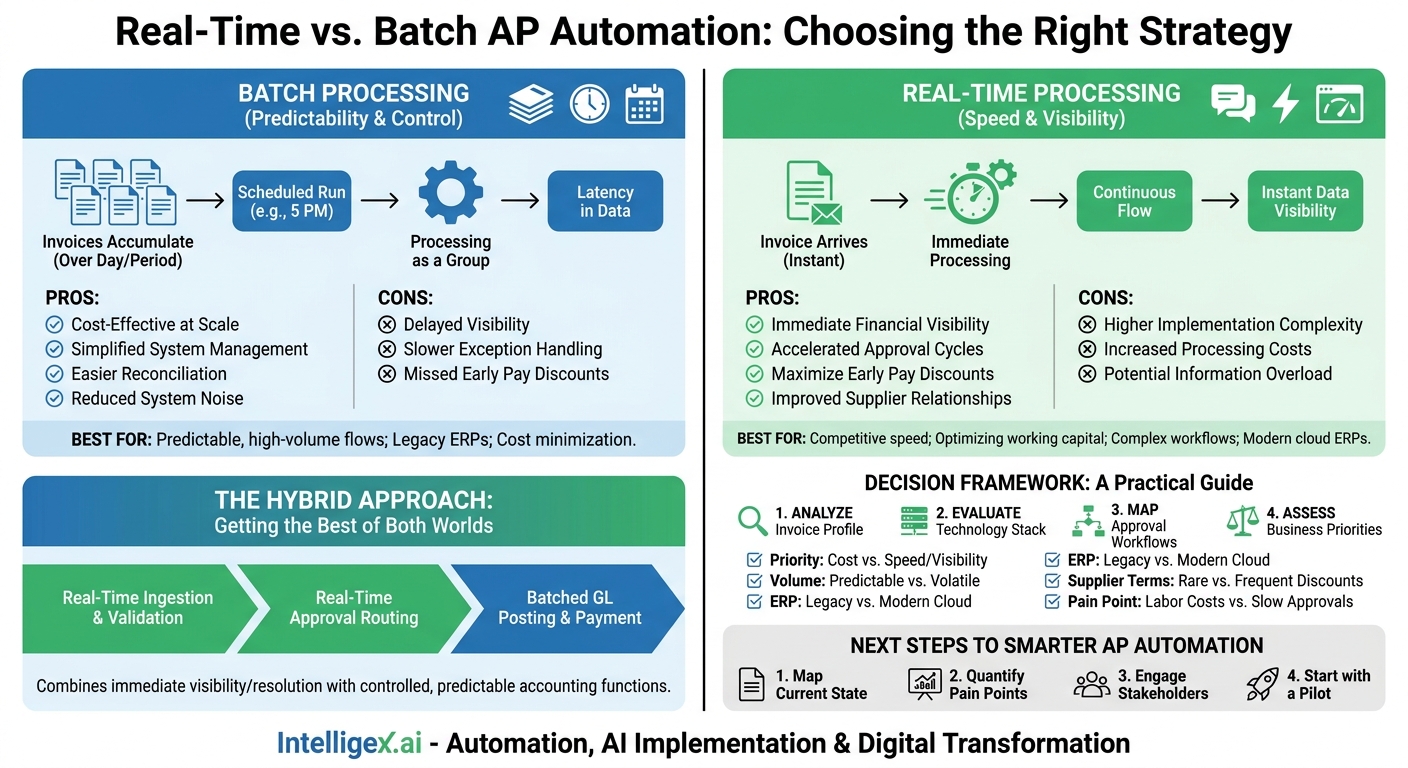
Batch processing in AP automation involves collecting a group of invoices over a specific period, perhaps a day or several hours, and processing them all together in a single, scheduled run. This is a traditional and common model. The system waits, accumulates documents, and then executes the extraction, validation, and coding tasks on the entire set. The process is predictable and happens at set intervals.
Real-time processing, on the other hand, handles each invoice individually as soon as it arrives in the system. When an email with an invoice attachment hits a designated inbox, the automation workflow kicks off immediately. Data is extracted, rules are applied, and the invoice is routed for approval within moments of receipt. This approach provides an immediate, continuous flow of information.
Neither method is inherently superior. The optimal choice depends entirely on your business needs, existing systems, and strategic goals. A company prioritizing cost control and predictable workloads might lean towards batch, while a business focused on speed and maximizing early payment discounts would favor real-time.
The Case for Batch Processing: Predictability and Control
Batch processing has been the backbone of financial systems for decades for good reason. It offers a structured, controlled environment that aligns well with traditional accounting cycles and can be highly efficient for organizations with specific operational patterns.
Advantages of a Batch Approach
- Cost-Effectiveness at Scale: Processing thousands of invoices in one go is often more computationally efficient than initiating a separate process for each one. This can lead to lower infrastructure and processing costs, especially in cloud-based environments where you pay for compute time.
- Simplified System Management: Scheduling a few large processing jobs is technically simpler than managing thousands of individual, concurrent workflows. It makes resource planning for your IT team more predictable. They know that at 10 PM every night, the system will need peak resources for two hours, rather than dealing with fluctuating demand throughout the day.
- Easier Reconciliation: For finance teams, reconciling a single batch of 1,000 invoices against a control report is often more straightforward than tracking 1,000 individual transactions that occurred at different times. It aligns well with daily or weekly financial closing procedures.
- Reduced System “Noise”: A real-time system might generate a constant stream of notifications for every invoice. A batch approach consolidates these, providing a single summary of exceptions or approvals needed, which can be less disruptive for managers.
Where Batch Processing Falls Short
The primary drawback of batch processing is the inherent delay. Information is only as current as the last batch run. This latency creates several business challenges:
- Delayed Visibility: Your finance team won’t have an accurate, up-to-the-minute view of liabilities. An urgent payment request might be based on incomplete data because a large batch of invoices from the previous day hasn’t been processed yet.
- Slower Exception Handling: If an invoice in a nightly batch has an error (like a mismatched PO number), you won’t know about it until the next morning. This delays the entire resolution process by at least a day, potentially straining vendor relationships or causing project delays.
- Missed Opportunities: The window to capture early payment discounts is often tight. A 24-hour delay from a batch process can be the difference between capturing a 2% discount and paying the full amount.
Is Batch Right for You?
Batch processing is often a good fit for businesses with highly predictable and high-volume invoice flows, where cost efficiency is the top priority and intraday financial visibility is not a critical requirement. Companies with legacy ERP systems that are best updated via scheduled imports may also find batch processing a more practical and stable integration method.
The Power of Real-Time Processing: Speed and Visibility
Real-time processing transforms AP from a reactive, historical bookkeeping function into a proactive, strategic financial tool. By eliminating processing delays, it provides the business with immediate intelligence to make faster, more informed decisions.
Advantages of a Real-Time Approach
- Immediate Financial Visibility: As soon as an invoice is received, it’s reflected in your AP system. This gives your CFO and finance leaders a true, real-time picture of cash flow and outstanding liabilities, enabling more accurate forecasting and budget management.
- Accelerated Approval Cycles: Invoices are routed for approval the moment they are validated. A project manager can receive a notification on their phone and approve a critical supplier invoice within minutes of its arrival, preventing bottlenecks and keeping projects on track.
- Improved Supplier Relationships: Vendors appreciate prompt communication. Real-time systems can instantly notify a supplier if their invoice has an issue, allowing them to correct and resubmit it quickly. This transparency and speed build trust and make you a preferred customer.
*Maximizing Early Payment Discounts: With instant processing, the clock on payment terms starts immediately. This gives your AP team the maximum possible time to secure approvals and process payments to capture valuable early-pay discounts, turning the AP department into a profit center.
Potential Real-Time Challenges
While powerful, a real-time approach introduces its own set of complexities:
- Higher Implementation Complexity: Building and maintaining systems that can handle a constant, unpredictable stream of events is more challenging than scheduling batch jobs. Integration with other systems (like your ERP) needs to be robust and capable of handling single, on-demand transactions.
- Increased Processing Costs: The “always-on” nature of real-time processing can consume more computing resources, potentially leading to higher costs, especially if your invoice volume is inconsistent with sharp peaks and long lulls.
- Potential for Information Overload: If not designed carefully, a real-time system can bombard approvers and finance staff with a constant flow of notifications. Workflows must be designed to batch notifications or use smart alerts to avoid overwhelming users.
Is Real-Time Right for You?
Real-time processing delivers immense value to organizations where speed is a competitive advantage. This includes industries like logistics, manufacturing, and retail, where supply chain velocity is critical. It’s also ideal for companies focused on optimizing working capital, managing project-based costs closely, or those with complex, multi-step approval workflows that are easily slowed by delays.
How to Choose: A Practical Decision Framework
Choosing between batch and real-time is not a purely technical decision. It requires a holistic look at your business processes, technology landscape, and strategic priorities. Follow these steps to guide your decision-making process.
- Analyze Your Invoice Profile: The first step is to understand the nature of the documents you process. Ask questions like: How many invoices do we receive per day or week? Is the volume steady, or does it come in large spikes (e.g., at the end of the month)? From how many different vendors do they come? Are they standardized or highly variable? High volumes with significant variability might benefit more from the instant validation of a real-time system.
- Evaluate Your Technology Stack: How modern is your core financial system or ERP? Older, on-premise systems may be designed for nightly batch imports, making real-time integration difficult or costly. Modern, cloud-native ERPs like NetSuite or Salesforce are often built with APIs that make real-time data exchange much simpler. Consider the capabilities of your existing infrastructure.
- Map Your Approval Workflows: Document your current end-to-end process, from invoice receipt to payment. How many people are involved in an approval? Are they in the same office or spread out globally? Complex, multi-stage workflows suffer exponentially from batch delays. If an invoice needs three approvals, a one-day batch delay at the start means the entire process is pushed back, even if the approvers act quickly.
- Assess Your Business Priorities: This is the most critical step. You must weigh competing goals. Is your primary objective to lower the per-invoice processing cost? Or is it to improve your Days Payable Outstanding (DPO) and capture more discounts? Be honest about what drives the most value for your company.
Decision-Making Checklist
Use this short checklist to help clarify your thinking. Which column best describes your organization?
- Our priority is… cost minimization vs. speed and visibility.
- Our invoice volume is… highly predictable vs. volatile and unpredictable.
- Our ERP is… a legacy system with limited APIs vs. a modern, cloud-based platform.
- Our supplier terms… rarely include early-pay discounts vs. frequently offer valuable discounts.
- Our biggest AP pain point is… high labor costs vs. slow approval cycles and late payment fees.
Answering these questions with your team will provide a clear directional arrow pointing towards batch, real-time, or even a hybrid model.
The Hybrid Approach: Getting the Best of Both Worlds
The choice between batch and real-time is not always a binary one. A sophisticated AP automation strategy can blend both approaches to optimize for different stages of the invoice lifecycle. This hybrid model allows you to harness the speed of real-time where it matters most while retaining the control and efficiency of batch for other parts of the process.
A Practical Hybrid Scenario
Consider a large retail company. Here’s how they could use a hybrid model:
- Real-Time Ingestion and Validation: When a supplier emails an invoice, it is captured in real-time. The AI-powered system immediately extracts the data, validates it against a PO in the procurement system, and checks for mathematical errors. If an error is found, an automated notification is sent back to the supplier within minutes, allowing for immediate correction.
- Real-Time Approval Routing: Once validated, the invoice is instantly routed to the correct budget holder for approval. The manager can approve it on their mobile device, keeping the process moving without delay.
- Batched GL Posting and Payment: While the invoice is approved and ready to pay, the final steps are handled in a batch. Every evening, a scheduled process posts all of the day’s approved invoices to the General Ledger in the ERP system. A separate, twice-weekly payment run is then executed to pay the invoices, allowing the treasury team to manage cash outflow predictably.
This hybrid approach provides the best of both worlds. The business gets immediate visibility into liabilities and resolves exceptions quickly (the real-time benefits). At the same time, the finance and IT teams benefit from a controlled, predictable process for core accounting and payment functions (the batch benefits).
Implementing AP Automation Safely: Governance and Human Oversight
Automating a critical financial process like Accounts Payable requires a strong focus on security, compliance, and governance. Whether you choose batch or real-time, you are handling sensitive data and executing financial transactions. Rushing an implementation without proper controls can introduce significant risk.
Key Governance Considerations
- Data Privacy and Security: Invoices contain sensitive information, including vendor bank account details, contact information, and pricing. Your automation solution must have robust security controls to protect this data, both in transit and at rest. Ensure it complies with data privacy regulations like GDPR or CCPA if applicable.
- Role-Based Access Control (RBAC): Not everyone in your company should be able to view or approve every invoice. Implement strict access controls so that users can only see and act on invoices relevant to their role and approval authority. An AP clerk should not be able to approve a multi-million dollar capital expenditure, for example.
- The Importance of the Human-in-the-Loop: Automation is not about completely removing people from the process. It’s about empowering them to focus on higher-value work. Your process must include a clear “human-in-the-loop” workflow for handling exceptions. The AI should flag invoices it cannot confidently process (e.g., a new format, a potential duplicate, or a value exceeding a certain threshold) for manual review by a skilled AP professional. This combination of machine efficiency and human judgment is the hallmark of a successful automation program.
- Audit Trails: Every action taken on an invoice, from receipt to payment, must be logged in an immutable audit trail. This is non-negotiable for internal controls and external audits (such as for SOX compliance). The system must record who touched the invoice, what they did, and when they did it.
Your Next Steps to Smarter AP Automation
Choosing between real-time and batch processing is a foundational step in your AP automation journey. The right decision will set the stage for a more efficient, strategic, and data-driven finance function. To move forward, avoid getting stuck in analysis paralysis and instead take clear, incremental steps.
Here is a simple action plan to get started:
- Map Your Current State: Before you can design the future, you must understand the present. Document your existing AP process from end to end. Identify the key steps, systems, and people involved.
- Quantify Your Pain Points: Don’t just rely on anecdotes. Gather data. Measure key metrics like your current average invoice processing time, your error rate, and the amount of time your team spends on manual data entry versus exception handling. This baseline will be crucial for building a business case and measuring success.
- Engage Your Stakeholders: Talk to everyone involved in the process: the AP team, procurement, IT, and the business leaders who approve invoices. Understand their needs and pain points. Their buy-in will be critical for a successful implementation.
- Start with a Pilot: You don’t need to automate everything at once. Select a specific subset of invoices, perhaps from a single department or a group of high-volume vendors, to run a pilot project. This allows you to test your chosen approach (batch, real-time, or hybrid) on a smaller scale, learn valuable lessons, and demonstrate value quickly before a full-scale rollout.
By taking a structured, business-first approach, you can move beyond the technical debate and implement an AP automation solution that delivers tangible value in speed, cost, quality, and financial visibility.
Your Next Read:
Get a FREE
Proof of Concept
& Consultation
No Cost, No Commitment!