

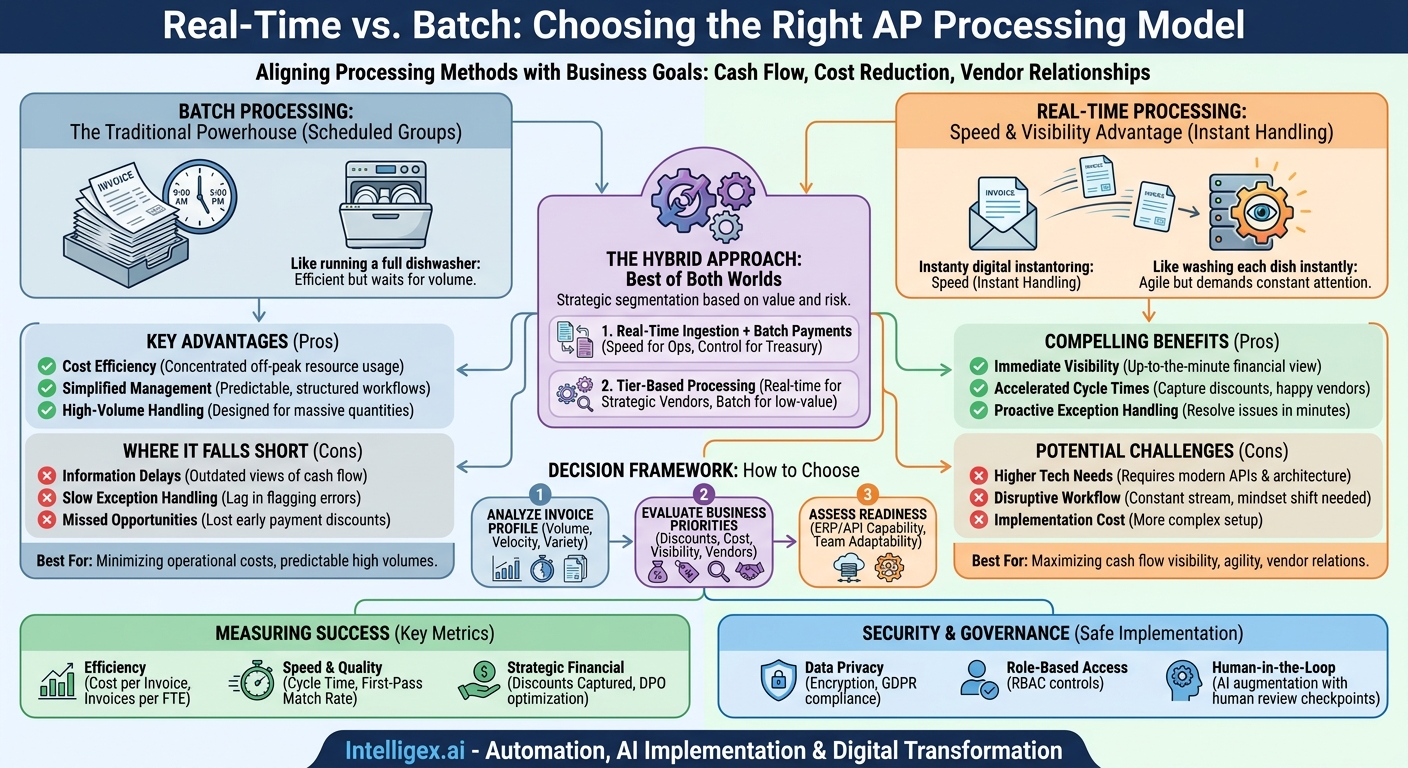
The decision to automate your Accounts Payable (AP) process is a critical first step. The next, equally important decision is how it should run. Should invoices be processed in scheduled groups, or should they be handled the moment they arrive? This is the core of the real-time versus batch processing debate. It’s not about choosing a universally “better” technology; it’s about aligning the processing method with your specific business goals, whether that’s maximizing cash flow, reducing operational costs, or strengthening vendor relationships.
Understanding the fundamental differences, benefits, and drawbacks of each approach is essential for building an AP function that doesn’t just pay bills, but actively contributes to your company’s financial health and operational agility. Let’s break down what each model means for your business in practical terms.
Understanding Batch Processing: The Traditional Powerhouse
Batch processing is the workhorse of traditional accounting. In this model, invoices are collected over a period of time (for example, a day or a week) and then processed together in a single, scheduled run. Think of it like running the dishwasher; you wait until it’s full to run a cycle because it’s an efficient use of resources.
This approach has long been favored for its predictability and efficiency. The entire AP team knows that invoice data extraction happens overnight, exception reports are ready for review by 9 AM, and payment runs are executed every Friday. This creates a rhythmic, manageable workflow.
Key Advantages of Batch Processing
- Cost Efficiency: Processing a large volume of transactions at once is computationally efficient. It concentrates system resource usage into specific off-peak windows, which can be less expensive than maintaining an “always-on” system.
- Simplified Management: Scheduled processes are predictable. Your team can plan its workload around known batch run times, creating a structured environment for tasks like exception handling and approvals.
- High-Volume Handling: Batch systems are inherently designed to handle large quantities of documents. They are well-suited for organizations that receive hundreds or thousands of invoices in predictable patterns.
Where Batch Processing Falls Short
Despite its benefits, the batch model introduces delays that can have significant business consequences. Because nothing happens between cycles, you are always working with slightly outdated information. An urgent invoice that arrives just after a batch run might sit unprocessed for 24 hours or more, creating a blind spot in your financial data.
This delay directly impacts exception handling. An invoice with a price mismatch isn’t flagged until the overnight run, and the AP clerk can’t begin investigating until the next business day. This lag extends the entire invoice lifecycle, potentially leading to missed early payment discounts and frustrated vendors inquiring about payment status. For finance leaders who need an up-to-the-minute view of cash flow and liabilities, batch processing presents a frustrating information gap.
Embracing Real-Time Processing: The Speed and Visibility Advantage
Real-time processing, as the name implies, handles each invoice individually the moment it is received. Instead of waiting for a scheduled run, an invoice arriving in an email inbox is immediately ingested, its data extracted by an AI model, and its validation and approval workflow initiated. This is less like running a dishwasher and more like washing each dish as soon as you’re done with it.
The primary business driver for adopting real-time AP automation is the demand for immediate financial visibility and business agility. In a fast-moving market, waiting 24 hours for an updated view of liabilities is no longer acceptable for many organizations.
The Compelling Benefits of Real-Time
- Immediate Financial Visibility: When an invoice is processed upon receipt, it is immediately reflected as a liability in your financial system. The treasury department gains a precise, up-to-the-minute view of cash commitments, enabling more accurate forecasting and better cash management.
- Accelerated Cycle Times: Real-time processing dramatically shortens the invoice-to-pay lifecycle. This speed makes it possible to consistently capture early payment discounts, which can translate into significant savings. It also improves relationships with key suppliers who value prompt payment.
- Proactive Exception Handling: Errors or mismatches are identified and flagged within minutes of invoice arrival. The AP team can contact the vendor or internal stakeholder for clarification immediately, resolving issues before they cause major delays.
Potential Challenges with Real-Time Implementation
The benefits of real-time processing come with technical and operational considerations. These systems often require more sophisticated architecture, relying on APIs (Application Programming Interfaces) for instant communication between your AP automation platform and your ERP, like NetSuite or SAP. This can involve higher initial implementation costs and require more IT resources to manage.
Operationally, a constant stream of individual tasks and notifications can be disruptive if not managed properly. Your team’s workflow shifts from structured, batch-based reviews to a more dynamic, continuous monitoring model, which requires a change in mindset and process design.
The Hybrid Approach: Getting the Best of Both Worlds
The choice between real-time and batch processing is not always a binary one. A hybrid approach allows you to strategically apply the benefits of each model where they make the most sense for your business. By combining the two, you can create a nuanced, highly effective AP process that balances cost, speed, and control.
This strategy involves segmenting your invoice workflow and applying the appropriate processing model to each segment. It acknowledges that not all invoices are created equal; a $100,000 invoice from a strategic supplier has different requirements than a $50 utility bill.
Practical Hybrid Scenarios
Here are a few common examples of how a hybrid model can be implemented:
- Real-Time Ingestion, Batch Payments: In this popular model, all incoming invoices are processed in real-time for data capture, validation, and approval. This provides immediate visibility into liabilities and allows for quick exception handling. However, the final payment execution is done in a scheduled batch (e.g., twice a week). This gives the treasury team control over cash outflow while the AP team benefits from real-time operational speed.
- Tier-Based Processing: You can segment processing based on vendor or invoice characteristics. For instance, invoices from strategic, high-volume suppliers might be processed in real-time to ensure prompt payment and capture discounts. In contrast, smaller, non-critical invoices could be handled in a daily batch to minimize processing costs.
- PO vs. Non-PO Invoices: PO-backed invoices, which are typically straightforward, are excellent candidates for real-time, straight-through processing. Complex non-PO invoices that require multi-level review and coding could be routed into a dedicated queue for a daily or twice-daily batch review by a specialized team.
A hybrid model provides the flexibility to optimize for what matters most. It lets you direct your resources toward speeding up high-value transactions while handling routine ones in the most cost-effective manner.
How to Choose: A Practical Decision Framework
Selecting the right processing model requires a clear-eyed assessment of your company’s specific needs, priorities, and capabilities. There is no one-size-fits-all answer. Follow these steps to determine whether batch, real-time, or a hybrid approach is the best fit for your AP department.
Step 1: Analyze Your Invoice Profile
First, understand the nature of the documents you process. Ask these questions:
- Volume: How many invoices do you process per month? Very high volumes (tens of thousands) can sometimes favor batch for raw throughput, while lower volumes may not justify the complexity of real-time systems.
- Velocity: Do invoices arrive in a steady stream throughout the day, or do you receive them in large clumps at specific times (e.g., the end of the month)? A steady stream is a natural fit for real-time processing.
- Variety: What is the mix of invoice types? If most are simple, PO-backed invoices, real-time automation can provide immense value. If many are complex, multi-page invoices requiring extensive manual review, the benefits of real-time speed might be diminished.
Step 2: Evaluate Your Business Priorities
Next, align your decision with your company’s strategic goals. This is the most critical step.
- Is capturing early payment discounts a primary financial objective? If yes, real-time is almost a necessity.
- Is minimizing operational cost the number one priority? If yes, traditional batch processing might be the most economical choice.
- How critical is real-time cash flow visibility for your finance and treasury teams? If they need an immediate view of liabilities, real-time is the clear winner.
- Are your vendor relationships strained due to payment delays? Real-time processing can be a powerful tool for improving supplier satisfaction.
Step 3: Assess Your Technology and Team Readiness
Finally, consider your existing infrastructure and the people who will use the system.
Your current Enterprise Resource Planning (ERP) system is a key factor. Does it have modern APIs that can support real-time data exchange? Older, on-premise systems may be better suited for traditional batch file integrations. For real-time integration, you often rely on an API gateway to manage these connections securely and efficiently. Cloud platforms like AWS API Gateway provide the infrastructure to build and manage these real-time links.
Also, consider your AP team. Are they prepared for a shift from a predictable, scheduled workflow to a more dynamic, continuous one? The transition requires training and a change in management to ensure the team can adapt to a new way of working.
Measuring Success: Key Metrics for AP Automation
Regardless of the model you choose, success is defined by measurable improvement. Tracking the right metrics is crucial to demonstrate the value of your AP automation initiative and identify areas for further optimization. Focus on a balanced set of indicators covering efficiency, quality, and strategic financial impact.
Efficiency and Cost Metrics
These metrics help you quantify the direct cost savings and productivity gains from automation.
- Invoice Processing Cost: This is a foundational metric. Calculate it by dividing the total cost of your AP operations (salaries, technology, overhead) by the number of invoices processed. The goal is to see this number decrease over time.
- Invoices Processed Per Full-Time Employee (FTE): A direct measure of your team’s productivity. Automation should enable each team member to handle a higher volume of invoices.
Speed and Quality Metrics
This group of metrics highlights the impact of your chosen processing model on speed and accuracy.
- Invoice Cycle Time: The average time from invoice receipt to its approval for payment. This is where real-time systems show their greatest strength, often reducing cycle times from weeks to days or even hours.
- First-Pass Match Rate: The percentage of invoices that are processed and approved automatically without any human intervention. A high rate indicates a highly efficient, well-tuned system.
- Exception Rate: The percentage of invoices that are flagged for manual review due to mismatches, missing information, or other issues. Your goal is to continuously reduce this rate.
Strategic Financial Metrics
These metrics connect AP performance to broader business objectives like cash management and vendor relations.
- Early Payment Discounts Captured: The dollar value of discounts taken as a result of faster processing. This provides a direct, hard-dollar ROI for your automation project.
- Days Payable Outstanding (DPO): While often a strategic treasury decision, the visibility and control offered by automation allow you to manage DPO more intentionally, paying on time or early when it’s advantageous.
- Vendor Inquiry Rate: A reduction in calls and emails from vendors asking about payment status is a strong indicator of a healthier, more transparent AP process.
AI, Data Security, and Governance in AP Automation
Automating AP involves handling some of your company’s most sensitive financial data. Whether you choose batch or real-time, implementing strong governance and security practices is not optional; it is a fundamental requirement for safe and responsible automation.
Modern AP automation platforms leverage AI to extract data from invoices. While powerful, this technology must be deployed within a secure framework.
Key Pillars of Safe Implementation
- Data Privacy and Security: Invoice data includes vendor bank account numbers, tax IDs, and contact information. Ensure any automation solution you consider has robust security controls, including end-to-end data encryption both in transit and at rest. Understand where your data is stored (data residency) to comply with regulations like GDPR.
- Role-Based Access Control (RBAC): No single user should have access to the entire end-to-end process. Implement strict access controls so that employees can only view or act upon the information necessary for their specific role. For example, an AP clerk might be able to enter and code an invoice, but only a manager can approve a payment run over a certain threshold.
- The “Human-in-the-Loop” Principle: AI is a tool to augment human intelligence, not replace it entirely. Your process must include a “human-in-the-loop” for critical checkpoints. This means establishing clear rules for when an automated workflow should be paused for human review. Common triggers include invoices over a certain dollar amount, invoices from a new or unverified vendor, or invoices where the AI model indicates a low confidence score on its data extraction. This ensures that human judgment is applied where it’s needed most.
By building your automation strategy on a foundation of strong governance, you can harness the power of AI while mitigating risk and ensuring compliance.
Your Next Steps: Building a Modern AP Strategy
Moving from theory to action requires a structured approach. Choosing between real-time and batch processing is a strategic decision that will shape the future of your finance operations. Use this step-by-step plan to guide your organization toward the right solution.
- Document Your Current State: Before you can design your future, you must understand your present. Map your existing AP process from the moment an invoice is received to the moment it is paid and archived. Use this exercise to identify bottlenecks, measure your current cycle times, and gather feedback from the AP team on their biggest pain points.
- Engage Key Stakeholders: AP automation does not exist in a vacuum. A successful project requires input from multiple departments. Talk to the treasury team about their needs for cash visibility. Consult with procurement to understand the importance of vendor relationships and early payment discounts. Partner with your IT department to assess the capabilities and limitations of your existing ERP and other systems.
- Define Your Primary Objective: With input from your stakeholders, clearly articulate the number one goal for your automation project. Is it to slash processing costs? Is it to accelerate the financial close? Or is it to become a “customer of choice” by paying strategic suppliers faster? This primary objective will be your North Star when evaluating different processing models and technology vendors.
- Start with a Pilot Project: You don’t need to overhaul your entire AP process overnight. Consider starting with a focused pilot program. You could, for example, implement a new real-time process for a single category of invoices (like marketing expenses) or for a specific group of high-volume vendors. A successful pilot builds momentum, provides valuable lessons, and demonstrates ROI, making it easier to secure buy-in for a full-scale rollout.
By following this methodical approach, you can move beyond the simple “real-time vs. batch” debate and build an AP automation strategy that delivers tangible, lasting value to your entire organization.
Your Next Read:
Get a FREE
Proof of Concept
& Consultation
No Cost, No Commitment!
